English
 Français
 Türkçe
 Español
 Русский

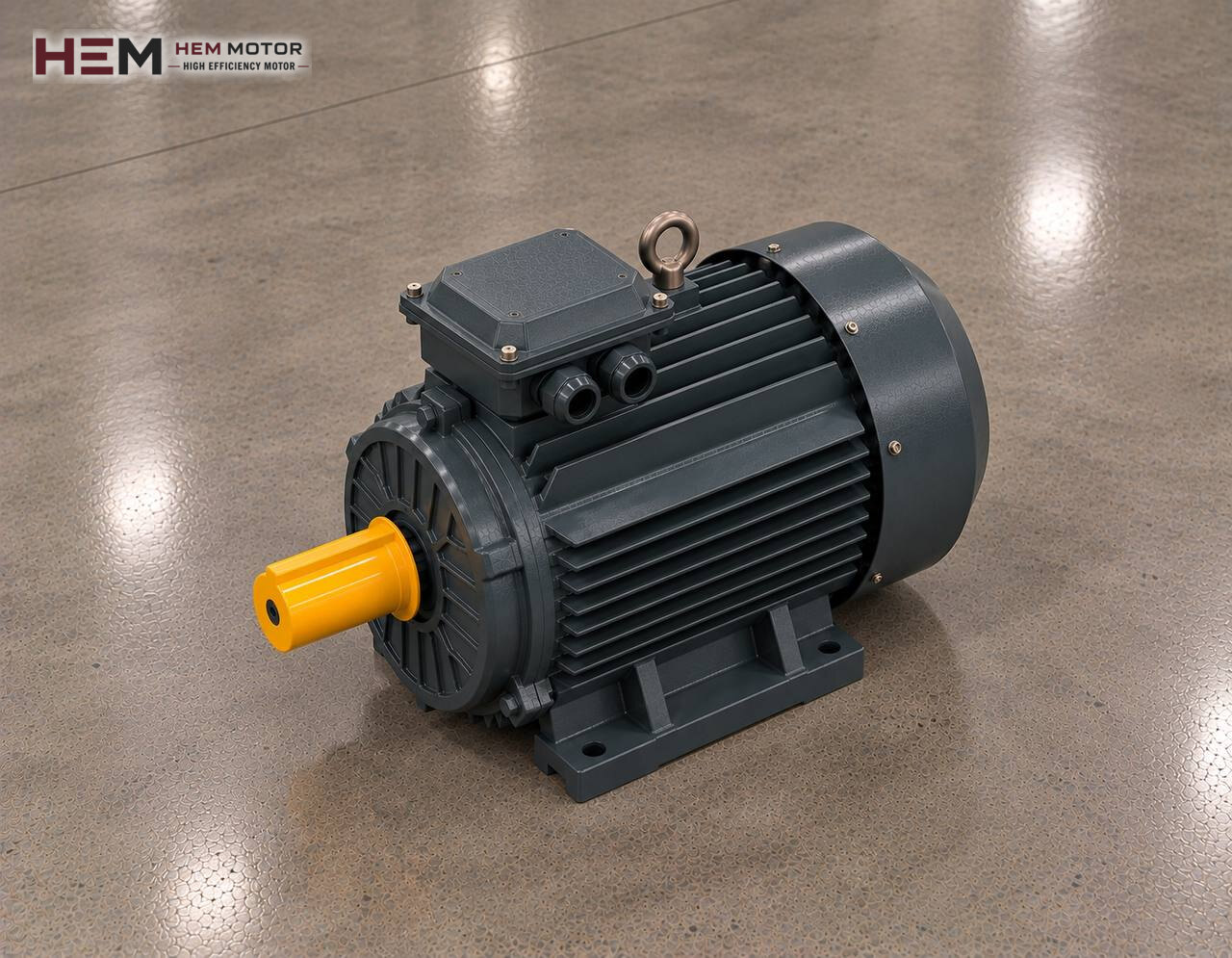
Metal belt grinders and polishing machines are workshop machines that run an abrasive belt or a cloth/felt wheel at high speed to dress weld seams, remove burrs and give stainless surfaces a satin or mirror finish. Machines in other industries can be found on the electric motors for industries list. This page covers bench-type belt grinders, double-ended polishing motors and tube/sheet finishing lines, together with their dust extraction and feed drives. Wood sanding machines are not the subject of this page.

Why is belt speed kept high?
In metal grinding the abrasive grains tear the chip away in very small pieces. For this to be efficient, the surface speed of the belt must be high; at low speed the grain slides over the metal, generates heat and the belt loads up quickly. That is why bench belt grinders usually have a 2-pole motor with the drive wheel mounted directly on the motor shaft. Wheel diameter, together with motor speed, determines belt speed.
On larger machines the motor sits inside the frame and turns the wheel through a belt. The belt drive allows belt speed to be changed by the pulley ratio and separates the wheel bearing from the motor shaft.
Contact wheel, slack belt and platen
When the workpiece is pressed against the part of the belt running over the rubber-faced contact wheel, cutting is aggressive and motor load rises noticeably. On the slack part of the belt between two rollers the pressure is soft; round parts and tubes are ground there as the belt follows their shape. Working against a flat platen puts surface flatness first, with a moderate load.
Because the operator's pressing force varies from machine to machine and from person to person, the load is not constant. If the current stays above the nameplate value for long periods, it points either to a worn belt or to excessive pressure.
Polishing wheels and the double-ended shaft arrangement
On polishing motors a cloth, sisal or felt wheel is fitted to the extended end of the motor shaft; bench machines carry one wheel at each end of the motor. In this arrangement the weight of the wheels and the pressing force of the workpiece act directly on the motor bearings. If a double-ended shaft or an extended shaft is needed for such an application, please specify it in your order; the shaft dimension is confirmed against the wheel seat of the machine.
Mirror polishing uses compound, and fibre and compound residue thrown off the wheel sticks to the motor's fan cover. Regular cleaning of the cover grille is the simplest maintenance that prevents the motor from overheating.
Wheel and stone peripheral speed limit
Every abrasive wheel and stone is marked with its maximum permitted speed or peripheral speed. Replacing the motor with a higher-speed model or running it above 50 Hz on a frequency inverter can exceed this limit. Keeping the pole number of the old motor and checking the wheel label is important for workplace safety.
Tube and sheet finishing lines
On stainless tube polishing and sheet satin finishing machines, several grinding heads are arranged in a row. Each head has its own motor and the heads work with different grit sizes. The rollers that carry the workpiece between the heads are turned by a separate geared motor; feed speed is usually set with a drive. For motor selection on geared drives, see the electric motors for reducers page.
On these lines the head motors run continuously for long hours. Some users also feed the head motors from drives to change belt speed according to the material. HEM's three-phase motors are suitable for inverter operation; if the motor will stay at full load at low frequency for long periods, separately ventilated cooling may be needed, and if the cable between drive and motor is long, a dv/dt or sine filter may be required. It is enough to state these in your order; details are on the inverter-compatible electric motors page.
Metal dust, extraction and protecting the motor
Fine metal dust and abrasive residue from grinding remain suspended in the air. This dust does not get inside the motor, but it builds up on the fan cover, the cooling fins and around the terminal box; the layer makes it harder to dissipate heat. Keeping the machine's extraction hood working is a priority for both the operator and the motor.
The extraction fan motor is also a standard three-phase motor; for fan selection and its relationship to the motor, see the industrial fan motors page. On machines that grind wet, the water spray must not be directed at the motor; a standard IP55 motor is not designed for a position where it stays under water continuously, and the machine builder's shield should be used if needed.
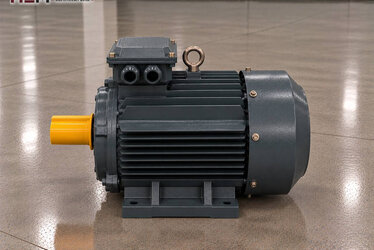
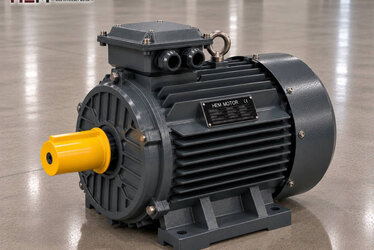
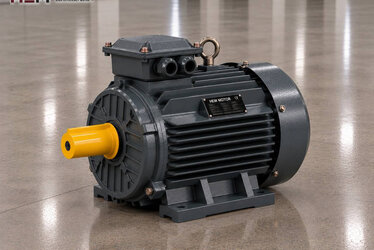
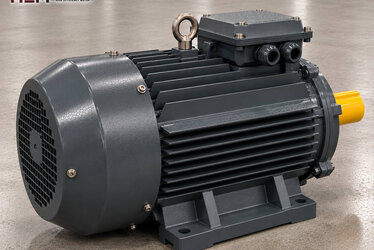
Example HEM motors for belt grinding and polishing drives
| Application | Motor's task | Point to check | Example HEM model |
|---|---|---|---|
| Bench belt grinder | Turning the wheel directly on the shaft | Wheel diameter, shaft end | 90S-2 aluminium — 1.5 kW, 2,895 rpm |
| Heavy workshop grinder / polisher | Continuous work under high pressing force | Wheel weight, bearing load | 100L-2 aluminium — 3 kW, 2,895 rpm |
| Tube / sheet line grinding head | Driving the belt over long shifts | Belt width, drive use | 132S2-2 aluminium — 7.5 kW, 2,930 rpm |
| Feed rollers | Slow feeding through a gearbox | Gearbox flange, speed range | 80M2-4 aluminium — 0.75 kW, 1,420 rpm |
The models in the table are for guidance; the right motor is determined by the machine's actual load, the required speed, the mounting arrangement and the operating conditions in the workshop.
Mounting and order information
On bench grinders the motor is usually foot-mounted (B3) or foot-and-flange mounted (B35); flange versions are also seen on line heads. Depending on frame size, HEM offers B3, B5, B14, B34, B35 and the vertical positions V1, V3, V5, V6 and V15; flange and shaft dimensions are confirmed with the order. A PTC or PT100 sensor can be added as an order option for monitoring winding temperature. If a brake motor is wanted so that the wheel stops quickly, please specify this in your order.
For small workshops without a three-phase supply, there is the single-phase electric motor series in the 0.18–5.5 kW range.
For a quote, send us the machine type (bench grinder, polishing motor, tube/sheet line), the power (kW) and speed (rpm) of the current motor, the supply voltage, the mounting arrangement, the shaft end dimension and the quantity required. To send a nameplate photo, see send the nameplate, we find the equivalent. Priced models are on the shop page; WhatsApp and phone details are on the contact page.
Frequently Asked Questions
My belt grinder slows down under load — is the motor too small?
First check whether the belt is worn and, if there is a drive belt, its tension. If these are fine and the current stays above the nameplate value, the next power size can be considered.
Can I speed up a polishing motor with a drive?
The maximum speed on the wheel or stone label must not be exceeded. If operation above 50 Hz is being considered, the wheel limit and the mechanical condition of the motor must be assessed together.
What should I state for a motor with a wheel on each end?
Give the diameter and length of both shaft ends, the wheel weight and the mounting arrangement. If a double-ended shaft is needed, state this clearly in your order.
Does metal dust damage the motor?
Dust builds up on the frame and fan cover and weakens cooling. Working extraction and regular cleaning are decisive for motor life.