English
 Français
 Türkçe
 Español
 Русский

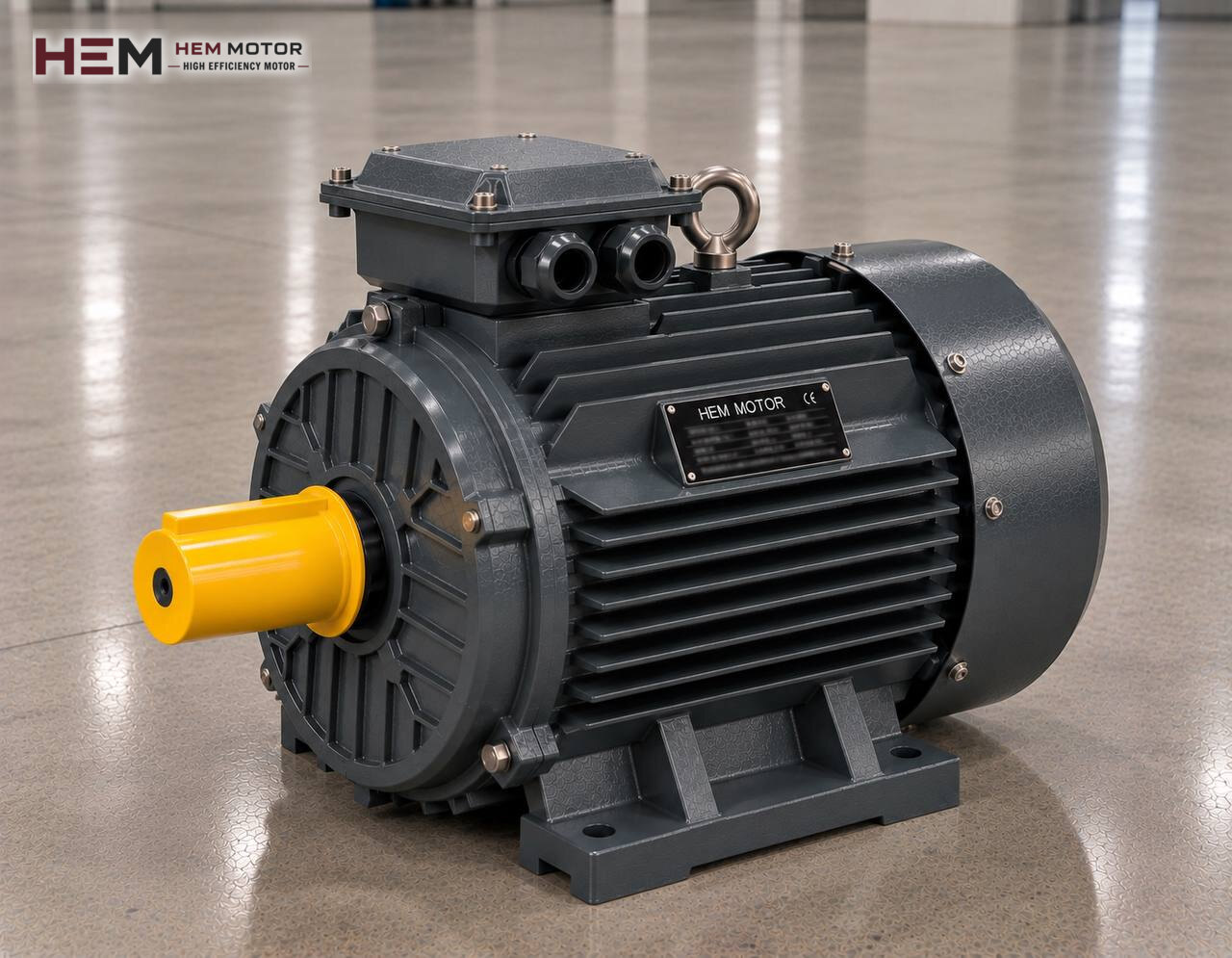
On a universal metal milling machine the cutting tool rotates while the workpiece advances with the table longitudinally, crosswise and vertically; this is how flat faces, slots, keyways, gears and profiles are machined. Motor pages for other industries are listed under electric motors for industries. This page focuses on the main spindle and table feed motors of knee-type universal and turret (vertical head) mills.

Knee-type, turret and horizontal mills compared
A knee-type universal mill has a knee moving up and down in front of the column, a cross slide above it and a swivelling table on top. In the horizontal spindle arrangement the cutter is mounted on an arbor coming out of the column and is supported by an outer bearing. With a universal head fitted, the same machine can also work as a vertical mill.
On a turret mill, the spindle motor stands vertically on top of the swivel head at the top of the column. Because this head can tilt left-right and forward-back, the motor takes the same angle. On the horizontal machine the motor is foot-mounted inside or behind the column, while on the turret head it works flange-mounted in a vertical position.
Cutter teeth and interrupted load
Unlike turning, milling is an interrupted cut: each tooth of the cutter enters and leaves the workpiece. As the side or face mill grows larger and the number of teeth increases, the number of teeth cutting at the same time changes, creating a fluctuating torque on the spindle. During roughing, especially when machining a steel surface with a wide face mill, the motor load rises and falls at short intervals.
The flywheel effect in the gearbox and the mass of the arbor partly smooth this fluctuating load. If chatter marks still appear, the cause is usually not the motor but cutter wear, clamping rigidity or excessive feed. Replacing the motor does not solve these problems; tooling and clamping should be checked first.
Climb and conventional milling
In conventional milling the cutter rotates against the feed direction of the workpiece; in climb milling it rotates in the same direction. In climb cutting, backlash in the table leadscrew can pull the workpiece into the cutter. This is a machine setting matter, but correct connection of the motor direction becomes important here: if two of the three phases are swapped, the spindle runs backwards.
Two separate motors for spindle and table feed
On most universal mills the spindle motor and the table feed motor are separate. The spindle motor is usually 4-pole, in the 1500 rpm class, and gear steps set the spindle speed. The feed motor is smaller; through its own gearbox it moves the table, knee and cross slide, and it also provides short bursts of high speed for rapid traverse.
The feed motor stops, starts and reverses often; as the table moves left and right, the motor is reversed too. This duty differs from the continuously running spindle motor and increases winding heating. For intensive series work, adding a winding sensor (PTC or PT100) to the feed motor can be considered.
On turret mills, table feed is often provided by a power feed unit; this small unit is specific to the machine builder and is not within the scope of a standard motor.
Example motors by mill type
| Drive | Duty | What to check | Example HEM model |
|---|---|---|---|
| Table feed on a knee-type mill | Frequent reversing, short runs | Feed gearbox input | 80M2-4 aluminium — 0.75 kW, 1,420 rpm |
| Turret mill head | Vertical mounting, belt steps | Flange type, head tilt | 100L1-4 aluminium — 2.2 kW, 1,450 rpm |
| Medium universal mill spindle | Interrupted cut, gear steps | Cutter diameter, arbor layout | 112M-4 cast iron — 4 kW, 1,450 rpm |
| Large horizontal mill spindle | Roughing with a wide face mill | Load fluctuation, frame rigidity | 132M-4 cast iron — 7.5 kW, 1,460 rpm |
These pairings are examples; the final selection is made by looking at the machine's actual load, the spindle speed requirement, the way the motor is mounted and the operating conditions. The old motor's nameplate value is the most reliable reference.
Vertical head mounting, cooling and chips
On a turret head the motor works vertically with the shaft facing down. In this position the motor must be prepared for vertical mounting; depending on size, HEM frames are supplied in vertical V1, V3, V5, V6 and V15 arrangements, as well as foot-mounted B3, flange B5 and B14 and combined B34/B35. Flange diameter and shaft dimension are compared with the old motor before ordering.
On a mill, chips are thrown over a wider area than on a lathe, and hot chips sometimes land on the fan cover of the vertical motor. Chip guarding and regular cleaning are important to keep the fan grille from clogging. If coolant and mist reach the motor directly, a standard IP55 motor is not designed for such continuous wetting; a protective measure by the machine builder or a special motor is needed, state this in your order.
Using a drive for speed setting
Workshops renovating an old mill may add a frequency converter on top of belt or gear steps. Our series are suitable for drive operation. If full load is taken for long periods with a large cutter at low spindle speed, the motor's own fan may not be enough and an external fan is needed; if there is a long cable between drive and motor, a dv/dt or sine filter is evaluated. These conditions should be stated in the order. If a brake motor is required for quick spindle stopping, state that in the order as well.
Information list for a milling machine motor
For a quick quotation, send the machine type (knee-type, turret, horizontal), whether the motor to be replaced is the spindle or feed motor, the motor power (kW), speed (rpm), supply voltage, mounting (foot, flange, vertical) and how many units are needed. In a small workshop without three-phase power, the single-phase electric motor series ranging from 0.18 kW to 5.5 kW may be an option for a light bench mill.
If the nameplate is readable, sending a photo is enough; the article on finding an equivalent motor from the nameplate shows the steps. The flange-mounted electric motors page is useful for vertical head connections. Models and current prices are in our electric motor shop; for WhatsApp and phone see the contact page.
Frequently Asked Questions
Why does the motor on my turret mill head get very hot?
In the vertical position chips and oil collect on the fan cover and airflow drops. The belt may also be over-tensioned. First clean the fan grille, check belt tension, then compare the motor current with the nameplate value.
Can any motor of the same power replace the table feed motor?
Besides power and speed, the flange, shaft dimension and gearbox connection must match exactly. Because feed motors reverse frequently, this duty should also be stated in the order.
The spindle motor runs backwards — is the motor at fault?
Usually not. Swapping two phases of the three-phase connection reverses the direction. Once an electrician corrects the connection, the spindle turns the right way.
If I upgrade the mill motor, can I remove metal faster?
Partly. Besides the motor, metal removal capacity is set by the rigidity of the machine frame, the gearbox and the cutter. Fitting a motor more powerful than the machine can handle may increase vibration; you should stay within the value given by the builder.