English
 Français
 Türkçe
 Español
 Русский

A metal lathe turns a workpiece clamped in the chuck and removes chips with a stationary tool, producing cylindrical parts such as shafts, bushes, flanges and gear blanks. Motor pages for all industries are gathered in the list of electric motors for industries. This page covers only the main spindle motor, feed arrangement and electrical side of the conventional universal (geared) lathe and the heavy-duty lathe.

Headstock spindle, chuck and motor position
The headstock on the left side of the lathe houses the main spindle carrying the chuck and the speed steps. On most machines the motor sits in the cabinet inside the left leg, on a hinged motor plate. The plate is pulled down by its own weight or by a tensioning bolt to tighten the V-belts; the belts run up to the input pulley of the headstock.
On some small machines the motor is flange-mounted to the back of the headstock. Whatever the arrangement, the motor's feet or flange must match the old motor's dimensions; otherwise the belt line shifts and the pulleys do not meet in the same plane.
Cutting load comes from diameter and depth of cut
On a lathe, the torque delivered by the motor corresponds to the cutting force the tool applies to the workpiece multiplied by the workpiece radius. At the same depth of cut, facing a large-diameter flange demands much more torque than turning a thin shaft along its length. During roughing the motor approaches its nameplate current, while in fine finishing the load is quite low.
The material also matters: mild steel and brass cut easily, while stainless and quenched-and-tempered steels raise the cutting force noticeably. Two workshops may therefore see different power needs on the same lathe. When replacing, the safest course is not to go below the power on the old motor's nameplate.
Starting with a heavy chuck
Large four-jaw chucks and unbalanced castings form a considerable rotating mass. While accelerating this mass from standstill, the motor briefly draws high current. Direct-on-line starting is common on medium lathes; on heavy machines star-delta or a soft starter may be used. The final decision depends on the machine's control circuit and the supply capacity.
Speed steps, forward-reverse and threading
On a conventional lathe the motor runs at a fixed speed; the chuck speed is selected with levers on the headstock. Because the motor delivers its power into this gearbox, most machines carry a 4-pole motor in the 1500 rpm class. Feed and leadscrew motion are taken from the same spindle through gears; most conventional lathes have no separate feed motor.
There are two ways to change chuck direction. In the first, the motor is reversed by contactors; at each change the motor stops and starts in the opposite direction. In the second, the motor runs continuously in one direction and direction is changed by a friction clutch in the headstock. When threading, the tool is withdrawn after every pass, so on a contactor-reversed lathe the motor can change direction several times a minute. These frequent starts heat the winding; if you use the machine this way, write it in the order note, and a PTC or PT100 sensor can be added to the winding on request.
On some lathes the chuck is stopped by a brake engaged by a pedal or lever. If the brake is on the motor and you want the same, state in your order that a brake motor is required.
Example motors by lathe type
| Lathe type | Typical work | What to check | Example HEM model |
|---|---|---|---|
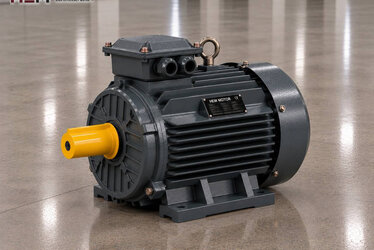
| Small bench lathe | Small shafts and bushes, repair work | Motor plate size, supply | 90S-4 aluminium — 1.1 kW, 1,445 rpm |
| Universal workshop lathe | General production, threading | Reversing method, belt type | 100L1-4 aluminium — 2.2 kW, 1,450 rpm |
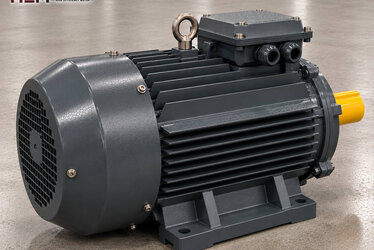
| Long-bed production lathe | Roughing, steel parts | Depth of cut, material | 132S-4 aluminium — 5.5 kW, 1,460 rpm |
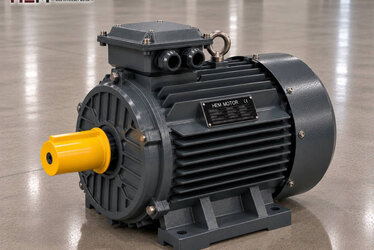
| Heavy-duty / large-swing lathe | Large flanges and castings | Chuck inertia, starting method | 160M-4 cast iron — 11 kW, 1,465 rpm |
The values are only meant as a guide. The right motor is chosen by examining the machine's actual cutting load, the chuck speed requirement, the way the motor is mounted and the workshop conditions together.
Chips, soluble oil and motor care
The lathe is one of the machines where coolant and soluble oil emulsion splash the most. The motor in the base cabinet usually sits where the fluid does not reach it directly, but emulsion collecting on the cabinet floor and oil vapour gradually form a dirt layer on the fan cover. Keeping the chip tray from overflowing and the cabinet door closed extends the motor's life. If the layout means the motor will be wetted directly by water or emulsion, a standard IP55 motor is not designed for this; a protective measure by the machine builder or a special motor is needed, state this in your order.
Belts should be checked yearly for tension and wear, and the hinge of the motor plate should be lubricated. When the motor is replaced, the pulley is usually removed from the old shaft and fitted to the new one, so the shaft diameter and key size must match.
Speed control, mounting options and single phase
Some workshops renovating old lathes leave the headstock in one fixed step and set the speed with a frequency converter. Our three-phase motors are suited to this use. However, if heavy cuts are taken at low chuck speed, the motor's own fan may not deliver enough air and a separate cooling fan may be needed; if the cable between drive and motor is kept long, a dv/dt or sine filter should be considered. Send these details with your order.
Foot-mounted B3, flange B5 and B14, the combined B34 and B35, and vertical V1, V3, V5, V6 and V15 arrangements are prepared according to frame size; flange and shaft dimensions are confirmed before ordering. In a small repair shop without a three-phase line, the single-phase electric motor series between 0.18 and 5.5 kW can be considered for a bench lathe.
What to send when requesting a lathe motor
To prepare a quotation, the following is enough: as machine information, the make and type of the lathe, the motor power (kW), speed (rpm), workshop voltage, mounting (hinged plate, foot or flange), whether direction is changed by the motor or by a clutch, and how many units are needed.
Sending a nameplate photo is often the quickest route; the article on finding an equivalent motor from the nameplate explains what to photograph. You can review products and current prices in our electric motor shop, or open the contact page to reach us by WhatsApp or phone.
Frequently Asked Questions
Why does the lathe motor struggle to start with the chuck loaded?
A large or unbalanced chuck creates high inertia at start; if the belt slips or the supply voltage drops, the motor accelerates slowly. First check belt tension and connections, then review the starting arrangement.
Does frequent reversing during threading wear the motor?
Every reverse start creates extra heat in the winding. In short use this is not a problem; for series threading, a winding sensor or clutch reversing is more suitable.
Can I fit a higher-speed motor in place of the old one?
A 2-pole motor roughly doubles all chuck speeds and takes the gearbox outside its design. Unless the machine builder says otherwise, the same speed class as the old motor should be chosen.
Can I fit the pulley to the new motor as it is?
Yes, if the shaft diameter and key size are the same as before. That is why the same frame size and shaft dimension are requested when replacing; the dimensions are compared in the order.