English
 Français
 Türkçe
 Español
 Русский

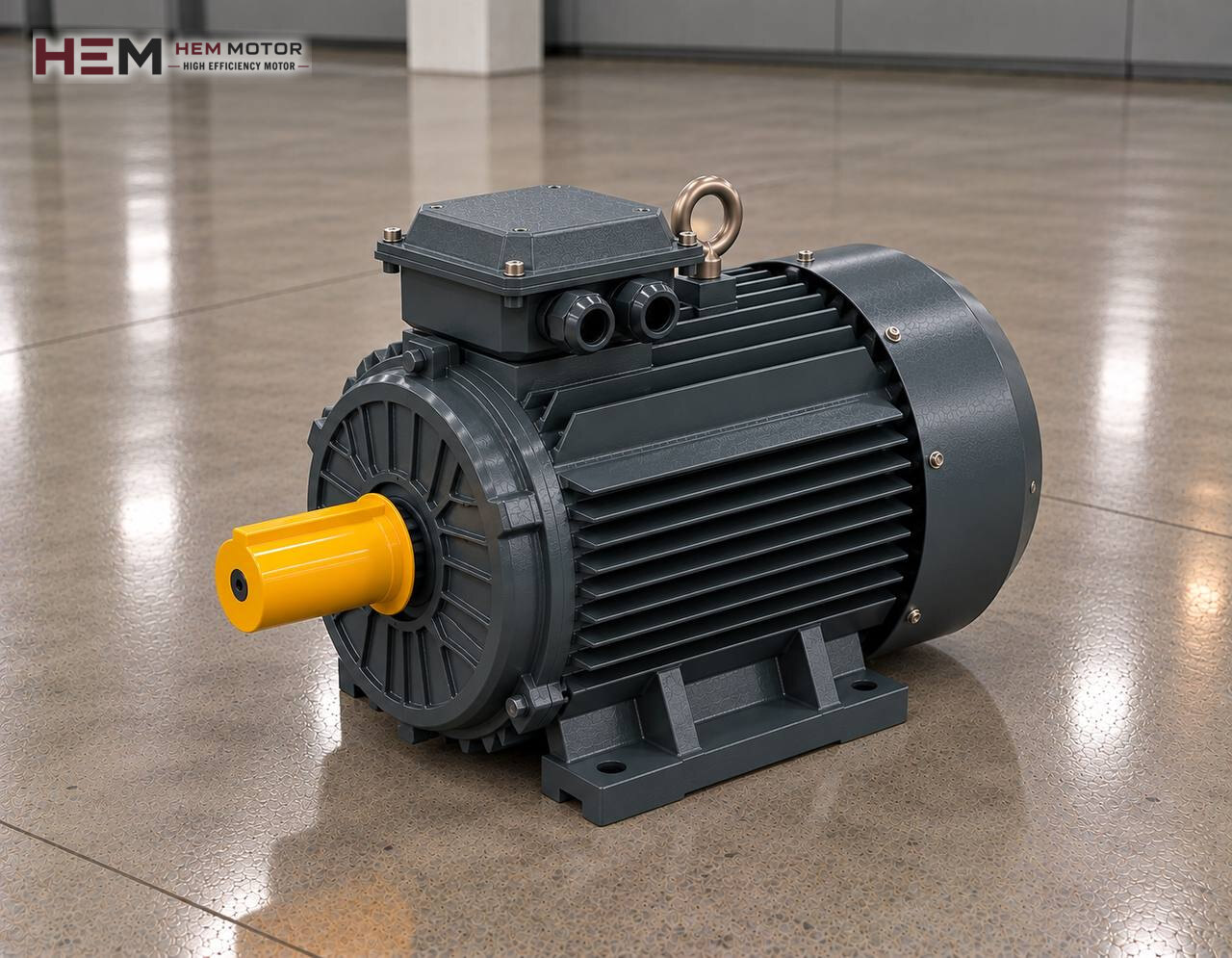
The last stop in a flour mill is the packing section: flour arriving from the product silo is weighed and filled into different packages, from small retail bags to standard flour sacks and big bags, then closed and palletised. The machines in this section hold many small-power motors, and they all share one problem: the flour itself. Flour does not flow freely; it compacts, bridges and becomes airborne. This page covers the motors working in packing and dosing; for the other sections of the mill you can return to the flour mill electric motors page.

How does flour's flow behaviour affect motor selection?
Wheat flour is a fine-grained powder that holds moisture. In the conical section of a silo or weigh hopper it compacts under its own weight, forms an arch and stops the flow. For this reason, on a flour packing line the dose is usually not delivered by a gate that opens and closes under gravity, but by an element that forces the feed: a horizontal or inclined feed screw, an agitator rotating at the bottom of the hopper, or an air-fluidised bottom.
For the motor this means that a flour feed screw needs higher and more variable torque than a sugar or salt screw. As the flour level in the hopper rises, the pressure on the screw rises; starting at the beginning of a shift with flour that has settled for hours is noticeably heavier than starts during the day. Leaving torque reserve on the feed screw motor and softening the start with an inverter is therefore common practice.
Coarse and fine feed: the two speeds of dosing
In bag filling with electronic weighing, the dose is completed in two stages. First the feeding element runs at high speed and fills most of the bag quickly; as it approaches the target weight it switches to slow feed and tops up the last few hundred grams little by little. On some machines this transition uses two separate screws, on others a two-speed motor, and today it is mostly done by speeding up and slowing down a single screw with a frequency inverter.
With a single inverter-driven screw, the motor accelerates, slows down and stops many times a minute. This duty heats the winding differently from continuous running; during fine feed the motor spends long seconds at low speed, where its own fan supplies little air. Our three-phase motors are suitable for inverter drive. If the time spent at low speed with full torque is long, a separate fan may be needed, and a cable filter if the panel is far away; state this information in the order. Details on the inverter-compatible electric motors page.
On some new small packaging machines the dosing screw turns with a position-controlled servo drive; this motor type is not included in HEM Motor's 2026 catalog. On the same machine, the pre-feed screw that fills the hopper and the agitator can run with a standard induction motor.
Drives by package type
Open-mouth bag filling
Empty flour sacks placed on the filling spout by an operator or an automatic bag placer are filled on the scale and then travel on a conveyor to the sewing machine. This line has a feed screw, a hopper agitator, a bag conveyor and sometimes a settling table that shakes the bag during filling to compact the flour. The bag conveyor motor is low power and runs through a gearbox; the settling table brings a short, repeated vibration load.
Valve bag filling
Valve bags are made closed; flour is pushed in through a filling spout inserted into the valve at the corner of the bag. For flour this pushing is usually done with a horizontal screw, on some machines with a fast-spinning impeller. In screw-type valve filling the motor works against back-pressure that rises as the bag fills; the load reaches its peak at the end of filling.
Big bag filling
Big bags going to bakeries and industrial customers are filled while hanging on a frame. Weighing is usually done on a scale under the bag; the feed screw or rotary valve (airlock) is of higher power, and a vibrating base may be used to compact the flour inside the bag.
Sewing, conveyor and palletising side
The filled bag passes under the sewing machine on a conveyor. Sewing heads often run with small motors supplied with the machine; for a small sewing or conveyor drive running on single-phase supply, our single-phase motor range covering 0.18–5.5 kW can be considered. The sewn bag passes the bag flattener and turning conveyor and reaches the palletiser; the conveyor and roller drives in this section are geared motors with frequent stop-start. For gearbox matching, the electric motors for gearboxes page is a guide.
Dust extraction in the packing area is usually handled by a separate filter and fan; flour escaping at the filling spout is recovered there. When extraction weakens, dust settles on the motors and the frames become coated with flour.
Dust, cleaning and maintenance
The packing section is one of the dustiest places in the mill. The IP55 frame limits dust ingress; however, flour combining with moisture on the motor and caking spoils cooling and calls for regular dry cleaning of the frame. Washing with pressurised water and direct contact with food are not conditions the standard IP55 motor is designed for; if the machine will be washed or the motor sits very close to the filling spout, a protective measure by the machine builder or a special motor is required, so state this in the order. For zones requiring motors of special construction because of the ignition risk of flour dust, such motors are not included in HEM Motor's 2026 catalog.
The most frequent cause of failure on screw motors is repeated start attempts against compacted flour. When a start fails, partly emptying the hopper protects the winding. A PTC sensor for monitoring winding temperature is an order option.
Example models for packing drives
For light drives such as the hopper agitator and the bag conveyor, the 0.55 kW 80M1-4 (1,400 rpm, 3.75 Nm) can be shown as an example. For the feed screw in open-mouth bag filling, the 1.5 kW 90L-4 (1,445 rpm, 9.91 Nm) and the 2.2 kW 100L1-4 (1,450 rpm, 14.5 Nm) are models worth looking at. For a larger screw in big bag feeding or valve filling, the 4 kW 112M-4 delivers 26.3 Nm at 1,450 rpm.
| Drive | Load character | Point to check in selection | Example HEM model |
|---|---|---|---|
| Hopper agitator, bag conveyor | Light, geared | Gearbox flange, dust build-up | 80M1-4, 0.55 kW |
| Open-mouth bag feed screw | Coarse/fine feed, inverter-driven | Cooling at low speed | 90L-4, 1.5 kW |
| Higher-capacity screw | Starting with compacted flour | Torque reserve, starting method | 100L1-4, 2.2 kW |
| Big bag or valve filling screw | Rising back-pressure | Peak load at end of filling | 112M-4, 4 kW |
| Servo-driven dosing screw | Position-controlled dosing | Not in the 2026 catalog | Not applicable |
The models in the table are examples; the final choice is made according to the machine load, required speed, mounting and operating conditions.
Information to send for a quotation
The packing machine make, package type (retail bag, open-mouth sack, valve bag, big bag), which drive the motor is on, power (kW), speed (rpm), mains voltage, mounting type, flange and shaft details and quantity are enough; also write whether it runs on an inverter. For motors with a readable nameplate you can use the send a nameplate photo page.
Current prices are on the buy page. Our WhatsApp and phone numbers are on the contact page.
Frequently Asked Questions
Why can't the flour feed screw start in the morning?
Flour that has stood in the hopper overnight compacts under its own weight and creates a heavy load on the screw. Leaving the hopper at a low level at the end of the shift and starting with an inverter usually solves the problem.
Why are bag weights inconsistent?
Most causes lie on the weighing and control side, but on the motor side uneven screw rotation during fine feed also plays a part. Check the inverter's minimum speed setting and the screw bearings.
Is an aluminium frame enough on a packing line?
Most drives on this line are low power, and the aluminium frame is offered up to 11 kW. At points with shaking, such as a vibrating settling table, a cast iron frame may be preferred.
Can you also supply the single-phase motor of the sewing machine?
Our single-phase range covers 0.18–5.5 kW. To use one in place of a motor designed specifically for a sewing head, we need to check dimensions and shaft fit together with the nameplate data.