English
 Français
 Türkçe
 Español
 Русский

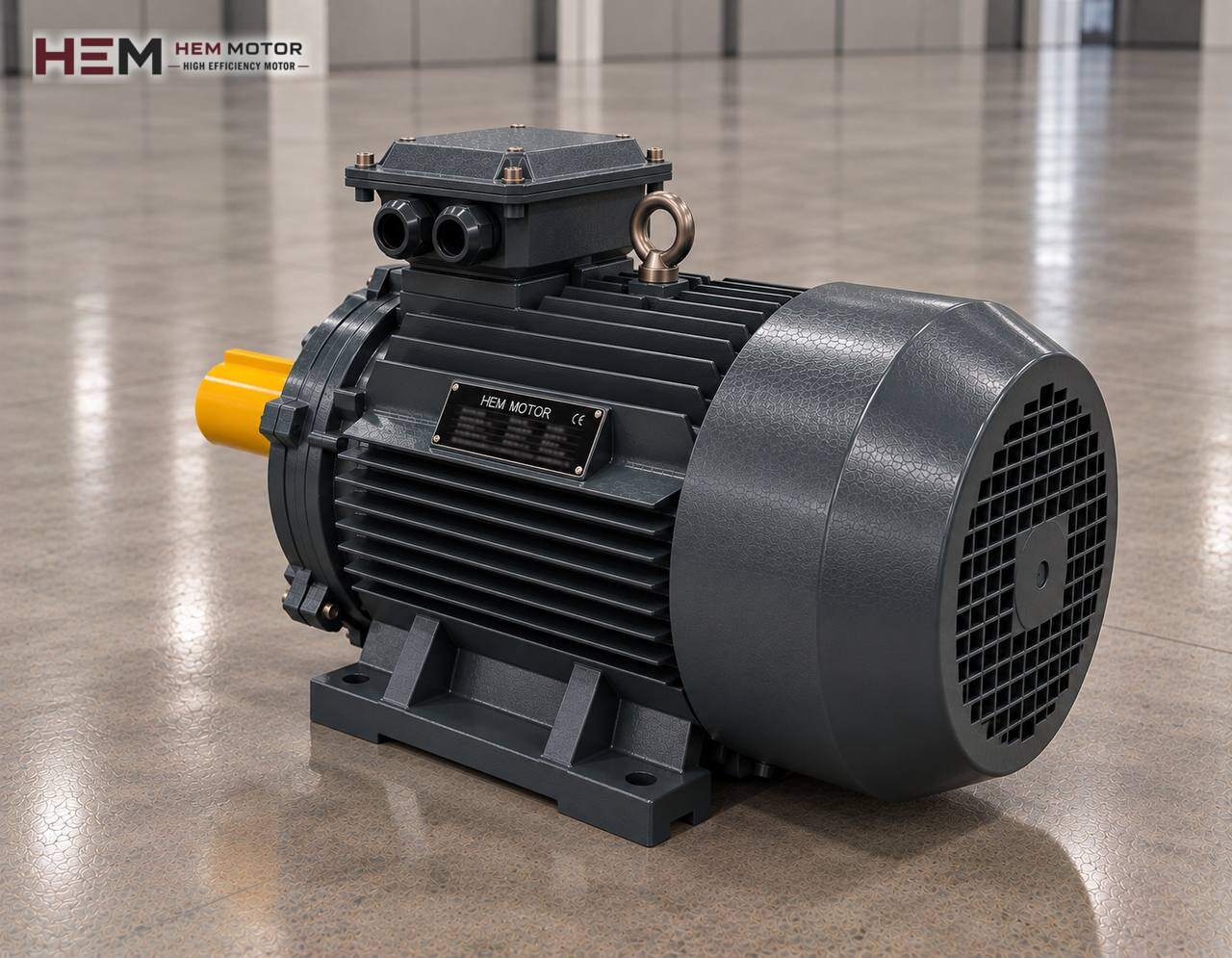
Bulgur starts from the same raw material as flour but is an entirely different product: the wheat is cooked and dried, then freed of its bran and brought to pilaf-size or fine kofte-size grains. A bulgur plant's machinery is therefore different from a flour mill's; instead of long grinding passages, a few powerful crushers, a dehulling machine and grading sieves come to the fore. This page focuses on the motors that turn these machines; for a general framework on other grain-processing plants, see the flour mill electric motors page.

How motors are spread across a bulgur plant
On a bulgur line the motor load is not evenly distributed. The cooking vessels and drying section work mainly with heat; the motors there are medium or small drives such as agitators, feed screws, circulation pumps and drying air fans. The real mechanical work is done in the section where the dried wheat is dehulled and the grain is split. So when planning a motor replacement in a plant, first make clear which station's motor is meant; the selection criteria for a crusher motor and a dryer fan have nothing in common.
Dehulling machine: a friction-driven load
The outer husk of the dried wheat is torn off by the grains rubbing against each other and against the surface between a rotor and a perforated screen. The rotor can be vertical or horizontal; some designs are lined with abrasive stone, others have paddles. The separated bran is removed through the aspiration line connected to the machine.
In this machine the motor runs under continuous high load. The load changes directly with the amount of grain entering the machine and how far the outlet gate is closed: the more the gate is throttled, the longer the grain stays in the machine, friction rises and dehulling improves, but motor current also climbs. It is important that the operator makes this setting without exceeding the current on the motor nameplate. The motor is usually belt-connected; on vertical-rotor machines the motor sometimes stands vertically beside the machine.
Crushing section: stone and roller crushers
Stone crusher
In traditional bulgur production the grain passing between two stones on a horizontal or vertical axis is split into coarse or fine pieces according to the gap. The stone crusher motor turns a heavy rotating mass; at start-up the inertia of the stone matters, and in operation the resistance of the grain entering between the stones. When the stone gap is narrowed, motor load rises noticeably, and on the same machine fine kofte-grade production strains the motor more than pilaf-grade production.
Roller crusher
In modern plants passing the grain between two fluted rolls is common. The load on a roller crusher is more even; on belt-driven roll pairs the motor load is set by the roll gap and feed rate. The details of roller milling will be covered on this group's roller mill page; here it is enough to note that in bulgur crushing the grain is hard and dry, so a load different from flour breaking can arise on the same roll length.
Starting, inertia and protection
The stone crusher and a large dehulling machine take time to accelerate at start-up. With direct-on-line starting, the starting current strains the supply and the belts; at higher powers star-delta, a soft starter or a frequency inverter is preferred. Which is suitable depends on whether the machine starts empty or full of grain. On a machine that must start loaded, star-delta may fall short; the machine builder's recommendation should be followed.
Because stone and roll gaps and the feed setting change often in the plant, there is a risk of the motor running overloaded for long periods. For crushers, a PTC or PT100 sensor monitoring winding temperature should therefore be considered as an order option. In plants that adjust speed with an inverter, our three-phase motors are suitable for this use; if long periods at low speed with full torque or a long cable are involved, we assess the need for an extra fan or filter together. See the inverter-compatible motors page on this topic.
Moisture, steam and bran dust
Unlike a flour mill, a bulgur plant contains both steam and dust. Steam from the cooking section condenses on cold surfaces, while in the crushing and dehulling section fine bran dust hangs in the air. Moist dust sticks to the motor frame, cakes and weakens cooling. The IP55 frame is protected against dust and water splashes; however, a motor standing for long periods in a steam-filled environment is at risk of condensation. In winter, when the plant stops overnight, an anti-condensation heater is an order option to keep moisture from collecting inside the motor.
For agitator and pump motors working beside the cooking vessels, washing with pressurised water and food contact are not conditions the standard IP55 motor is designed for; in such a case a protective measure by the machine builder or a special motor is needed, so state it in the order.
Mounting and connection
Most bulgur machines are driven by belt and pulley; the motor is foot-mounted on a slide base and belt tension is adjusted from there. On vertical-rotor dehullers there are also arrangements where the motor works in a vertical position. Depending on frame size, our motors are offered foot-mounted B3, flange-mounted B5 and B14, foot-and-flange B34 and B35, and vertical V1, V3, V5, V6, V15; we confirm shaft and flange dimensions at the order. For geared drives such as sieves and screws, the electric motors for gearboxes page is a guide.
Example HEM models for a bulgur line
For an auxiliary drive such as a grading sieve or screw, the 4 kW 112M-4 delivers 26.3 Nm at 1,450 rpm. For a small stone crusher the 11 kW 160M-4 (1,465 rpm, 71.7 Nm) is a model worth looking at. For a medium-sized belt-driven dehuller the 22 kW 180L-4 (1,470 rpm, 142.9 Nm), and for a low-speed pulley arrangement the 15 kW 180L-6 (978 rpm, 146.5 Nm) can be shown as examples.
| Bulgur station | Motor load | Point to watch in selection | Example HEM model |
|---|---|---|---|
| Grading sieve, screw | Continuous, geared | Gearbox connection, dust | 112M-4, 4 kW |
| Small stone crusher | High-inertia start, depends on stone gap | Starting method, overload | 160M-4, 11 kW |
| Dehulling machine | Continuous, friction, high | Outlet gate setting, belt | 180L-4, 22 kW |
| Low-speed belt-driven crusher | Heavy, belt-driven | Keeping the pole number | 180L-6, 15 kW |
The models in the table are examples; the final choice is made according to the machine load, required speed, mounting and operating conditions.
What to send when requesting a quotation
Write which station's machine the motor is for (dehuller, stone or roller crusher, sieve, dryer fan), the machine make, the power (kW) and speed (rpm) of the existing motor, mains voltage, mounting type, pulley or coupling details and the quantity required. Adding the starting method and whether an inverter is used speeds up selection. If the nameplate is readable, the steps on the find an equivalent from the nameplate photo page are enough.
Model prices are on the shop page. For WhatsApp and phone, use the numbers on the contact page.
Frequently Asked Questions
Why does the crusher motor run hotter when producing fine kofte-grade bulgur?
For fine crushing the stone or roll gap is narrowed and the grain is worked harder in the machine. This raises motor current. When narrowing the gap, also reduce the feed rate and measure the current.
Why does the dehuller's motor current change during the day?
Grain moisture, feed rate and outlet gate setting directly change friction. Grain arriving from the dryer at a different moisture can raise the load; if the current exceeds the nameplate value, the settings should be reviewed.
Is star-delta starting enough for a stone crusher?
If the machine starts empty, it is usually enough. If it must start with grain between the stones, the reduced torque in star connection may not suffice; a soft starter or inverter should be assessed with the machine builder.
Is a standard motor suitable for the agitator in the cooking section?
If the motor stands on a bracket above the vessel, away from steam and water splashes, a standard IP55 motor can be used. If it will be exposed to direct washing, a protective measure is needed; state this in the order.