English
 Français
 Türkçe
 Español
 Русский

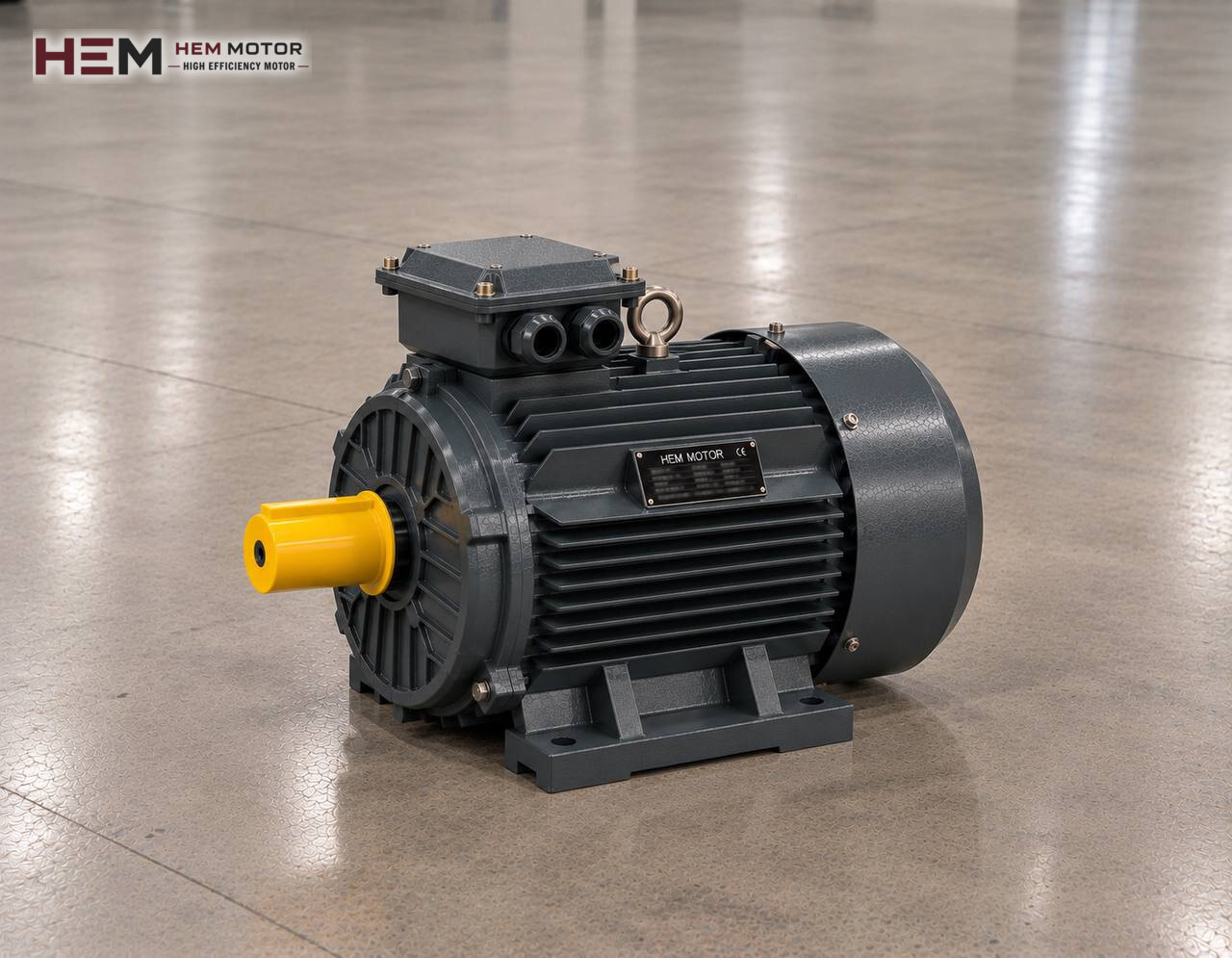
A plansifter is the large square sifter that separates the mixed stock leaving each passage of a flour mill into flour, semolina and bran. Dozens of stacked sieve frames sit inside a box hung from the ceiling on suspension rods; as the box swings in small circles in the horizontal plane, the stock travels between the layers and is separated by fineness. This page covers the motor that produces that circular motion; for the mill's other machines, see the flour mill electric motors page.

The suspended box and its centre of gravity
A plansifter has no body standing on the floor. The box hangs from a steel structure in the ceiling on flexible rods and can swing freely. In the middle of the box, in the frame between the two sieve stacks, there is a vertical shaft carrying an adjustable counterweight. When this shaft turns, the centrifugal force of the counterweight moves the whole box around a small-radius circle.
In most designs the motor is attached to this central frame and swings with the box, turning the shaft through a short belt drive. On some machines the motor sits on a fixed bracket above or beside the box and passes the motion through a flexible connection. In both solutions, what really sets the motor load is the mass of the box and the circular force of the weight rather than the product itself.
Challenges for a swinging motor
A motor that moves with the box lives a different life from one on a fixed base. The frame is under constant circular acceleration; the bearings carry both the load of their own shaft and this oscillation. The cable leaving the terminal box bends a little on every turn. The cable should therefore be of a flexible type, laid with a loop to absorb the swing, and held by a sound gland at the box entry.
Connection bolts, cable lugs and motor foot bolts can loosen over time. Periodic tightness checks of these should be part of the maintenance plan. If the motor stands on a fixed bracket most of these problems disappear, but wear of the flexible connection must be monitored.
Mounting position and direction of rotation
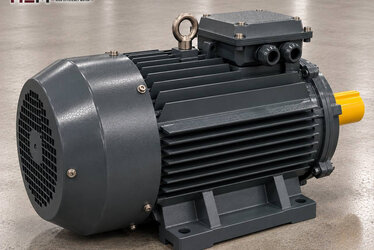
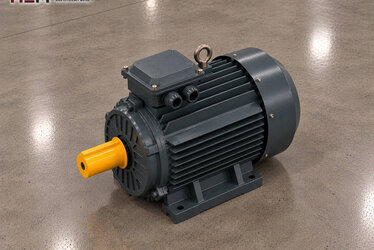
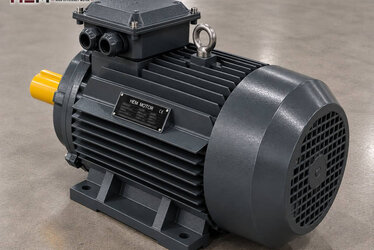
Because the drive shaft is vertical, on some plansifters the motor is also fitted vertically, shaft down or up. HEM motors can be supplied with feet, with flange, with both, and in vertical positions depending on frame size; the required arrangement is settled in the order together with shaft and flange dimensions. Whether extra parts such as a rain cover are needed for a vertically fitted motor is discussed at the same time.
The direction of rotation affects product flow inside the sifter; the wrong direction can make product run back in the channels. The correct direction is written in the machine maker's documentation. After the new motor is connected, the direction is verified with a short run; if wrong, two phases are swapped.
Swing during run-up and run-down
A plansifter accelerates slowly. The counterweight and the box mass are large; as the box passes the natural frequency of the suspension rods it swings wider than usual for a moment. At start-up this passage is short. During stopping, however, the box slows down by itself and stays longer in this zone; the risk of striking neighbouring boxes, ducts or cloth sleeves arises at these moments. Some makers recommend a brake to shorten the stop.
The motor's thermal protection should be set for this long acceleration time; otherwise protection trips early during the start. Direct-on-line starting is common at small ratings. If a frequency converter is to be used for controlled acceleration and stopping, our three-phase series is suitable; however, the box must not dwell in the resonance zone for long, and drive settings should be made together with the sifter maker. If the cable is long, state the filter requirement in the order (inverter-compatible motors).
Sieve cleaning, flour dust and protection
The plansifter is an enclosed machine kept under slight vacuum by aspiration; even so, flour spreads around when the lid is opened and sieve frames are changed. The IP55 protection of the motor frame limits dust ingress, but flour sticking to the fan cowl weakens cooling; the motor fins should be wiped when the frames are cleaned. Since the mill runs for weeks without interruption, fitting a PTC or PT100 sensor in the winding to monitor temperature is a good precaution.
If the plansifter hall is classified as a hazardous dust zone, keep in mind that a standard IP55 motor is not produced for such an area; the measure foreseen by the designer or a special motor must be written clearly in the order. For small laboratory test sifters with only single-phase supply, our single-phase motor series (0.18–5.5 kW) can be considered.
Example HEM motors
Plansifter motors are small compared with the mill's large drives and are usually 4-pole. Examples to look at are 2.2 kW 100L1-4 (1,450 rpm, 14.5 Nm), 3 kW 100L2-4 (19.8 Nm) and 4 kW 112M-4 (26.3 Nm). If the existing motor is 6-pole, 3 kW 132S-6 (968 rpm) keeps the same number of poles.
| Plansifter arrangement | Motor situation | To check | Example HEM model |
|---|---|---|---|
| Small box with few sections | On central frame, swings with box | Flexible cable, gland | 100L1-4, 2.2 kW |
| Medium twin-stack box | On central frame, vertical | Vertical position, flange size | 100L2-4, 3 kW |
| Large multi-section box | Long acceleration | Thermal setting, stopping time | 112M-4, 4 kW |
| 6-pole motor on older machine | On fixed bracket | Number of poles, pulley ratio | 132S-6, 3 kW |
This table is a guide; for each plansifter the motor is determined by considering together the real load of the box, the required speed, the mounting position and the conditions in the hall.
Information needed for a plansifter motor
Send us the machine brand and number of box sections, the power (kW) and speed (rpm) of the old motor, the plant voltage, the mounting position (horizontal or vertical, flange or foot), whether the motor swings with the box, the direction of rotation and the quantity. A nameplate photo of the old motor is often enough on its own. Models and current prices are in our shop; WhatsApp and phone details are on the contact page.
Frequently Asked Questions
Why does a plansifter motor suffer cable failures?
If the motor swings with the box, the cable bends on every turn. A fixed-type cable and a loose gland eventually lead to breakage; a flexible cable, enough loop allowance and a sound gland prevent this.
Why does the box swing so much when the plansifter is switched off?
While stopping, the box passes the slow speed matching the natural frequency of the suspension and stays in this zone for a while. The swing is temporary; if it is excessive, check the suspension rods and the counterweight setting, and if necessary look at the maker's brake recommendation.
Does changing the motor's number of poles affect sifting?
Yes. The box's rotational speed determines sifting quality and comes from motor speed and the pulley ratio. If the number of poles changes, the pulleys must change too; this decision should be taken with the sifter maker.
Can the plansifter motor be fitted vertically?
Yes, if the machine design requires it. Vertical positions are offered depending on the motor frame; shaft direction, flange size and additional protective parts are defined together in the order.