English
 Français
 Türkçe
 Español
 Русский

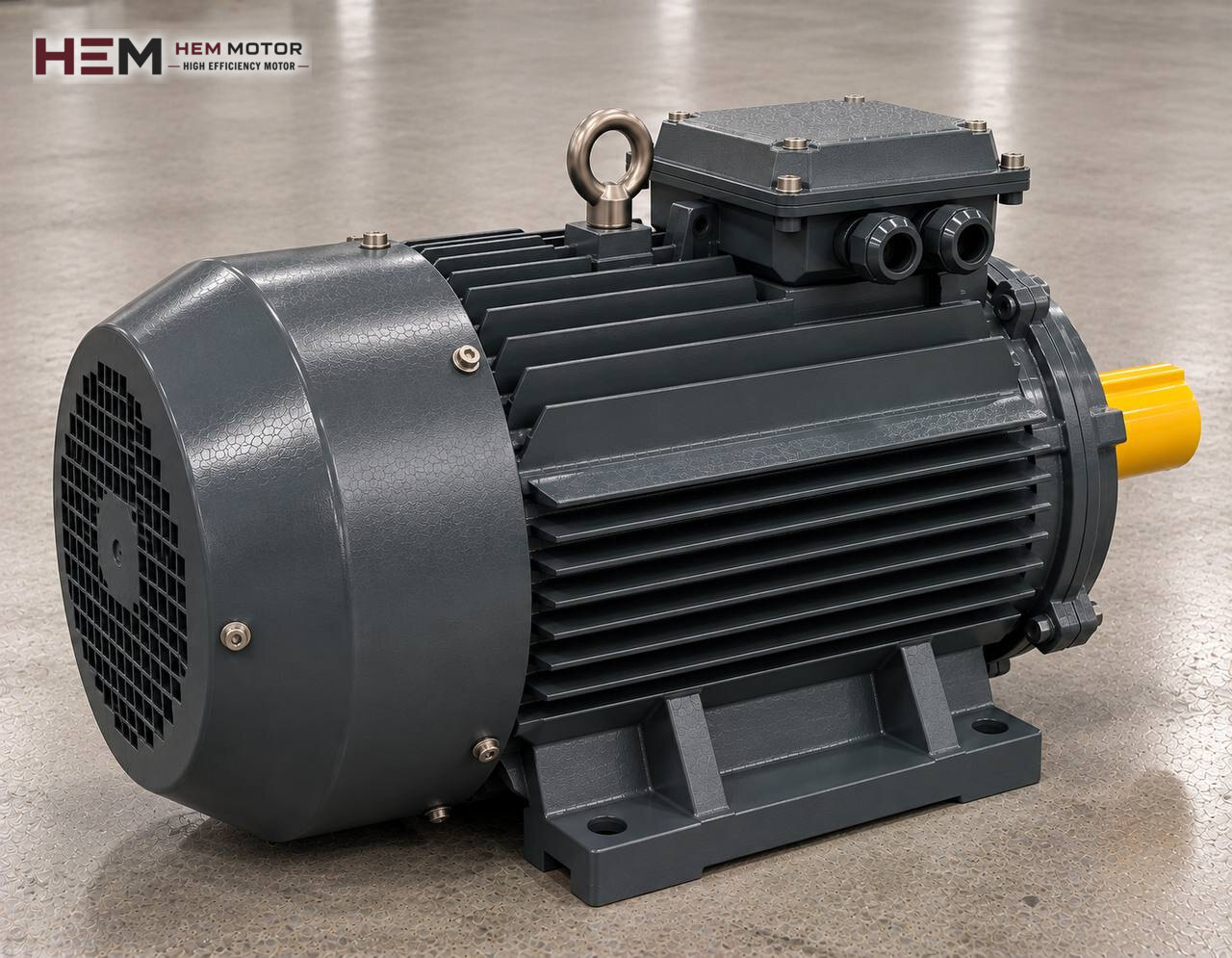
A roller mill is the machine that turns wheat into flour step by step in a modern flour mill. One roller mill usually has two separate grinding sections; in each section a pair of rolls, one fast and one slow, draws the stock between them, compressing and cutting it at the same time. This page covers the electric motor that turns those rolls; for the other machines of the mill, see the flour mill electric motors page.

Differential speed in the roll pair and the motor's share
The two rolls of a pair do not turn at the same speed. Break passages use fluted rolls, and the fast roll clearly outruns the slow one; this difference opens the bran and scrapes the endosperm out. Reduction passages use smooth rolls with a smaller ratio, and the work is mainly crushing. The mill builder sets the ratio for each passage.
In the typical layout the motor drives only the fast roll. The slow roll takes its motion from the fast one through a gear pair or a toothed belt. The power drawn from the motor therefore goes both into the grinding work between the rolls and into the losses of this internal transmission. The two sections of one roller mill run on separate motors, and each motor may have a different rating to suit the load of its passage.
Where the load comes from: roll gap and feed
The current drawn by the motor depends above all on the roll gap. As the miller closes the gap, more stock is broken and the current rises; this is why in many mills the ammeter of each roll motor is read as an indicator of the grinding setting. Irregular feed, changes in the tempering moisture of the grain or worn flutes also give different results at the same current.
When no product arrives, the rolls are moved apart by a pneumatic or electric mechanism. The rolls then do not rub against each other while idle, and the motor runs at light load. Short current swings when the rolls open and close are normal; continuous swings show that the feed roll or the sensor should be checked.
Starting sequence and continuous duty
The roller mill starts empty, that is, with the rolls apart. The inertia of the rolls and the large pulley stretches the start by a few seconds, but the breakaway torque is low. Medium-sized mills are often connected straight to the mains, while large ones are run up with a star-delta switch or an electronic starter that limits the starting current. Across the plant, aspiration is started first, then the sifters, and the roll motors last; bringing each motor in a few seconds apart spreads the starting load on the transformer.
A flour mill often runs for weeks without stopping. The motor should therefore be kept at steady load slightly below its rated current; if the current constantly sits at the nameplate value, a larger motor or the passage setting should be reviewed. A PTC or PT100 sensor in the winding and an anti-condensation heater for damp winter stoppages can be added to the order.
Belts, base and floor layout
Roll motors are usually foot-mounted on a base on the floor below the roller mill; the belts rise through an opening in the floor to the pulley of the fast roll. On some roller mills the motor sits on an adjustable bracket at the side. In both cases belt tension puts a side load on the motor bearing; stating the pulley diameter and the number of belts in the order makes bearing selection easier.
Motor frames can be prepared with feet, with flange, or with both, and in vertical positions depending on size; we confirm the shaft and flange dimensions together with the order. When belts are replaced, check that the two pulleys are in the same plane; misalignment wears both the belt and the motor bearing early.
Flour dust, temperature and protection
On the roll floor, fine flour dust settles everywhere. The frame of HEM's three-phase motors is IP55 class, but if the fan cowl grille and cooling fins are not cleaned regularly the motor heats up. In summer the temperature of the roll floor rises; if ambient conditions fall outside the catalogue limits, state this in the order.
Flour dust can form an explosive mixture at certain concentrations. If the roll floor is classified as a hazardous area, keep in mind that a standard IP55 motor is not built for such an environment; the measure foreseen by the plant designer or machine builder, or a special motor, is then required, and this must be stated clearly in the order. If roll speed is to be changed in operation, our three-phase motors can be driven by a frequency converter; conditions such as long periods of full load at low speed or a long drive cable may call for an extra fan or a filter and should be reported in advance (details: inverter-compatible motors).
Example HEM models by passage
Roll motors are usually 4-pole and are reduced to the fast roll speed by the pulley ratio. The models below are a starting point for different passages and mill sizes: 15 kW 160L-4 (rated torque 97.8 Nm, rated speed 1,465 rpm), 18.5 kW 180M-4 (120.2 Nm, 1,470 rpm), 22 kW 180L-4 (142.9 Nm) and 30 kW 200L-4 (194.2 Nm, 1,475 rpm).
| Roll section | Nature of the load | To state in the order | Example HEM model |
|---|---|---|---|
| Reduction passage, smooth roll | Mainly crushing, even load | Pulley diameter, number of belts | 160L-4, 15 kW |
| Late break passages | Fluted roll, medium load | Fast roll speed, starting method | 180M-4, 18.5 kW |
| First and second break | High breaking work, current varies with setting | Motor floor, base layout | 180L-4, 22 kW |
| Large long-roll mill | Continuous high load | PTC, anti-condensation heater | 200L-4, 30 kW |
These rows are examples; the right motor for each roll is chosen by assessing together the real load of the mill, the speed required by the fast roll, the mounting arrangement and the working conditions on the floor.
Information needed for a roll motor enquiry
For a quotation, send the machine brand and passage of the roller mill, the power (kW) and speed (rpm) of the existing motor, the plant voltage, the mounting type (foot or bracket), the pulley layout, the starting method and the quantity. If you have the old motor, a nameplate photo speeds up finding an equivalent. All models are listed with current prices in our shop; our WhatsApp and phone numbers are on the contact page.
Frequently Asked Questions
Why is the roll motor ammeter important?
The current shows how much work is done in the roll gap. The miller sets the gap by watching this value; a current constantly close to the nameplate value indicates that the passage is overloaded.
Can the two sections of one roller mill have motors of different ratings?
Yes. If the two sections serve different passages, their loads also differ; the motor of each section is chosen for the needs of its own passage.
Why does the motor draw low current when the rolls are apart?
When the rolls are separated no grinding takes place between them; the motor only turns the rolls, the internal transmission and the belts. This is normal and is also why the start is made in this position.
Does belt tension affect the motor?
Yes. An over-tight belt puts a high side load on the motor bearing, while a slack belt slips and heats up. Tension should be set to the manufacturer's value and pulley alignment checked whenever belts are changed.