English
 Français
 Türkçe
 Español
 Русский

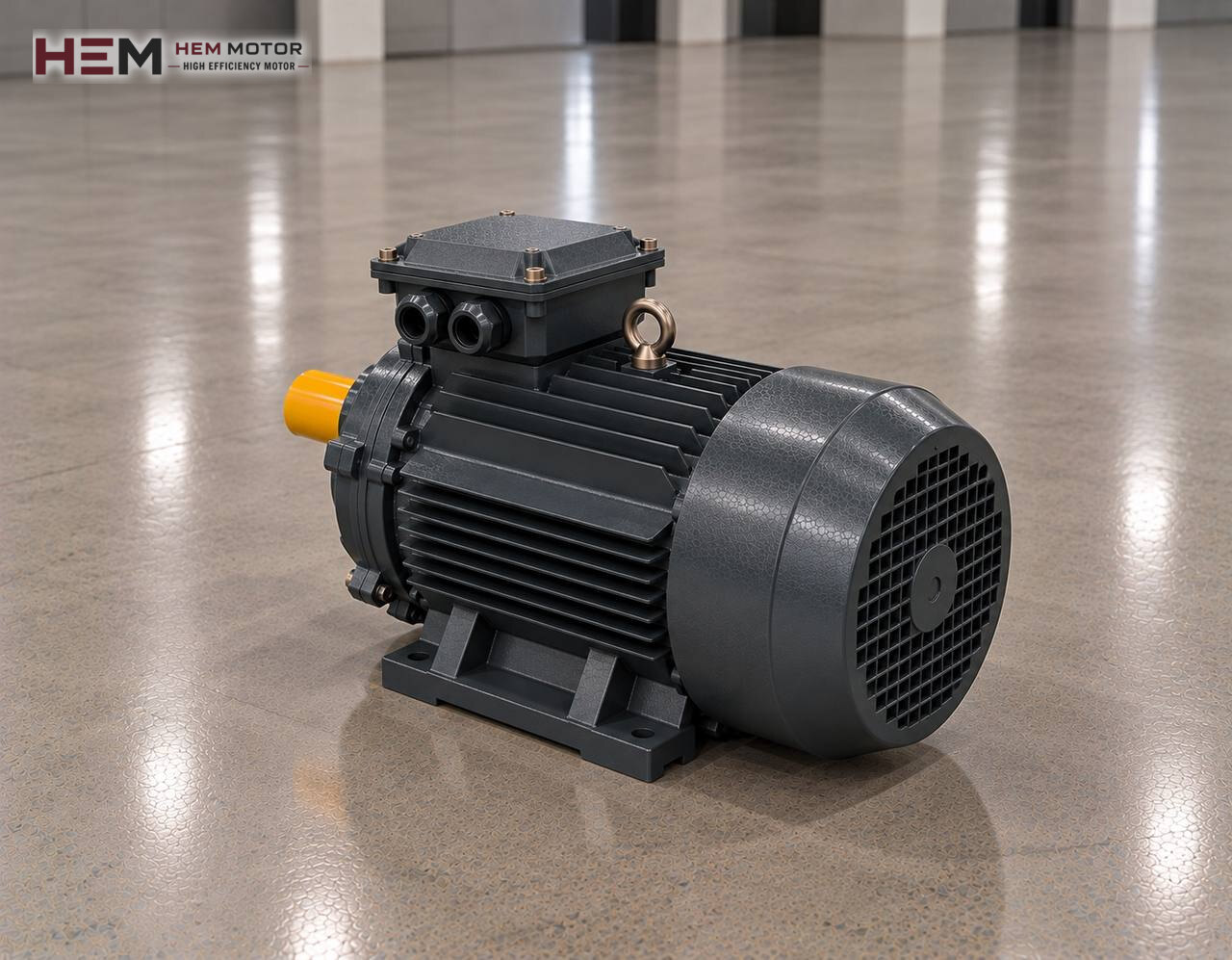
When truck mixers return to the plant, the fresh concrete left in the drum and the wash water are either dumped on site or fed to a concrete reclaimer. The machine washes this mixture and separates the sand and gravel from the cement slurry; the separated aggregate is reused, and the slurry water is kept agitated in a pond and returned to the plant. This page explains which parts the three-phase motors on this machine turn and how they are selected; for the plant's other motors see the concrete plant electric motors page.

Which parts do the motors turn on a concrete reclaimer?
A reclaiming plant usually has three or four separate drives. The first and most heavily loaded is the washing and separating unit: on some machines a washing screw turning in an inclined trough, on others a slowly rotating perforated washing drum. This part agitates the aggregate in water, strips the cement paste from it and discharges clean sand and gravel at one end. The motor turns this part through a gearbox.
The second drive is the agitator in the slurry pond. If cement and fines settle at the bottom of the pond they harden; so the agitator keeps the pond constantly moving. The third drive is the pump that carries slurry water to the plant or between ponds; some plants also have a separate feed pump for clean water.
There are also jobs the motor does not do. The vibrating screen at the outlet of some machines works with unbalanced-mass vibration motors attached to its body; these vibration motors are a product separate from standard motors and are not included in HEM Motor's 2026 catalogue. Water level floats, density meters and dosing valves also belong to the machine's control system.
Variable load on the washing screw and drum
The reclaimer's load depends on how much leftover concrete each truck mixer brings. One mixer may discharge only wash water, while another may bring several cubic metres of returned concrete. The screw or drum needs very different torque in these two cases. During a heavy discharge the screw trough fills quickly with sand and gravel and the motor runs loaded; when the discharge ends the load drops fast.
The hardest moment is starting the machine after a long stop. Material left in the trough or drum has settled with water and sometimes started to harden. The motor then meets a high breakaway torque. That is why machine manufacturers ask for the trough to be emptied and rinsed at the end of each working day; this maintenance step also protects the motor.
Power and speed: which information is the basis?
For each drive, power and speed come from the machine manufacturer's data or the existing motor's nameplate. The washing screw and drum turn at low speed; this low speed comes from the gearbox, and the motor is mostly 4-pole, i.e. in the 1500 rpm class. The pond agitator is also geared, and the blade diameter and pond depth set the power. For the slurry pump, the flow, head and pump speed given by the pump manufacturer are the basis; since the pump is often directly coupled, the motor speed must equal the pump speed.
No single kW value can be given for a reclaimer; the machine's capacity, how many mixers it accepts per hour and the drive layout vary between manufacturers. The powers of the three motors on the same machine also differ greatly.
| Drive point | Operating pattern | Key information for selection | Connection |
|---|---|---|---|
| Washing screw | Variable, shock load; start when full | Gearbox ratio, old motor nameplate | Flange motor + gearbox |
| Washing drum | Slow rotation, unbalanced load | Drum diameter, drive layout | Foot motor + gearbox or chain |
| Slurry pond agitator | Continuous running, heavy start after a stop | Blade diameter, pond depth | Vertical or flange motor + gearbox |
| Slurry / water pump | Continuous, abrasive fluid | Pump flow, head, speed | Coupling or pump adaptor |
The information in the table is illustrative; for each drive the final choice is confirmed with machine data, the required speed and the mounting dimensions.
Connection dimensions: gearbox flange, vertical agitator and pump
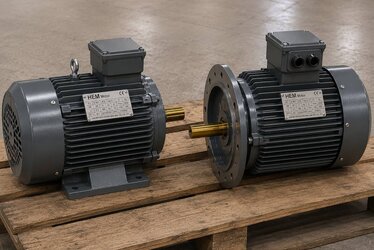
When replacing a motor, the first information to check is the IEC frame number; but to confirm the match, mounting type, shaft diameter and length, key, flange diameter and foot hole spacing are compared with the old motor. On the washing screw the motor usually sits on the gearbox input flange (B5 or B14). On the pond agitator the motor often stands vertically (such as V1) on a bridge over the pond; with vertical mounting the flange size and shaft direction are checked especially. On pumps the motor is foot-mounted and coupled, or flange-mounted on a pump adaptor.
Depending on frame size, HEM offers B3 foot, B5/B14 flange, B34/B35 foot-and-flange and upright arrangements such as V1; the list is in the mounting arrangements question and dimensions in the frame size table. The kW, rpm, volts and star/delta data on the nameplate are matched with the new motor too. For geared drives the electric motors for gearboxes page helps, and for the pump side the centrifugal pump electric motor page.
Splashing water, cement slurry and winter
The reclaimer is the wettest spot in the plant. Water splashes when the mixer drum is emptied, muddy water may overflow the screw trough, and the pond edge is always wet. The IP55 protection of HEM motors is against dust and splashing water; immersion of the motor, pressurised water directed at it, or the motor standing in slurry are outside the scope of this class. Placing the motor away from the splash zone or under a cover is a measure for the machine manufacturer and the operator; when the machine is washed, the hose should not be pointed at the motor.
Cement slurry sticks to the motor housing and, when dry, covers the fins; regular cleaning preserves cooling. According to the catalogue, the motors are defined for ambient temperatures from minus 15 to plus 40 degrees and altitudes up to 1000 m above sea level. If the pond risks freezing in winter, condensation can form inside the motor while it stands; a heater element against it, and a PTC sensor for winding temperature, can be added with the order. Conditions outside these limits should be stated in the order.
A machine that runs as mixers arrive: starting and the inverter
At many plants the washing screw runs only while a mixer is discharging; a sensor or the operator starts the machine and stops it a set time after discharge ends. This means many starts at irregular intervals during the day. The agitator, on the other hand, usually runs continuously and stops only for maintenance; its start after a long stop is heavy.
A frequency inverter can be used to adjust the speed of the screw or drum to the amount of incoming material and to give a soft start with a full trough. If long running at low speed with an inverter is planned, the motor's own fan may not be enough; a separately powered fan is considered. If the cable is long, a dv/dt or sine filter is considered. Keeping the inverter panel away from the wet area should also be planned. Details are on the inverter compatible electric motors page.
Information to send when replacing a reclaimer motor
Stating where the motor sits on the machine is the first step to finding the right one: screw, drum, agitator or pump. It is enough to send photos of the old motor's nameplate and connection via WhatsApp; how to take them is explained in the find an equivalent from the nameplate article, and our numbers are on the contact page.
- Machine information: type of reclaimer and the part the motor drives
- Power (kW), speed (rpm) and current on the old motor nameplate
- Site voltage and connection
- Mounting type: foot, flange (B5/B14) or vertical; shaft and flange dimensions
- How close the motor is to water and slurry, and whether it is covered
- Starting method and inverter use
- PTC sensor or anti-condensation heater request, and required quantity
Motor groups to review in the shop
For screw and agitator drives working in a wet, abrasive environment, cast iron frame electric motors are mostly preferred; for small pumps and agitators aluminium frame models can also be considered. For geared drives you can look at the 4 kW cast iron 112M-4 (1,450 rpm) and 11 kW cast iron 160M-4 (1,465 rpm); for directly coupled slurry pumps with a pump speed in the 3000 rpm class, the 5.5 kW cast iron 132S1-2 (2,930 rpm); and for small 1500 rpm pumps or agitators, models such as the 3 kW aluminium 100L2-4 (1,450 rpm). These are only to give an idea; whether they will work on your machine is checked separately. All models on sale are gathered on the shop page.
Frequently Asked Questions
Why does the washing screw start hard in the mornings?
Sand and cement paste that settled in the trough overnight need a high breakaway torque. Emptying and rinsing the trough at the end of the day largely reduces this problem; increasing motor power alone is not the solution.
Why does the agitator motor run all the time?
If movement in the slurry pond stops, cement sinks to the bottom and hardens. The agitator is therefore chosen to run continuously; the motor is assessed for S1 continuous duty.
Can you also replace the vibration motor on the screen?
Unbalanced-mass vibration motors are a separate product group and are not included in HEM Motor's 2026 catalogue. We offer standard three-phase motors for screw, drum, agitator and pump drives.
Does an IP55 motor withstand wash water?
IP55 protects against splashing water; it is not designed for pressurised water jets or immersion. The motor needs to be protected from the splash zone.
How is the speed of the slurry pump motor determined?
The pump speed given by the pump manufacturer is the basis. If the pump is directly coupled, the motor speed is chosen from the 3000 or 1500 rpm class accordingly.