English
 Français
 Türkçe
 Español
 Русский

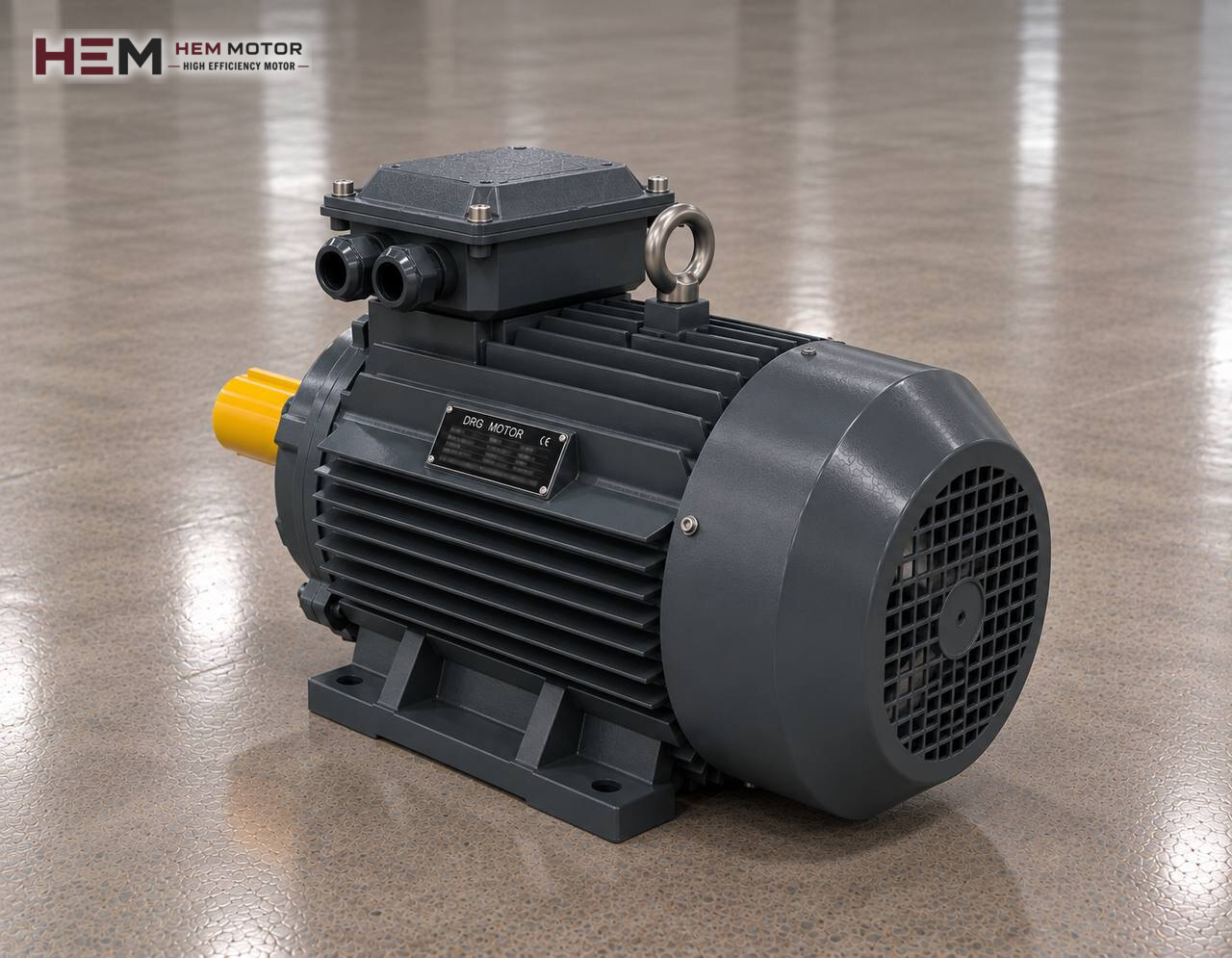
In a concrete plant, the water going into the mix is measured as precisely as the cement and aggregate. The part that takes this water from the tank or well and pumps it to the water scale or flow meter, and that feeds the line used to wash the mixer at the end of the day, is a centrifugal pump driven by a three-phase motor. This page covers only the motors of the plant's water pumps; for mixer, screw and belt motors you can return to the parent page concrete plant electric motors.

What exactly does the water pump motor do in the plant?
The motor's job is to turn the pump shaft and hence the impeller. The impeller draws water from the suction inlet and pushes it into the delivery line. The water either fills the water scale above the mixer and, once weighed, is released into the mixer by a valve, or passes through a flow meter straight into the mixer. The control stops the pump when the scale is full or the flow meter reaches the target quantity.
Plants usually have more than one water pump: the feed pump carrying the mix water, the wash pump used to clean the mixer and scale, and sometimes a separate submersible or surface pump drawing water from a well into the tank. Admixture dosing pumps are usually very low power, often machine-specific pump-motor units. Submersible pump motors are built to run under water; a standard IP55 motor is not designed for that job. Valves, the flow meter, the water scale's load cells and the level floats are also outside the motor's task.
What data does the pump motor need?
Motor selection starts from the pump. The flow (m³/h), head (m), pump speed and the power required at the pump shaft given by the pump manufacturer are the basic information. These values are on the pump's nameplate or on the curve in its catalogue. Since a plant pump is usually chosen to fill the scale within a set time, the flow requirement depends on the batch time; the head is set by the tank level, the height of the scale and losses in the pipework.
If the motor of an existing pump is being replaced, the old motor's nameplate is the fastest route: power, speed, current, voltage and mounting type are looked for in the same way. No single kW value can be said to "suit a concrete plant water pump"; as scale height and line length change, so does the required power.
Why must the speed match the pump's speed?
On centrifugal pumps there is no gearbox between motor and pump; the motor shaft speed is the impeller speed. If the pump is designed for about 2,900 rpm, a 2-pole motor is needed; if for about 1,450 rpm, a 4-pole motor. Changing the number of poles changes the pump curve completely: fitting a 2-pole motor to a 4-pole pump raises flow and pressure, overloads the motor and strains the pump; in the opposite case the scale fills late.
2-pole motors, i.e. in the 3000 rpm class, are common on plant water pumps; but the decision is always made from the pump's own data.
| Pump and its task | Operating pattern | Point checked for the motor |
|---|---|---|
| Mix water feed pump | Short run each batch, frequent starts | Starts per hour, pump speed |
| Mixer and scale wash pump | A few times a day, higher pressure | Pump power, coupling or adaptor size |
| Tank filling (surface) pump | Long running controlled by a level float | Continuous duty, ambient conditions |
| Return water pump | Water containing cement slurry | Pump type, wear, motor position |
The cases in the table are examples; the final choice is confirmed with the pump data, the required speed and the mounting dimensions.
Pump adaptor, coupling and dimensions to compare
Two connections are common on plant water pumps. On close-coupled pumps the pump casing sits directly on the motor flange and the impeller is fitted on the motor shaft; here the flange type (B5 or B14), flange diameter, shaft diameter and length and key size must suit the pump. On coupled pumps a foot-mounted motor and the pump sit on a common base; the foot hole spacing, shaft height and shaft size are compared with the old motor, and the coupling alignment is reset after the change.
The first information to check is the IEC frame number, but it is not enough on its own; mounting type, shaft, flange and foot dimensions are checked together with power, speed and voltage. The mounting options of HEM motors are in the which mounting arrangements question, their dimensions in the frame size table; flange-mounted models are introduced on the flange-mounted electric motors page. For general rules on pump motors, the centrifugal pump electric motor and booster set pump motor pages are also useful.
Pump room, humidity and frost risk
Water pumps usually stand under the plant, next to the water tank or in a small pump room. These places are damp; water dripping from the gland or mechanical seal may collect under the motor. The IP55 protection of HEM motors is against dust and splashing water; the motor being under water is not covered by this protection. Enough height above the floor and water drainage in the pump room protect the motor.
The catalogue ambient range is −15 to +40 degrees Celsius and 1000 m altitude. At open plants with frost risk in winter, protecting the pump and the line against freezing is the site's job; an anti-condensation heater is an order option to keep condensation from forming in the motor during stops. Conditions outside this range are reported in the order.
Start every batch, pressure control and the inverter
The mix water pump starts with every batch and stops when the scale is full. At plants producing many batches per hour this means very frequent starts for the motor. Since starting current heats the winding, the number of starts per hour should be stated in the order and, if needed, a PTC winding sensor requested; PTC is an order option.
Instead of stopping the pump for each batch, some plants run it at constant pressure with a frequency inverter and cut the water with a valve. This arrangement reduces the number of starts and softens water hammer. Since pump load falls quickly with speed, motor cooling at low speed is usually not a problem; still, with a long cable a dv/dt or sine filter is considered. Details on inverter operation are on the inverter compatible electric motors page.
What to send when replacing a pump motor
When the water pump stops, the plant cannot produce concrete; so finding the right motor the first time matters. You can send photos of the motor nameplate and the pump-motor connection via WhatsApp; which photos are useful is explained in the finding an equivalent motor from the nameplate article. Phone and WhatsApp numbers are on the contact page.
- Machine information: the pump's task (feed, wash, tank filling) and pump brand/type
- Flow, head and pump speed on the pump nameplate
- Power (kW), speed (rpm), current and voltage on the old motor nameplate
- Connection: close-coupled (B5/B14 flange) or coupled foot motor; shaft diameter and length
- Approximate starts per hour or inverter use
- Humidity in the pump room and winter conditions
- PTC or anti-condensation heater request, and quantity
Product groups to look at in the shop
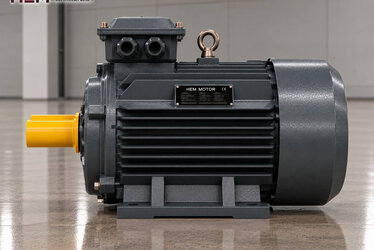
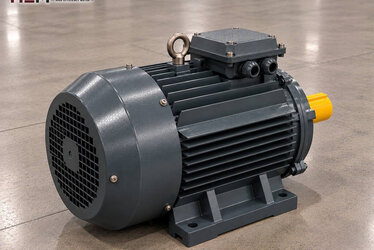
On small and medium plant water pumps, aluminium frame electric motors are often used because they are light and suit pump adaptors; in damp pump rooms or for larger pumps cast iron frame models can also be considered. For pumps in the 3000 rpm class, the 3 kW cast iron 100L-2 (2,895 rpm), 4 kW cast iron 112M-2 (2,905 rpm) and 7.5 kW aluminium 132S2-2 (2,930 rpm); for a pump in the 1500 rpm class, the 2.2 kW cast iron 100L1-4 (1,450 rpm) can be reviewed as examples. These products are examples; their suitability for your pump is confirmed separately. All models are on the buy electric motors page.
Frequently Asked Questions
The water scale fills more slowly than before; has the motor weakened?
The pump suction side, strainer and valves should be checked first. If the motor turns in the wrong direction the flow also drops; the direction is corrected by swapping two phases.
If I fit a higher-speed motor to my pump, will the scale fill faster?
The pump curve changes and the motor and pump are overloaded. The speed should stay equal to the pump's design speed; for more capacity, consult the pump manufacturer.
Can you also supply a submersible pump motor?
Submersible pump motors are made to run under water and are not included in HEM Motor's 2026 catalogue. We offer standard three-phase motors for surface pumps.
Can the wash pump and the feed pump run with the same motor?
Even if their mechanical connections are the same, the pumps' flow and pressure needs differ. Each pump should be assessed from its own nameplate.
When a close-coupled pump motor is changed, should the seal be changed too?
Since the impeller is fitted on the motor shaft, the mechanical seal and gaskets should be checked during dismantling. This is the pump service's job; the motor shaft size must be the same as the old one.