English
 Français
 Türkçe
 Español
 Русский

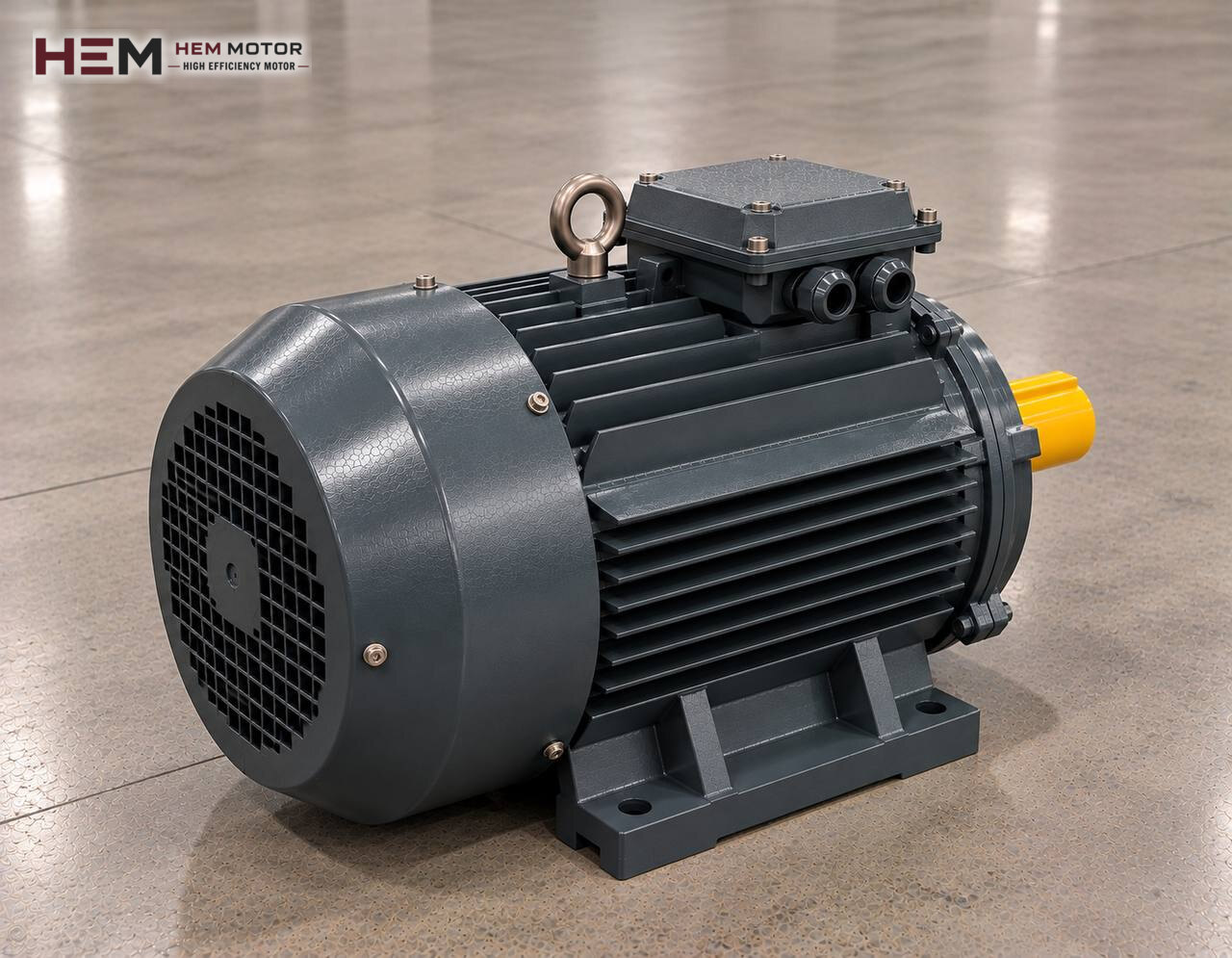
In a concrete plant, the accuracy of the recipe depends on how many kilos of sand and gravel leave the bins. This job is done by the gates under the bins and the weighing belt; then a loading belt or a skip bucket carries the weighed aggregate to the mixer. This page covers the motors that drive the bin outlet, the weighing belt and the loading belt; the plant's other motor points are collected on the concrete plant electric motors page.

Where do motors work on the aggregate line?
A typical plant has an aggregate bin with four or more compartments, each holding sand or gravel of a different size. The gates under the compartments are mostly opened by pneumatic cylinders, so there is usually no electric motor at this point. The motor's real places are: the weighing belt running under the compartments, the inclined loading belt that carries the weighed material up, and in some plants vibrators fixed to the bin wall.
Compact plants may use a skip bucket instead of a loading belt. A skip is a hoist drive that pulls the material up on a rope and needs a braked drive that holds the load in the air. Brake motors are not on HEM's 2026 product list; the skip hoist motor should be replaced with the special drive specified by the plant manufacturer. The advice on this page is for belt drives.
Weighing belt: short, heavy and precise
A weighing belt is a frame a few metres long sitting on load cells. When the recipe starts, the sand and gravel gates open in turn, material builds up on the belt and the gate closes when the scale reaches the target weight. During this time the belt is usually stopped; when weighing is finished the belt runs and discharges the aggregate onto the loading belt.
This mode of operation is hard on the motor. The belt starts fully loaded in every batch, carrying all the aggregate for one batch. In a plant producing dozens of batches per hour, that means dozens of heavy starts per hour. Even if the motor power looks small for the continuous load, starting torque and the number of starts determine the choice. A PTC sensor to monitor winding heat suits this belt very well and is an order option.
In some plants each compartment has its own weigh hopper with a continuously running collecting belt instead of a weighing belt. In that layout the belt runs with a continuous but variable load; the heavy-start problem is smaller and the hoppers' discharge timing becomes important.
Inclined loading belt and rollback
The loading belt carries the weighed aggregate to the waiting hopper above the mixer and is usually installed at a noticeable incline. If you stop the belt while it is carrying load, the incline component of the weight tries to turn the belt backwards. This rollback is prevented by a backstop inside the gearbox or attached to the drum; the motor itself does not do this job.
On an inclined belt the incline component is added to the starting torque, so a larger motor is selected than for a horizontal belt of the same length. Belt length, incline angle, belt speed and the amount of aggregate in the heaviest batch go into the plant manufacturer's calculation. If the old motor is replaced, the nameplate values and gearbox ratio should stay the same. On long belts a ramp from a frequency inverter can be used so that the belt does not slip at start.
Bin vibration and damp sand
Damp sand can arch in a bin compartment and not flow even when the gate opens. To prevent this, a vibrator is fixed to the bin wall or air blasts are injected into the compartment. External vibrators are special motors carrying unbalanced weights on both shaft ends; this product group is separate from the standard squirrel cage series and is not in the HEM Motor 2026 catalogue.
When the bin wall vibrates, belt motors on the same frame also receive this vibration. The motor foot bolts and the gearbox torque arm connection should be checked regularly.
Connection and environment
The most common drive on weighing and loading belts is a shaft-mounted gearbox on the drum shaft with the motor sitting on its input flange. Larger belts may use a foot-mounted motor, a coupling and a foot-mounted gearbox. On HEM motors, foot, flange and foot-and-flange designs as well as vertical positions can be selected depending on frame size; we finalise the flange and shaft diameter that fit the gearbox together with the order. For the gearbox side the electric motors for reducers page helps, and for general belt drive rules the conveyor belt motors page.
The aggregate area is outdoors, sand and stone dust are heavy, and frost and condensation occur in winter. An IP55 motor limits this dust and rain splash; a canopy over the motor and cleaning mud from the fan cover extend its life. For long standstills an anti-condensation heater is an order option. If the belt will be slowed by a frequency inverter and run at full load for long periods, the motor's own fan may not be enough and a separately powered fan is added; if the cable between inverter and motor is long, an output filter (dv/dt or sine) is considered. The topic is covered separately on the inverter compatible electric motors page.
Example HEM models and selection table
On weighing belts, 4-pole cast iron motors mostly match the gearbox input. For a short weighing belt the 4 kW cast iron 112M-4 (1,450 rpm, 26.3 Nm) or the 7.5 kW cast iron 132M-4 (1,460 rpm, 49.1 Nm) can be taken as examples. On long, inclined loading belts the 11 kW cast iron 160M-4 (1,465 rpm, 71.7 Nm) or the 15 kW cast iron 160L-4 (1,465 rpm, 97.8 Nm) are options worth checking.
| Belt or point | Character of the load | Value affecting the choice | Example HEM model |
|---|---|---|---|
| Short weighing belt, small plant | Start with a full belt in every batch | Batches per hour, PTC | 112M-4, 4 kW |
| Long weighing belt, multi-compartment bin | Heavy start, long belt | Aggregate per batch | 132M-4, 7.5 kW |
| Continuously running collecting belt | Variable but continuous load | Hopper discharge sequence | 132M-4, 7.5 kW |
| Inclined loading belt | Incline component, tendency to roll back | Incline angle, backstop, ramp | 160M-4, 11 kW |
| Long, steep loading belt, large plant | High starting torque | Belt speed, starting method | 160L-4, 15 kW |
The models in the table are only examples; the final choice is made by assessing the machine load, required speed, mounting and operating conditions together.
What to send for a quotation
Tell us which machine you need a motor for (weighing belt, collecting belt or loading belt), and add the required power (kW) and speed (rpm), the plant voltage, the motor's mounting arrangement, the gearbox input flange and how many units you need. If you have a photo of the old motor's nameplate, please share it too. Frame options and current prices can be seen on the shop page; our WhatsApp and phone numbers are on the contact page.
Frequently Asked Questions
Why does the weighing belt motor fail often?
It starts with a full belt in every batch and stops and starts dozens of times per hour. The number of starts, thermal relay setting and winding temperature should be checked together; a PTC sensor is recommended for this belt.
The inclined belt rolls back when it stops — should the motor be changed?
No; the backstop that prevents rollback is in the gearbox or on the drum. The motor does not do this job; the backstop should be checked first.
Can you supply the hoist motor of a skip bucket plant?
A skip hoist needs a braked drive that holds the load in the air; brake motors are not in our 2026 catalogue. The motor specified by the plant manufacturer should be used for this drive.
Can the bin vibrator also be bought from you?
Vibrators with unbalanced weights are a separate product group and are not in our 2026 catalogue. We supply standard motors for the belt drives under the bin.