English
 Français
 Türkçe
 Español
 Русский

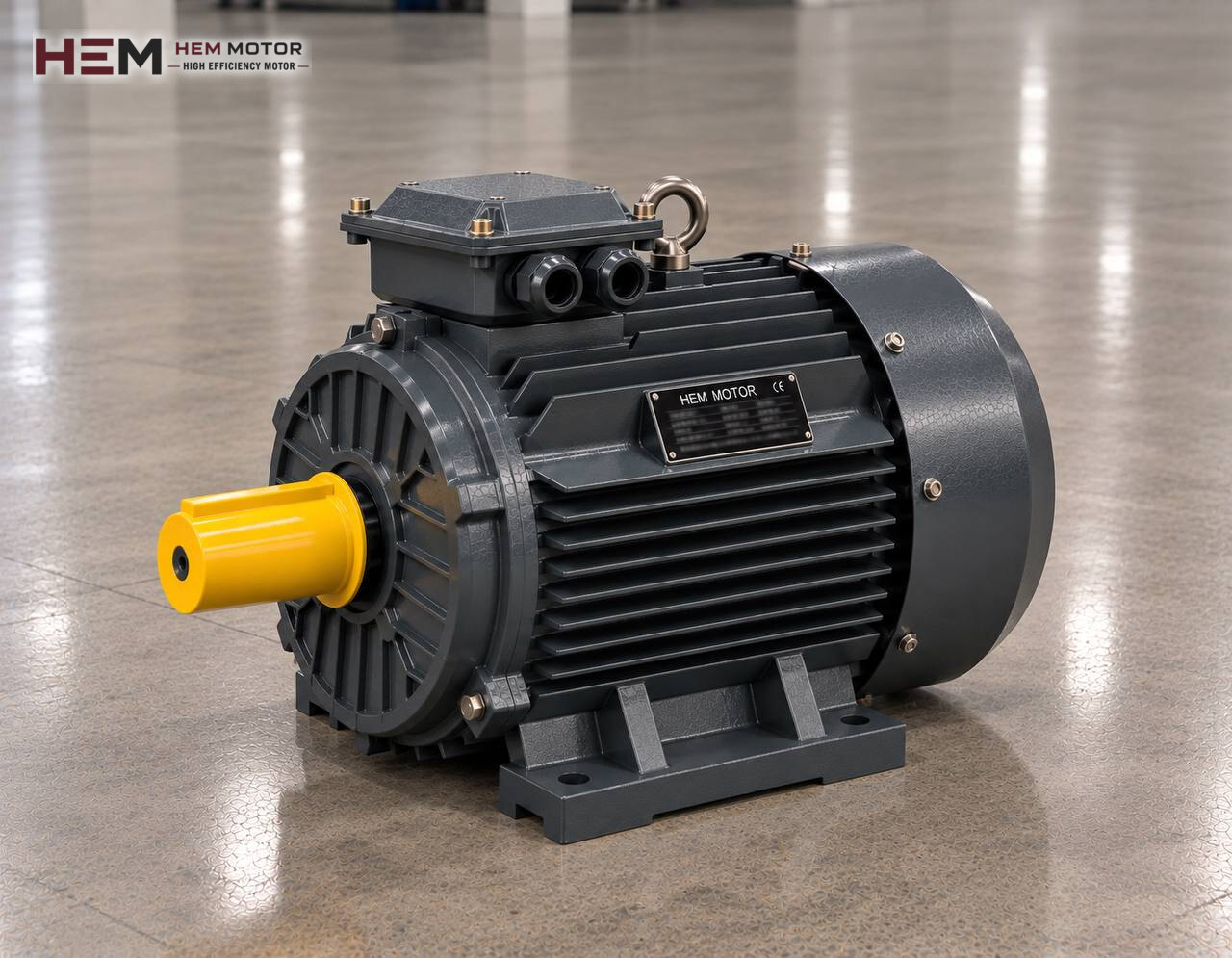
In compact and mobile concrete plants, the part that lifts the weighed sand and gravel to the top of the mixer is often a skip bucket travelling up and down on inclined rails. The bucket is pulled up by a steel rope wound on a winch drum, tips over at the top to discharge, and comes back down. This page covers only the three-phase motor that turns that drum through a gearbox; for the other motor points of the plant you can return to the concrete plant electric motors page.

The motor's share in the skip winch: only turning the drum
In a skip system the electric motor turns the input shaft of the gearbox, and the gearbox turns the rope drum. As the drum rotates the rope winds up and the loaded bucket climbs along the rail. At the top the bucket wheels enter the curve at the end of the rail, the bucket tips forward and the aggregate drops into the mixer inlet. Then the motor runs in reverse and the empty bucket comes down under its own weight, controlled by the rope.
The jobs the motor does not do are especially important on this machine. The brake that holds the bucket at any point and keeps it from falling when power fails; the limit switches that stop the bucket from overtravelling at the top or bottom; the slack rope switch that detects a loose rope; and the safety pin or lock that fixes the bucket mechanically during maintenance form the plant's safety system. They are assessed separately from motor selection, under the machine manufacturer's responsibility and according to the applicable regulations. A standard motor cannot be said to provide load holding or lifting safety on its own.
Treating the brake and load holding separately from the motor
On skip winches the brake is usually arranged in one of two ways: an electromagnetic brake attached to the rear of the motor, or a separate disc or shoe brake acting on the coupling between motor and gearbox. Which one is used, how much braking torque it has and in what order it releases and closes is the plant manufacturer's design. If the motor itself was braked in the old arrangement, this is visible on its nameplate and housing; if a brake motor is required, state it in the order.
If the brake is a separate part on the coupling side, when replacing the motor you check how the brake disc and coupling will seat on the new shaft; this is why shaft diameter and length matter twice on this machine. After the motor change, the brake setting, the limit switches and the rope condition must be inspected by an authorised person.
Which data give the motor information?
The data that set the motor power of a skip winch are the amount of aggregate in the bucket, the own weight of the bucket and its carriage, the rail inclination, the bucket's travel speed, the drum diameter and the gearbox ratio. All of these enter the plant manufacturer's calculation and appear in the plant's technical file. If the motor in an existing plant is being replaced, the power, speed, current and voltage on the old nameplate are the best starting point; no single kW value can be called "suitable" for a skip bucket.
Speed also needs care. The gearbox ratio and drum diameter link the bucket speed to the motor speed. If a 6-pole motor is fitted instead of a 4-pole one, the bucket rises more slowly and the batch time grows; moving to 2-pole raises the rope speed and the load on the brake. So the speed class should stay as on the old nameplate.
| Stage of the skip cycle | Motor condition | Safety part assessed separately from the motor |
|---|---|---|
| Start from the bottom with a full bucket | Highest starting torque | Brake release sequence |
| Travel up the rail | Loaded running at constant speed | Rope and drum condition |
| Tipping and discharge at the top | Slowing down, stop | Top limit switch |
| Lowering the empty bucket | Reverse direction, driven by the load | Slack rope switch, bottom limit |
| Maintenance and work under the bucket | Motor de-energised | Mechanical lock or safety pin |
The table shows a general cycle; the final motor choice is confirmed with the plant manufacturer's data, the required speed and the mounting dimensions.
Connection to the drum gearbox and dimensions to check
Two layouts are common on skip winches. In one, a foot-mounted motor and a foot-mounted gearbox sit on a common base with a coupling and often a brake disc between them. In the other, the motor is flange-mounted directly on the gearbox and the brake sits behind the motor or at the gearbox output. The first piece of information is the IEC frame number; then the mounting type (such as B3, B5, B35), shaft diameter and length, key size, foot hole spacing and flange dimensions are compared with the old motor.
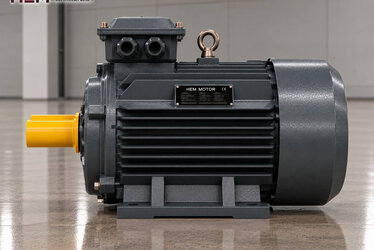
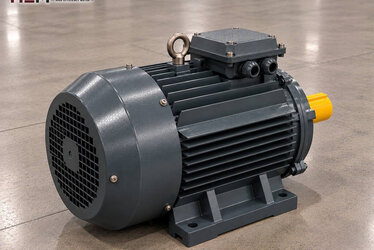
HEM motors are offered in foot, flange, foot-and-flange and vertical arrangements depending on frame size; see the mounting arrangements question for the options and the frame size table for dimension comparison. Electrical values are also set side by side: power, speed, voltage, current and connection. General information on lifting drives is on the lifting and crane motor page, and the gearbox connection on the electric motors for gearboxes page.
Dust, rain and cold at an open plant
The skip winch usually stands below the mixer platform or next to the start of the rail, often outdoors. The bucket raises some aggregate dust at each discharge; sand grains settle on the fan cover and fins of the motor. The IP55 protection class is against dust and splashing rain; still, a canopy over the motor and cleaning mud from the fan cover keep the cooling intact.
Catalogue values apply to an ambient temperature between −15 and +40 degrees Celsius and altitudes up to 1000 m. At sites that drop below this limit in winter, or at high-altitude plants, this should be stated in the order. On mobile plants the motor is moved and reinstalled often; after each installation the foot bolts and coupling alignment must be checked. An anti-condensation heater and a PTC winding sensor are order options.
Frequent starts, lowering direction and the frequency inverter
The skip motor starts at least twice per batch: up with a full bucket and down with an empty one. At a plant with many batches per hour, this means the winding constantly heats and cools. The motor protection relay setting and the PTC sensor should be considered for these frequent starts.
When lowering, the bucket drives the motor; the motor may then act like a generator. With a direct mains supply this is usually not a problem, but on skip winches with a frequency inverter a braking resistor or similar solution is planned on the inverter side for the energy returned during lowering. The inverter can give smooth acceleration at start and a slow approach at the top; however, the brake release and closing sequence must be set up by the machine manufacturer together with the inverter logic. Long running at low speed, a separate fan and cable filters are explained on the inverter compatible electric motors page.
Information to send when replacing the skip motor
When the skip motor stops, the plant cannot take aggregate, so sending complete information in the first message matters. You can share the old motor's nameplate and photos showing the brake and coupling arrangement via WhatsApp, following the steps on the send your motor nameplate page; the numbers are on the contact page.
- Machine information: plant type (stationary/mobile), bucket volume and plant manufacturer
- Power (kW), speed (rpm), current and voltage on the old motor nameplate
- Mounting type: foot, flange or foot-and-flange; shaft diameter and length
- Brake arrangement: on the motor or on the coupling; if a brake motor is required, state it clearly
- Starting method: direct-on-line or frequency inverter
- Approximate number of batches per hour and ambient conditions
- PTC sensor or anti-condensation heater request, and quantity
Motor groups to review in the shop
Because skip winches work outdoors in dust and under shock loads, cast iron frame electric motors are usually preferred; on small mobile plants aluminium frame models can also be compared. If the gearbox input is in the 1500 rpm class, the 11 kW cast iron 160M-4 (1,465 rpm), 22 kW cast iron 180L-4 (1,470 rpm) and 30 kW cast iron 200L-4 (1,475 rpm) can be reviewed as examples; if the gearbox was calculated for the 1000 rpm class, the 15 kW cast iron 180L-6 (978 rpm) is a model to look at. These models are examples; their suitability for your skip winch and the brake requirement are confirmed separately. All powers are on the buy electric motors page.
Frequently Asked Questions
Can the skip bucket motor hold the bucket in the air?
It is not the motor that holds the bucket but the winch's brake and safety system. That system is checked separately according to the plant manufacturer's design and the applicable regulations; if a brake motor is needed, it should be stated in the order.
Why does the bucket jolt when discharging at the top?
This is usually related to the top limit setting, the rail curve or the rope tension. These mechanical points should be checked before changing the motor.
The old motor was 6-pole; can I fit a 4-pole one?
With the same gearbox the bucket rises faster, and the rope and brake are strained more. The speed class should stay as on the old nameplate, and any change discussed with the plant manufacturer.
Can a skip winch be run with an inverter?
Yes; a braking resistor for the energy returned during lowering and the brake release sequence are planned on the inverter side. If there is long running at low speed, state it in the order.
Does the slack rope switch affect the motor choice?
It does not affect motor power, but it is part of skip safety. After the motor is changed, an authorised person must test that this switch and the limit switches work.