English
 Français
 Türkçe
 Español
 Русский
 العربية
 Deutsch
 Italiano


When buying an electric motor for a dairy plant, the first check is whether the motor will run in a wet area washed every day by CIP and hose, or in a dry section such as the cold store or boiler room. The second check is the machine's place in the milk flow: from raw milk reception to pasteurisation and from the homogeniser to the filling machine, a stopped motor raises the question of how long the product can wait without breaking the cold chain. The list below starts from these two questions and sets out the information to be written in the order.
In which area of the dairy will the motor run?
The motor may run in the process hall, the cold room or the refrigeration plant, and the selection follows that area.
In a dairy, milk is taken from the tanker by the reception pump, passes through the plate cooler and goes to the storage tanks. Then come the separator, pasteuriser, homogeniser, yoghurt or cheese preparation tanks and the filling and packaging line. Alongside these are ammonia or glycol refrigeration compressors, ice water pumps, boiler feed pumps and the wastewater treatment plant.
Dividing the purchasing list by these areas makes the job easier. Motors in the process hall are chosen for daily washing, conveyors in the cold room for low temperature and condensation, and compressor motors in the refrigeration plant for long, uninterrupted running. The area is where selection starts.
What protection is needed against CIP washing and caustic vapour?
Against splashing water and chemicals, standard IP55 is enough at most points; where the motor is hosed down directly, IP56 is requested.
In a dairy, lines and tanks are washed with hot caustic and acid solutions at the end of each production run; floors and machine exteriors are also cleaned with a hose. In this environment water and chemicals splash onto the motor frame, the terminal box gasket hardens over time and the paint blisters. Cable entries facing downwards, unused gland holes closed and the motor positioned so that water does not collect are the basic measures.
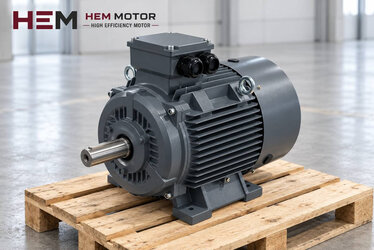
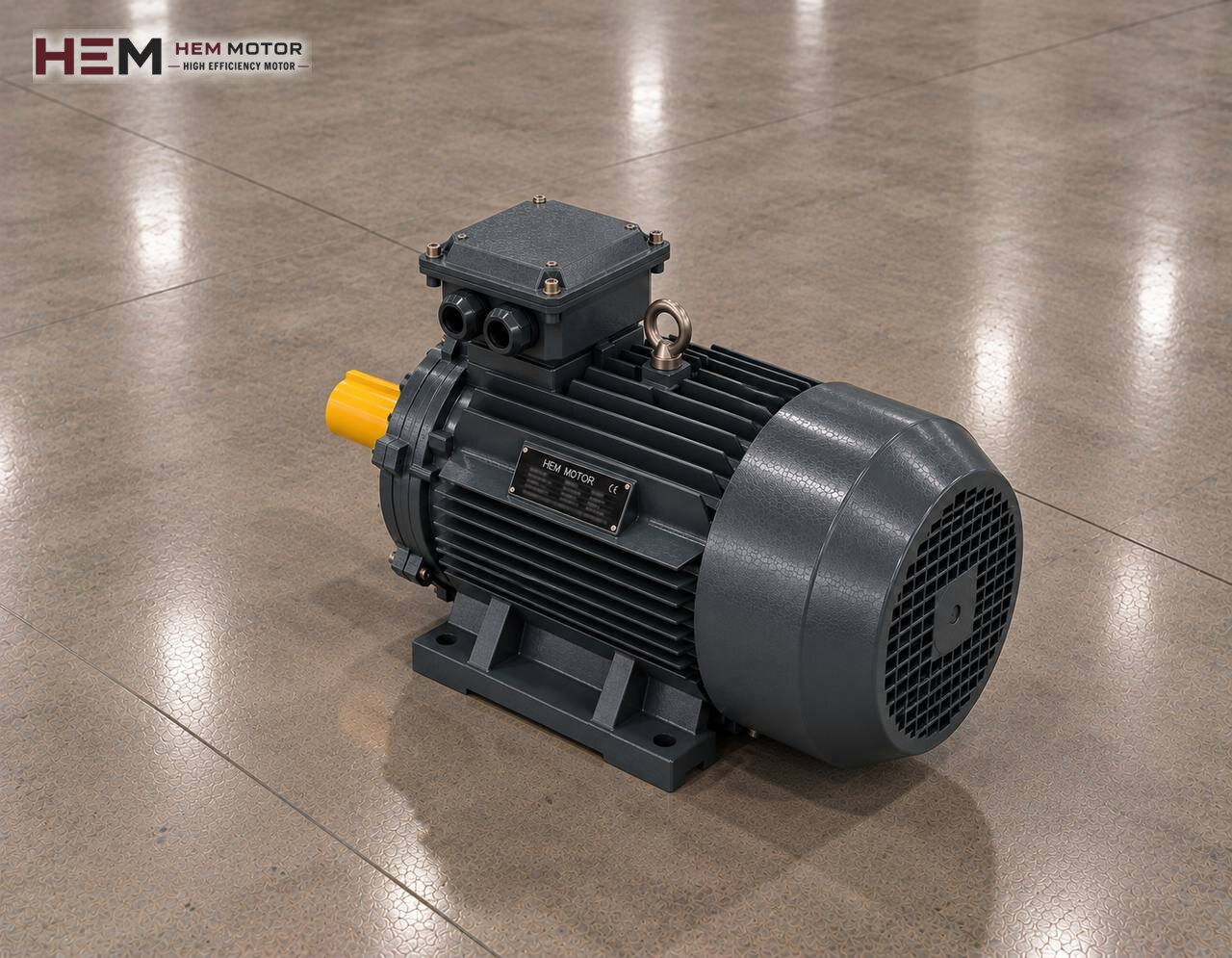
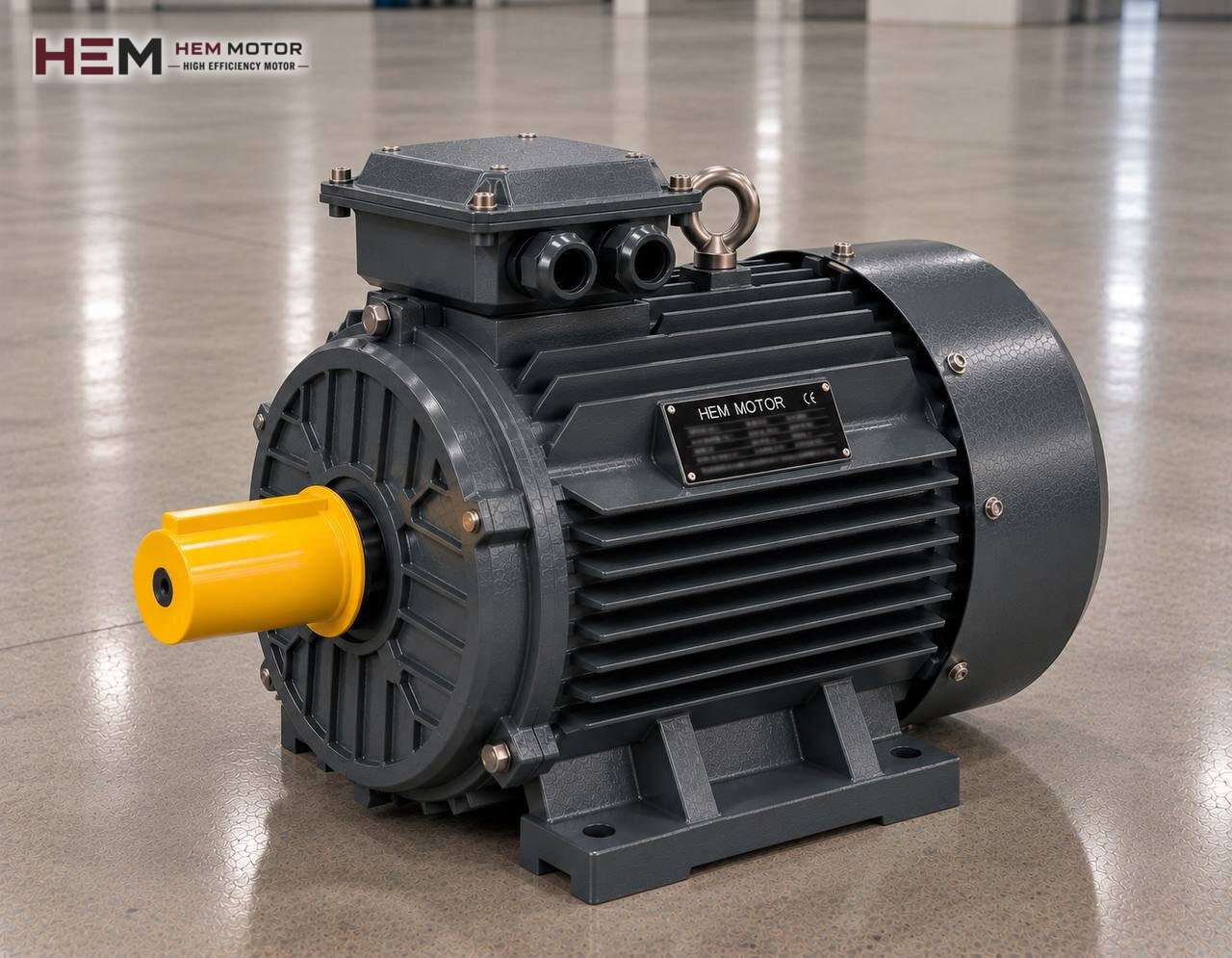
HEM Motor series come with IP55 protection and class F insulation; for points washed directly with a hose, IP56 can be requested as a special order. Areas in direct contact with food or subject to hygienic design requirements need a special motor with a stainless frame; this duty may fall outside the standard series in the 2026 catalogue, so consult us with the application information. The hygienic zone is handled separately.
| Check | What it means in a dairy | To state in the order |
|---|---|---|
| Washing level | CIP, daily hose cleaning, caustic vapour | IP55 standard; IP56 special order for direct washing |
| Ambient temperature | Cold room, refrigeration plant, boiler room | Ambient condition, need for anti-condensation heater |
| Load type | High pressure on the homogeniser, continuous light load on the tank agitator | Shaft power, starting condition, running time |
| Mounting | Vertical agitator on tank, foot-mounted pump, flanged gearbox | Mounting type such as B3, B5, B35 or V1 |
| Speed control | Pump with adjustable flow, filling line conveyor | Drive use, low-speed duration, cable length |
How are power and starting determined on the homogeniser and separator?
On the homogeniser the power follows the highest operating pressure; on the separator the protection setting follows the long starting time.
The homogeniser is a piston pump that forces milk through a narrow gap at very high pressure, and it carries one of the largest motors in the plant. The motor turns the crankshaft via a belt pulley; the load changes with the pressure setting. The motor power should therefore be selected according to the machine manufacturer's value at the highest operating pressure. Higher pressure means higher load.
The separator needs a long starting time as it brings its heavy bowl from standstill to operating speed. During this time the motor current stays high, and the protective devices must be set accordingly. With star-delta starting the torque drops to about one third, so the starting time may become even longer; this is general knowledge, confirm with the machine manufacturer. The protection setting decides here.
How is the motor chosen for the milk pump, CIP pump and tank agitator?
Pumps use two-pole motors grouped in the same power and frame, while agitators use vertically mounted geared drives.
Milk transfer pumps and CIP supply pumps are usually 2-pole centrifugal pumps and form the most numerous motor group in the plant. Grouping them in the same power and frame makes spare holding and replacement after a failure easier. Series for pump drives are listed on the pump electric motors page. Fewer types mean faster swaps.
Agitators in storage and ripening tanks are low-power, low-speed geared drives that often stand vertically on top of the tank lid. These motors may be mounted vertically, such as V1; the mounting type is offered according to frame and the flange dimension is confirmed in the order. When buying a replacement for an existing motor, the shaft dimensions, foot or flange connection and the electrical values on the nameplate should be compared together with the IEC frame number. The frame number alone is not enough.