An IP55 electric motor has a frame that is dust-protected and resistant to water jets from any direction. It is sufficient for closed workshops, dusty production areas, covered outdoor installations and most sites exposed to rain. The places where you should consider IP56 are environments where the motor faces powerful water jets, water arriving like waves, or frequent and intensive washing.
In HEM Motor three-phase asynchronous series the degree of protection is IP55 as standard; IP56 is an option that can be requested when ordering. In this article we look at what the code says, the limits of IP55 and how to keep the protection intact on site.
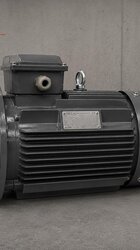
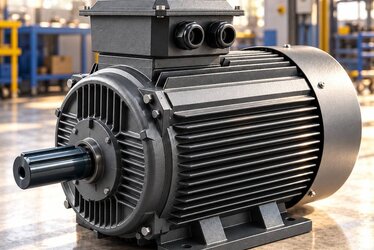
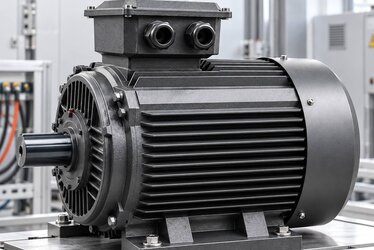
Three-phase motor in a dusty production area (representative image).
What do the two digits of the IP code mean?
For rotating electrical machines the degree of protection is defined in IEC 60034-5. The first digit after the letters IP indicates protection against solid objects and dust, the second against water. The higher the digit, the higher the protection, but the two digits are independent: a motor that is good against dust does not have to be equally good against water.
First digit 5 (dust-protected): Dust is not considered fully excluded from the frame; however, the amount that enters does not reach a level that impairs safe operation or the insulation.
Second digit 5: A water jet directed at the frame from any direction has no harmful effect.
Second digit 6: Provides protection against more powerful water jets and water arriving in waves.
So the difference between IP55 and IP56 is on the water side, not the dust side. If your problem is dust, IP56 on its own brings no solution.
In which environments is IP55 sufficient?
The vast majority of motors in industry run without problems at IP55. Typical examples are:
Closed factories and workshops, including areas with a dust load such as flour, feed, wood shavings or stone dust.
Outdoor installations covered by a canopy: compressor rooms, pump stations, conveyor lines.
Outdoor motors that occasionally get rain but are not constantly sprayed with water.
Machines cleaned briefly with a hose at low pressure.
In these environments the decisive factor is often not the IP class but installation and maintenance. An IP55 motor with a clogged fan cover heats up much sooner than the same motor kept clean, because a totally enclosed motor rejects its heat through the finned surface using air from the external fan.
What does IP55 not cover?
The IP class is not a label that solves everything. An IP55 motor is not designed for the following situations:
Running underwater or being submerged: In pit pump stations at risk of flooding, the motor must be kept above water level. Submersible applications require a separate motor type.
Washing with high-pressure and hot water: The lance of a pressure washer forces the seals. Such hygiene wash-down areas are not within the scope of the standard series in the 2026 catalogue; describe the application and ask us.
Explosive atmospheres: Gas or combustible dust zones are handled not by IP class but by a separate classification; a standard motor is not used for this purpose.
Chemical and salty air: The IP class concerns water entering, not corrosion. For coastal sites and chemical vapour, paint and fasteners are discussed separately.
When is IP56 needed?
The situations in which you should consider IP56 relate to the force and frequency of the water:
Places exposed to waves and splashing water, such as ship decks, piers or quays.
Lines washed with a powerful hose at the end of every shift; for example around the mixer of a concrete plant or stone washing screens.
Installations in irrigation fields where sprinkler heads spray directly onto the motor.
Roofless high platforms that get horizontal rain driven by wind.
When deciding, the question "does the motor get wet?" is not enough; ask "how, with what force and how often does water reach the motor?". If you are undecided, describe the environment in a few sentences and ask about the IP56 option when ordering. You can review suitable HEM Motor models and current prices in the online store.
Prices and technical data are on the product pages; choose a model and order online.
A motor that leaves the factory as IP55 can lose this protection through small mistakes during installation. Points to watch:
Terminal box and cable gland
The cable gland must suit the outer diameter of the cable, and its seal must grip the cable fully. Unused cable entries are closed with blanking plugs. After connection, the terminal box cover is closed with its gasket in place and its bolts tightened in a crosswise sequence. If the cover gasket is crushed or torn, it is replaced.
Mounting orientation and cable loop
The cable should enter the gland not from above but from below, forming a "drip loop"; this way water running along the cable drips to the ground instead of into the gland. A gland mouth facing upwards channels rainwater straight into the terminal box.
Condensation and drainage
In outdoor areas with large day-night temperature differences and in motors that stand idle for long periods, condensation can form inside the frame. On designs with a condensate drain hole in the frame, this hole must be at the lowest point for the mounting orientation. Mounting the motor in an orientation different from the one specified when ordering can leave the hole at the top. For installations with long idle periods, state the measure to be taken against condensation when ordering.
Vertical mounting
On vertical motors with the shaft facing down, the fan cover is at the top, and rain, leaves or dust fall straight into the air intake. In this case whether a protective canopy is needed for the fan cover is discussed when ordering. For details, see the vertical mounting V1/V5 article.
Hypothetical example: an outdoor irrigation pump
Imagine a 7.5 kW pump motor running in a pump station covered by a sheet-metal canopy on a farm. Rain occasionally reaches the motor from the sides, but there is no direct water jet. In this installation IP55 is sufficient; what needs to be done is to position the gland facing downwards and give the cable a drip loop. As an example model, the 132M-4 cast iron frame motor, 7.5 kW, rated 1,460 rpm, 400/690 V (Δ/Y), is suitable.
Suppose the same farm has a second pump onto which one of the sprinkler heads sprays directly. There are two options here: move the motor out of the spray angle or request the IP56 option when ordering. The first option is often simpler and more permanent. Other models for agricultural applications are on the agricultural machinery electric motors page.
Conclusion: describe the environment when ordering
IP55 is the right standard for most dusty and humid environments in industry; IP56 is for places that see powerful water jets and waves. Neither covers running underwater, pressurised hot washing or explosive atmospheres. Keeping the protection on site depends on the gland, seals, cable direction and mounting orientation.
Example models: 112M-4 (4 kW, 1,450 rpm, cast iron), 132M-4 (7.5 kW, 1,460 rpm) and 160M-4 (11 kW, 1,465 rpm). Review suitable models and current prices on the buy electric motors page. Send a photo of your existing motor's nameplate, its speed, mounting details and a short description of the environment via the nameplate submission page and request a quote for the right model.
Frequently Asked Questions
Can an IP55 motor run outdoors in the rain?
Yes, IP55 is sufficient for most outdoor installations exposed to rain. It is important that the gland faces downwards, the cable has a drip loop and, in vertical mounting, the fan cover is protected.
Can an IP56 motor withstand pressure washing?
IP56 provides protection against powerful water jets; hygiene washing with high-pressure and hot water is a separate matter. For such areas, describe the application and ask us.
Is it better to choose IP56 in a dusty environment?
No; the first digit of IP55 and IP56 is the same, the difference is only in water protection. In a dusty environment what really matters is keeping the fan cover and the finned frame clean.
Where is the IP class shown on the motor nameplate?
The IP class appears on the motor nameplate alongside voltage, current and insulation class information. On HEM Motor three-phase series you will see IP55 and insulation class F on the nameplate.
HEM Motor Models Related to This Article
The cards show example models related to the topic. A suitable motor is not chosen by power alone: compare speed, voltage, mounting, shaft and connection dimensions on the product page; if unsure, send a photo of the existing motor’s nameplate on WhatsApp.
The IEC frame number gives the height from the motor's foot base to the shaft centre in millimetres. In the HEM Motor sales range, the small frames between 63 and 112 mostly carry ... More Details
When replacing a motor in a tight installation space, the same IEC frame code alone is not a sufficient guarantee. The frame code defines shaft height, foot hole spacing and shaft ... More Details
When replacing a car lift motor, two checks cause more trouble than power and speed: how the hydraulic pump is attached to the motor and the duty regime in which the lift runs the ... More Details
When the motor of a press brake's hydraulic unit is replaced, flange and coupling compatibility is checked at three points: the new motor's flange must seat in the spigot recess an... More Details
On many machines that have run for years, the belt-and-pulley arrangement is questioned because of its maintenance burden: the belt stretches, needs re-tensioning, the pulley groov... More Details
When the motor of a geared drive fails, the gearbox is usually sound and stays in place; only the motor is replaced. In that case the new motor has to match two things at once: the... More Details
We use necessary and optional cookies to improve your experience, enhance content and analyse traffic. Under the GDPR, optional (analytics/marketing) cookies are only used with your explicit consent. Please choose your preference below.
Cookie Policy
 English
 Français
 Türkçe
 Español
 Русский