The Hz value on an electric motor nameplate states the supply frequency the motor was designed for, and it directly sets the shaft speed. When the same winding is fed at a different frequency, speed, torque, current and cooling all change together, so the 50 Hz on the plate is an operating condition that has to be read together with the voltage.
How is frequency linked to synchronous speed?
Synchronous speed is directly proportional to frequency and inversely proportional to the number of pole pairs. In every supply period the rotating field in the stator advances by one pole pair. The formula is written like this:
ns = 120 × f / p
Here ns is the synchronous speed per minute, f the frequency in hertz and p the number of poles. At 50 Hz a 2-pole winding gives 3000, a 4-pole 1500 and a 6-pole 1000 rpm synchronous speed (general information; confirm with the machine manufacturer).
The real speed at the shaft never quite reaches that synchronous value.
For current to be induced in the rotor bars, a small speed difference between the field and the rotor is needed, which is called slip. Figures such as 1445 or 2895 on the plate are the rated speed with that slip deducted and are measured at full load; on a motor running unloaded, a tachometer shows a value very close to synchronous speed.
Why are the Hz and V values on the plate read together?
Because the magnetic flux of the winding is set by the ratio of voltage to frequency, and the motor is calculated for that ratio. If frequency drops while voltage stays the same, flux rises, the lamination stack approaches saturation and no-load current climbs noticeably. If frequency goes up with unchanged voltage, flux weakens; the motor draws more current to carry the same load and starting torque falls.
On site the practical meaning is simple. A motor whose plate reads 230/400 V and 50 Hz delivers its rated values at that voltage and that frequency. Once either half of the pair changes, the current, speed and efficiency on the plate no longer describe that condition.
What happens to torque, current and cooling when frequency changes?
If voltage is changed in the same proportion as frequency, torque capability is roughly kept, while power rises or falls with speed. This is the basic operating principle of frequency converters: below rated frequency the voltage/frequency ratio is held constant and the motor turns with approximately constant torque.
Above rated frequency the picture changes. The drive cannot raise its output voltage above the supply voltage, so flux weakens; speed increases while available torque falls in inverse proportion to frequency. This region is called "field weakening" and shaft power stays roughly constant.
Cooling is the part most often forgotten. The fan on the frame is mounted on the shaft and its airflow drops with speed. A motor running for long periods at low frequency with full torque heats up even when its current is at the rated value; instead of touching the frame by hand, use an infrared thermometer and measure the fan cover side and the frame next to the terminal box at the same time.
Our three-phase series are suitable for speed control with a frequency converter; for long periods at low speed with full torque an external fan may be needed; if the drive-to-motor cable is long, a dv/dt or sine filter is considered; these conditions are stated with the order.
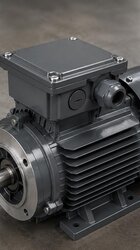
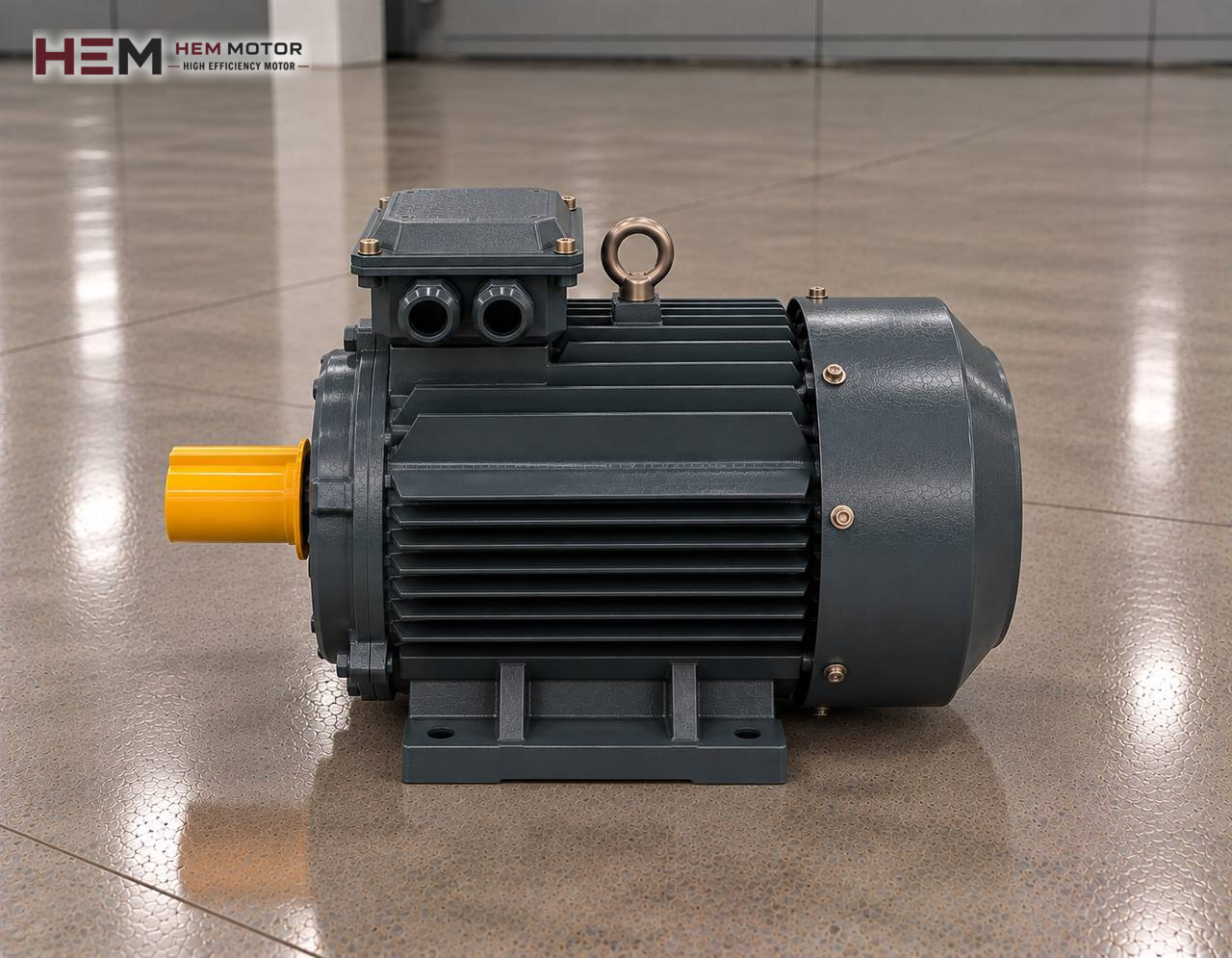
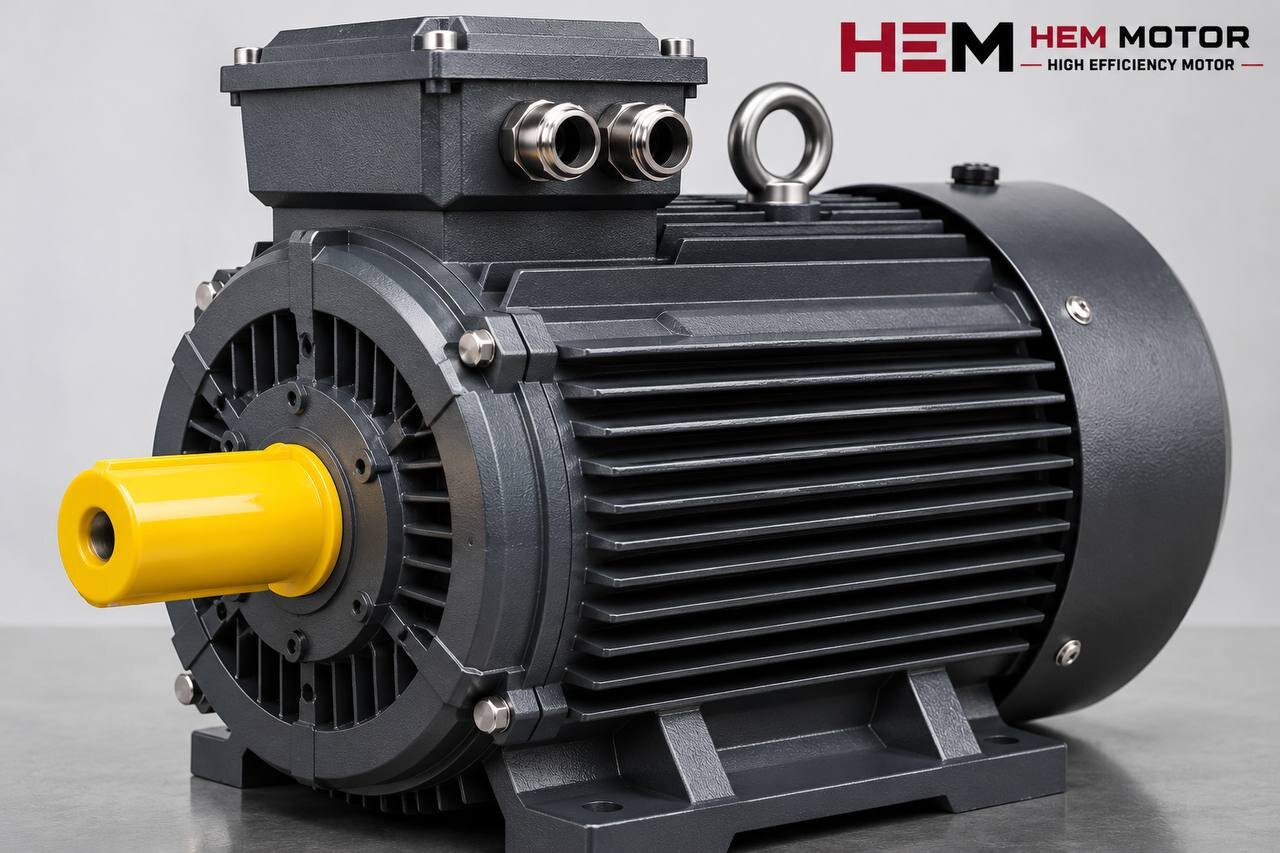
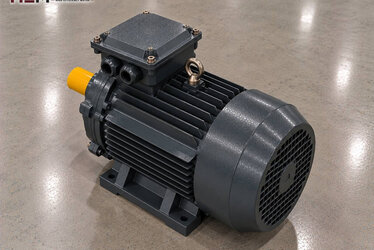
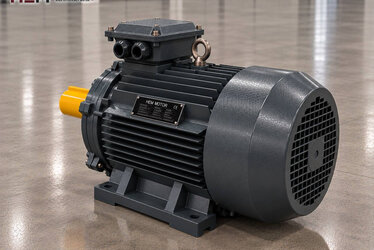
The frequency and voltage on the plate show under which supply condition the motor delivers its rated values (representative image).
Prices and technical data are on the product pages; choose a model and order online.
How can a frequency-related problem be identified on site?
The first job is to measure which frequency the supply really has. With motors fed straight from the grid this is rarely in question; on building sites, in fields or in standby power applications running on a generator, the generator speed moves with load and frequency drifts.
A multimeter with a frequency function or a power analyser is enough for the measurement. Connect it between two phases in the terminal box and take a reading first at no load, then with the machine under load. If the generator loses frequency noticeably under load, motor speed drops by the same ratio and the pump pressure, conveyor speed or fan airflow lags behind what was expected.
Observation
Possible frequency link
Check
Speed clearly below the plate value, current high
Generator loses frequency under load
Read frequency and voltage at the same time under load
No-load current above the usual level, frame heats without load
Voltage/frequency ratio high, over-magnetisation
Compare rated voltage and frequency in the drive parameters with the plate
Heating at low speed, normal at high speed
Fan airflow has dropped with speed
Record running time and speed profile, consider an external fan
Motor cannot carry the load at high speed
Torque drop in the field weakening region
Calculate required torque against available torque at that frequency
A common mistake in drive systems is not entering the nameplate values into the motor parameter menu of the drive. A rated frequency or rated voltage left at factory setting runs the motor with the wrong flux from day one.
What should be known before use on a supply with a different frequency?
If the motor will run on a supply whose frequency differs from the plate, say so at the order stage. A motor fitted to a machine that will be shipped abroad is the most typical case. When frequency changes, speed changes, and the pulley ratio or gearbox of the machine is recalculated accordingly.
The standard HEM Motor series is for 50 Hz. Another frequency is optional; speed, current and torque differ slightly from 50 Hz, please state it with the order. All models rated at 50 Hz are listed by power and speed on the buy electric motors page.
For the compatibility check, voltage, frequency, connection (Δ/Y) from the plate and the speed the machine requires are written into the same table; the engineer preparing the electrical design selects the protective devices on the basis of these values.
What does a different pole number change at the same power?
On a 50 Hz supply the pole number divides the speed given by frequency: at the same kW, more poles mean lower speed and higher rated torque. The three cast iron models below show this difference at 1.5 kW; all of them carry a 230/400 V (Δ/Y), 50 Hz plate.
90S-2: 1.5 kW, 2895 rpm, 4.95 Nm. For machines that want high speed, such as fans and centrifugal pumps.
90L-4: 1.5 kW, 1445 rpm, 9.91 Nm. The speed seen most often on conveyors, mixers and geared drives.
100L-6: 1.5 kW, 949 rpm, 15.1 Nm. Where a lower shaft speed and higher torque are needed.
Although power is identical in all three models, torque changes roughly in inverse proportion to speed: T = 9550 × P / n. Once you know which speed and torque you are looking for, you can filter the list in the electric motor store by frame and pole number. The series is offered in IE3, IE4 and IE5 efficiency classes; which class is available for a given model is confirmed with the order. Other ratings of the same family are on the asynchronous electric motors page.
If the plate of your motor shows a different frequency or an unusual voltage pair, send a sharp photo of the plate and the shaft speed your machine needs through the find an equivalent from the nameplate page; we will work out the effect of the frequency difference on speed together. For prices and frame options you can also check the HEM Motor sales list.
Frequently Asked Questions
If the plate only says 50 Hz, can the motor be sped up with a drive?
For short periods and to a limited extent it is possible, but above rated frequency torque drops and bearing and balance limits come into play. Target speed and required torque should be checked with the machine manufacturer.
Why does the speed of a generator-fed motor fluctuate?
Generator frequency depends on engine speed and moves briefly as load changes. Because the speed of an asynchronous motor follows that frequency, speed oscillation appears at the machine.
Is the gap between rated and synchronous speed a fault?
No; that gap is slip and is needed for torque to develop. Slip grows as load rises, and the speed on the plate shows the full-load value.
What happens if the plate frequency is not entered in the drive menu?
The drive may feed the motor with the wrong voltage/frequency ratio. The result is either over-magnetisation and heating or low torque and frequent overcurrent alarms.
HEM Motor Models Related to This Article
The cards show example models related to the topic. A suitable motor is not chosen by power alone: compare speed, voltage, mounting, shaft and connection dimensions on the product page; if unsure, send a photo of the existing motor’s nameplate on WhatsApp.
In compact electric motor selection, power density shows how small a frame the same kilowatts are taken from; cooling area is the outer surface through which that frame can shed he... More Details
An aluminium frame is a sound choice for drives with low vibration, coupling alignment or moderate pulley load, no shocks and a flat base. Where small pulleys put a large radial lo... More Details
IEC and NEMA nameplates are not compared directly but field by field after translation: power from HP to kW, protection from enclosure type to IP code, while efficiency class and s... More Details
IP55 protection is enough in most cases for an electric motor working outdoors, provided the motor does not take rain directly, condensation water can drain from the frame, and the... More Details
Class F insulation means the winding materials are chosen to withstand up to 155 °C; Class B temperature rise means that at rated load the motor's winding rises no more than 80 K a... More Details
No, they are not the same thing. The insulation class defines the thermal ceiling of the insulating material around the winding; the permitted ambient temperature shows how warm th... More Details
We use necessary and optional cookies to improve your experience, enhance content and analyse traffic. Under the GDPR, optional (analytics/marketing) cookies are only used with your explicit consent. Please choose your preference below.
Cookie Policy
 English
 Français
 Türkçe
 Español
 Русский
 العربية
 Deutsch
 Italiano