A three-phase electric motor starts on the rotating field that a three-phase supply creates by itself; a single-phase electric motor cannot build a rotating field with one winding, so it needs an auxiliary winding and a capacitor. Most of the practical differences grow from this: power range, current at the same output, starting torque, vibration, failure points and speed control.
Why can a single-phase electric motor not start on its own?
A supply taken between one phase and neutral produces a magnetic field in the stator that does not rotate; it simply grows and shrinks in place. That field pulls the rotor equally in both directions. Result: a stationary rotor does not move, it only hums.
The fix is a second winding displaced from the main one, plus a capacitor that shifts the current in that winding forward. Together they build an artificial rotating field. In capacitor-start types a centrifugal switch or a relay takes the start capacitor out of circuit once speed rises; in permanent split capacitor types a single capacitor stays connected for the whole run.
A three-phase winding has no such helper. The 120-degree time shift between the three phases already creates the rotating field, and the machine starts without any extra parts.
Why is the current of two motors of equal power so different?
Because a single-phase unit draws its power over two conductors and from a lower voltage, at the same shaft power it pulls several times the current of a three-phase unit. In the formulas the difference is a single factor:
Single-phase: I = P / (U × η × cosφ) · Three-phase: I = P / (√3 × U × η × cosφ)
For a hypothetical example, take efficiency and power factor as 0.8 for both machines. A shaft power of 1.5 kW on a 220 V single-phase supply comes to roughly 1500 / (220 × 0.64) ≈ 10.7 A. On a 400 V three-phase supply the same power gives 1500 / (1.732 × 400 × 0.64) ≈ 3.4 A. Real values are read from the nameplate; these rough assumptions only show the ratio (general information; confirm with the machine manufacturer).
Such a high current directly affects the choice of cable, contactor and protective device. Cross-section and protection rating are calculated by the electrical engineer who prepares the panel design, together with line length, voltage drop, installation method and ambient temperature.
How do starting torque and running behaviour change?
On a three-phase machine starting torque comes from the winding design and does not depend on a capacitor. On a capacitor motor, that capacitor arrangement is the main factor that sets starting torque.
A permanent split capacitor single-phase motor runs comfortably on light-start loads such as a fan or a centrifugal pump, yet it may struggle to break away a full screw conveyor or a piston compressor waiting under pressure. Capacitor-start designs exist to close this gap. When capacitance falls over time, the first sign is a motor that growls under load for a few seconds and starts late.
Running behaviour differs too. Torque in a two-winding motor pulses every cycle; a technician who rests a hand on the housing feels clearly more vibration than on a three-phase unit. In sensitive drives this vibration shows up in coupling and bearing life.
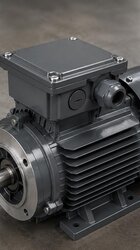
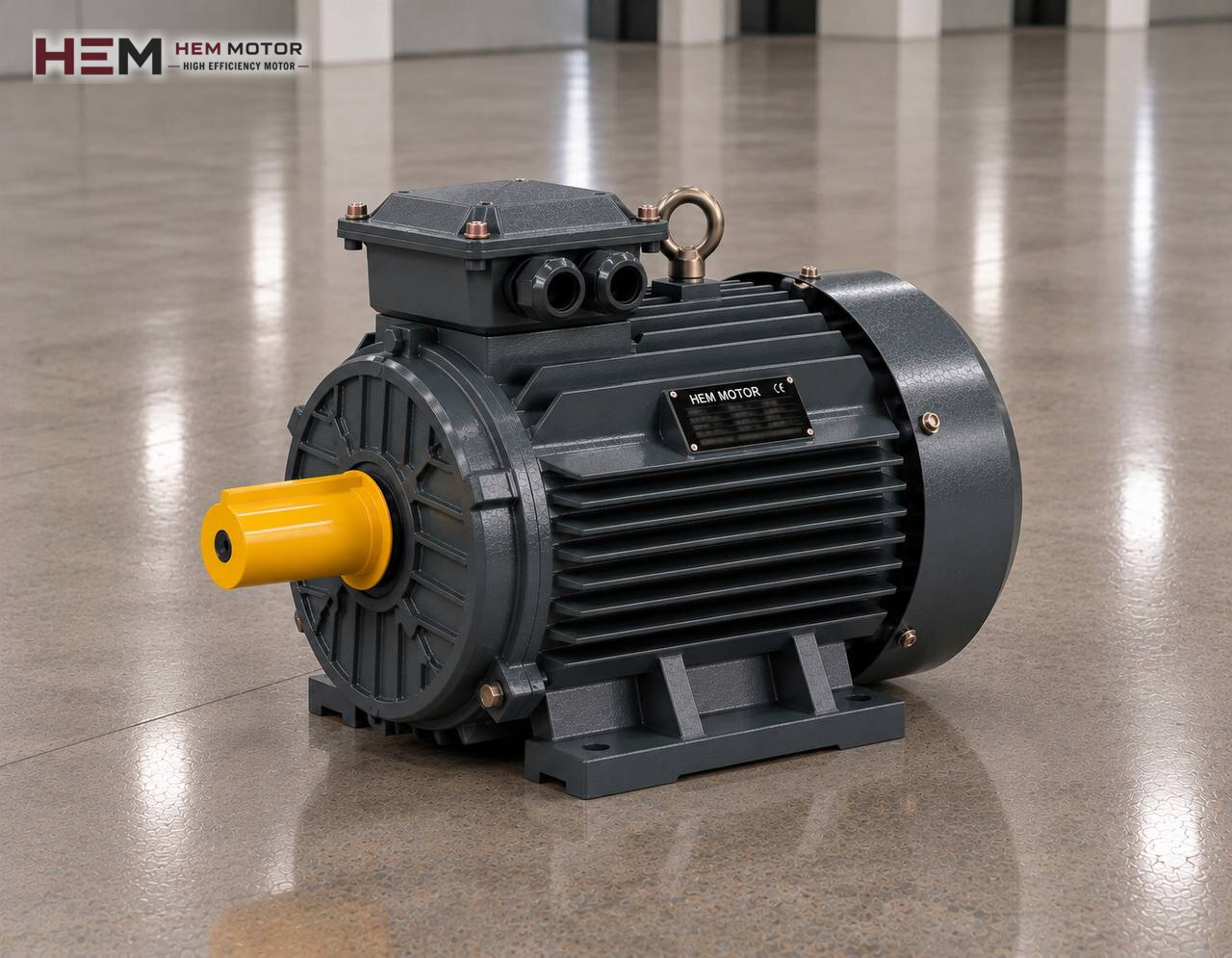
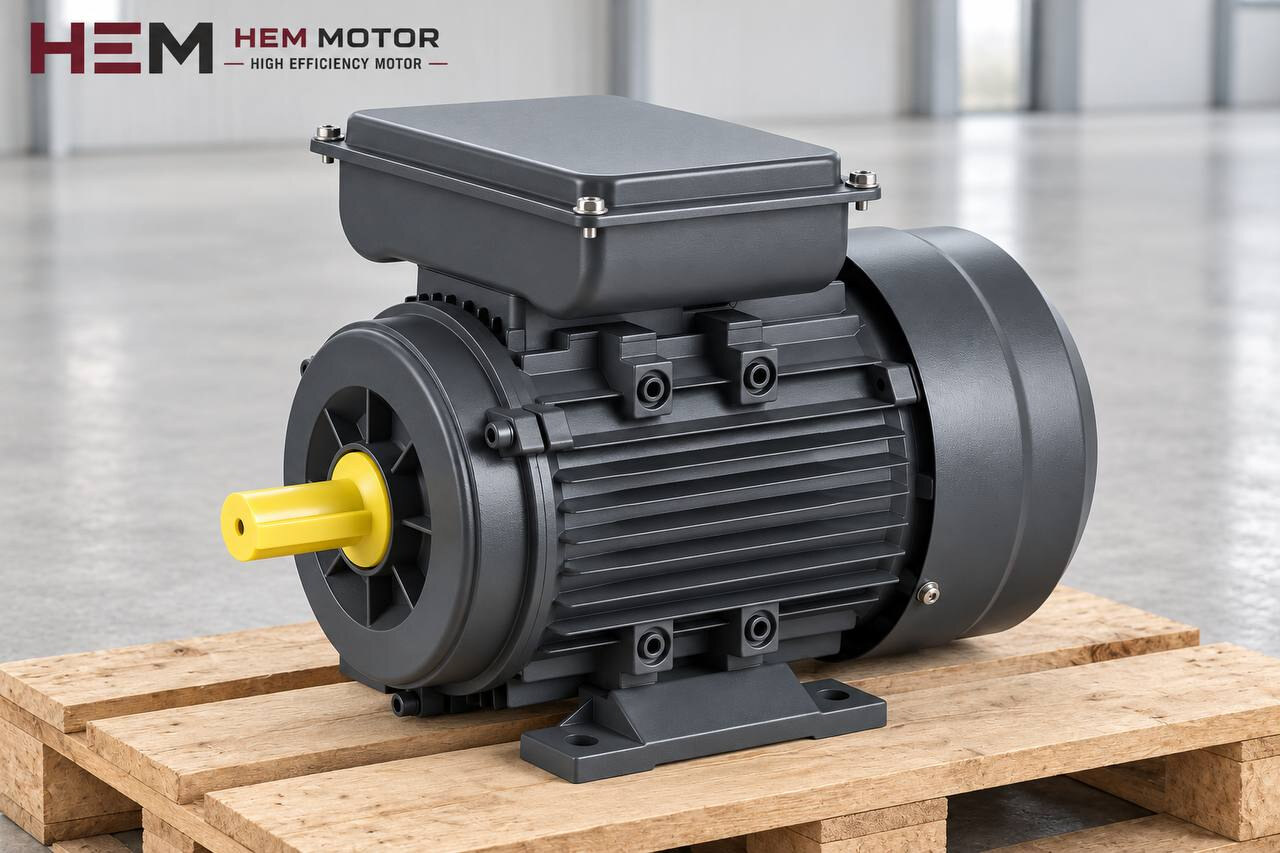
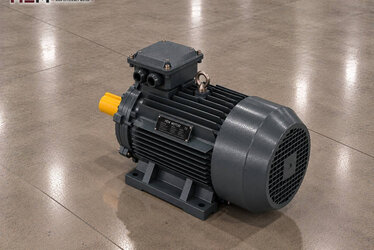
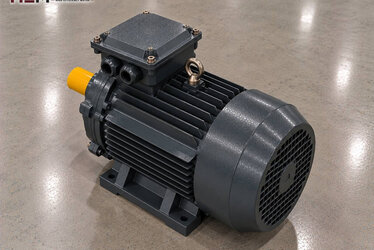
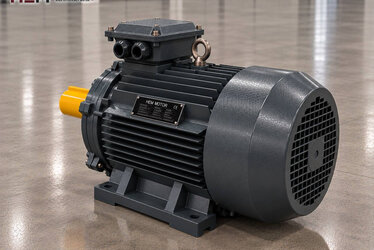
On single-phase electric motors the capacitor box is visible as a separate part on the housing (representative image).
Comparison table: which feature sits on which side?
Feature
Three-phase electric motor
Single-phase electric motor
Supply
Three-phase grid, 230/400 V or 400/690 V depending on model
220 V single-phase grid
HEM Motor power range
0.25–355 kW
0.18–5.5 kW
Starting arrangement
No extra parts; star/delta or soft starter at higher ratings
Auxiliary winding and capacitor; centrifugal switch on some types
Reversing direction
Swap any two phases
Reverse the auxiliary winding leads as shown on the terminal diagram
Current at equal power
Low
Clearly higher
Common failure point
Phase loss, bearings, winding insulation
Capacitor, centrifugal switch, bearings
Speed control with a frequency inverter
Suitable; conditions are stated with the order
Usually not suitable with standard drives
Prices and technical data are on the product pages; choose a model and order online.
Which faults show up more often on which type in the field?
On single-phase motors the capacitor tops the list of complaints. If the motor hums but does not turn, and starts once the shaft is nudged by hand, check the capacitor first. With power isolated, discharge it through a resistor, measure it on the capacitance range of a multimeter and compare with the printed value: a few minutes' work. A swollen or oil-leaking capacitor makes measuring unnecessary.
On the three-phase side the most insidious problem is phase loss. A running machine keeps turning on two phases, its sound deepens, current climbs and, unless the thermal overload relay is set correctly, the winding can be damaged by heat within a few hours. Reading the current of each phase separately with a clamp meter reveals it at once.
A stopped three-phase unit with a missing phase will not start at all.
When is three-phase chosen, and when single-phase?
If the site has a three-phase supply and the power exceeds a few kilowatts, the choice is almost always a three-phase electric motor. Single-phase makes sense where three phases cannot be brought in: a small workshop next to a village house, a garden irrigation pump, a small booster set or a shop machine on a single-phase connection. On the three-phase side, power and speed steps starting at 0.25 kW are listed on the store page.
A sensible order for the decision: measure the supply type on site first, then define the shaft power and starting load of the machine. If speed adjustment is needed, write that down from the start as well. For anyone wanting to run a three-phase motor on a single-phase line there are frequency inverters with single-phase input and three-phase output; in that case a small three-phase motor rated 230/400 V is connected in delta. Input current of the drive and capacity of the line must be checked separately (general information; confirm with the drive manufacturer's manual).
Our three-phase series are suitable for speed control with a frequency inverter; for long periods at low speed with full torque an external fan may be needed; if the drive-to-motor cable is long, a dv/dt or sine filter is considered; these conditions are stated with the order.
What should be checked before replacing an old single-phase motor with a three-phase one?
First, confirm that the supply really carries three phases; seeing three phases in the panel is not enough, so measure phase-to-phase voltage. Next, match the power, speed and mounting of the old nameplate with the new model. Frame number is the first clue to fit. For a definite fit, compare shaft diameter, flange and foot hole spacing on the technical drawings.
Small drives in the 1500 rpm class are a typical replacement case. In HEM Motor's aluminium-frame series, three steps suit the job: 80M2-4 (0.75 kW, 1420 rpm, 1.75 A at 400 V), 90S-4 (1.1 kW, 1445 rpm, 2.48 A) and 90L-4 (1.5 kW, 1445 rpm, 3.30 A). All three are 230/400 V, IP55, with class F insulation.
If you still need a single-phase motor, the right frame and capacitor arrangement for models in the 0.18–5.5 kW range is settled with the order. All frames of the three-phase family are collected on the asynchronous electric motors page.
Not sure which type to move to? Send us the old nameplate and the supply details from your panel through the contact page, and we will work out the match for your grid and load together. Prices and current options are open in the HEM Motor product list.
Frequently Asked Questions
Can a single-phase motor be connected to a three-phase grid?
A 220 V single-phase motor can run when connected between one phase of the three-phase grid and neutral. Connecting it between two phases applies excess voltage to the winding and burns the motor.
Can a three-phase motor run on a single-phase line with a capacitor?
At small ratings it can be turned with a capacitor connection, but it cannot deliver its nameplate power and may overheat. For a lasting solution a drive with single-phase input or a proper single-phase motor is preferred.
If the capacitor of a single-phase motor fails, which value should be fitted?
Use the capacitance and voltage printed on the old capacitor or the value on the motor nameplate. Fitting a different capacitance changes starting behaviour and winding temperature.
How is the direction of rotation of a three-phase motor changed?
With power off, swap any two of the three phases arriving at the terminal box. On direction-sensitive machines such as pumps and fans, confirm the direction with a short run after the change.
HEM Motor Models Related to This Article
The cards show example models related to the topic. A suitable motor is not chosen by power alone: compare speed, voltage, mounting, shaft and connection dimensions on the product page; if unsure, send a photo of the existing motor’s nameplate on WhatsApp.
In compact electric motor selection, power density shows how small a frame the same kilowatts are taken from; cooling area is the outer surface through which that frame can shed he... More Details
An aluminium frame is a sound choice for drives with low vibration, coupling alignment or moderate pulley load, no shocks and a flat base. Where small pulleys put a large radial lo... More Details
IEC and NEMA nameplates are not compared directly but field by field after translation: power from HP to kW, protection from enclosure type to IP code, while efficiency class and s... More Details
IP55 protection is enough in most cases for an electric motor working outdoors, provided the motor does not take rain directly, condensation water can drain from the frame, and the... More Details
Class F insulation means the winding materials are chosen to withstand up to 155 °C; Class B temperature rise means that at rated load the motor's winding rises no more than 80 K a... More Details
No, they are not the same thing. The insulation class defines the thermal ceiling of the insulating material around the winding; the permitted ambient temperature shows how warm th... More Details
We use necessary and optional cookies to improve your experience, enhance content and analyse traffic. Under the GDPR, optional (analytics/marketing) cookies are only used with your explicit consent. Please choose your preference below.
Cookie Policy
 English
 Français
 Türkçe
 Español
 Русский
 العربية
 Deutsch
 Italiano