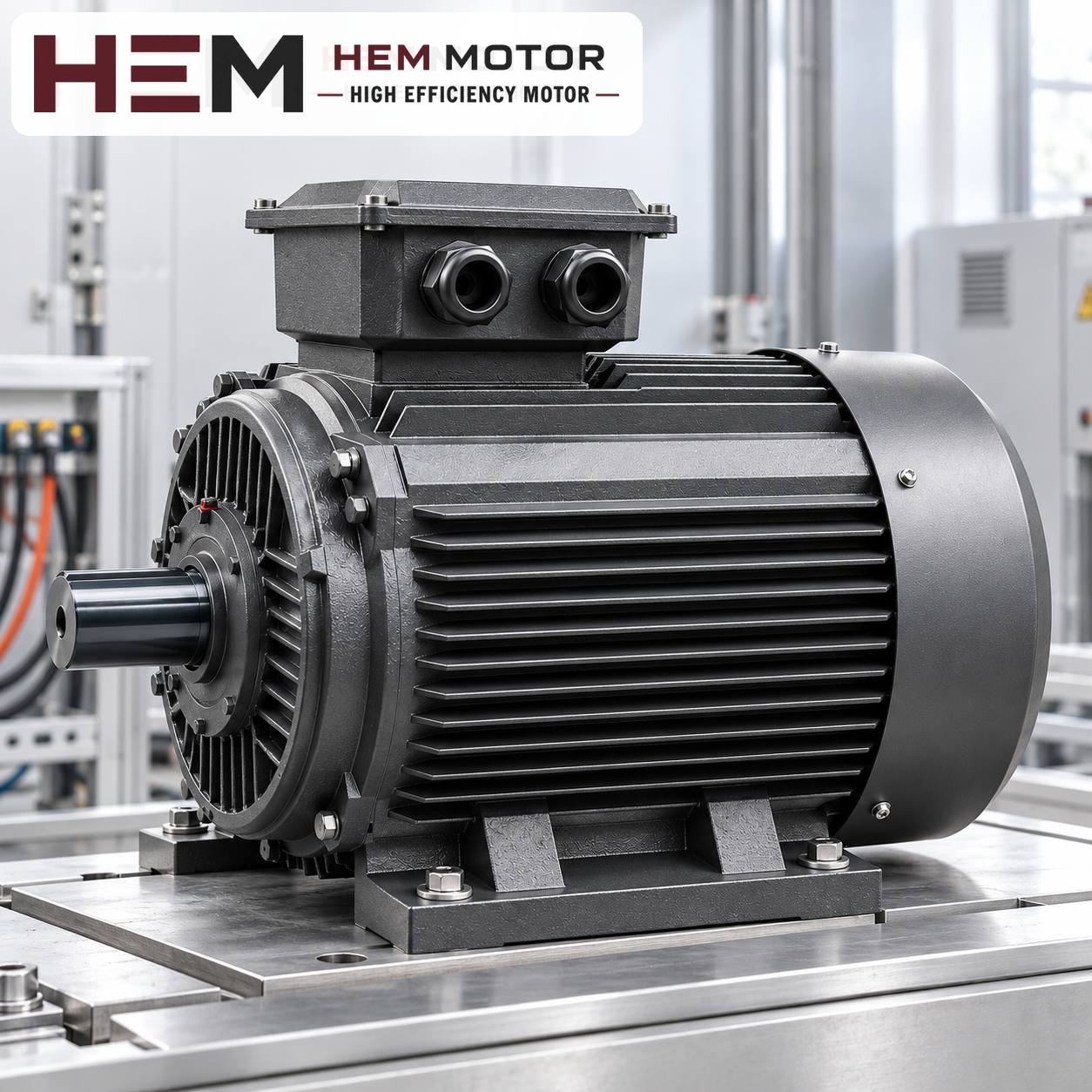
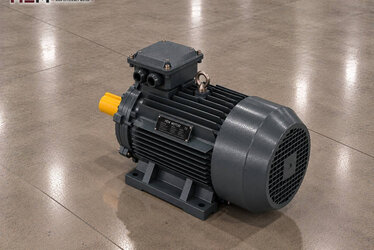
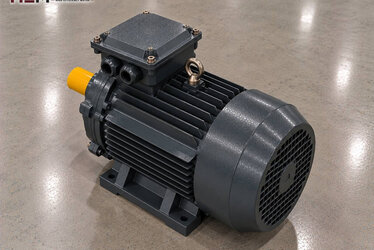
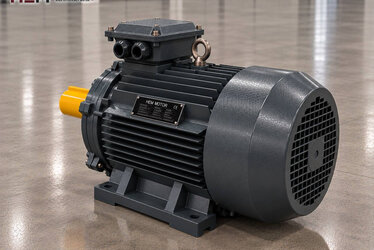
What separates S1 from S3 is whether the electric motor reaches thermal equilibrium within a running period: in S1 the motor runs at constant load long enough for its temperature to stop rising, while in S3 short running and rest periods repeat in a regular cycle and the motor never reaches equilibrium in any of them. If a nameplate says S3, it always carries a percentage next to it (e.g. S3 40%).
How does IEC 60034-1 classify duty types?
The standard labels duty types from S1 to S10 according to how the load changes over time and how that change affects winding temperature. The codes do not describe the motor's "power" but the time pattern in which it can deliver that power.
S1 is continuous duty. S2 defines short-time duty (e.g. S2 30 min); the motor starts cold, stops when the time is up and rests until it is back at ambient temperature. S3 is intermittent periodic duty, and the thermal effect of the starting current is neglected. S4 and S5 add the effect of starting and electrical braking to the same pattern, while S6 describes operation where the motor never stops but loaded and no-load periods alternate (general information; confirm with the current edition of the standard).
On the purchasing side, the pair most often confused is S1 and S3.
What does the percentage on an S3 nameplate mean?
The percentage is the ratio of loaded running time within one cycle to the total cycle time; it is called the cyclic duration factor, or ED from the German abbreviation. Standard values are 15%, 25%, 40% and 60%, and unless stated otherwise the cycle time is taken as 10 minutes.
The formula is:
ED (%) = tload / (tload + trest) × 100
A motor marked S3 40% is designed to run for 4 minutes at rated load and stand still for 6 minutes in a 10-minute cycle. Running the same motor continuously takes the winding to a hotter point than its insulation class allows. Conversely, using an S1 motor on intermittent work causes no problem; it may simply be larger than needed.
How can you tell on site whether a duty is S1 or S3?
Measuring the machine's real operating pattern with a stopwatch or a PLC log gives a more accurate result than trusting the catalogue or habit. Three pieces of information are needed: loaded time, rest time and the number of starts per hour.
Record the pick-up and drop-out moments of the contactor from the PLC, or with a logging clamp meter, for at least one shift.
On the current graph, separate the load periods (where current approaches the nameplate value) from the idle periods; if the motor is turning but current is low, that period is not rest but no-load running.
Find the length of one cycle and the loaded time within it, then calculate ED.
Note the number of starts per hour. If it is high, the duty moves from S3 towards S4 and the thermal effect of the starting current has to be included.
If the cycle is much longer than 10 minutes, for example 40 minutes running and 20 minutes stopped, the motor heats up substantially during the load period; in practice this pattern is treated like S1.
Holding a contact thermometer or a thermal camera on the motor frame during the recording also points the way. In S3 duty the frame temperature rises and falls like a saw tooth. In continuous work it climbs for the first hour or two, then stays on a flat line.
Hypothetical example: feed conveyor of a moulding press
Suppose the feed belt of a press runs for 90 seconds before each stroke and then waits for 135 seconds. The cycle is 225 seconds, ED = 90 / 225 × 100 = 40%. Starts come to about 16 per hour, which is not high. This pattern fits the S3 40% definition.
The picture changes if the same belt runs for 45 minutes without stopping at the end of a shift to clear stock. Those 45 minutes are enough for the motor to approach thermal equilibrium; the selection should be made for S1. This is the detail most often missed on site: the normal production pattern looks like S3, but a weekly cleaning or clearing job actually runs the motor continuously.
The duty pattern is identified by recording current and frame temperature together (representative image).
Prices and technical data are on the product pages; choose a model and order online.
When the motor never stops but the load changes from period to period, the equivalent power method is used for continuous duty. Since heat in the winding is proportional to the square of current, the root mean square of the periods is taken:
Peq = √( Σ Pi² · ti / Σ ti )
In a hypothetical mixer, take 6 minutes at 5 kW and 4 minutes at 2 kW. Peq = √((25 × 6 + 4 × 4) / 10) = √16.6 ≈ 4.1 kW. The arithmetic mean would give 3.8 kW and make the motor look smaller. Whatever the result, the power in the highest period must stay safely below the motor's breakdown torque (general information; confirm with the machine manufacturer).
On machines that stop and start rather than run continuously, this formula alone is not enough. During rest periods the fan stops too, so cooling slows down; the S3 calculation has to be built on the ED values given by the manufacturer.
Which mistakes age a motor early?
The most expensive mistake is fitting a motor marked S3 25% to a continuously running pump just because its power matches the old motor that was removed. The power looks the same, the motor runs on day one, and within a few weeks the winding varnish begins to darken.
The second mistake is ignoring the number of starts. A crane travel drive or a packaging machine that starts dozens of times an hour heats the winding with several times rated current at every start, even if its ED looks low. The third appears in variable frequency drive applications: a motor running at full torque at low speed for long periods finds its own fan insufficient. Our three-phase series are suitable for speed control with a frequency converter; long operation at low speed with full torque may require a separate fan; if the drive-to-motor cable is long, a dv/dt or sine filter is considered; these conditions are stated with the order.
If a decision was made without measurement, reading and logging frame temperature twice a day in the first week on motors without a PTC winding sensor is cheap insurance. PTC/PT100 sensors can be requested as an order option. Our first start-up check guide lists which values go on the form during commissioning.
Example models for continuous operation
If the measured pattern comes out as S1 or as a long-cycle S3, selection is based on continuous-duty values. Standard series motors usually carry S1 as the duty type on the nameplate; for HEM Motor models, confirm the duty type on the nameplate with the order. You can compare the power steps in the electric motor shop. Three 4-pole steps as examples:
90L-4: aluminium frame, 1.5 kW, 1445 rpm, 3.30 A at 400 V, 9.91 Nm; for light feed belts.
112M-4: cast iron, 4 kW, 1450 rpm, 7.95 A at 400 V, 26.3 Nm; against the 4.1 kW equivalent power of the hypothetical mixer, one step up should be considered.
132S-4: cast iron, 5.5 kW, 1460 rpm, 10.7 A at 400 V, 36 Nm; the choice that leaves torque margin for a mixer with a 5 kW peak period.
All motors in the series are IP55 protected, insulation class F and CE marked; IE3, IE4 and IE5 efficiency classes are offered, and the class for each model is settled with the order. Power and speed tables across the family are collected in the asynchronous electric motors section.
If you have a one-shift current log or cycle times taken with a stopwatch, share them together with a nameplate photo of the existing motor through the contact page; we will look at ED and the number of starts together and settle whether the selection should be continuous or intermittent. Other frame and speed options are in the HEM Motor product list.
Frequently Asked Questions
Is a motor without a duty type on its nameplate treated as S1?
In general practice a motor with no stated duty type is taken as S1. Still, check the manufacturer's catalogue or the whole nameplate; on some short-time motors the information is printed separately in small type.
Can an S3 40% motor replace an S1 motor?
It can if the machine really runs intermittently and ED does not exceed 40%. On a continuously running machine, an S3 motor of the same power overheats.
What happens if the cycle time is longer than 10 minutes?
The S3 definition is based on a 10-minute cycle; the longer the cycle, the more the motor heats during the load period. For long cycles, calculate for S1 or ask the manufacturer for a value specific to the cycle.
When does the number of starts per hour become decisive?
As starts become more frequent, the thermal effect of starting current can no longer be neglected and the duty shifts to S4. In that case load inertia and the number of starts should be shared with the manufacturer.
HEM Motor Models Related to This Article
The cards show example models related to the topic. A suitable motor is not chosen by power alone: compare speed, voltage, mounting, shaft and connection dimensions on the product page; if unsure, send a photo of the existing motor’s nameplate on WhatsApp.
In compact electric motor selection, power density shows how small a frame the same kilowatts are taken from; cooling area is the outer surface through which that frame can shed he... More Details
An aluminium frame is a sound choice for drives with low vibration, coupling alignment or moderate pulley load, no shocks and a flat base. Where small pulleys put a large radial lo... More Details
IEC and NEMA nameplates are not compared directly but field by field after translation: power from HP to kW, protection from enclosure type to IP code, while efficiency class and s... More Details
IP55 protection is enough in most cases for an electric motor working outdoors, provided the motor does not take rain directly, condensation water can drain from the frame, and the... More Details
Class F insulation means the winding materials are chosen to withstand up to 155 °C; Class B temperature rise means that at rated load the motor's winding rises no more than 80 K a... More Details
No, they are not the same thing. The insulation class defines the thermal ceiling of the insulating material around the winding; the permitted ambient temperature shows how warm th... More Details
We use necessary and optional cookies to improve your experience, enhance content and analyse traffic. Under the GDPR, optional (analytics/marketing) cookies are only used with your explicit consent. Please choose your preference below.
Cookie Policy
 English
 Français
 Türkçe
 Español
 Русский
 العربية
 Deutsch
 Italiano