The kW value on an electric motor nameplate is output power: it shows the mechanical power the motor can deliver continuously at its shaft at rated voltage, frequency and load. The electrical power drawn from the supply is higher, because the grid also pays for the energy lost in the copper, the lamination stack, the bearings and the cooling fan.
Why does the kW on the nameplate refer to shaft power?
Because for asynchronous motors built to the IEC 60034 family, rated power is defined as the mechanical power taken from the shaft end. That is also what the person reading the plate wants to know: will this motor turn the pump, the fan or the gearbox?
A machine builder calculates the load requirement on the shaft side. Drum torque and speed of a conveyor, flow and pressure of a fan or the head of a pump all end up as the power needed at the shaft. The nameplate speaks the same language. A motor marked 7.5 kW is designed to deliver 7.5 kW to the other side of the coupling; that is not the figure the electricity meter will see.
The rest of the nameplate describes the input side. Voltage, rated current, power factor (cos φ) and, on some plates, efficiency are there so you can work out what will be drawn from the supply. Sizing a panel or a generator from the kW line alone means skipping half of the calculation.
How do you find the motor's input power from the nameplate?
Input power can be calculated in two separate ways; on a correctly read nameplate the two results come out close to each other. The first goes through efficiency: input power is output power divided by efficiency.
Pin = Pout / η
The second uses the electrical values on the plate. For a three-phase motor, active input power is calculated like this:
Pin = √3 × U × I × cos φ
In the formula U is the voltage read between two phases, I is the current flowing in the cable and cos φ is the power factor line on the plate. Both formulas apply at rated load. When the motor runs lightly loaded, current and power factor drop together; a calculation from nameplate values then shows more consumption than really occurs (general information; confirm with the machine manufacturer).
Single-phase motors have no √3 factor and the formula becomes U × I × cos φ. The logic stays the same: the nameplate kW is at the shaft, while the meter also pays for the difference.
Hypothetical calculation: how much does a 7.5 kW motor draw from the supply?
As an example, take the cast iron frame 132M-4 model in the 1500 rpm class. According to catalogue data its rated power is 7.5 kW, nominal speed 1460 rpm and rated current at 400 V is 14.3 A. Assume a power factor of 0.82; the real value should be read from the nameplate.
Apparent power: √3 × 400 × 14.3 ≈ 9,907 VA, or about 9.9 kVA. Active input power: 9.9 × 0.82 ≈ 8.1 kW. Dividing the 7.5 kW at the shaft by this figure gives an efficiency of roughly 0.92.
The 0.6 kW in between turns into heat. Copper losses heat the winding, iron losses heat the lamination stack; bearing friction and the fan take their share too. That loss is the reason you cannot keep your palm on a fully loaded frame for more than a few seconds.
The two figures from the calculation are useful in different places. 8.1 kW goes into energy consumption and operating cost, while 9.9 kVA is used in transformer, generator and cable sizing. To compare similar power steps, look at the current and torque values in the electric motor shop.
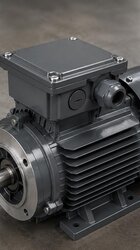
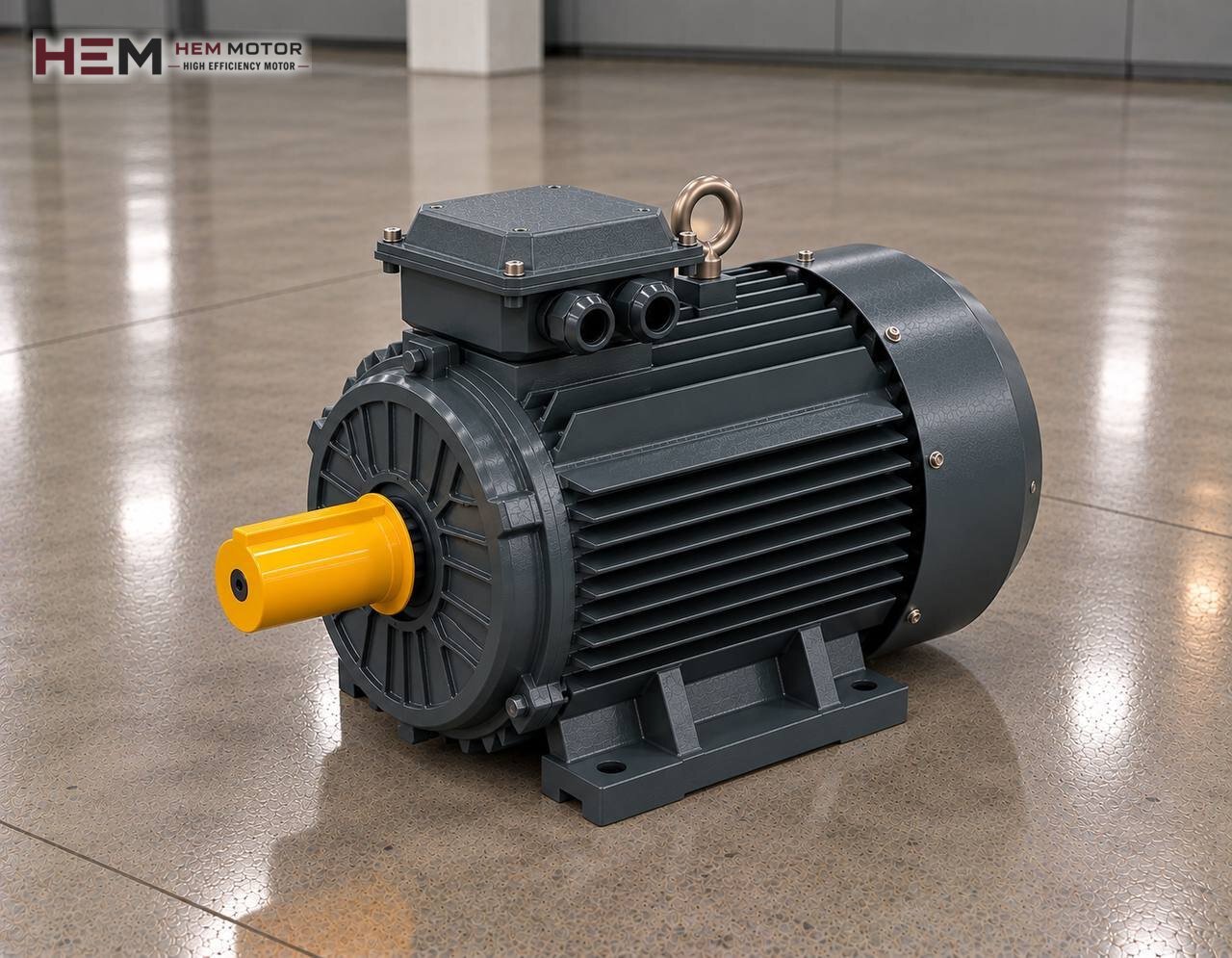
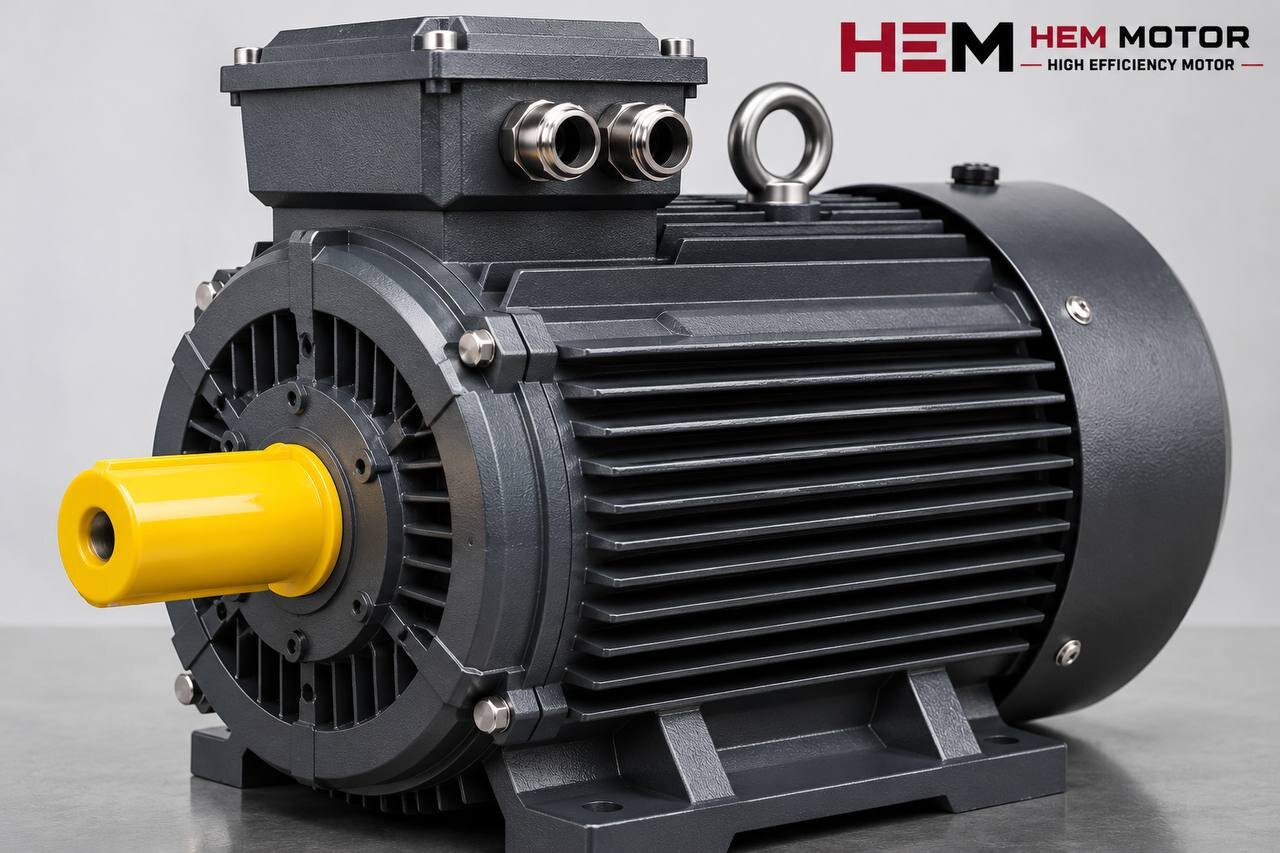
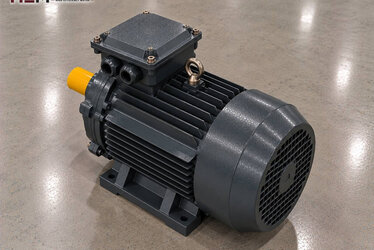
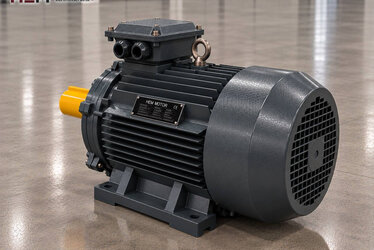
The kW value on the nameplate is shaft output power; the current, voltage and cos φ lines are for working out the input side (representative image).
Prices and technical data are on the product pages; choose a model and order online.
Which instrument measures input power on site, and in what order?
The most reliable route is a three-phase power analyser. A clamp ammeter and voltmeter also give an approximate result, but since they cannot measure power factor, the calculation rests on an assumption.
Let the motor reach thermal balance under load; a reading taken on a cold motor changes after half an hour.
Connect the analyser voltage leads as close to the motor terminals as possible and clamp the current probes on the cables of the same phases. The arrow on the clamp should point towards the load; a reversed clamp shows negative power.
Record the three phase currents, the line-to-line voltages, total kW, kVA and cos φ as an average over at least a few minutes.
Compare the measured kW not with the nameplate kW, but with the input power calculated from the nameplate.
On motors driven by a frequency converter, measure at the converter output. Power on the input side includes the converter's own losses. The waveform on the output side also misleads cheap clamp meters; use a True-RMS instrument. Our three-phase series are suitable for speed control with a frequency converter; for long operation at low speed with full torque a separate fan may be needed; if the drive-to-motor cable is long, a dv/dt or sine filter is considered; these conditions are stated with the order.
Why are kW, kVA and HP confused?
The three units describe three different things and can appear side by side on nameplates. kW is active power, kVA is apparent power, and HP is the old unit for expressing kW.
Unit
What it describes
Where it is used
kW (nameplate)
Mechanical output power at the shaft
Comparison with the machine's requirement
kW (measured)
Active power drawn from the supply
Energy consumption, efficiency check
kVA
Voltage × current × √3, excluding power factor
Transformer, generator, cable size
HP
Old unit of output power (1 HP = 0.746 kW)
Matching older machines and nameplates
A frequent mistake goes like this: a compressor motor with 10 HP on its plate is replaced by a 7.5 kW motor, and then a 7.5 kVA generator is assumed to be enough. While delivering 7.5 kW at the shaft, the motor will draw between 9 and 10 kVA from the generator. The current surge at starting is higher still.
Older nameplates sometimes show HP only. That is output power too. Multiply the HP figure by 0.746 and round the result to the equal or next higher kW value in the catalogue; do not order until speed, IEC frame and connection type match.
Which value is used for panel, generator and transformer sizing?
These calculations use rated current and starting current, not the nameplate kW. Cable cross-section, circuit breaker and thermal relay setting are also set from current; the electrical engineer responsible for the project calculates and approves the values according to the regulations.
The inputs are clear: rated current and voltage, the link arrangement in the terminal box (Y or Δ), how the motor is started (direct, Y/Δ, soft starter, converter), cable length and installation method, ambient temperature. Reading current without checking that a motor marked 230/400 V is star-connected on a 400 V supply, and one marked 400/690 V is delta-connected on a 400 V supply, wastes time. For a generator, the voltage dip at starting is also calculated; this value is often more decisive than the continuous load.
The same logic holds at higher ratings. The 4-pole 160M-4 delivers 11 kW at the shaft and draws 20.4 A at 400 V; the aluminium frame 112M-4 is rated 4 kW and 7.95 A. For both models the current gives information that the kW value alone does not. The power and speed list of the same family is on the asynchronous electric motors page; IE3, IE4 and IE5 efficiency classes are offered, and which class is supplied for a given model is confirmed with the order.
Before connecting a new motor, use the commissioning checklist for direction, terminal links and the no-load current check.
If kW, current and cos φ on the plate of your motor do not seem to agree, share a clear photo of the nameplate and the values you measured through our contact page; we will separate input and output power together and pin down the replacement step. Models sorted by power and speed are listed with their current values on the HEM Motor sales page.
Frequently Asked Questions
Why does the kW I measure differ from the nameplate kW?
The nameplate value is output power at the shaft, while the analyser shows input power drawn from the supply. At rated load it is normal for the measured value to be slightly higher than the plate; if it is much lower, the motor is running lightly loaded.
How can efficiency be found if it is not on the nameplate?
Calculate input power from the voltage, current and cos φ on the plate and divide the output power by it. This is an approximate value; for exact efficiency, refer to the manufacturer's test data.
Is the motor's kW enough when choosing a generator?
It is not. Generators are rated in kVA and must also cover starting current; the starting method and voltage dip should be calculated by an electrical engineer.
How is the kW equivalent of an old HP-rated motor found?
The HP figure is multiplied by 0.746 and the equal or next higher kW value in the catalogue is chosen. No replacement is made unless speed, frame number and mounting type also match.
HEM Motor Models Related to This Article
The cards show example models related to the topic. A suitable motor is not chosen by power alone: compare speed, voltage, mounting, shaft and connection dimensions on the product page; if unsure, send a photo of the existing motor’s nameplate on WhatsApp.
In compact electric motor selection, power density shows how small a frame the same kilowatts are taken from; cooling area is the outer surface through which that frame can shed he... More Details
An aluminium frame is a sound choice for drives with low vibration, coupling alignment or moderate pulley load, no shocks and a flat base. Where small pulleys put a large radial lo... More Details
IEC and NEMA nameplates are not compared directly but field by field after translation: power from HP to kW, protection from enclosure type to IP code, while efficiency class and s... More Details
IP55 protection is enough in most cases for an electric motor working outdoors, provided the motor does not take rain directly, condensation water can drain from the frame, and the... More Details
Class F insulation means the winding materials are chosen to withstand up to 155 °C; Class B temperature rise means that at rated load the motor's winding rises no more than 80 K a... More Details
No, they are not the same thing. The insulation class defines the thermal ceiling of the insulating material around the winding; the permitted ambient temperature shows how warm th... More Details
We use necessary and optional cookies to improve your experience, enhance content and analyse traffic. Under the GDPR, optional (analytics/marketing) cookies are only used with your explicit consent. Please choose your preference below.
Cookie Policy
 English
 Français
 Türkçe
 Español
 Русский
 العربية
 Deutsch
 Italiano