English
 Français
 Türkçe
 Español
 Русский
 العربية
 Deutsch
 Italiano

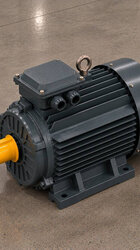
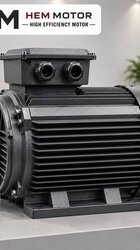
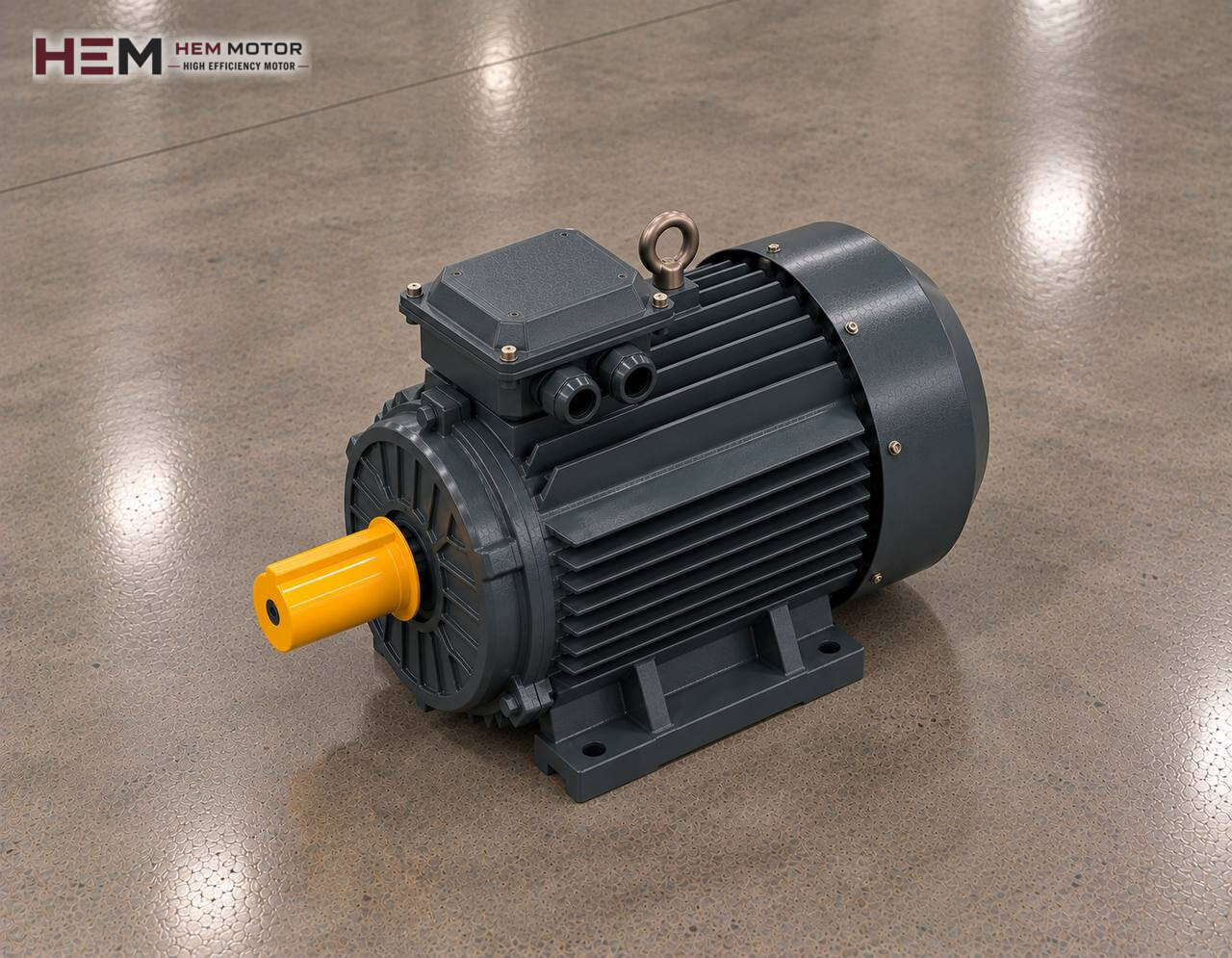

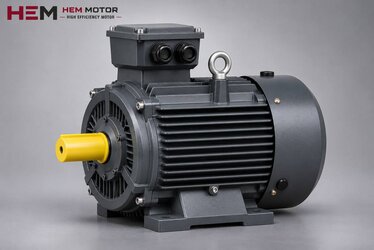
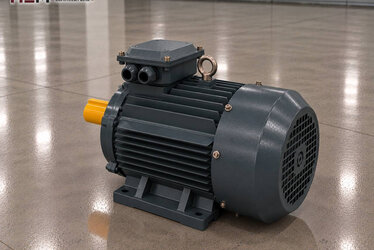
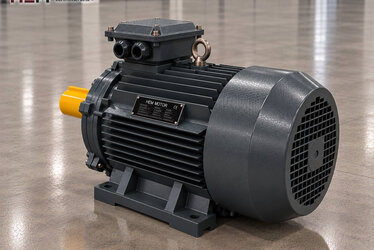
An asynchronous electric motor is an AC machine whose rotor turns because the rotating field set up by the stator windings induces current in the rotor bars, so the shaft always runs slightly slower than that field, below synchronous speed. No cable, brush or commutator is connected to the rotor. That is why most pumps, extractor fans, belt conveyors and mills in a factory are driven by three-phase asynchronous motors.
How does energy reach the shaft when no wire is connected to the rotor?
Energy crosses the narrow air gap between stator and rotor as magnetic flux; the two parts never touch. The stator slots hold three separate coil groups spaced evenly around the circumference. Because the three phase voltages follow one another in time, the coils peak in turn as well. The result is a single field inside the frame that circles at a speed tied to the supply frequency.
The rotor is a stack of thin electrical steel laminations with conducting bars running lengthwise through it. Both ends of the bars are joined by short-circuit rings. As the rotating field sweeps across the bars, a small voltage appears in each one, the rings close the circuit so current flows, and a current-carrying conductor inside a field is pushed. That push is what turns the shaft.
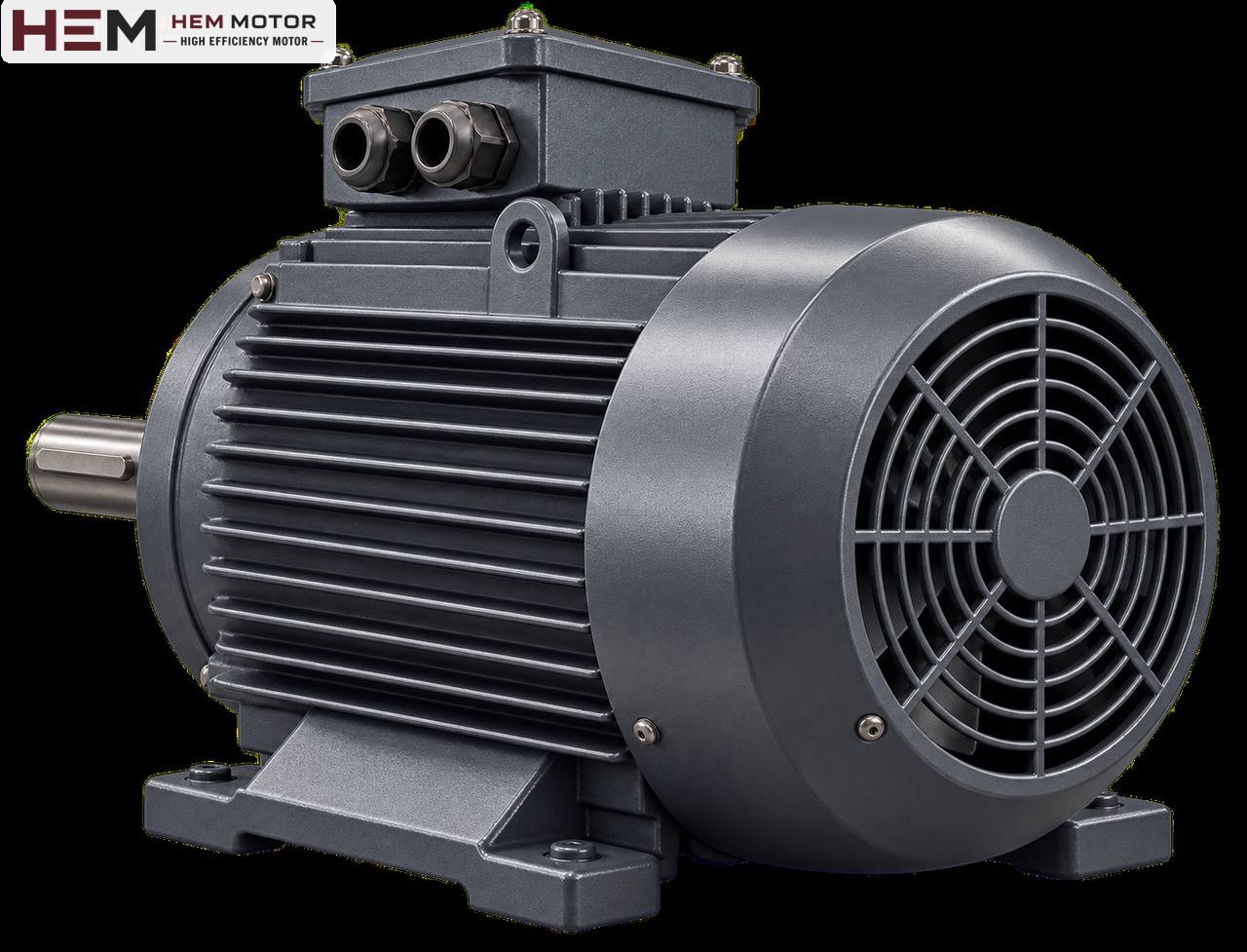
Open the terminal box cover and the layout becomes obvious.
You will see six screws on the terminal board: three are the coil starts, three are the coil ends, all marked with a letter-number code. No conductor runs to the rotor. Bar and ring material varies from one manufacturer to another; for HEM Motor models, confirm this detail when ordering.
Why can shaft speed never catch up with the field?
If the shaft reached field speed there would be no relative motion between bars and field, no voltage in the bars and no push. So the motor always lags behind. The gap is called slip, and the word "asynchronous", meaning not in step, describes exactly this lag.
Two relations are enough for the calculation (general information; confirm with the machine manufacturer):
ns = 120 × f / p s = (ns − n) / ns
In the formula f is frequency, p the number of poles and n the shaft speed read with a tachometer. A four-pole machine turns its field 1500 times a minute at 50 Hz. On a motor with 1460 rpm on the nameplate, slip at rated load comes to about 2.7%. Small, yet measurable.
That ratio does not stay fixed. On a motor with the coupling removed and running idle, an optical tachometer aimed at reflective tape shows a value just under 1500; once the machine is loaded and thermally settled, the reading drops towards the nameplate figure and stays there. If the reading sits well below nameplate speed, two possibilities stand out: the driven machine is asking for more than the motor's rated power, or the voltage at the terminals has sagged. Speed is never read on its own; current and line-to-line voltage are written down at the same moment with a clamp meter and a multimeter.
How do speed and torque shift when the pole count changes?
Each doubling of the pole count halves field speed, and the torque expected at the shaft for the same power grows accordingly. Torque follows T = 9550 × P / n, with P in kilowatts, n in rpm and T in newton-metres.
Three real 7.5 kW models from the HEM Motor catalogue show the difference clearly:
| Model | Poles | Field speed | Nameplate speed | Rated torque |
|---|---|---|---|---|
| 132S2-2 | 2 | 3000 rpm | 2930 rpm | 24.4 Nm |
| 132M-4 | 4 | 1500 rpm | 1460 rpm | 49.1 Nm |
| 160M-6 | 6 | 1000 rpm | 970 rpm | 73.8 Nm |
On the six-pole model torque approaches three times that of the two-pole one and the frame grows to 160M; the other two stay in a 132 frame. For a geared belt drive, speed is chosen together with the gearbox ratio. Mistakes get expensive. With the wrong pole count, either the belt never reaches its target speed or money goes on an oversized gearbox. Every step is listed by power and speed on our electric motor sales page.
Which nameplate lines describe the character of the motor?
To identify an asynchronous motor, read the power, voltage and connection, rated current, speed, frequency, cos φ, efficiency class, IP code, insulation letter and IEC frame number on the nameplate. Taken together, they show which supply, which load and which mounting the motor suits.
Voltage is the line most often misread. If it says "230/400 V (Δ/Y)", the coils go into star on a 400 V factory supply. A machine marked "400/690 V (Δ/Y)" is connected in delta on that same supply, and that is the one a star-delta starter can bring up to speed. The diagram inside the cover and the position of the terminal links should be compared at every first start.
The standard HEM Motor range comes with IP55 protection, insulation letter F and 50 Hz, and carries CE marking. IE3, IE4 and IE5 options exist; which class a given model is supplied in is settled when ordering. Foot, flange and vertical versions vary by frame; for dimensions, see the 2D technical drawings.