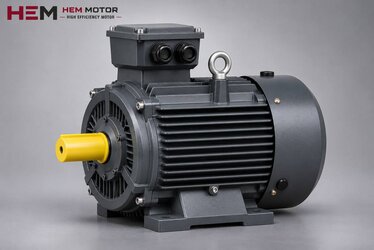
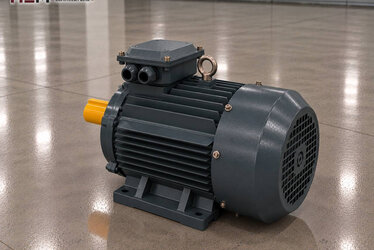
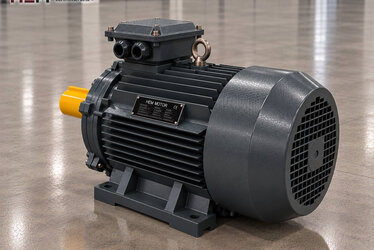
In an asynchronous electric motor, slip grows roughly in proportion to load across the normal operating range: the rotor, which turns just below synchronous speed at no load, falls back to the rated speed printed on the nameplate at full load. At half of rated load the slip is roughly half the nameplate slip; as breakdown torque approaches this linearity breaks down and speed drops quickly.
Why does slip increase with load?
Slip rises with load because the rotor can only produce the current needed to carry the shaft torque by lagging behind the rotating field. A rotor turning at synchronous speed has bars that do not cut any field lines; with no voltage induced in the bars, both current and torque stay at zero.
As load comes on, the rotor slows slightly. The speed difference to the field grows, voltage and current induced in the bars increase, and this balance settles by itself until torque matches the load. In the low-slip region rotor current rises almost linearly with slip, so torque also follows slip proportionally (general information; confirm with the machine manufacturer).
The formula is short. s = (ns − n) / ns, where ns is synchronous speed and n is measured shaft speed, and on a 50 Hz supply the rotating field of a 4-pole machine makes 1500 revolutions per minute.
How is rated slip calculated from the nameplate speed?
Subtract the rated speed printed on the plate from the synchronous speed and divide the result by the synchronous speed. On a 15 kW, 4-pole motor plated 1465 rpm the difference is 35 rpm; rated slip comes to 35 / 1500 ≈ 2.3%.
In small motors this ratio is noticeably larger. In the package data the 1.5 kW 4-pole model has a rated speed of 1445 rpm, a rated slip of about 3.7%; on the 0.25 kW 4-pole model it exceeds 10% at 1340 rpm. The main reason is that rotor resistance stays proportionally high for the frame size.
Write slip, not speed, on the maintenance form. It is the easiest way to compare motors of different power on the same scale, because the speed readings of a 3000 rpm pump motor and a 1500 rpm fan motor say nothing when placed side by side, while once each slip percentage is divided by its own nameplate slip it is immediately clear which one is carrying more load.
How much does speed change at partial load?
In the linear region slip falls together with load ratio, so speed moves closer to synchronous speed. The table below is a rough estimate for a motor plated 1465 rpm; the values are hypothetical, valid at rated voltage with a warm winding, and are not a motor test report.
Load ratio
Approximate slip (rpm)
Expected shaft speed (rpm)
Comment
No load
1–3
1497–1499
Only friction and fan loss are being covered
25%
9
1491
Motor may be oversized for the job
50%
18
1482
A common operating point for pumps and fans
75%
26
1474
Region where efficiency stays high
100%
35
1465
Nameplate value
115% and above
more than 40
below 1460
Linearity starts to break down, heating accelerates
It can also be read the other way round. Dividing measured slip by rated slip gives the load ratio: if 1482 rpm is read, 18 / 35 ≈ 0.51, meaning the motor is at roughly half load. A load ratio found with a clamp meter is misleading at light loads, because no-load current takes a large share that is independent of load; slip does not carry that share. The rated speeds on the model pages in the store are a ready starting value for this calculation.
How do voltage and winding temperature affect slip?
For the same torque, slip changes inversely with the square of the applied voltage; if voltage drops, the motor carries the same load with more slip. A voltage 5% low increases slip by roughly 10% (general information; confirm with the machine manufacturer).
The effect of temperature is less well known but common on site. Rotor bar resistance rises as the bars heat up, and since slip is proportional to resistance a warm motor turns slightly slower than a cold one at the same load. A difference of a few rpm between the speed read at the first morning start and the one read in the afternoon is therefore normal. The same shift appears when ambient temperature rises in a closed pump room in summer. The difference is small. But someone reading speed to estimate load who does not know this may think the same motor is at half load in the morning and two-thirds load in the afternoon, and write two different reports.
If you are going to compare, take the measurement after the motor has reached thermal equilibrium.
At least half an hour of running is enough; note the line-to-line voltage at the same time.
For an optical tachometer reading, reflective tape is stuck to the shaft end or the coupling hub (representative image).
Prices and technical data are on the product pages; choose a model and order online.
The biggest source of error is supply frequency: if frequency is 49.9 instead of 50.0 Hz, the field speed of a 4-pole machine drops from 1500 to 1497 rpm. On a motor with a rated slip of 35 rpm, 3 rpm causes a deviation of almost 9% in the load estimate.
That is why frequency must be seen in the same minute as the tachometer reading.
An energy analyser on the panel or a multimeter able to read frequency does the job.
Stick a small piece of reflective tape on the shaft end or coupling hub and refit the guard.
Let the motor run under load for at least half an hour; measure while the process is at a steady point.
Hold the optical tachometer square to the tape, take three readings and write down the average.
Record supply frequency and the three line-to-line voltages at the same time.
Recalculate synchronous speed with the measured frequency: ns = 120 × f / p.
This measurement is not made with an instrument whose resolution is coarser than 1 rpm. On belt-driven machines, if the reading is taken from the machine pulley, belt creep enters the result and the motor slip looks larger than it is; take the reading from the motor shaft.
What does larger than expected slip point to?
If measured slip is clearly larger than the load calculated from current requires, check voltage first and then the rotor. Low voltage is the most frequent cause and becomes noticeable under load on motors at the end of a long cable run.
If voltage is normal, a broken rotor bar or a crack at the joint with the short-circuit ring becomes a possibility. In that case the current needle swings rhythmically while load is steady, and a hum beating at twice slip frequency is heard from the motor. Sidebands appearing on both sides of supply frequency, seen with an instrument that analyses the current spectrum, support this diagnosis; the final decision is made by the rewind shop after removing the rotor.
If slip is smaller than expected, that is if the motor turns almost at synchronous speed, the load is lighter than assumed. That is not a fault but a sizing question.
How is this used when replacing a motor?
The real load found from slip gives a more reliable starting point than a current measurement when choosing the power of the new motor. If load ratio stays below 40% all the time, one step down can be considered; starting torque and peak loads must be taken into account separately.
On speed-sensitive machines, such as gear pumps or conveyors with set belt speed, if the nameplate speed of the new motor differs from the old one by a few rpm, flow or speed changes by the same amount. Three 4-pole examples for comparison:
90L-4, cast iron, 1.5 kW, 1445 rpm, 3.30 A at 400 V; rated slip about 3.7%.
132M-4, cast iron, 7.5 kW, 1460 rpm, 14.3 A at 400 V; rated slip about 2.7%.
160L-4, cast iron, 15 kW, 1465 rpm, 27.3 A at 400 V; the hypothetical values in the table were built on this nameplate.
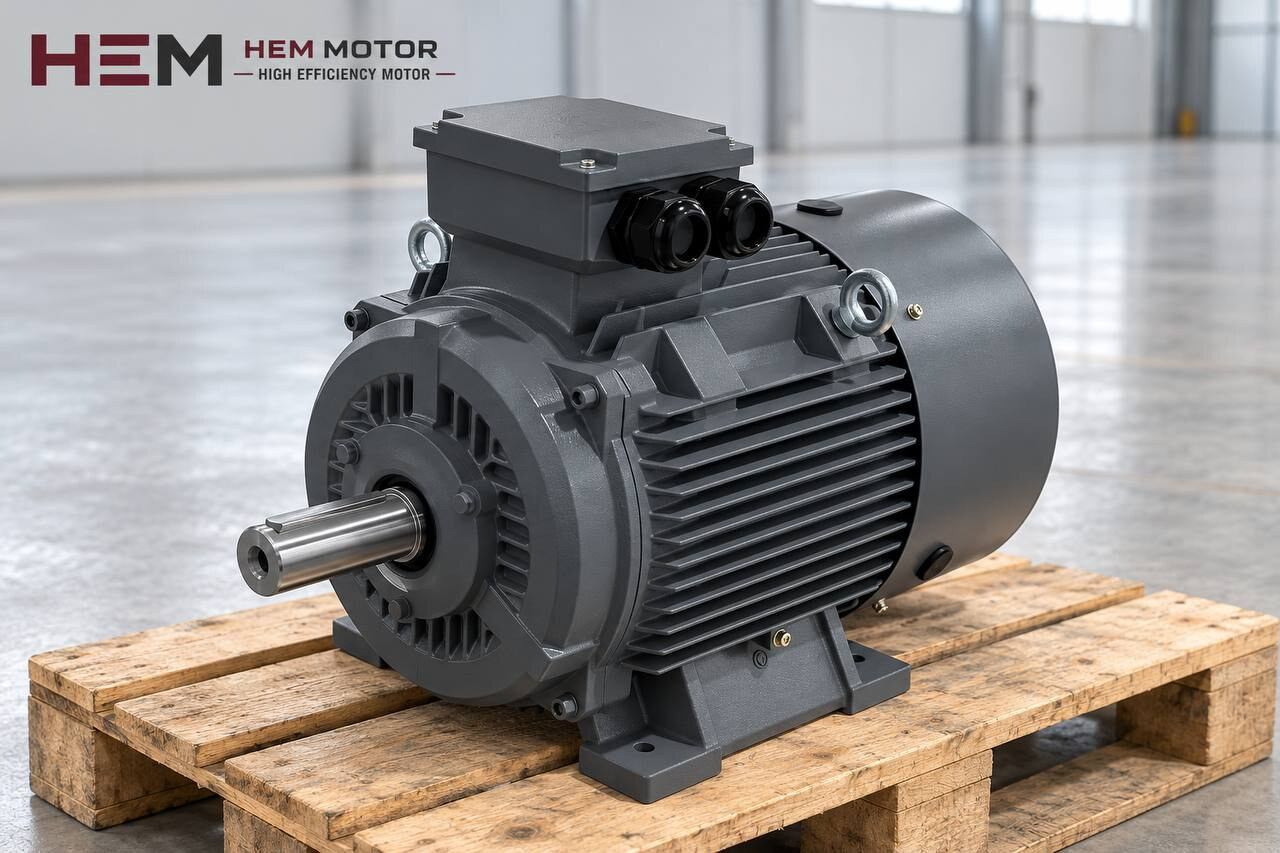
Rated speeds for the other power steps are listed on the model pages in the electric motor store. The models are IP55 with class F insulation; which of the IE3, IE4 and IE5 classes can be supplied is confirmed per model with the order. Options across the family are gathered on the asynchronous electric motors page.
If you have loaded speed, frequency and voltage readings, send them together with a photo of the old motor's plate through the nameplate submission page; we will calculate the real load together and pick the right step from the HEM Motor sales list.
Frequently Asked Questions
Does an asynchronous motor running at no load reach synchronous speed?
No; there is always a small lag, just enough to cover friction and fan loss. If the rotor reached synchronous speed, torque would drop to zero and the motor would slow down.
Does slip change on a motor driven by a frequency converter?
For the same torque the speed difference in rpm stays roughly constant, so at low frequency slip as a percentage grows. The slip compensation setting in the drive partly makes up for this difference.
Is a motor turning below rated speed overloaded?
If voltage and frequency are normal and the warm motor turns clearly below the nameplate speed, load may be exceeding the rated value. Current and voltage should be measured together for a firm decision.
Why do two motors of the same power show different slip?
Rotor design, efficiency class and manufacturing tolerances affect slip. In high-efficiency motors rotor losses are kept low, so slip is usually smaller and speed slightly higher.
HEM Motor Models Related to This Article
The cards show example models related to the topic. A suitable motor is not chosen by power alone: compare speed, voltage, mounting, shaft and connection dimensions on the product page; if unsure, send a photo of the existing motor’s nameplate on WhatsApp.
An asynchronous electric motor is an AC machine whose rotor turns because the rotating field set up by the stator windings induces current in the rotor bars, so the shaft always ru... More Details
When selecting an asynchronous electric motor for a heavy inertia load, the deciding factor is not continuous running power but whether the motor can bring the load up to rated spe... More Details
Shaft end load on an asynchronous electric motor is the radial force that the belt pull on the pulley places on the shaft and, through it, on the drive-end bearing; the closer the ... More Details
The five operating mistakes that age an asynchronous electric motor early are: forcing a motor chosen for continuous duty into frequent starts, running it on unbalanced or low volt... More Details
To verify the values on an asynchronous electric motor nameplate in the field, you turn the nameplate into a measurement plan: voltage and connection type are checked in the termin... More Details
In an asynchronous electric motor, most of the no-load current is magnetising current and is almost independent of load; the part that grows as load is applied is the active compon... More Details
We use necessary and optional cookies to improve your experience, enhance content and analyse traffic. Under the GDPR, optional (analytics/marketing) cookies are only used with your explicit consent. Please choose your preference below.
Cookie Policy
 English
 Français
 Türkçe
 Español
 Русский
 العربية
 Deutsch
 Italiano