Selecting an Asynchronous Electric Motor for Heavy Inertia Loads

Selecting an Asynchronous Electric Motor for Heavy Inertia Loads

When selecting an asynchronous electric motor for a heavy inertia load, the deciding factor is not continuous running power but whether the motor can bring the load up to rated speed within an acceptable time. To check this, the load inertia referred to the motor shaft, the average torque the motor delivers during start-up and the load's counter-torque are calculated together; the acceleration time must stay below the motor's permissible starting time.

Large fan impellers, flywheel presses, crusher rotors, centrifuges and mill drums fall into this class. On these machines a motor that seems powerful enough can overheat the rotor during start-up and trip the protection relay.

Why is an inertia load calculated separately from continuous power?

Because the energy needed to spin a heavy mass is spent only during start-up, until the machine reaches rated speed, and a large share of that energy turns into heat in the rotor. This load never shows in the continuous power figure. For example, a fan that needs only 22 kW in continuous operation can hold the motor at high current for more than 20 seconds while starting.

During start-up the current drawn from the supply is several times the rated value on the nameplate; in those seconds the rotor bars and stator winding heat up with no chance to cool. On a pump with a short start this lasts a few seconds and causes no trouble; on a load with high inertia the time stretches and heat builds up. Here fan and pump part ways. Two questions are asked in selection: does the motor produce enough torque to accelerate the load, and does this acceleration finish within the motor's thermal limits?

How is load inertia referred to the motor shaft?

The inertia of a load connected through a belt or gearbox is referred to the motor shaft by multiplying it by the square of the speed ratio: Jreferred = Jload × (nload / nmotor)². If the machine runs slower than the motor, the inertia felt at the shaft decreases; if it runs faster, it increases.

Total inertia is found by adding the inertias of the motor rotor, the pulleys and the coupling to this value. Fan and flywheel inertia is taken from the machine manufacturer's data; if it is missing, a rough estimate can be made from the impeller's mass and radius, but the margin of error is large. The inertia values in this article are given in SI units.

Hypothetical example: a fan impeller with an inertia of 60 is belt-driven at 1000 rpm, the motor runs at 1475 rpm. The referred inertia is 60 × (1000 / 1475)² ≈ 27.6. Adding a hypothetical 0.3 for the rotor and pulleys gives a total of about 27.9.

Which formula gives the acceleration time?

The acceleration time is found by dividing the product of total inertia and angular speed by the average accelerating torque:

ta = Jtotal × ω / (Tmotor,avg − Tload,avg)    ω = 2π × n / 60

Tmotor,avg is the average of the torque the motor delivers from standstill to rated speed and is estimated from the torque curve read at the locked-rotor, breakdown and pull-up points. Tload,avg is the load's counter-torque over the same range. On a fan the counter-torque rises with the square of speed, so its average is taken as roughly one third of the full-speed value (general information; confirm with the machine manufacturer).

Let us continue the example. Take a 30 kW motor at 1475 rpm with a rated torque of 194.2 Nm. With direct-on-line starting, assume a hypothetical average motor torque of 350 Nm and a fan counter-torque of 160 Nm at full speed referred to the motor shaft; the average counter-torque is then about 55 Nm. ω = 2π × 1475 / 60 ≈ 154.5 rad/s. The acceleration time comes out at 27.9 × 154.5 / (350 − 55) ≈ 14.6 seconds.

Why is star-delta starting inadequate for heavy inertia?

In star the voltage per winding drops, so torque stays at roughly one third of the delta value; with high inertia the net accelerating margin melts away, and the start either drags on or the motor stalls at an intermediate speed. While trying to lower the current, you raise the rotor's thermal load.

In the same example the average motor torque in star falls to about 117 Nm. With a counter-torque of 55 Nm the net accelerating torque is 62 Nm and the time rises to 27.9 × 154.5 / 62 ≈ 70 seconds. Moreover, because the fan's counter-torque grows with speed, the motor may never reach rated speed in star; at the changeover to delta the current jumps to a level close to a direct start. An electronic soft starter also cuts the voltage and therefore reduces torque in proportion to the square of the voltage; it runs into the same bottleneck.

Two routes suit heavy inertia better: a ramped start with a frequency converter (it gives torque close to rated torque while the current is limited) and mechanical solutions such as a fluid coupling that bring the load in after the motor. Our three-phase series are suitable for speed control with a frequency converter; long periods at low speed with full torque may require an external fan; if the drive–motor cable is long, a dv/dt or sine filter is considered; these conditions are stated with the order.
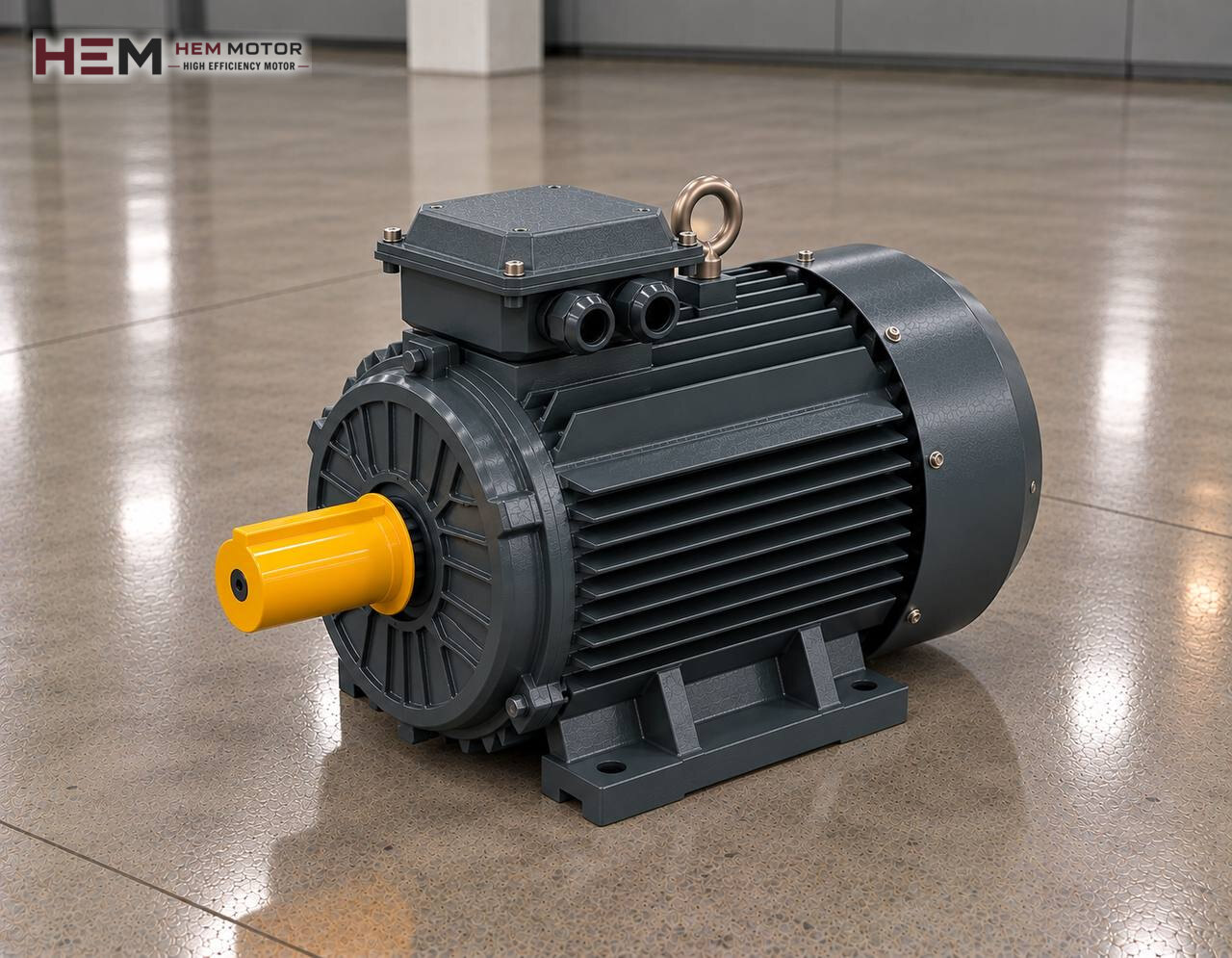

Electric motor driving a backward-curved radial fan
Large-diameter fan impellers are typical inertia loads that strain the motor at start-up even when their continuous power is modest (representative image).

Prices and technical data are on the product pages; choose a model and order online.

How can the heat built up in the rotor during start-up be estimated?

In a start without counter-torque, rotor losses equal the kinetic energy stored in the mass once acceleration ends: E = ½ × J × ω². As counter-torque increases, this loss increases too (general information; confirm with the motor manufacturer's starting data).

With the total inertia of the example, E ≈ 0.5 × 27.9 × 154.5² ≈ 333 kJ. That energy is the price of a single start. Because this energy is dumped into a small rotor mass within seconds, the temperature climbs quickly. On a machine that stops and restarts often during a shift, the next start comes before the rotor has cooled; that is why the number of consecutive starts is limited separately.

Selection steps and decision table

  1. Obtain the load's inertia, speed and counter-torque character (fan, constant torque, flywheel) from the machine manufacturer.
  2. Refer the inertia to the motor shaft and add the rotor and pulley inertias.
  3. Calculate the motor's average torque and the acceleration time with the chosen starting method.
  4. Compare the time and the number of starts per hour with the values permitted by the motor manufacturer.
  5. If the limit is exceeded, change the starting method or move up one power step; choose the protection relay class for a long start.
Calculation resultInterpretationPossible decision
Short acceleration, infrequent startsContinuous power is decisiveSelection by power calculation is enough
Direct start acceptable, star-delta time far too longReduced-voltage starting torque is insufficientConverter ramp, or direct start if the supply allows it
Time borderline even with direct startHigh rotor thermal loadOne power step up, converter or fluid coupling
Frequent starts and high inertiaRotor does not cool between startsConverter drive; ask the manufacturer for the consecutive start limit

Example electric motors for a heavy inertia calculation

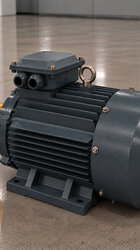
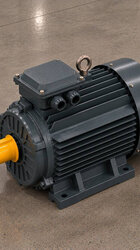
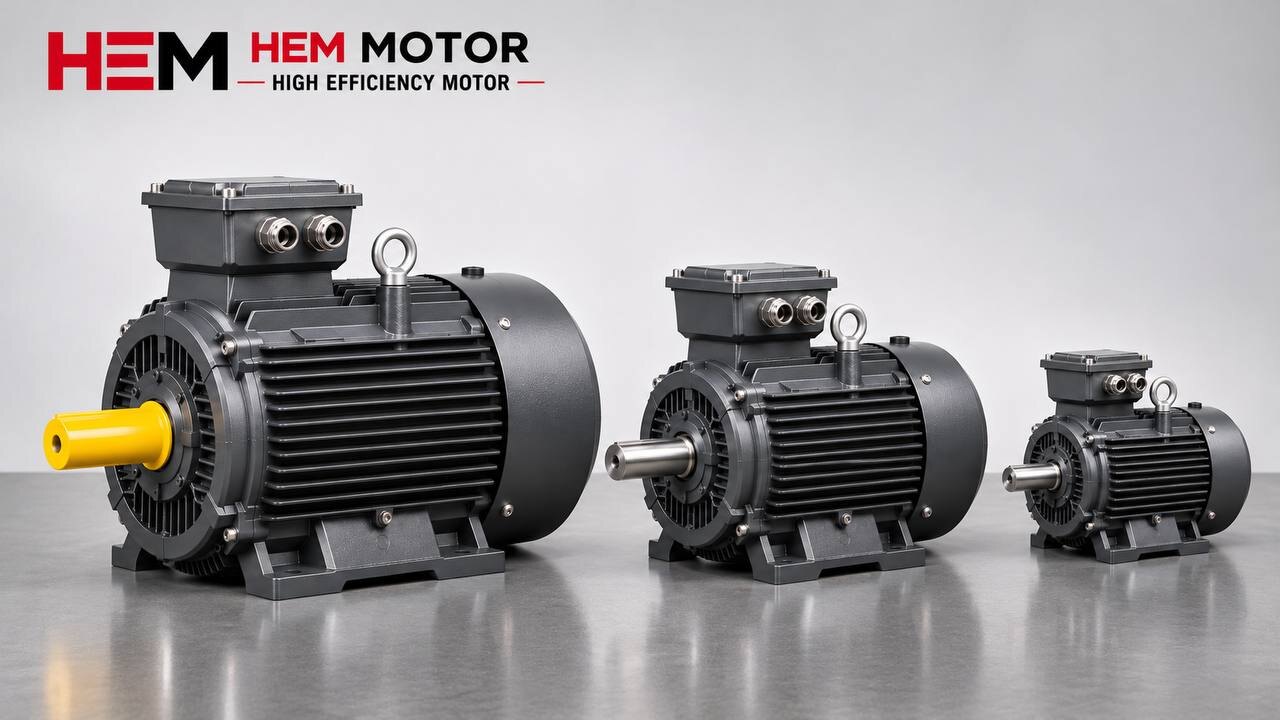
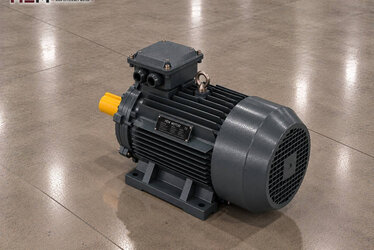
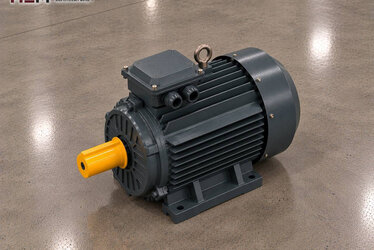
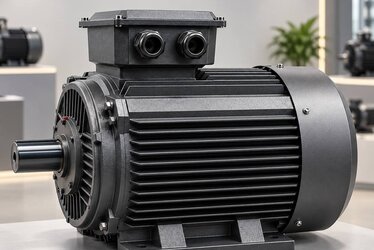
For the 30 kW fan in the example and similar flywheel loads, it makes sense to start with cast iron frames in the 1500 rpm class. All power and speed steps are listed in the electric motor shop:

  • 200L-4, 30 kW, 1475 rpm, 194.2 Nm; 400/690 V. The rated torque in the example is taken from this model.
  • 225S-4, 37 kW, 1485 rpm, 237.9 Nm. An example of the next step up when the starting time approaches the limit.
  • 225M-4, 45 kW, 1485 rpm, 289.4 Nm; for larger inertia or frequent starts.

If rotor inertia, the ratio of starting torque to rated torque and the longest accepted acceleration time do not appear in the catalogue for these models, confirm them with the order. The series is offered in IE3, IE4 and IE5 efficiency classes; the class of the model is settled at the order stage. Frame and mounting options for heavy industrial duty are under general-purpose industrial motors, and the whole three-phase family is on the asynchronous electric motor family page.

If you share the load inertia, machine speed, belt or gearbox ratio and the starting arrangement in your panel through the contact page, we can calculate the acceleration time with you and discuss which frame suits the job. To compare options, the HEM Motor model list is also at hand.

Frequently Asked Questions

If the overcurrent relay trips while the fan starts, was the motor undersized?

Not always; the problem is often not power but a long acceleration time. First check the starting arrangement in the panel and the trip class of the overcurrent relay, then calculate the acceleration time.

Does fitting a more powerful motor solve the problem on a flywheel press?

It shortens the starting time, but with frequent starts rotor heat may still be the limit. In that case a converter drive is usually the better solution.

Does a soft starter work on a heavy inertia load?

Because it lowers the voltage, it also reduces torque; it can be used if the calculation shows the start completes. If it is borderline, a frequency converter is preferred.

I don't know the load inertia; what should I do?

Ask the machine manufacturer for the impeller or flywheel inertia. Without data, a rough estimate is made from mass and diameter, but extra margin should be left in the selection.

HEM Motor Models Related to This Article

The cards show example models related to the topic. A suitable motor is not chosen by power alone: compare speed, voltage, mounting, shaft and connection dimensions on the product page; if unsure, send a photo of the existing motor’s nameplate on WhatsApp.

30 kW 1500 rpm Cast Iron Frame Electric Motor 200L-4

200L-4

30 kW · 1500 rpm

  • Cast iron frame · IEC 200L
  • 1475 rpm · IP55
  • Mounting: B3 foot; flange (B5/B14/B35) depending on frame, confirmed with the order

US$1,211.23 (€1,108.54)

View product
37 kW 1500 rpm Cast Iron Frame Electric Motor 225S-4

225S-4

37 kW · 1500 rpm

  • Cast iron frame · IEC 225S
  • 1485 rpm · IP55
  • Mounting: B3 foot; flange (B5/B14/B35) depending on frame, confirmed with the order

US$1,497.78 (€1,370.80)

View product
45 kW 1500 rpm Cast Iron Frame Electric Motor 225M-4

225M-4

45 kW · 1500 rpm

  • Cast iron frame · IEC 225M
  • 1485 rpm · IP55
  • Mounting: B3 foot; flange (B5/B14/B35) depending on frame, confirmed with the order

US$1,656.00 (€1,515.60)

View product

Similar Articles