In most cases yes, but turning the motor and bolting it down is not enough. When a motor shipped for horizontal operation (IM B3) is moved to a vertical position, you reassess which direction the bearings carry the axial load in, whether the condensate drain holes stay at the lowest point, rain getting into the fan cover, and the orientation of the terminal box. Stating the mounting arrangement with the order is always safer than adapting afterwards.
How do IM codes define horizontal and vertical positions?
IEC 60034-7 codes the mounting arrangement with letters and numbers. Codes starting with B describe a horizontal shaft, those starting with V a vertical shaft. The most common on site are:
IM code
Shaft direction
Fixing
Where you see it on site
IM B3
Horizontal
Foot-mounted, on the floor
Pump, fan, gearbox base
IM B5 / B35
Horizontal
Flange / foot and flange
Gearbox input, direct machine connection
IM V1
Vertical, shaft down
By flange
Vertical pump, mixer, vertical shaft crusher
IM V3
Vertical, shaft up
By flange
Drives sitting below, some gearboxes
IM V5 / V6
Vertical, shaft down / up
Foot-mounted, on a wall
Wall-hung belt drives
The code on the nameplate or the order shows which position the motor was prepared for.
A foot-mounted motor hung vertically on a wall becomes V5 or V6; a flange motor mounted vertically becomes V1 or V3.
When the code changes, the internal arrangement of the motor may not change, but some details always do. Which details change is covered one by one under the headings below (general information; confirm with the machine manufacturer).
Why are the bearings loaded differently in a vertical position?
In a horizontal motor the rotor weight acts on the bearings as radial load. When the shaft becomes vertical, the same weight turns into axial load and is carried by only one side of the bearing arrangement. If the motor in V1 position also carries a pump impeller or mixer blade, that extra weight and the thrust created by the liquid add in the same direction.
Standard motors usually have a locating bearing (which holds axial load) and a floating bearing. In vertical operation the axial load should be carried by the locating bearing. If the load direction falls on the side the locating bearing cannot take, bearing life shortens markedly.
So two pieces of information are needed: whether the shaft will point down or up, and the size of the axial force hung on or carried by the shaft. The machine manufacturer provides the second. For HEM motors, the bearing arrangement used and the permitted axial load in vertical position are confirmed with the order.
Why are drain holes and sealing reconsidered?
Inside the frame of every motor that runs hot and cools down, condensate forms. In a horizontal motor this water leaves through drain holes or drain plugs at the bottom of the frame. When the motor turns vertical, the old "bottom" is now a side; water collects at the new lowest point, often on the lower bearing cover.
The result comes slowly.
A few months later insulation resistance in the winding drops, the grease in the lower bearing turns to emulsion and the bearing starts to rust. The first sign on site is the megger reading sliding steadily down through the winter months.
In the shaft-down (V1) position there is another problem: the shaft seal, in an environment where water or liquid splashes, is challenged from below rather than above, and liquid leaking from the pump gland can creep along the shaft into the motor. In the shaft-up (V3, V6) position, water and dust falling onto the shaft exit collect on top of the seal. In both cases the seal type and the need for an extra slinger ring should be discussed with the order.
Prices and technical data are on the product pages; choose a model and order online.
How are the fan cover and terminal box protected in the new position?
In V1 position the fan cover faces up. Outdoors or where dust and foreign objects fall from above, this cover easily becomes a bowl; rainwater, leaves and bolts drop straight onto the fan. Fitting a rain canopy over the cover is common practice for this position.
The orientation of the terminal box changes too. If the cable entries now face up, water runs along the cable to the gland. Turning the box so the cable openings face the floor or the side, and laying the cable with a drip loop before the gland, reduces this risk.
The series is IP55 protected. This protection applies to the mounting arrangement the motor was ordered for and a correctly positioned drain arrangement. When the mounting arrangement is changed on site, this assumption must also be rechecked.
A protection class is not a number on its own but a statement that makes sense together with how the motor stands; the same frame sheds water by itself when horizontal, while in a vertical position it may collect that water on the bearing cover.
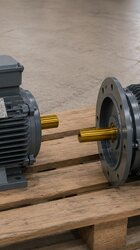
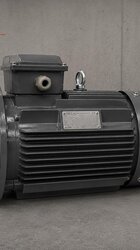
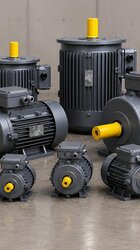
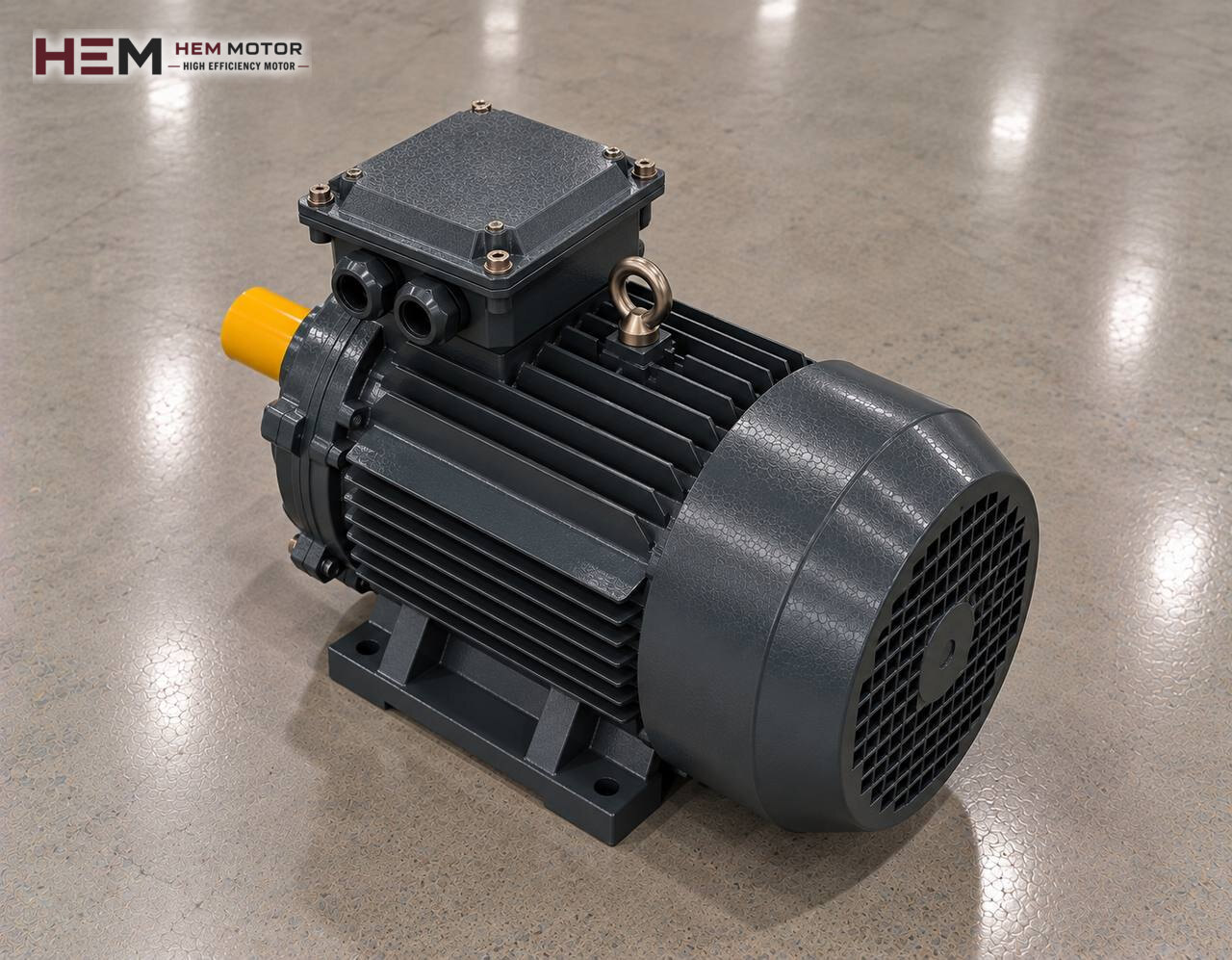
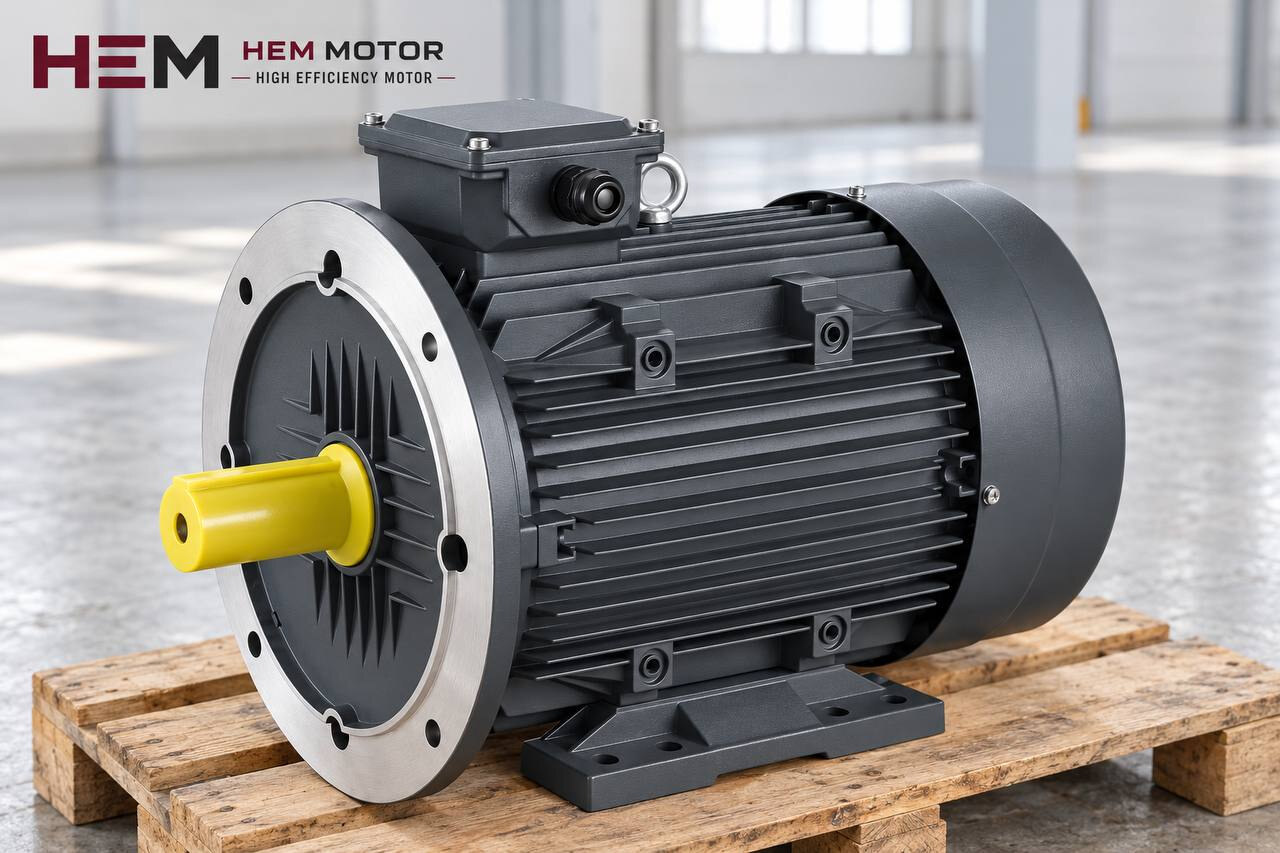
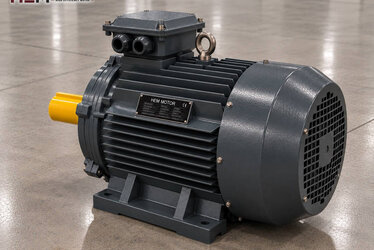
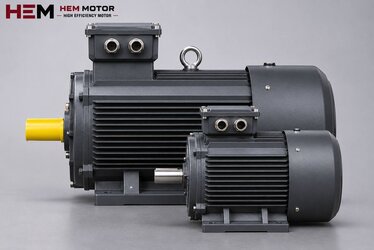
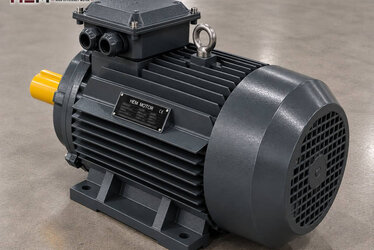
A foot-and-flange frame allows both horizontal and vertical mounting; the position should be written on the order (representative image).
Which checks are made on site before changing the position?
If you have a motor that came for horizontal use and you need to run it vertically, proceeding in this order makes the job safe:
Read the mounting code on the nameplate. If it says IM B3 the motor was shipped for horizontal use; if it is IM B35 or a flange code, vertical mounting is mechanically possible but the internal details are still checked.
Get the shaft direction and the axial force on the shaft from the machine manufacturer; impeller or blade weight and the thrust during operation should be written separately.
Check whether the drain holes stay at the lowest point in the new position; if not, do not drill the frame without consulting the supplier.
Turn the terminal box so the cable entries face the floor or the side; when replacing the box gasket, use a new one.
At first start, listen to the bearings and measure frame temperature separately at the lower and upper bearing areas. In a vertical motor the load-carrying bearing is expected to run warmer, but if the difference grows day by day, stop and check.
Which HEM models are considered for vertical mounting?
For vertical pumps, mixers and small vertical drives, aluminium frame motors are often preferred on a flange because of their low weight. Three example steps:
90L-4: aluminium frame, 1.5 kW, 1445 rpm, 3.30 A at 400 V, 9.91 Nm; for small vertical mixers and dosing drives.
112M-4: aluminium frame, 4 kW, 1450 rpm, 7.95 A at 400 V, 26.3 Nm; for medium-sized vertical pumps and tank mixers.
132S-4: aluminium frame, 5.5 kW, 1460 rpm, 10.7 A at 400 V, 36 Nm; for applications with heavier impellers and higher axial thrust.
These motors come with IP55, class F insulation and CE marking; IE3, IE4 and IE5 options are available, and the model's class is fixed with the order. The whole family is on the asynchronous electric motors page. Flange and frame dimensions are given per frame on the technical drawings page. To find an equivalent for the motor you have, see the finding an equivalent from the nameplate article.
Share the existing motor's nameplate photo, its position on the machine and the load on the shaft through our contact page; we will settle a suitable arrangement for vertical operation together. All steps are in the HEM Motor product list.
Frequently Asked Questions
Can a foot-mounted (B3) motor be hung vertically on a wall?
Mechanically it can, and this position is called V5 or V6. The bearing arrangement, drain holes and terminal box orientation must be checked for the new position.
Which bearing runs warmer in a vertical motor?
The bearing carrying the axial load usually runs warmer. If the difference grows over time, the bearing or the load direction should be checked.
How is a shaft-down motor protected outdoors?
A rain canopy is fitted over the fan cover and the terminal box is turned so the glands face down. The drain arrangement must also suit the vertical position.
Is it better to buy a new motor for the vertical position or adapt the existing one?
If axial load is small and the environment is dry, adaptation is often enough. With a heavy impeller, outdoor use or splashing liquid, a motor ordered for the vertical position carries less risk.
HEM Motor Models Related to This Article
The cards show example models related to the topic. A suitable motor is not chosen by power alone: compare speed, voltage, mounting, shaft and connection dimensions on the product page; if unsure, send a photo of the existing motor’s nameplate on WhatsApp.
Checking that electric motor pulleys lie in the same plane means seeing whether the side faces of both pulleys meet on one straight line. In practice a taut string, a steel straigh... More Details
If an electric motor's coupling element fails often, the first thing to investigate is shaft misalignment, followed by coupling selection, starting and shock loads, environmental e... More Details
The quickest way to tell foundation looseness from unbalance in electric motor vibration is to loosen the foot bolts one at a time while measuring and watch the change, and to comp... More Details
When building a sound enclosure around an electric motor, cooling is preserved by giving the enclosure a labyrinth or silenced inlet large enough for the air the motor fan draws, p... More Details
In an electric motor running in a hot environment, winding and bearing temperatures are monitored separately because they heat up from different sources, have different limits and ... More Details
When an electric motor is started for the first time at sub-zero temperatures, three things need checking: winding insulation resistance and any moisture or ice inside, bearing gre... More Details
We use necessary and optional cookies to improve your experience, enhance content and analyse traffic. Under the GDPR, optional (analytics/marketing) cookies are only used with your explicit consent. Please choose your preference below.
Cookie Policy
 English
 Français
 Türkçe
 Español
 Русский
 العربية
 Deutsch
 Italiano