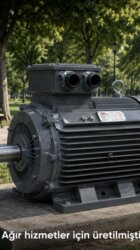
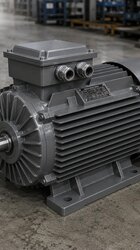
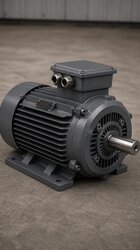
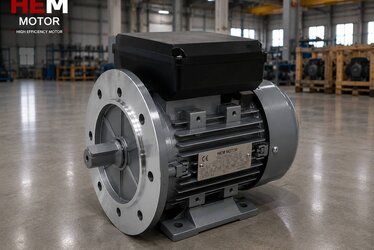
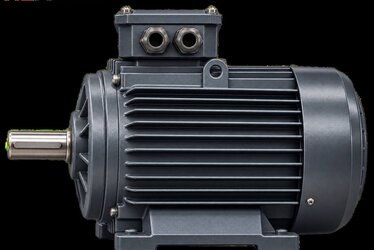
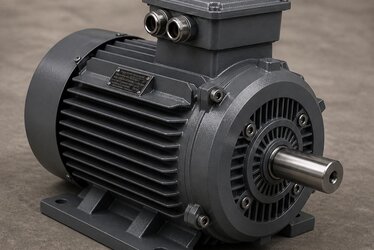
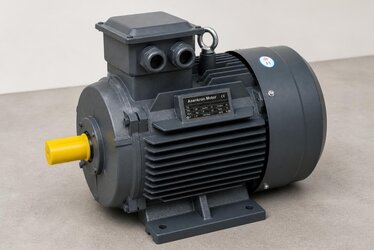
Picture two 22 kW motors in the same plant. One drives a cooling-tower fan and runs summer and winter, easily 6,000 hours a year. The other drives a transfer pump in the warehouse that is switched on a few times a week, perhaps 1,000 hours a year. On paper they are identical: same power, same poles, same price. Over their working lives, though, they cost the business very different amounts. The single strongest variable in the ratio between operating cost and purchase price is running hours.
Three buckets of lifetime cost
Acquisition: purchase price, freight, installation and commissioning.
Energy: the electricity the motor draws for every hour it runs.
Maintenance and failure: lubrication, bearing replacement, insulation checks, rewinds if needed, and unplanned downtime, which can be the most expensive item of all.
The balance between these buckets is not fixed. The same motor can have a completely different cost profile depending on hours, load and environment, so it is more useful to calculate the ratio for your own site than to rely on a generic percentage.
Expressing the purchase price in kWh
A practical way to put everything on the same scale is to divide the motor's price by your electricity tariff. The result tells you how many kWh the motor is "worth". Prices and tariffs change, but the ratio stays meaningful for a long time.
To keep the example simple, assume the 22 kW motor's price divided by the tariff comes to 20,000 kWh. Recalculate this with your own quote and tariff; the logic below stays the same.
Energy: the two scenarios worked through
Input power is shaft power divided by efficiency. Say the fan motor runs at 80% load, delivering about 17.6 kW to the shaft. The IE3 limit for a 4-pole 22 kW motor is 93.0%; using that figure, the motor draws roughly 18.9 kW.
6,000 hours a year: about 113,500 kWh. The notional 20,000 kWh purchase price is roughly two months of electricity. Over 15 years consumption passes 1.7 million kWh and the purchase price is a few percent of the total.
1,000 hours a year: about 18,900 kWh. Here the purchase price equals about a year of electricity. Over 15 years consumption is around 280,000 kWh, and the purchase price becomes a much larger share.
The same motor is a minor line next to the energy bill in one case and a noticeable part of the total in the other. Knowing the actual load makes the picture sharper; see motor load ratio and correct sizing.
Choosing the efficiency class with this ratio
Switch the same example to IE4 and the limit rises to 94.5%. The motor now draws about 18.6 kW, roughly 0.3 kWh less per hour.
On the 6,000-hour fan, that saves about 1,800 kWh a year.
On the 1,000-hour pump, about 300 kWh a year.
If the IE4 premium over IE3 were, say, the equivalent of 5,000 kWh, the fan would pay it back in under three years, while the pump would need more than fifteen and might never get there within its service life. The decision comes from running hours, not from the class itself. Our IE3 vs IE4 investment comparison goes into the payback in more depth.
Prices and technical data are on the product pages; choose a model and order online.
On a continuously running motor, planned maintenance is usually small next to energy. What it contains, however, decides how long the motor lasts:
Lubrication and bearings: bearings are the wearing parts; more hours mean shorter greasing and replacement intervals.
Insulation checks: periodic megger readings give warning before a winding fails.
Temperature monitoring: PTC or PT100 sensors catch overheating before it becomes a failure.
Cleaning: in dusty areas, clean fins and fan cowls keep cooling effective.
We set out intervals in our periodic maintenance schedule, and weigh repair against replacement in rewind or buy new.
The line that never appears: unplanned downtime
Most lifetime-cost sheets have no row for the biggest risk. If the cooling-tower fan stops in mid-summer, lost production, spoiled product and emergency sourcing can exceed the price of the motor in a single event. For critical drives, two questions matter: is an equivalent motor available to swap in, and is anything monitoring the motor closely enough to warn you? A spare for a critical line works like insurance on the lifetime cost.
Building the ratio for your own site
Establish annual running hours and average load, ideally by measurement.
Divide shaft power by efficiency for input power, then multiply by hours for annual kWh.
Convert the quoted price to kWh by dividing by your tariff.
Add planned maintenance, and for critical motors, the potential cost of downtime, as separate lines.
Divide the premium for a higher class by the annual kWh saving to get payback.
Conclusion
The ratio of operating and maintenance cost to purchase price is not a fixed number; hours, load and environment set it. On long-running motors energy dominates and a higher efficiency class pays back quickly. On lightly used motors, purchase price and maintenance discipline matter more. For high-hour applications, have a look at our IE4 high-efficiency motors, or contact us for a comparison based on your own running hours.
Frequently Asked Questions
Is the purchase price always a small share of lifetime cost?
No. On motors running thousands of hours a year it is small, because energy overtakes it quickly. On motors running a few hundred or a thousand hours, the purchase price can be a significant part of the total.
Which efficiency figure should I use in the calculation?
Ideally the efficiency given on the nameplate or in the catalogue at the load point closest to your real operation. If that is not available, the IEC 60034-30-1 class limit is a reasonable starting point, but treat the result as an estimate.
What is the most effective way to cut maintenance cost?
Correct lubrication and regular monitoring of temperature and insulation catch problems early. These small costs prevent the large ones, such as unplanned downtime and winding failure.
Is a higher efficiency class pointless for a motor that rarely runs?
The energy payback can take a long time, but the legal minimum efficiency class still applies. For low-hour applications, the class required by regulation is usually enough, and correct sizing is a better place to spend attention than a higher class.
HEM Motor Models Related to This Article
The cards show example models related to the topic. A suitable motor is not chosen by power alone: compare speed, voltage, mounting, shaft and connection dimensions on the product page; if unsure, send a photo of the existing motor’s nameplate on WhatsApp.
If you only have single-phase 220 V electricity at home, in a small workshop, a garden or on a farm, the motor you can use is a single-phase motor. When you ask for prices, even tw... More Details
“How much is this motor?” has no single answer. But if you divide the price by the motor’s power, an interesting picture appears: on a small motor every kilowatt costs much more, w... More Details
A buyer opening a motor price list usually hunts for one line: "how much is 7.5 kW?" What they find is a range rather than a single figure, and the gap between the low and high end... More Details
Monday morning, the fan motor on a cooling tower burns out. The maintenance manager has two options: send it for rewinding or buy a new one. Rewinding takes days. A new motor can b... More Details
The most honest answer to "How much is a 7.5 kW three-phase motor?" is another question: which 7.5 kW motor? A 4-pole IE3 unit and a 6-pole IE5 unit of the same power come in diffe... More Details
A machine builder writing the spec for a new packaging line types, out of habit, "IP65, class H, PTC, heater, special colour". The line will sit in a closed, dry hall with a stable... More Details
We use necessary and optional cookies to improve your experience, enhance content and analyse traffic. Under the GDPR, optional (analytics/marketing) cookies are only used with your explicit consent. Please choose your preference below.
Cookie Policy
 English
 Français
 Türkçe
 Español
 Русский