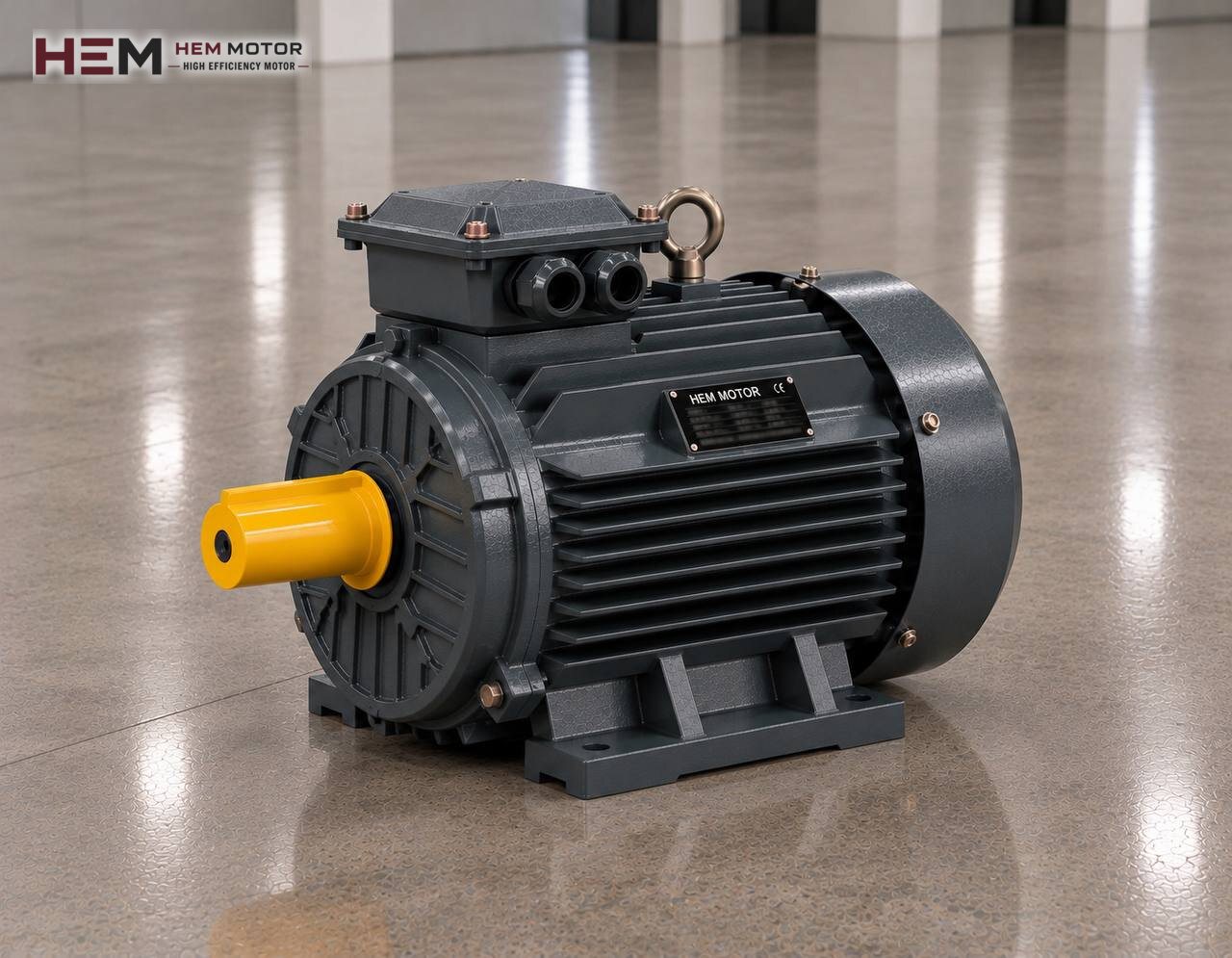
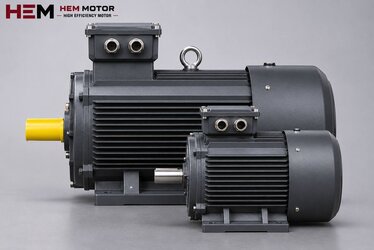
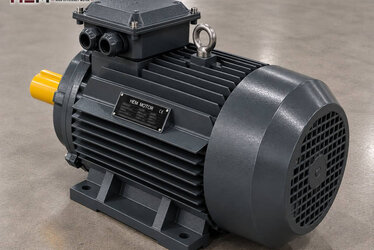
An electric motor maintenance plan for textile mills is built around how quickly lint and fibre dust cut off a motor's cooling. In the spinning, weaving and finishing departments, the most frequent cause of motor failure is overheating due to the fibre layer covering the fan cover and frame fins. The plan therefore stands on three legs: different cleaning intervals by department, extra checks for the hot, humid environment of the stenter and dyehouse, and a spares arrangement for hundreds of small motors.
How does fibre dust heat a motor?
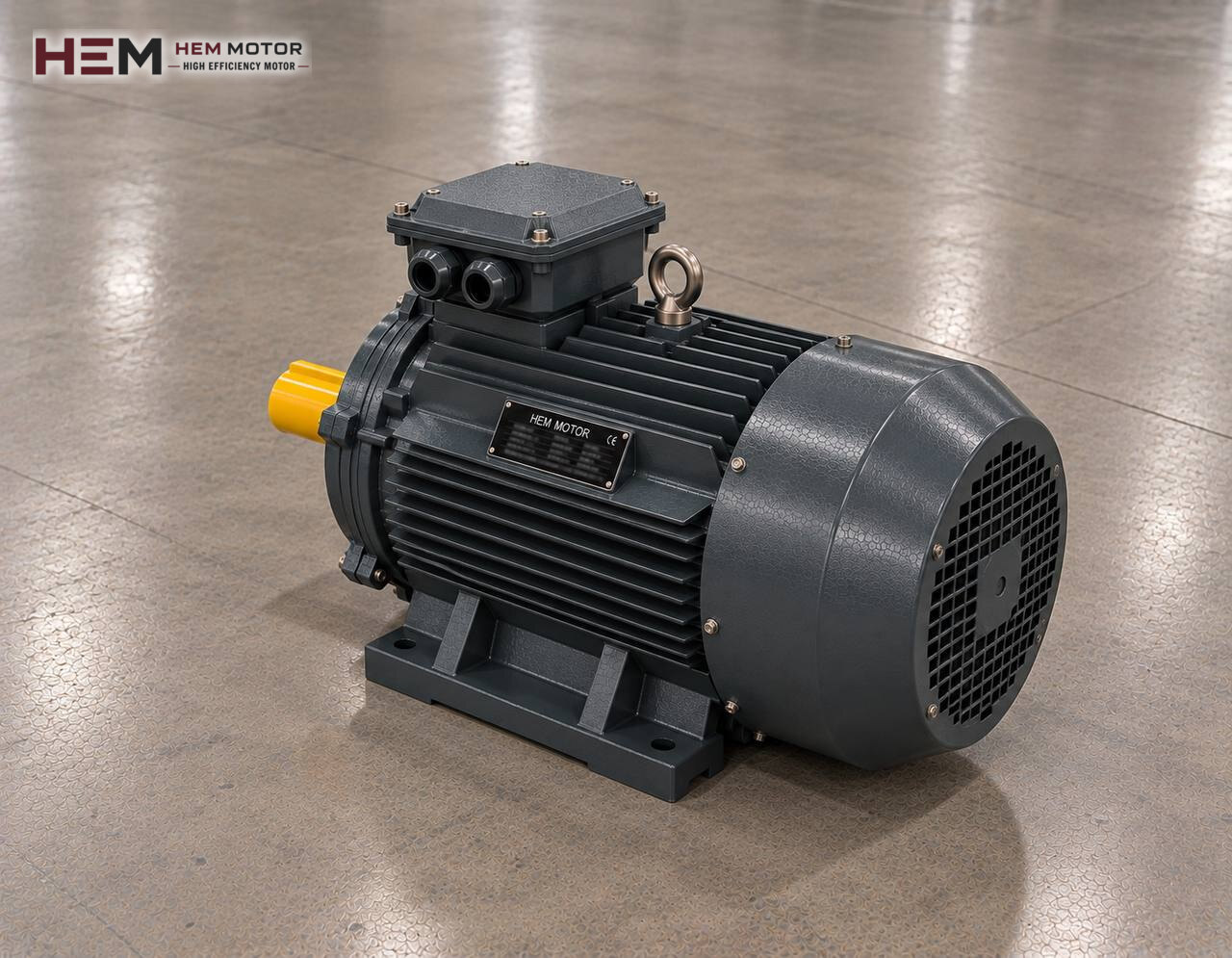
A three-phase asynchronous motor cools itself by blowing air over its frame with a fan mounted on its own shaft. In halls with carding, drawing and ring spinning machines, cotton and synthetic fibres hanging in the air are sucked into the fan cover grille with this air flow. Within a few weeks the grille felts up, the gaps between the fins fill and the motor can no longer get its own cooling air. The motor draws in its own dust.
The result is a silent rise in winding temperature. The motor keeps running, but the insulation ages a little more with every period of overheating. The winding failure often appears months later, and its cause is a fan cover that was not cleaned.
The first rule of the maintenance plan is therefore simple: keep the cooling path open.
How is the cleaning interval set for each department?
The cleaning interval follows the fibre load of each department: most often in the carding room, least often in the weaving hall. Not all halls in a textile mill are equally dusty. The blowroom and carding department carry the heaviest fibre load; lint builds up in the weaving hall, but more slowly; in finishing and the dyehouse there is little dust, but humidity and temperature are high. Setting a separate interval for each department directs the team's time to where it is needed most.
Department
Dominant effect
Recommended cleaning and checks
Blowroom, carding
Heavy fibre and cotton dust
Fan cover and fins at least once a week; visual check at the start of each shift
Drawing, roving, ring spinning
Fine fibre, continuous running
Cleaning every two weeks; monthly current measurement on main drive motors
Weaving hall
Lint build-up, hundreds of small motors
Monthly group cleaning; wipe motor frames during loom stops
Stenter and drying
Hot air, chemical vapour
Monthly terminal box and bearing check; temperature monitoring on fan motors
Dyehouse, washing
Humidity, water splashes
Monthly gasket and cable entry check; insulation measurement every six months
If cleaning is done with compressed air, care should be taken to blow fibres outwards, not into the motor. Vacuum cleaning is safer where possible, because compressed air can also push dust between the bearing seals. A vacuum does not push dust into the seal.
What needs attention on the motors of stenter hot air fans?
On stenter fan motors, bearings, grease and winding temperature are monitored because of the hot air laden with chemical vapour. A stenter uses hot air circulation to stretch and dry fabric; a stenter line has many circulation and exhaust fans. The motors of these fans usually stand outside the machine, but the air around them is hot and carries vapour from finishing chemicals. Exhaust fans also cause an oily vapour layer to build up on the frame. That layer weakens cooling too.
On these motors, bearing temperature and noise should be monitored monthly and greasing done at the interval recommended by the manufacturer. A PTC sensor can be added as an order option to monitor winding temperature. The PTC reports overheating early. Drives directly exposed to the hot air stream inside the stenter, however, need a special motor; they may fall outside the standard series in HEM Motor's 2026 catalogue, so ask us with the nameplate and application details.
Dye liquor circulation pump drive in the dyehouse (representative image).
How does humidity affect circulation pump motors in the dyehouse?
In the dyehouse, steam and floor water get in through the terminal box gasket and cable gland and threaten the winding insulation. On jet and overflow dyeing machines, the circulation pumps that move the dye liquor through the fabric run under high load for hours throughout a dyeing batch. The pump motor stands between the steam rising from the hot liquor and water on the floor. The terminal box gasket and cable gland are the most neglected points in this area. This is where water most often gets in. In the standard series the degree of protection is IP55; for motors that water is aimed at directly during floor washing, IP56 can be considered as a special order. Motors of machines standing idle for long periods are at risk of condensation; an anti-condensation heater can be added as an order option. Measuring insulation resistance every six months shows early whether moisture has reached the winding.
Prices and technical data are on the product pages; choose a model and order online.
How is maintenance planned for hundreds of small motors in the weaving hall?
The small motors in the weaving hall are maintained in groups by power, poles and mounting. Every loom carries several motors. In a weaving hall, each loom has a main drive motor plus dobby, jacquard and cloth take-up drives. Although each is small, their number runs into hundreds, and a stopped loom is a direct production loss.
In this hall maintenance should be planned per motor type, not per loom.
Grouping motors of the same power, pole count and mounting simplifies both the cleaning round and the spares arrangement. Loom stops (warp change, adjustment) can be used to wipe motor frames and check belt tension. Being able to fit the same type from the shelf immediately in place of a failed motor determines the hall's output more than the motor itself. A spare on the shelf shortens the stoppage. Small aluminium frame models suited to loom drives are sorted by pole count in our store.
Which extra checks do drives with frequency converters need?
On converter drives, cooling at low speed, fibre build-up and bearing noise are checked in addition. In textiles, winding, tensioning and stenter speed control is widely done with frequency converters. Our three-phase series are suitable for speed control with a frequency converter; long full-torque running at low speed may require an external fan; if the drive–motor cable is long, a dv/dt or sine filter is considered; these conditions are stated in the order. Since a motor turning at low speed produces little air from its own fan, fibre build-up takes effect faster on these motors. These motors need cleaning more often.
During the maintenance round, special attention should be paid to bearing noise on converter-fed motors; damage caused by bearing currents can show up as a rhythmic hum in the bearing. The hum is an early warning. If this sign appears, earthing and cable layout should be reviewed together with the panel engineer.
How is a spare motor arrangement set up in textiles?
In textiles, the spares arrangement is built on frame sharing because of the large number of machines. A common frame cuts the number of spares. On replacement, the IEC frame number is the first piece of information; compatibility is confirmed by comparing mounting type, shaft diameter and length, foot hole spacing, flange and electrical values. B3, B5, B14, B34, B35 and vertical V1/V3/V5/V6/V15 are offered according to frame; the flange dimension is confirmed in the order.
As an example, the 7.5 kW, 4-pole aluminium frame 132M-4 (1460 rpm, 400/690 V) can be a common spare for stenter circulation fans or medium-sized pumps in the dyehouse. Fan and pump can share the same spare. For dust extraction and fibre collection fans, the 15 kW, 2-pole cast iron 160M2-2 (2945 rpm) can be considered. For large central filter fans or air handling unit fans, the 37 kW 200L2-2 (2960 rpm, 64 A at 400 V) can be considered. Other power ratings are listed in the HEM Motor store.
How are maintenance records combined with the production plan?
Motor maintenance is combined with the production plan by placing it on days when production stops anyway. In textiles, machines often run six days a week in three shifts; time for planned maintenance is limited. Tying Sunday stops and gaps between orders to the maintenance calendar makes it possible to clean motors without clashing with production. The Sunday stop is set aside for cleaning. If the cleaning date, measured current and bearing noise note for each motor are kept in a single table, it becomes clear within a few months which department needs more frequent intervention. If you send us the plates of motors that keep heating up in the carding department or on the stenter line through the find-an-equivalent-from-the-nameplate page, we will work out together common frames suited to your spares group. You can compare the other drives in the halls by power and pole count in our product store.
Frequently Asked Questions
How often should motors in the carding department be cleaned?
As it is the department with the heaviest fibre load, the fan cover and fins should be cleaned at least once a week. A visual check of the grille at the start of each shift is also recommended.
Is cleaning motors with compressed air harmful?
Blowing fibres into the motor can push dust into the bearing seal. Air should be directed outwards; vacuum cleaning should be preferred where possible.
Which options should be considered for stenter fan motors?
A PTC sensor to monitor winding temperature in a hot environment is an order option. Drives directly exposed to the hot air stream inside the stenter need a special motor.
What does a hum from the bearing of a converter-fed motor indicate?
It may be a sign of damage caused by bearing currents. Earthing and cable layout should be checked together with the panel engineer.
HEM Motor Models Related to This Article
The cards show example models related to the topic. A suitable motor is not chosen by power alone: compare speed, voltage, mounting, shaft and connection dimensions on the product page; if unsure, send a photo of the existing motor’s nameplate on WhatsApp.
Checking that electric motor pulleys lie in the same plane means seeing whether the side faces of both pulleys meet on one straight line. In practice a taut string, a steel straigh... More Details
If an electric motor's coupling element fails often, the first thing to investigate is shaft misalignment, followed by coupling selection, starting and shock loads, environmental e... More Details
The quickest way to tell foundation looseness from unbalance in electric motor vibration is to loosen the foot bolts one at a time while measuring and watch the change, and to comp... More Details
When building a sound enclosure around an electric motor, cooling is preserved by giving the enclosure a labyrinth or silenced inlet large enough for the air the motor fan draws, p... More Details
In an electric motor running in a hot environment, winding and bearing temperatures are monitored separately because they heat up from different sources, have different limits and ... More Details
When an electric motor is started for the first time at sub-zero temperatures, three things need checking: winding insulation resistance and any moisture or ice inside, bearing gre... More Details
We use necessary and optional cookies to improve your experience, enhance content and analyse traffic. Under the GDPR, optional (analytics/marketing) cookies are only used with your explicit consent. Please choose your preference below.
Cookie Policy
 English
 Français
 Türkçe
 Español
 Русский
 العربية
 Deutsch
 Italiano