Electrical erosion in an electric motor bearing is recognised most clearly by evenly spaced transverse lines on the outer ring raceway that look like a washboard (fluting), and by the raceway turning dull grey as if sandblasted. These marks are the result of microscopic sparks from current passing through the lubricant film because of shaft voltage; they are seen mostly on motors driven by a frequency converter.
What causes current to pass through a bearing?
The main cause of bearing current is voltage building up on the shaft, breaking through the lubricant film and discharging to the frame. Fast switching at the output of a frequency converter carries common-mode voltage onto the shaft through the capacitive coupling between winding and rotor.
The lubricant film normally behaves like a thin insulator. When voltage exceeds the film's strength, the film breaks down for an instant and a small arc forms; each arc melts a microscopic particle out of the raceway. This happens thousands of times a second. After months the mark becomes visible to the eye.
Similar current can appear on motors fed directly from the mains, but the cause is different: on large frames, magnetic asymmetry drives a circulating current through the shaft. A weak earthing path and a coupled machine sitting at a different potential can also cause current.
What do electrical erosion marks look like on a removed bearing?
Three types of mark are looked for on a removed bearing: fluting, frosting and individual crater points. To tell them apart, the ring is cleaned with solvent, dried and examined under a strong torch, ideally with a 10x magnifier, changing the light angle; the lines only stand out when light strikes the raceway from the side.
With fluting, regularly spaced light and dark lines run across the outer ring raceway at right angles to the rolling direction; from a distance they look like a washboard.
With frosting, the raceway loses its bright steel colour and takes on a satin or sandblasted look; it is often the stage before fluting.
Crater points show under the magnifier: small pits with melted edges and a rough floor. The balls show the same dulling on their surface.
Check the colour of the grease too.
Burnt carbon particles turn grease dark grey or black; with normal wear grease thickens but does not darken this much. A technician who takes a fingertip of grease and smears it on white paper sees the difference straight away. Comparing it with the grease from the motor's other bearing also helps: current usually leaves heavier marks in one of the two bearings. When looking for a replacement motor, frame and power data are on the product pages in the HEM Motor shop.
How is electrical erosion told apart from mechanical damage?
The key is the pattern. Electrical fluting is evenly spaced around the whole raceway and extends beyond the load zone; mechanical damage is usually concentrated in the load zone and irregular.
Mark
Likely cause
Distinguishing sign
Evenly spaced transverse lines, all the way round
Bearing current
Balls dull grey; grease dark
Pits at ball pitch, in one zone only
Standstill vibration (false brinelling)
Motor stood for a long time on a vibrating floor without running
Flaking in the load zone
Fatigue, overload, belt tension
Sharp edges, bright metal
Scratches and dents, sand in the grease
Contamination
Random direction of marks
False brinelling and fluting are the pair most often confused. On a motor that saw vibration in transport or storage, the marks fall at ball pitch and their number matches the number of balls. Electrical flutes are far more numerous. They bear no relation to ball pitch. Count the marks over a quarter of the circumference and compare with the number of balls in the cage: if the marks clearly outnumber the balls, look first for an electrical cause.
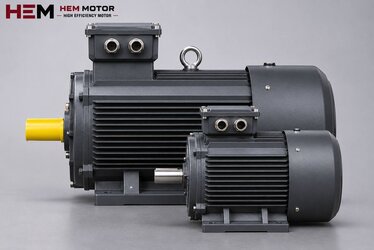
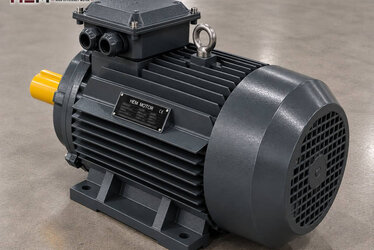
Bearing current marks are looked for on the outer ring raceway of the removed bearing (representative image).
Prices and technical data are on the product pages; choose a model and order online.
Which signs give a warning before the motor is dismantled?
Before dismantling, the earliest sign is a change in bearing noise. As fluting progresses, a steady hum or a whistle-like tone rises from the bearing; its pitch changes with motor speed.
In vibration analysis, clear peaks appear at the outer ring defect frequency and its harmonics. Envelope analysis warns early. If maintenance only has a handheld vibration meter, keeping a weekly log from the same point shows the upward trend.
Shaft voltage can also be measured directly. This uses a carbon-brush probe touching the shaft and a high-bandwidth oscilloscope; the measurement is taken with the motor running, with proper safety measures and by experienced staff. If peak values rise week by week, the risk is growing.
A common mistake: when a bearing fails early, only the bearing is replaced. The new bearing carries the same marks within a few months.
The cause is still there.
Which measures are taken against bearing current?
Measures work in two directions: reducing the source of the current and giving the current a path that bypasses the bearing. Which is enough depends on the motor frame, the drive and the earthing quality of the installation.
Using symmetrical shielded motor cable, bonding the shield 360 degrees at both ends and running a bonding strap with low high-frequency impedance between motor frame and machine base.
Fitting a common-mode filter or output filter at the drive output and using the switching frequency recommended by the drive maker.
Diverting current to the frame past the bearing with a grounding ring or brush touching the shaft.
Fitting an electrically insulated bearing, usually at the non-drive end (NDE), to break the circulating current.
Our three-phase series are suitable for speed control with a drive. If full load is drawn at low speed for hours, a separately powered fan may be needed, and an output filter if the drive is far away; state these conditions with the order. Insulated bearings, a shaft grounding ring and the bearing type used in standard models are not verified information for HEM; confirm with the order.
What information should you send HEM for a motor with damaged bearings?
When you suspect bearing current, it matters which information is collected before the motor is replaced; it helps both to find the cause and to choose the right equivalent. The first step is a clear photo of the motor nameplate.
Information to send: motor nameplate, drive make and switching frequency, cable type and length, earthing arrangement, close-up photos of the removed bearing and how many months the bearing lasted. Taking the nameplate photo as described on the find an equivalent motor from the nameplate page speeds things up. The order to follow when commissioning the new motor is in the commissioning guide.
112M-4: aluminium frame 4 kW for light machines; rated current 7.95 A, 26.3 Nm at 1450 rpm.
160M-4: the 11 kW step common on fan and pump drives, aluminium frame; 20.4 A and 71.7 Nm at 1465 rpm.
160L-4: cast iron frame 15 kW for heavy conditions; 27.3 A, 97.8 Nm at 1465 rpm.
The application details to include with a quote request are listed in the how to prepare a quote request article; reach us with photos and nameplate through our contact page.
Frequently Asked Questions
Can a fluted bearing be cleaned and reused?
No. The raceway surface is permanently damaged; the bearing is replaced, and then the source of the current is removed by going through earthing, cable and drive settings one by one.
Does electrical erosion also occur on mains-fed motors?
Yes, though less often. Magnetic asymmetry on large frames or external current sources such as welding machines can cause it.
Is a shaft grounding ring enough on its own?
It helps clearly in most installations, but used with poor earthing and unshielded cable it may not solve the problem fully. The earthing arrangement is dealt with at the same time.
Which bearing needs to be insulated?
To break the circulating current, the non-drive end bearing is usually insulated. The decision depends on motor frame and drive arrangement; the option is confirmed with the order.
HEM Motor Models Related to This Article
The cards show example models related to the topic. A suitable motor is not chosen by power alone: compare speed, voltage, mounting, shaft and connection dimensions on the product page; if unsure, send a photo of the existing motor’s nameplate on WhatsApp.
Checking that electric motor pulleys lie in the same plane means seeing whether the side faces of both pulleys meet on one straight line. In practice a taut string, a steel straigh... More Details
If an electric motor's coupling element fails often, the first thing to investigate is shaft misalignment, followed by coupling selection, starting and shock loads, environmental e... More Details
The quickest way to tell foundation looseness from unbalance in electric motor vibration is to loosen the foot bolts one at a time while measuring and watch the change, and to comp... More Details
When building a sound enclosure around an electric motor, cooling is preserved by giving the enclosure a labyrinth or silenced inlet large enough for the air the motor fan draws, p... More Details
In an electric motor running in a hot environment, winding and bearing temperatures are monitored separately because they heat up from different sources, have different limits and ... More Details
When an electric motor is started for the first time at sub-zero temperatures, three things need checking: winding insulation resistance and any moisture or ice inside, bearing gre... More Details
We use necessary and optional cookies to improve your experience, enhance content and analyse traffic. Under the GDPR, optional (analytics/marketing) cookies are only used with your explicit consent. Please choose your preference below.
Cookie Policy
 English
 Français
 Türkçe
 Español
 Русский
 العربية
 Deutsch
 Italiano