English
 Français
 Türkçe
 Español
 Русский
 العربية
 Deutsch
 Italiano

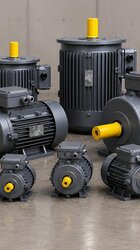


When the fuse or breaker on a star-delta panel trips at changeover, the cause is usually that the motor is switched to delta before it has gained enough speed in star, a current surge created during the short dead interval of the changeover, or a delta link wired in the wrong phase sequence. The fuse itself is rarely the problem; the timer, the starting torque of the load and the contactor wiring are checked first.
Why can current at changeover be higher than at start?
On a classic panel the motor is cut off from the supply for a few tens of milliseconds between the Y contactor dropping out and the Δ contactor pulling in. The rotor keeps turning meanwhile, and the flux left in the iron core generates a voltage at the stator terminals.
When the Δ contactor closes, the changeover is smooth if the mains voltage and the motor's own voltage are in phase. If the angle between them has grown, the two voltages add up and a very short but steep current peak passes through the winding. This peak can exceed even the starting current.
A moulded-case breaker with an electronic trip unit takes it for a short circuit and opens instantly.
Someone standing in front of the panel can catch the sequence by ear: the deep hum in Y, a half-second gap, the snap of the Δ contactor and right after it the breaker handle dropping with a "clack". If you hear that sequence, the fault most likely lies in the changeover itself, not in the motor winding.
How many seconds should the timer be set to?
The timer is set to the moment the motor reaches roughly 80–90 percent of rated speed in Y; there is no single value in seconds that fits everyone. A light fan may need 3–4 seconds while a heavy crusher or a high-inertia fan wheel can take more than 10 seconds (general information; confirm with the machine manufacturer).
On site the right time is found with a clamp meter. The clamp goes on one of the motor cables, a start is made and the second at which the Y current drops towards the plate value is noted with a stopwatch. If changeover to Δ happens while current is still at its peak, the motor has not accelerated and the time is extended. If current dropped long ago and the motor stays in Y for a long time, the time is needlessly long; staying in Y under load also heats the winding.
A common reflex on site makes things worse. When someone says "the breaker trips", the time is shortened. Bad idea. The motor is switched to Δ at an even lower speed and trips become more frequent.
Why can the load not accelerate in star?
In a Y connection each winding sees 1/√3 of the voltage it gets in Δ, so both current and torque fall to roughly one third. If the counter-torque of the machine is greater than this reduced torque, the motor hangs at an intermediate speed in Y.
A belt full of material, a packed screw conveyor, a loaded mixer, a piston compressor starting against tank pressure and a large centrifugal pump with its valve left open are well-known examples. The motor sticks at around 1000–1200 rpm in Y, the timer runs out and at changeover to Δ the current grows almost as large as a second full start. The trip is no longer caused by the changeover. Telling them apart is easy: empty the machine and repeat the same start. If the changeover is clean when empty, the problem lies in the method. For heavy loads, handing the start over to an electronic starter or a frequency converter is considered. Our three-phase series are suitable for speed control with a frequency converter; for long periods of full-torque operation at low speed an external fan may be needed; if the drive–motor cable is long a dv/dt or sine filter is considered; these conditions are stated with the order.
What happens if the phase sequence of the delta link is reversed?
If the Δ contactor pairs the winding ends wrongly, the motor is forced for a moment to turn in the opposite direction at changeover and current rises above even the starting current. The breaker either opens at once or the motor carries on with a jolt and a hard knock from the frame.
The six terminals in the terminal box are the starts and ends of the three windings. In a correct Δ the three windings close like a ring and each junction goes to a separate phase; the diagram inside the nameplate or on the back of the terminal cover shows this pairing. If two cables swapped places after a panel renewal or motor change, everything looks normal in Y and the problem only shows at changeover.
Do the check after isolating and locking off the supply. Follow each conductor one by one from the output terminal of the Δ contactor to the motor terminal box with the continuity range of a multimeter; even if the cable numbers look right, check whether the link bars in the terminal box have been removed.