Electric Motor Selection Form: Information to Provide When Requesting a Quote

Electric Motor Selection Form: Information to Provide When Requesting a Quote

The information needed when requesting a quote for an electric motor falls into five groups: supply (voltage, frequency, starting method), mechanical interface (mounting type, IEC frame number, shaft end), nature of the load (power or torque, speed, starting difficulty), environment and duty, and finally quantity and required documents. If each of these five groups is filled in, the supplier can propose a single model; if one is missing, the reply usually comes back as a list of questions. The selection form below is explained field by field so that purchasing and maintenance speak the same language.

Which missing details slow down a quotation?

The most common request seen in practice consists of only one sentence: “We need a 22 kW motor.” That sentence covers three different 2, 4 and 6-pole models, several foot or flange mounting arrangements and two different voltage connections at once. The supplier either asks about every possibility one by one or assumes the most common option; in the second case there is a risk of the wrong motor arriving on site.

The second frequent gap is a missing speed. At the same power, a 1000 rpm motor delivers roughly three times the torque of a 3000 rpm one; the belt ratio or gearbox on the machine cannot absorb that difference. The third gap is the mounting arrangement: if a B5 flange motor arrives in place of a B3 foot-mounted motor, it cannot be fitted to the machine.

How is the electrical supply written on a quotation form?

The supply section states the mains voltage, frequency and starting method. The first line of the form is the site supply voltage. Depending on the model, the winding of our series motors is 230/400 V or 400/690 V; on a 400 V site a 230/400 V winding runs in star and a 400/690 V winding runs in delta. This difference directly affects the starting method: star-delta starting requires the motor to be able to run in delta at supply voltage, which is why a 400/690 V winding is preferred at larger ratings.

How the motor is to be started is a separate line too: direct on line, with a star-delta contactor set, with a soft starter or through a frequency converter. Converter operation needs extra information. Our three-phase series are suitable for speed control with a frequency converter; for long periods at low speed with full torque, a separate fan may be required; if the drive-to-motor cable is long, a dv/dt or sine filter is considered; these conditions are stated in the order.

The form should therefore include lines for speed range and cable length.

The standard frequency is 50 Hz. If a different supply frequency is involved, this is optional; speed, current and torque differ slightly from 50 Hz, so please state it in the order.

What does the form need for the mechanical interface?

The mechanical section lists mounting type, IEC frame number and shaft end. Mounting arrangements B3, B5, B14, B34, B35 and vertical V1/V3/V5/V6/V15 are offered according to frame size; the flange size is confirmed in the order. For vertical mounting, whether the shaft end faces the ceiling or the floor must be written separately, because the bearing arrangement and the protection against water entry change accordingly. Writing “same as the existing motor” on the form is not enough; the mounting type used must be stated clearly.

The IEC frame number is the first piece of information for compatibility; exact compatibility is confirmed by comparing mounting type, shaft diameter and length, foot hole spacing, flange and electrical values. For the numerical values of these dimensions, the HEM Motor 2026 catalogue can be used; on the form, the name of the coupling, pulley or gearbox input type on the machine side should be written.

How is the power requirement of the load shown in figures?

If the power is unknown, it can be calculated from the machine's shaft torque and speed: P (kW) = T (Nm) × n (rpm) / 9550. If there is a gearbox or belt in between, the output requirement is carried to the motor shaft by dividing by the transmission efficiency. This calculation is general knowledge; confirm it with the machine manufacturer's data.

Hypothetical example: a belt conveyor needs 1300 Nm of torque and 48 rpm at the gearbox output. Shaft power is 1300 × 48 / 9550 ≈ 6.5 kW; assuming a gearbox efficiency of 0.92, the requirement at the motor shaft is about 7.1 kW. In the standard power steps, the 7.5 kW 4-pole motor just above this carries the load. Writing the calculation itself on the form, that is torque, speed and efficiency, lets the supplier check the selection.

Starting difficulty is a separate line. A fan that starts unloaded and a mixer that starts full need different motor behaviour at the same rated power. Adding a note such as “starts under load”, “high inertia” or “frequent start-stop” makes it easier for the supplier to decide whether to upsize the motor.

Prices and technical data are on the product pages; choose a model and order online.

What should the form say about environment and duty?

Ambient conditions and duty go on separate lines of the form. Our series motors have IP55 protection and class F insulation. IP56 for areas with heavy water spray, PTC or PT100 embedded in the winding and an anti-condensation heater for standstill are order options. The form should state ambient temperature, the amount of dust and vapour in the air and altitude; at high altitude, thin air weakens cooling.

The duty must also be written: continuous duty, short-time duty or a given number of starts per hour. For tasks such as explosive atmospheres, submersible use, brake motors or two-speed motors, a special motor is required for this task; it may fall outside the scope of the standard series in HEM Motor's 2026 catalogue, so ask us with the nameplate and application details.

Form fieldExample entryWhy it is needed
Supply voltage and starting400 V, star-deltaWinding connection and choice of 230/400 V – 400/690 V
Power and speed7.5 kW, 1500 rpm synchronousNumber of poles and torque
Mounting typeB3 foot-mounted, horizontalAbility to fit the machine
IEC frame and shaft end132M, keyed shaft, coupledCoupling or pulley fit
Load and startingBelt conveyor, starts under loadPower margin and starting method
EnvironmentDusty, semi-open yardProtection, sensor and heater options
Quantity and documents2 units, CE declarationScope of the quotation
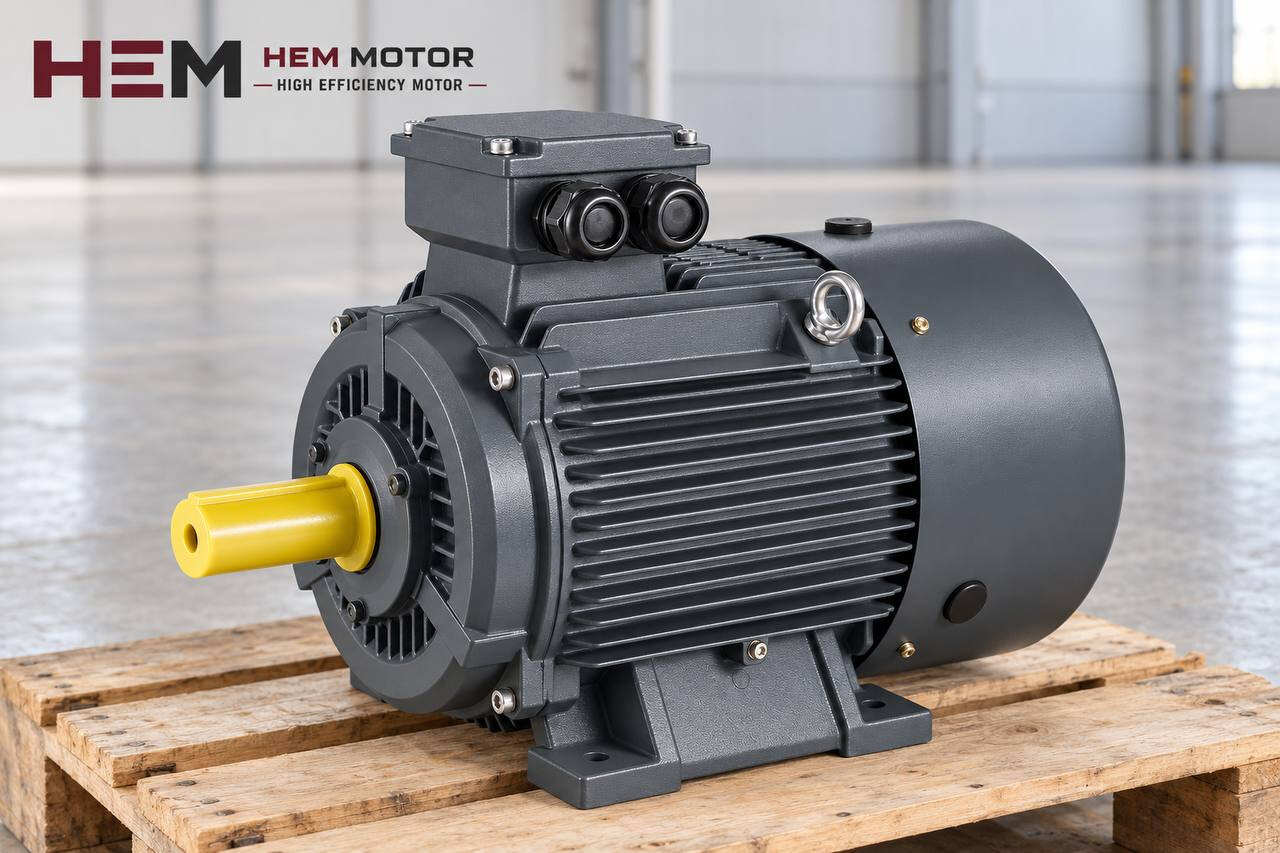
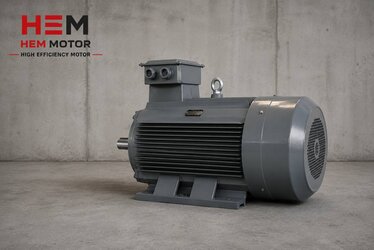
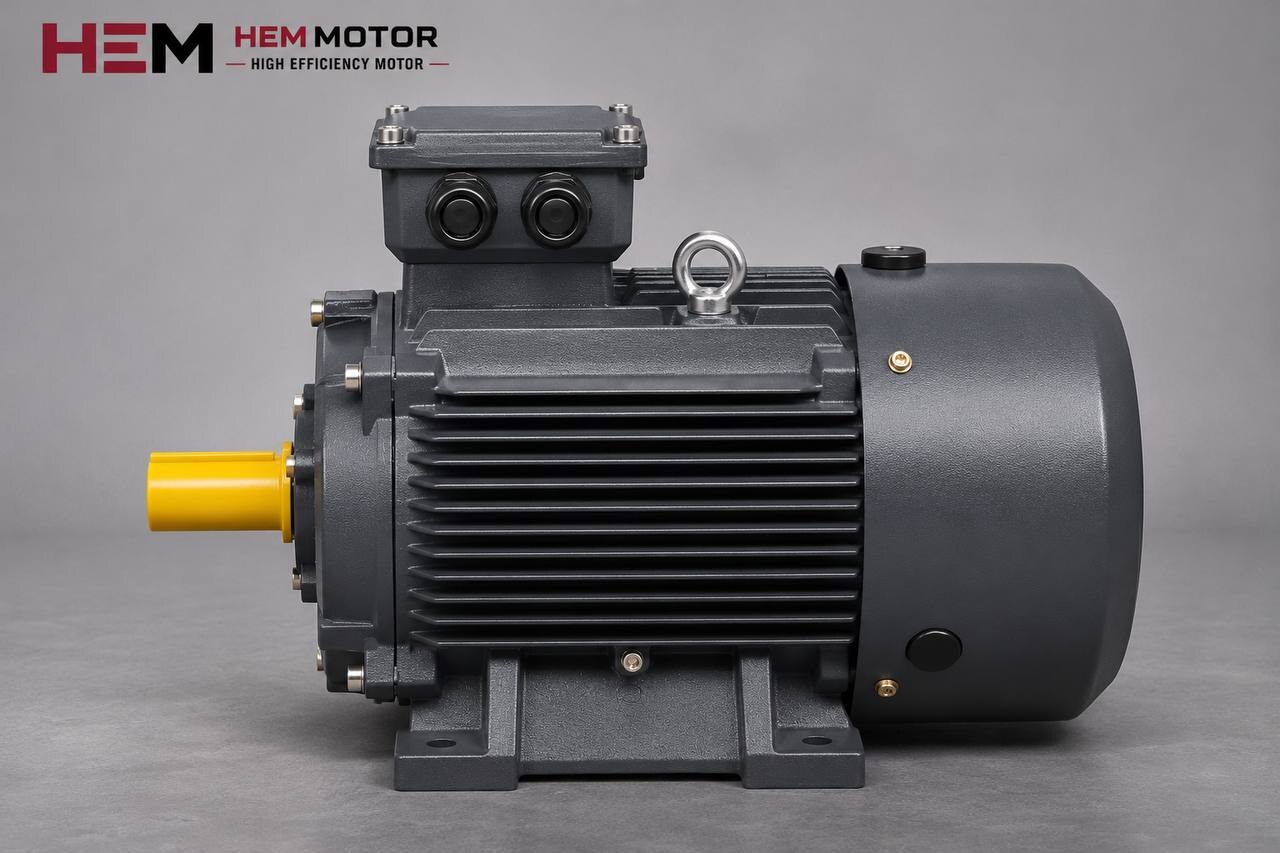
Side view of a B3 foot-mounted three-phase electric motor
Mounting type, frame number and shaft end are the three basic lines in the mechanical section of the form (representative image).

Why do the nameplate and photos help in a replacement?

For a model to replace a failed motor, the fastest route is to start from the old motor's nameplate. The nameplate shows power, speed, voltage connection, current and often the frame number. If the nameplate is unreadable, a clear picture of the motor's foot and shaft side plus a few values taken with a tape measure is enough to estimate the frame.

You can share the nameplate picture and the connection side of the motor using the equivalent motor matching from nameplate steps; the preparing a quote request article complements this with the general framework. While preparing the form, you can follow which power matches which frame on the model cards in our electric motor shop.

What does a completed form look like?

Example pairings for the conveyor calculation above and for a few other loads are given below; all are hypothetical and must be confirmed with the machine's actual data.

  • For the belt conveyor needing 7.1 kW, the 7.5 kW, 4-pole cast iron 132M-4: rated speed 1460 rpm, voltage 400/690 V; on a 400 V site its running connection is delta, so it is suitable for star-delta starting.
  • For a continuously running extraction fan, the 15 kW, 4-pole 160L-4: for this 1465 rpm frame, the inertia of the fan impeller should also be given on the form.
  • For a coupled process pump, the 55 kW, 4-pole 250M-4: for this 1485 rpm model, the starting method and the shaft power requested by the pump manufacturer should appear on the form.

The general purpose industrial motor family page gives an overview of the product group all three models belong to.

What should be checked before sending the form?

Before sending, read the form once more through the eyes of the maintenance team: if one of the lines for voltage and connection, speed, mounting type or environment is empty, complete it first. If there is a difference between the calculated power and the existing nameplate power, noting it avoids misunderstanding. When you send the completed form with any layout drawing and nameplate photo via our contact page, the assessment starts directly with a model proposal. You can compare the models corresponding to the lines on the form by power and speed in the HEM Motor product shop.

Frequently Asked Questions

Can a quote be requested if the power is unknown?

Yes; if the machine's shaft torque and speed or the old motor's nameplate are provided, the power can be calculated. If neither is available, the machine type, capacity and starting method are the starting point for an estimate.

Should both synchronous and rated speed be written on the form?

Synchronous speed determines the number of poles, while rated speed is the actual value on the nameplate. For a replacement, writing the rated speed from the nameplate prevents confusion.

Why does the starting method matter in a quotation?

Star-delta starting requires a winding that can run in delta at supply voltage. With converter operation, the speed range and cable length determine additional options.

Is altitude needed in every quotation?

For sites near sea level it usually makes no difference. At high-altitude sites the air is thinner and cooling weakens; in that case altitude should be stated on the form.

HEM Motor Models Related to This Article

The cards show example models related to the topic. A suitable motor is not chosen by power alone: compare speed, voltage, mounting, shaft and connection dimensions on the product page; if unsure, send a photo of the existing motor’s nameplate on WhatsApp.

7.5 kW 1500 rpm Cast Iron Frame Electric Motor 132M-4

132M-4

7.5 kW · 1500 rpm

  • Cast iron frame · IEC 132M
  • 1460 rpm · IP55
  • Mounting: B3 foot; flange (B5/B14/B35) depending on frame, confirmed with the order

US$387.29 (€354.46)

View product
15 kW 1500 rpm Cast Iron Frame Electric Motor 160L-4

160L-4

15 kW · 1500 rpm

  • Cast iron frame · IEC 160L
  • 1465 rpm · IP55
  • Mounting: B3 foot; flange (B5/B14/B35) depending on frame, confirmed with the order

US$665.08 (€608.69)

View product
55 kW 1500 rpm Cast Iron Frame Electric Motor 250M-4

250M-4

55 kW · 1500 rpm

  • Cast iron frame · IEC 250M
  • 1485 rpm · IP55
  • Mounting: B3 foot; flange (B5/B14/B35) depending on frame, confirmed with the order

US$2,025.96 (€1,854.20)

View product

Similar Articles