English
 Français
 Türkçe
 Español
 Русский
 العربية
 Deutsch
 Italiano

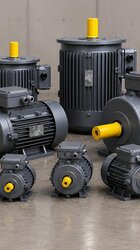
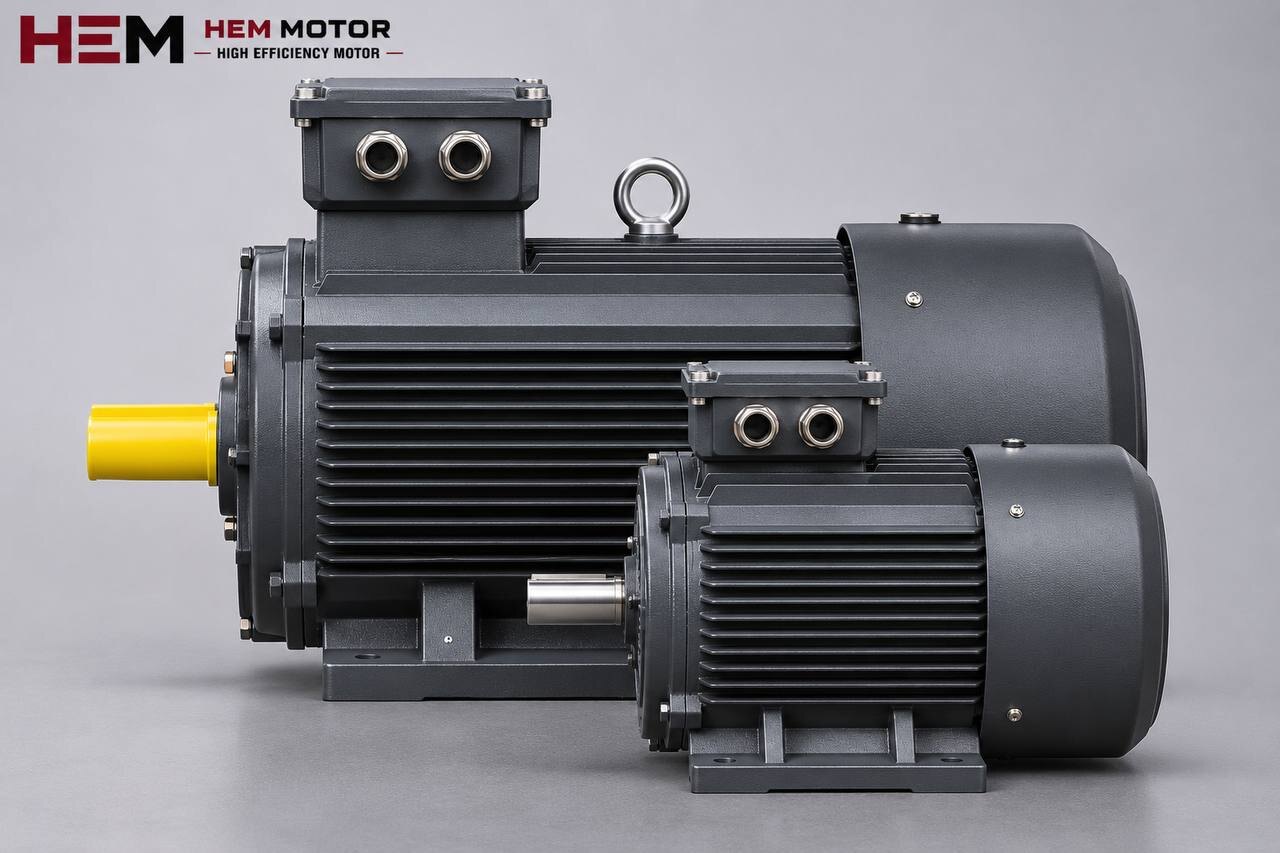

Under IEC 60034-1, the power on the nameplate is defined, unless stated otherwise, for an installation altitude of up to 1000 metres and air not exceeding 40 °C. Higher up the air thins, the fan moves less mass at the same speed, and the winding heats more at the same shaft power. Above 1000 metres the motor is either used at reduced power or the next step up is chosen; the manufacturer's altitude-temperature table gives the ratio.
Why does altitude heat the motor?
The heat of a totally enclosed, externally fan-cooled motor is carried away by the air the fan blows along the frame fins. Air's capacity to carry heat is proportional to its density. As altitude increases, air pressure and density fall; even if the fan moves the same volume, the mass of air carried decreases.
Losses, however, do not change.
At the same shaft power the same heat is produced in the winding, the laminations and the bearings, but less of it is carried away; winding temperature rises as a result.
At high locations the ambient air is usually cooler, and this partly offsets the effect of thinner air. The standard offers an approach that takes this offset into account: at a given altitude, if ambient temperature is low enough, derating may not be needed (general information; confirm with the machine manufacturer).
What changes on the electrical side?
Thin air also has lower dielectric strength. In low-voltage motors this usually concerns not the winding but the clearances in the terminal box and the cable ends. On standard motors running at normal network voltage the practical effect is limited; even so, at very high altitudes the connections in the terminal box must be kept clean and tight, because flashover risk rises when moisture and dust combine.
On motors with a frequency converter, the converter itself is also affected by altitude and has its own derating table. Motor and drive must be checked separately. The two do not use the same table.
How is the derating calculation set up?
The calculation uses two inputs: installation altitude and the highest ambient temperature at that point. The manufacturer's table gives a factor where these two values intersect.
Ppermitted = Pnameplate × kaltitude/temperature
Thinking the other way round is more useful for selection: the shaft power the machine needs is divided by this factor, and the first nameplate power equal to or greater than the result is chosen.
Prequired nameplate ≥ Pshaft / kaltitude/temperature
Because the value of the factor varies with motor design, insulation class and cooling method, giving a general figure would be misleading. Values valid for HEM motors are confirmed with the order once installation altitude and ambient temperature are stated.
Hypothetical example: a mine conveyor at 2500 metres
Suppose a conveyor needs 17 kW shaft power by measurement, and the site is at 2500 metres with a summer shade temperature around 30 °C. Assume a factor of 0.88 is read from the manufacturer's table for this condition, as an example.
Required nameplate power comes out at 17 / 0.88 ≈ 19.3 kW. The 18.5 kW step is not enough; 22 kW is chosen. The same conveyor could run comfortably on an 18.5 kW motor at sea level; you can see the two steps side by side in the electric motor shop. Do not finalise this calculation without taking the factor from your own supplier's table. The difference looks small; its effect is not.
What is the point of class F insulation with class B temperature rise?
The insulation material tells you how much heat the winding will tolerate. The upper limit of class F insulation is above that of class B. Many standard motors are made with class F insulation and designed to stay within class B temperature rise at rated load.
The difference is a thermal margin. In situations such as a short overload, a hot afternoon or high altitude, this margin protects the winding.
Whether this margin can be used in the altitude calculation depends on the design and requires the manufacturer's approval. Pushing a motor at nameplate power at high altitude because "it is class F anyway" quietly shortens winding life. Insulation in the HEM series is class F; if a higher insulation level is needed, it should be discussed before ordering.