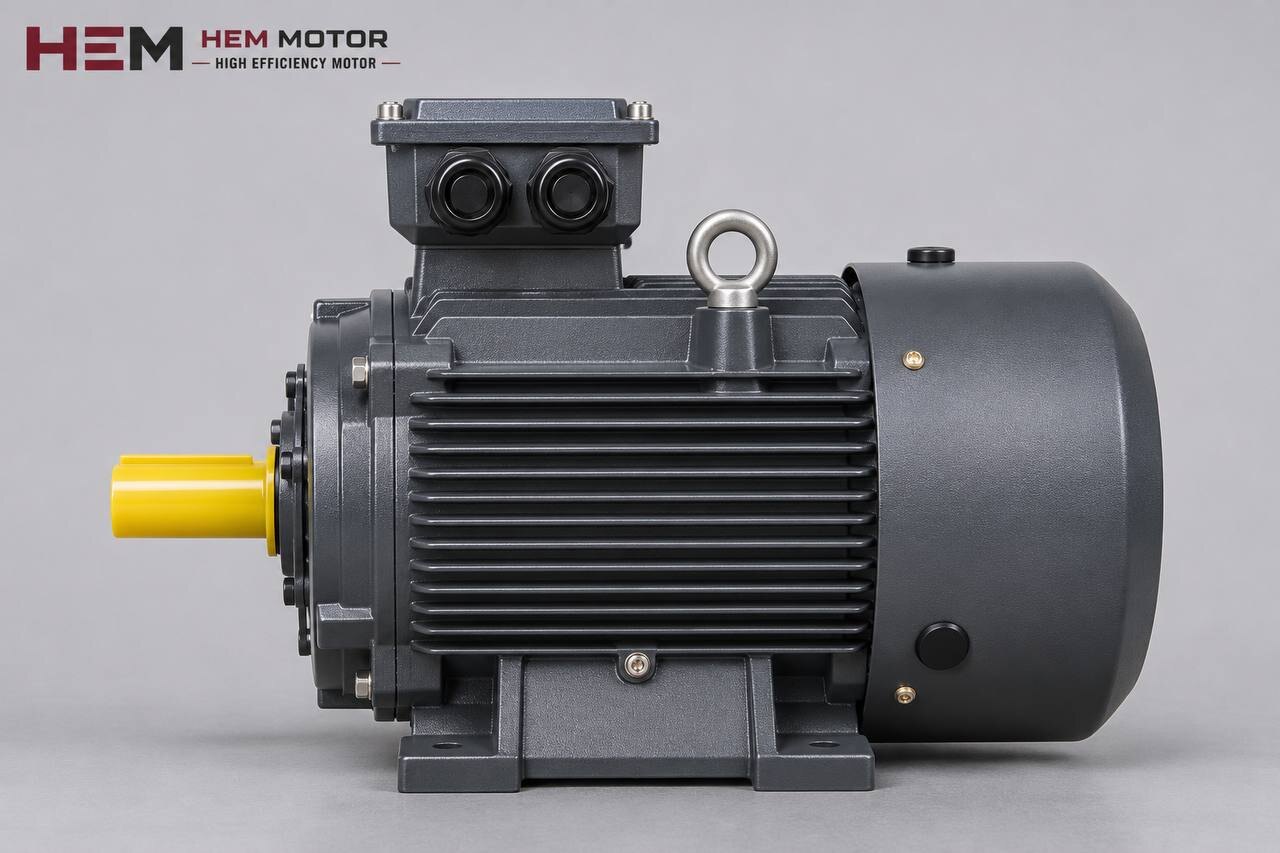
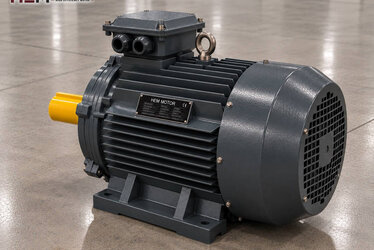
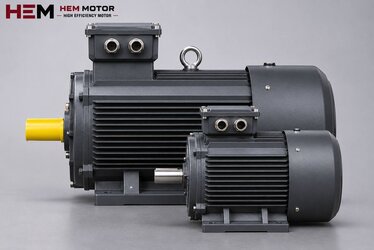
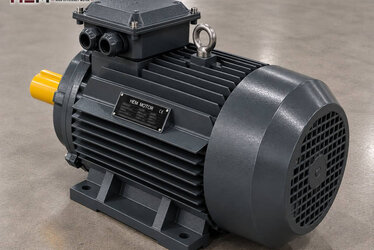
The drain hole at the lowest point of an electric motor's housing exists so that water condensing inside the housing can run out; if paint or coating closes this hole, water collects inside, the insulation resistance of the winding falls, the bearings rust and the motor can fail unexpectedly. On site this small hole is often overlooked when the motor is repainted or its mounting arrangement is changed.
Why does water collect inside the motor?
A totally enclosed machine cooled by its own fan heats up while running and slowly cools once the switch is opened. Meanwhile the air inside contracts and draws outside air in through the labyrinths, around the shaft seal and through the terminal box entry. If this air is humid, it turns into water droplets on the cooling inner surfaces. The housing practically breathes. This cycle repeats with every run-stop cycle. On outdoor sites with large daily temperature swings, in food plants with washdown and in cold stores, a noticeable amount of water can collect inside the housing within a few months. Class IP55 limits dust and hose water coming from outside; it cannot stop the dew that forms inside by itself.
An example shows the scale of the problem. If a pump motor on an outdoor site that reaches 30 °C by day and drops to 10 °C at night starts and stops several times a day, some humid air enters with each cooling. The amount of water at a time is small but builds up over months; if the drain path is closed, it has nowhere to go.
Where is the drain hole and how does it work?
Drain holes are made at the point of the housing that comes lowest when the motor is installed. They are usually in the area of the front and rear end shields, sometimes in the middle of the frame. On some motors the hole is left open, on others it comes closed with a removable plastic plug or screw.
The principle is simple.
Gravity carries water to the lowest point and the hole lets it out. If the hole is not in the right place and open, this arrangement does not work.
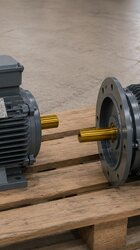
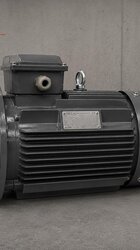
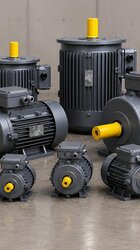
The drain hole must remain at the lowest point of the housing for the mounting arrangement used (representative image).
How does paint close the hole?
After arriving on site, a motor may be repainted to match the plant's colour standard. A thick coat applied by spray or brush easily fills a hole a few millimetres wide. Powder paint or epoxy coating forms a hard skin once dry.
Touch-up paint during maintenance has the same effect. Machine builders sometimes paint the whole machine together with the motor and forget to mask the hole. Even with the hole closed, the motor looks sound from outside. The problem is noticed only when a failure comes.
Another factor that makes checking harder is the small size of the hole. On most frames this opening of a few millimetres sits on the underside of the end shield edge, out of the line of sight. The maintenance team sees the motor from above and from the side; seeing the underside needs a mirror or a torch.
Which failures does a closed drain hole cause?
Symptom
Probable cause
What is seen on site
Low insulation resistance
Lower part of the winding exposed to water or humid air
Low value in the megger test, residual current device tripping
Bearing noise and vibration
Water entering the bearing housing, grease breaking down
Rust marks, darkened grease, rising noise
Phase-to-frame short circuit
Winding overhangs sitting in water for a long time
Fuse or breaker tripping at the first start
Rust in the terminal box
Water collected inside evaporating and condensing
Oxidised connection screws
The most dangerous moment is the first start after a long standstill. Water collected in a motor that has cooled over the weekend can short the winding to the frame when voltage is applied on Monday morning.
Prices and technical data are on the product pages; choose a model and order online.
What happens when the mounting arrangement changes?
The position of the drain holes is set according to the mounting arrangement ordered. A hole made for a horizontal foot-mounted (B3) motor no longer sits at the bottom when the motor is mounted vertically (V1, V5) or hung from the ceiling. Water collects at the new lowest point and cannot get out.
That is why, if the motor will be used in a different position, the mounting arrangement must be stated clearly in the order. If the position of an existing motor is to be changed, whether there is a suitable drain at the new lowest point should be assessed with an authorised service. The technical drawings can be used for mounting dimensions. Vertical and flange options appear with their mounting arrangement in the shop list.
Which checks should be made during maintenance?
Find the drain hole or plug at the lowest point for the motor's mounting arrangement.
If it is closed by paint or dirt, open it carefully with a thin wire or suitable tip while the motor is de-energised; do not go deep enough to touch the winding.
On the plugged type, remove the plug at regular intervals to drain the water, then refit it.
If water comes out, measure insulation resistance before running the motor.
When repainting, mask the hole with tape or a plug.
In washdown areas and on sites with large temperature changes it is good practice to write this check into the periodic maintenance list. During long standstills an anti-condensation heater also reduces moisture build-up. The sequence to follow when starting a machine that has stood for a long time is described in the motor commissioning guide.
Which models can be chosen for applications exposed to moisture?
Three four-pole steps often used on drives in washdown areas and outdoors:
90S-4: 1.1 kW, 1445 rpm, 2.48 A at 400 V, 7.27 Nm, aluminium frame.
100L1-4: 2.2 kW, 1450 rpm, 4.52 A at 400 V, 14.5 Nm, aluminium frame.
112M-4: 4 kW, 1450 rpm, 7.95 A at 400 V, 26.3 Nm, cast iron frame.
All three models are built to IP55 with class F insulated windings; an anti-condensation heater and PTC thermistor can be added as order options. The mounting arrangement and drain position are stated with the order. You can compare options by mounting arrangement in the electric motor shop and see the whole frame family on the asynchronous electric motors page.
If you share the nameplate of the motor to be replaced and the position it is mounted in via our motor nameplate submission page, we will determine the equivalent model and the suitable mounting arrangement together. The information needed for a quotation is in the quotation request guide. Current prices by model are listed on the HEM Motor sales page.
Frequently Asked Questions
Does a drain hole lower the motor's protection class?
A drain hole of the right size in the right place is part of the protection class design. The real risk is the hole being closed or ending up in the wrong position.
Is it right to leave the plug open permanently?
It depends on the environment. In dusty surroundings the plug is kept fitted and opened at intervals; in very humid surroundings an open drain may be preferred. The manufacturer's instructions apply.
Can the motor be run if water came out of the hole?
Insulation resistance is measured first. If the value is low the motor is dried; no voltage is applied until the measurement returns to normal.
What should be watched when repainting a motor?
Drain holes, nameplate, the rubber gasket of the terminal box and the front seal should be taped over. A thick coat of paint can also reduce heat dissipation from the cooling fins.
HEM Motor Models Related to This Article
The cards show example models related to the topic. A suitable motor is not chosen by power alone: compare speed, voltage, mounting, shaft and connection dimensions on the product page; if unsure, send a photo of the existing motor’s nameplate on WhatsApp.
Checking that electric motor pulleys lie in the same plane means seeing whether the side faces of both pulleys meet on one straight line. In practice a taut string, a steel straigh... More Details
If an electric motor's coupling element fails often, the first thing to investigate is shaft misalignment, followed by coupling selection, starting and shock loads, environmental e... More Details
The quickest way to tell foundation looseness from unbalance in electric motor vibration is to loosen the foot bolts one at a time while measuring and watch the change, and to comp... More Details
When building a sound enclosure around an electric motor, cooling is preserved by giving the enclosure a labyrinth or silenced inlet large enough for the air the motor fan draws, p... More Details
In an electric motor running in a hot environment, winding and bearing temperatures are monitored separately because they heat up from different sources, have different limits and ... More Details
When an electric motor is started for the first time at sub-zero temperatures, three things need checking: winding insulation resistance and any moisture or ice inside, bearing gre... More Details
We use necessary and optional cookies to improve your experience, enhance content and analyse traffic. Under the GDPR, optional (analytics/marketing) cookies are only used with your explicit consent. Please choose your preference below.
Cookie Policy
 English
 Français
 Türkçe
 Español
 Русский
 العربية
 Deutsch
 Italiano