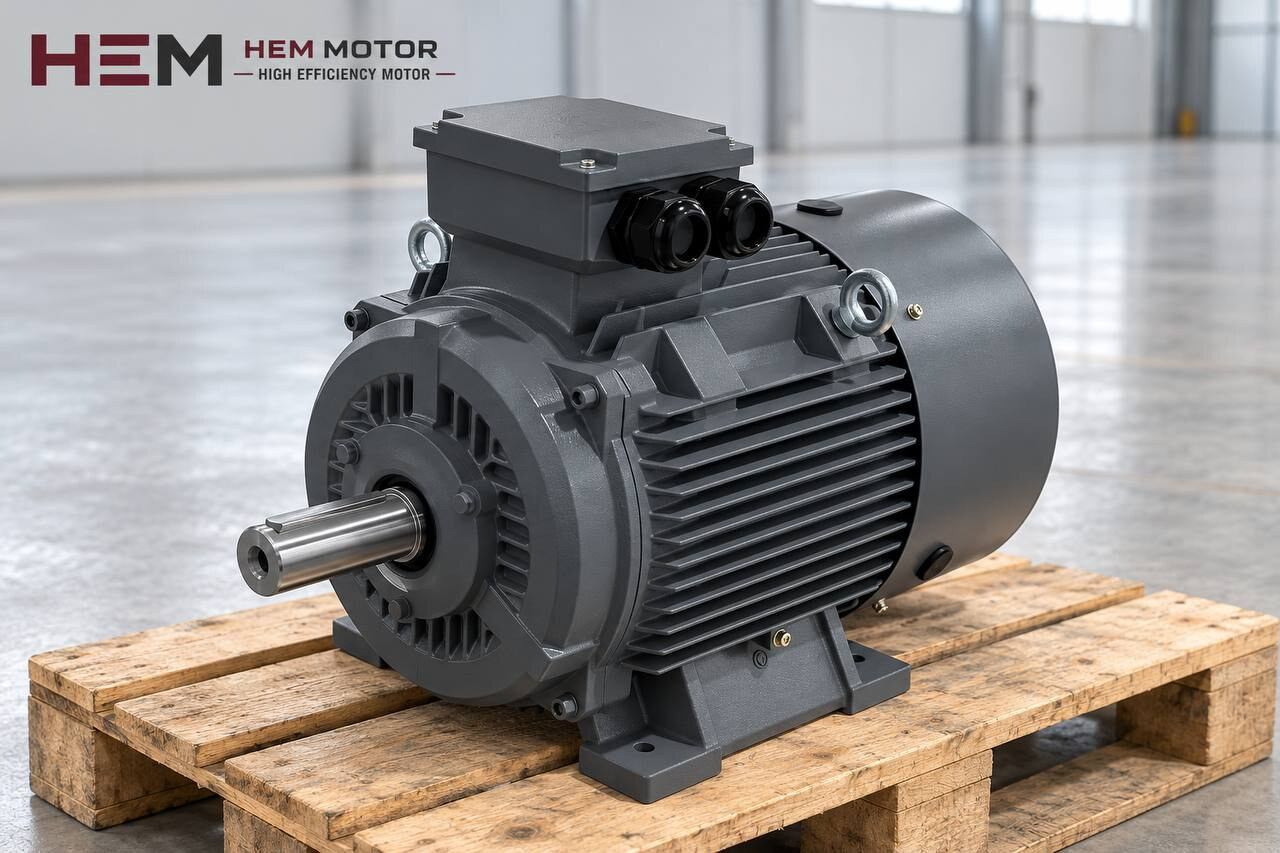
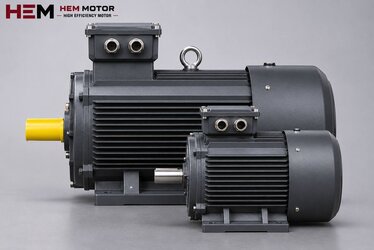
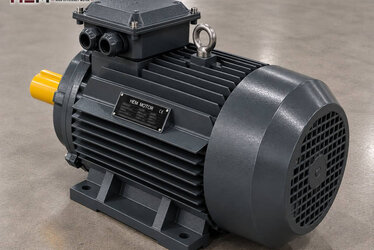
In an electric motor built to the IEC standard, direction of rotation is defined from the shaft side, that is, looking at the motor's drive end from the front. A catalogue or nameplate that says "clockwise" speaks for the person facing the shaft end; someone looking from behind the fan cover sees the same rotation as anticlockwise, and most of the confusion starts there.
From which end does IEC define direction of rotation?
IEC 60034-8 defines direction of rotation for an observer facing the drive end (D end, the side where the shaft comes out). The same standard also sets the relationship between terminal markings and phase sequence: if phases L1, L2, L3 are connected to terminals U1, V1, W1 in that order, a person standing facing the drive end sees the shaft turn clockwise (general information; for details see the standard itself and the motor manufacturer's connection diagram).
HEM Motor's motors are built to the IEC standard.
If direction information appears on the nameplate or in technical documentation, it should be read as seen from the shaft side unless stated otherwise.
NEMA MG 1 documents used in North America define the viewing end differently; the reference is usually the end opposite the drive. So the same motor can be called "clockwise" in one catalogue and "anticlockwise" in another. When comparing drawings from two different sources, first noting which end is being viewed settles half the arguments on site from the start (general information).
Why do direction arguments come up so often on site?
Because there are three separate markings describing the motor, the pump and the fan at the same time, and their reference ends may not match. The motor document takes the shaft end as its basis. The arrow on the pump casing shows the impeller's direction, and the arrow on the fan scroll shows the fan's own rotation.
A typical scene goes like this.
The electrician connects the motor, looks from behind the fan cover and says "it turns clockwise, that's right". The mechanic looks from the pump side, sees the arrow on the pump casing and says the direction is wrong. Both are right. The problem is that nobody states the reference end. What decides is the arrow on the pump casing, because the impeller is designed for that direction. The motor's "correct" direction is the direction the machine it drives wants.
Belt drives add one more layer of confusion: pulleys turn the motor and the machine in the same direction, but once a gear stage comes in between, direction reverses. On geared drives, the input and output direction information on the gearbox label is checked separately.
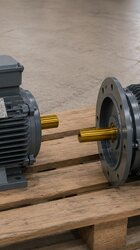
Under IEC, direction of rotation is defined looking at this end, the shaft side, from the front (representative image).
How is direction checked before connecting to the machine?
The safest way is to measure the supply's phase sequence with a phase rotation tester and, before fitting the coupling, run the motor very briefly and watch the direction from the shaft end. Even a single start in the wrong direction with the coupling fitted leaves damage in some machines.
Connect the phase rotation tester to the L1, L2, L3 terminals at the panel output and note that the sequence is correct.
Connect the motor cables to terminals U1, V1, W1 in the same order; place the links according to the connection shown on the nameplate.
Without fitting the coupling or belt, tape the key on the shaft end and run the motor with a one-second "bump".
Look at the shaft end from the front, note the direction and compare it with the direction the driven machine wants.
If the direction is wrong, isolate the power, lock it and swap two of the supply cables with each other.
If the coupling cannot be removed, direction is followed with a small piece of tape stuck to the motor's fan blades or shaft end while the motor runs down. Looking through the fan cover grille is easy, but then you must remember you are looking from the fan side.
Prices and technical data are on the product pages; choose a model and order online.
On which machines does reverse rotation cause real damage?
On some machines reverse rotation is only a loss of efficiency; on others it means mechanical damage in the first second. The difference is whether the machine contains a threaded connection, a one-way element or a direction-specific seal.
Machine
What happens in reverse
Risk
Centrifugal pump
Pressure and flow fall, current often looks normal
Long inefficient running without anyone noticing
Pump with impeller threaded on the shaft
Impeller nut can loosen
Impeller rubbing on the casing
Screw compressor
Pushes towards suction instead of discharge
Serious damage to the compressor block
Radial fan
Air flows but flow rate drops clearly
Wrong adjustment and an unnecessarily large motor choice
Screw conveyor and belt conveyor
Material is carried the wrong way
Overflow and jamming at the feed inlet
The trap with a centrifugal pump is this: it delivers some water even in reverse. The pressure gauge is not at zero and the motor does not draw excess current; you need to compare with the curve to see that the pump is running at half capacity. That is why checking at commissioning whether pressure and flow match the pump label is the first job. The nameplate speeds of pump motors are shown on each product card on our shop page.
Does the motor's own fan cool in both directions?
In standard asynchronous motors the cooling fan usually has straight blades and cools the motor in both directions of rotation. Some large-frame two-pole motors, however, may use a unidirectional, angled-blade fan for noise and efficiency; if these motors run in reverse, cooling weakens.
If there is a direction arrow on the fan cover or the frame, the motor is prepared to run in that direction. If there is no arrow and the application needs running in both directions, this should be stated when ordering. For HEM Motor models, confirm when ordering whether the fan type suits both directions. The practical way to tell on site is to hold your hand in front of the fan cover grille while the motor runs idle for a few minutes in one direction and then the other, and compare the strength of the airflow; with a unidirectional fan a clear weakening is felt in reverse. For a precise comparison, an anemometer reading is taken at the same point. Frame temperature is watched too: a motor with a unidirectional fan running long in reverse gives a hotter frame at the same load.
For applications running in both directions (a conveyor that backs up, a mixer that also turns the other way), one more thing should be considered: if the motor is started in reverse before it has fully stopped during a direction change, the current and torque surge becomes very large. A short wait between the two directions in the control spares both the motor and the gearbox teeth from this surge.
How should direction be written in an order or quotation?
If direction is to be written, the reference end must be written too: for example "clockwise viewed facing the drive end". "Turns right" or "clockwise" on its own is misunderstood at quotation stage because it does not say who is looking from where.
In most standard applications motor direction is not stated in the order, because it is set on site by swapping two phases. The cases that need stating are those affecting the motor's construction, such as a unidirectional fan, a direction-specific shaft seal or running in both directions. Our quotation request guide lists step by step which details are useful when asking for a quote; for first-start checks, our commissioning list also includes the direction test.
Examples often chosen for centrifugal pump and fan drives:
100L-2: cast iron, 3 kW, 2895 rpm, 5.71 A at 400 V, 230/400 V. For small centrifugal pumps.
132S1-2: cast iron, 5.5 kW, 2930 rpm, 10.1 A at 400 V, 400/690 V. For booster and process pumps.
180L-4: cast iron, 22 kW, 1470 rpm, 39.7 A at 400 V. For radial fans and large circulation pumps.
Selection notes specific to pump applications are on the pump electric motors page, and you can find all power steps with their prices in our electric motor shop.
If there is a direction arrow on the old motor's plate or on the machine, send a photo showing the arrow and the plate in the same frame via our find-an-equivalent-from-the-nameplate page; we will clarify together what to watch for regarding fan type and connection. Other models are on the HEM Motor sales page.
Frequently Asked Questions
What is done to reverse a three-phase motor?
After the power is isolated and locked, any two of the supply cables are swapped. Moving the links does not reverse the direction; it spoils the connection type.
If there is no direction arrow on the plate, does the motor run in both directions?
Most standard motors run in both directions. With a unidirectional fan or a direction-specific seal there is usually an arrow; if you are not sure, confirm when ordering.
How is direction reversed on a single-phase motor?
On single-phase motors, direction is reversed by swapping the connection ends of the auxiliary winding. The connection diagram is inside the terminal box cover.
Can direction be checked without a phase rotation tester?
It can; the coupling is removed and the motor is run briefly while watching from the shaft end. A tester, however, lets you know the direction in advance without running the motor at all.
HEM Motor Models Related to This Article
The cards show example models related to the topic. A suitable motor is not chosen by power alone: compare speed, voltage, mounting, shaft and connection dimensions on the product page; if unsure, send a photo of the existing motor’s nameplate on WhatsApp.
Checking that electric motor pulleys lie in the same plane means seeing whether the side faces of both pulleys meet on one straight line. In practice a taut string, a steel straigh... More Details
If an electric motor's coupling element fails often, the first thing to investigate is shaft misalignment, followed by coupling selection, starting and shock loads, environmental e... More Details
The quickest way to tell foundation looseness from unbalance in electric motor vibration is to loosen the foot bolts one at a time while measuring and watch the change, and to comp... More Details
When building a sound enclosure around an electric motor, cooling is preserved by giving the enclosure a labyrinth or silenced inlet large enough for the air the motor fan draws, p... More Details
In an electric motor running in a hot environment, winding and bearing temperatures are monitored separately because they heat up from different sources, have different limits and ... More Details
When an electric motor is started for the first time at sub-zero temperatures, three things need checking: winding insulation resistance and any moisture or ice inside, bearing gre... More Details
We use necessary and optional cookies to improve your experience, enhance content and analyse traffic. Under the GDPR, optional (analytics/marketing) cookies are only used with your explicit consent. Please choose your preference below.
Cookie Policy
 English
 Français
 Türkçe
 Español
 Русский
 العربية
 Deutsch
 Italiano