The L10h value shows the operating hours that ninety percent of a group of identical bearings running under the same conditions will reach without fatigue damage; in other words it describes the statistical life of a population, not how long a single bearing will last. In an electric motor this value depends on load, speed and lubrication, and the catalogue figure only holds if those conditions are met.
Which formula is the L10h calculation based on?
Basic life is found from the ratio between the bearing's dynamic load rating C and the equivalent load P acting on it, raised to a power. The basic expression in ISO 281 is as follows (general information; confirm with the machine manufacturer):
L10 = (C / P)p million revolutions
L10h = 106 / (60 × n) × (C / P)p hours
Here n is speed in rpm, and p is 3 for ball bearings and 10/3 for roller bearings. Because the exponent is large, the ratio is very sensitive to small changes. A ten percent increase in load cuts ball bearing life by roughly a quarter.
That is why the load estimate matters. Current and torque values of the steps can be compared on the electric motor sales page.
Why does speed affect life directly?
In the formula n is in the denominator. If the same bearing under the same load turns twice as fast, its life in hours halves, because fatigue accumulates with the number of revolutions. The bearing of a 2-pole motor at 3000 rpm gives a shorter life in hours at the same load when compared with a four-pole machine at 1500 rpm.
Hypothetical example: let the C/P ratio of a ball bearing be 8. (8)3 = 512 million revolutions. At 1500 rpm that means 512 × 106 / (60 × 1500) ≈ 5700 hours, at 3000 rpm ≈ 2850 hours. If the ratio rises to 12, (12)3 = 1728 million revolutions, ≈ 9600 hours at 3000 rpm.
The figures only show the effect of the ratio; the real C value comes from the bearing catalogue and P from the application's load calculation.
Where does the bearing load in a motor come from?
The electric motor's own rotor is light and balanced; the main source of bearing load is the drive element fitted to the shaft. Three sources stand out.
Belt tension: in a pulley drive the belt pulls the shaft end sideways. As pulley diameter gets smaller, the belt force needed for the same torque grows and radial load rises.
Coupling misalignment: in a direct coupled drive, axis offset puts a rotating extra load on the bearing.
Axial load: in vertical mounting, rotor weight, the hydraulic thrust of a pump impeller or helical gear forces act along the shaft.
Each of these increases P. A mistake maintenance teams often make is tensioning the belt more than needed “to be safe”. The tension value given by the belt manufacturer should be checked with a tension meter.
How far from the shaft end the pulley is fitted also matters. The further out the pulley sits on the shaft, the longer the lever arm and the higher the load on the front bearing; so push the pulley in until it rests against the shaft shoulder.
Why may the catalogue L10h not hold on site?
The basic formula only calculates fatigue; it does not include lubrication quality, contamination or temperature. ISO 281 brings these effects into a modified life calculation with the aISO correction factor. In a dirty or hot environment this factor can fall well below one.
On site most bearings die from causes other than fatigue. Depleted grease or the wrong grease being pumped in, dust and moisture ingress, hammering the bearing during assembly and shaft currents in converter-fed motors are the most frequent causes. In these cases the bearing fails far below its L10h value.
Do not write life down by guesswork.
Temperature acts in two ways. Grease thins and oxidises at high temperature, so the relubrication interval shortens. As the bearing housing heats up, internal clearance also changes. As a rough rule, grease life shortens noticeably with each rise of operating temperature above a certain value; the exact interval is taken from the grease manufacturer's table (general information; confirm with the machine manufacturer).
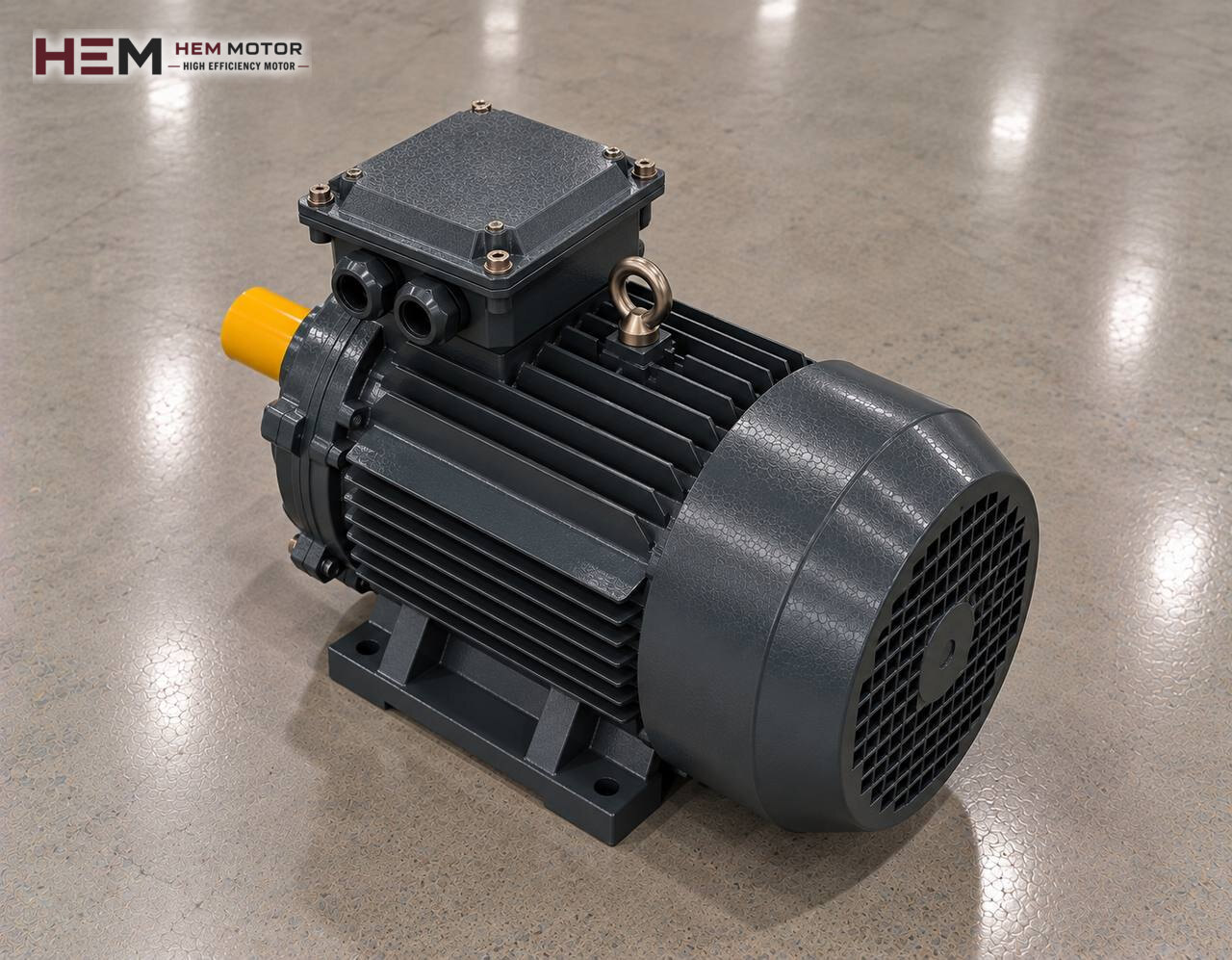
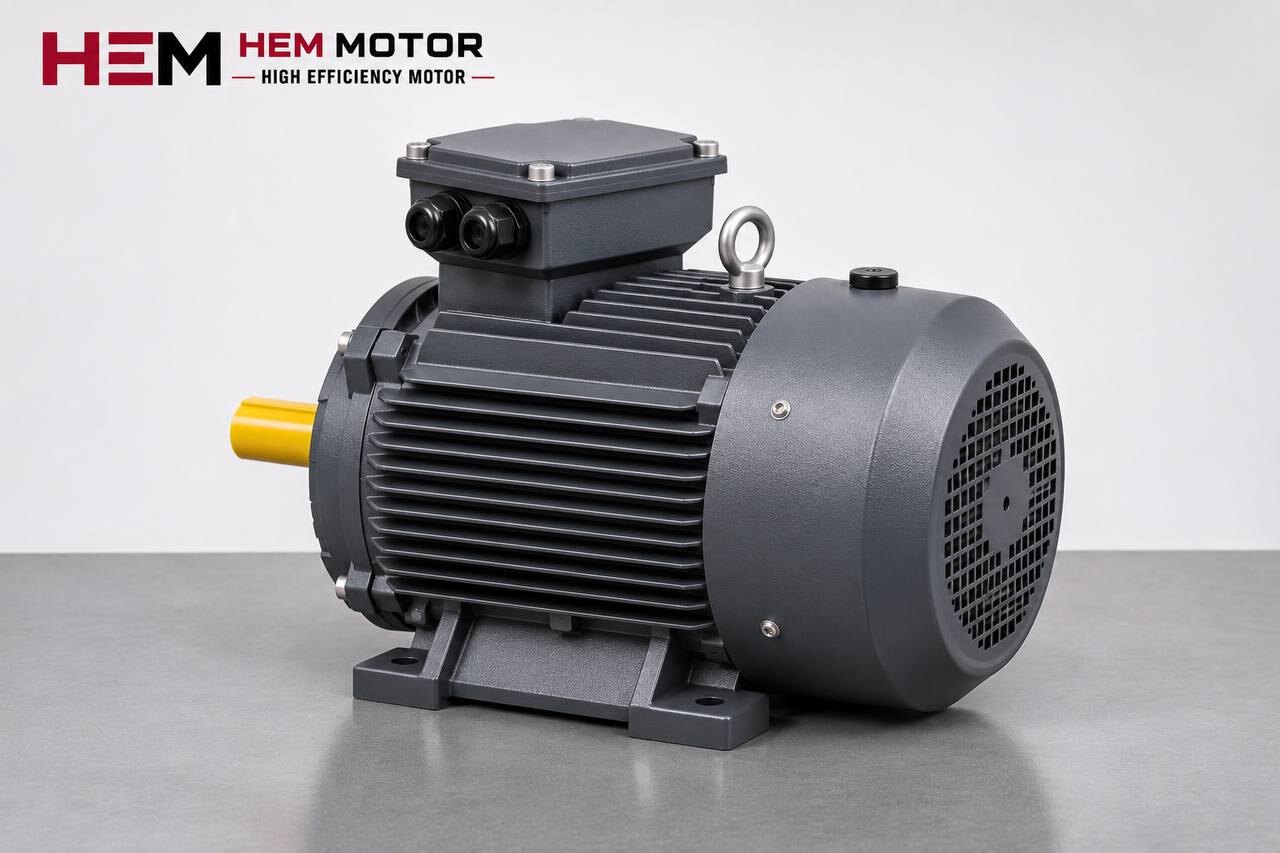
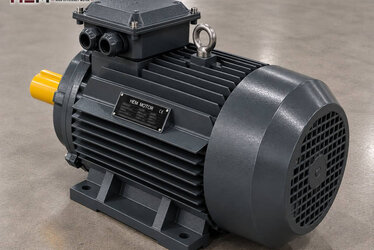
The load and temperature that set bearing life depend as much on how the drive element is mounted as on the motor (representative image).
Prices and technical data are on the product pages; choose a model and order online.
L10h is a planning value; the real condition of the bearing is followed by measurement. Three simple methods are enough for most plants.
Vibration: overall vibration level in velocity (mm/s) on the bearing cover is recorded regularly. A rise over time means more than the absolute value. The ISO 10816 / ISO 20816 series is the framework used for assessment.
Temperature: both bearing covers are read with an IR gun, each time from the same marked point. A difference between the two covers, or one cover rising on its own, shows that something has changed.
Sound: regular listening with a stethoscope or ultrasonic listening device can catch early damage before vibration does.
Keep records in date order. A single value means little on its own; the trend tells everything.
If a spare motor is waiting on the shelf, its bearing is affected too. In a motor that has not turned for a long time grease collects at one point and marks can form on the raceways on a vibrating floor; for this the measures in the keeping a spare motor on the shelf article are applied.
How is the calculation set up for an application?
The job of the site engineer is to roughly estimate the load on the bearing and set the required life before choosing the motor. The information needed:
Information
Source
Role in the calculation
Motor speed
Plate
n in the formula
Pulley size, belt profile
Measurement on the drive
Radial load
Pulley position on the shaft
Measurement
Lever arm
Mounting and axial force
Machine documents
Equivalent load P
Ambient temperature and dust
Site observation
Correction factor
Desired maintenance interval
Maintenance plan
Target life
With this information, life is found using the bearing manufacturer's calculation tool or catalogue table. If the result falls short of the target, the pulley diameter is increased, the drive is changed to a coupling or a motor with a larger frame is chosen.
At commissioning, bearing sound, vibration and cover temperatures should be recorded as the first reference; the commissioning checklist lists these measurements.
Which models are considered for high-speed motors?
The effect of speed on life is felt most on 2-pole motors. 2-pole steps from the cast iron frame series often used in fan and pump applications:
160M1-2: 11 kW, 2945 rpm, 400/690 V (Δ/Y), 19.6 A at 400 V, 35.7 Nm.
160M2-2: 15 kW, 2945 rpm, 26.5 A at 400 V, 48.6 Nm.
160L-2: 18.5 kW, 2940 rpm, 32.5 A at 400 V, 60.1 Nm.
The bearing type and brand used in these models are confirmed with the order; bearing size is given in the technical and product catalogue and the technical drawings. If radial load is high in a belt drive, state this with the order. All steps can be seen in the electric motor store.
Send the pulley size, belt profile, mounting and a plate photo of the existing motor through the find an equivalent from the nameplate page; we will assess together an arrangement that reduces bearing load. Prices can be seen in the HEM Motor sales list.
Frequently Asked Questions
If L10h = 20,000 hours is stated, will the bearing last 20,000 hours?
It is a statistic, not a promise. Ten percent of bearings running under the same conditions may fatigue before this time; if lubrication and contamination conditions are poor, the share is higher.
Does bearing life increase if the motor is changed to 4-pole?
Yes, because life in hours at the same load is inversely proportional to speed. But since the speed the machine needs will change, this decision is made with the machine manufacturer.
At what bearing temperature is there a problem?
The trend is looked at rather than a single limit. A clear rise compared with earlier records at the same load, or a growing difference between the two covers, is a situation to investigate.
Why can a bearing fail earlier in a drive-fed motor?
The common mode voltage produced by the frequency converter can pass small currents from shaft to bearing and from there to the frame. In applications with long cables and high power, an insulated bearing or a shaft grounding ring is considered; this option is asked about with the order.
HEM Motor Models Related to This Article
The cards show example models related to the topic. A suitable motor is not chosen by power alone: compare speed, voltage, mounting, shaft and connection dimensions on the product page; if unsure, send a photo of the existing motor’s nameplate on WhatsApp.
Checking that electric motor pulleys lie in the same plane means seeing whether the side faces of both pulleys meet on one straight line. In practice a taut string, a steel straigh... More Details
If an electric motor's coupling element fails often, the first thing to investigate is shaft misalignment, followed by coupling selection, starting and shock loads, environmental e... More Details
The quickest way to tell foundation looseness from unbalance in electric motor vibration is to loosen the foot bolts one at a time while measuring and watch the change, and to comp... More Details
When building a sound enclosure around an electric motor, cooling is preserved by giving the enclosure a labyrinth or silenced inlet large enough for the air the motor fan draws, p... More Details
In an electric motor running in a hot environment, winding and bearing temperatures are monitored separately because they heat up from different sources, have different limits and ... More Details
When an electric motor is started for the first time at sub-zero temperatures, three things need checking: winding insulation resistance and any moisture or ice inside, bearing gre... More Details
We use necessary and optional cookies to improve your experience, enhance content and analyse traffic. Under the GDPR, optional (analytics/marketing) cookies are only used with your explicit consent. Please choose your preference below.
Cookie Policy
 English
 Français
 Türkçe
 Español
 Русский
 العربية
 Deutsch
 Italiano