English
 Français
 Türkçe
 Español
 Русский

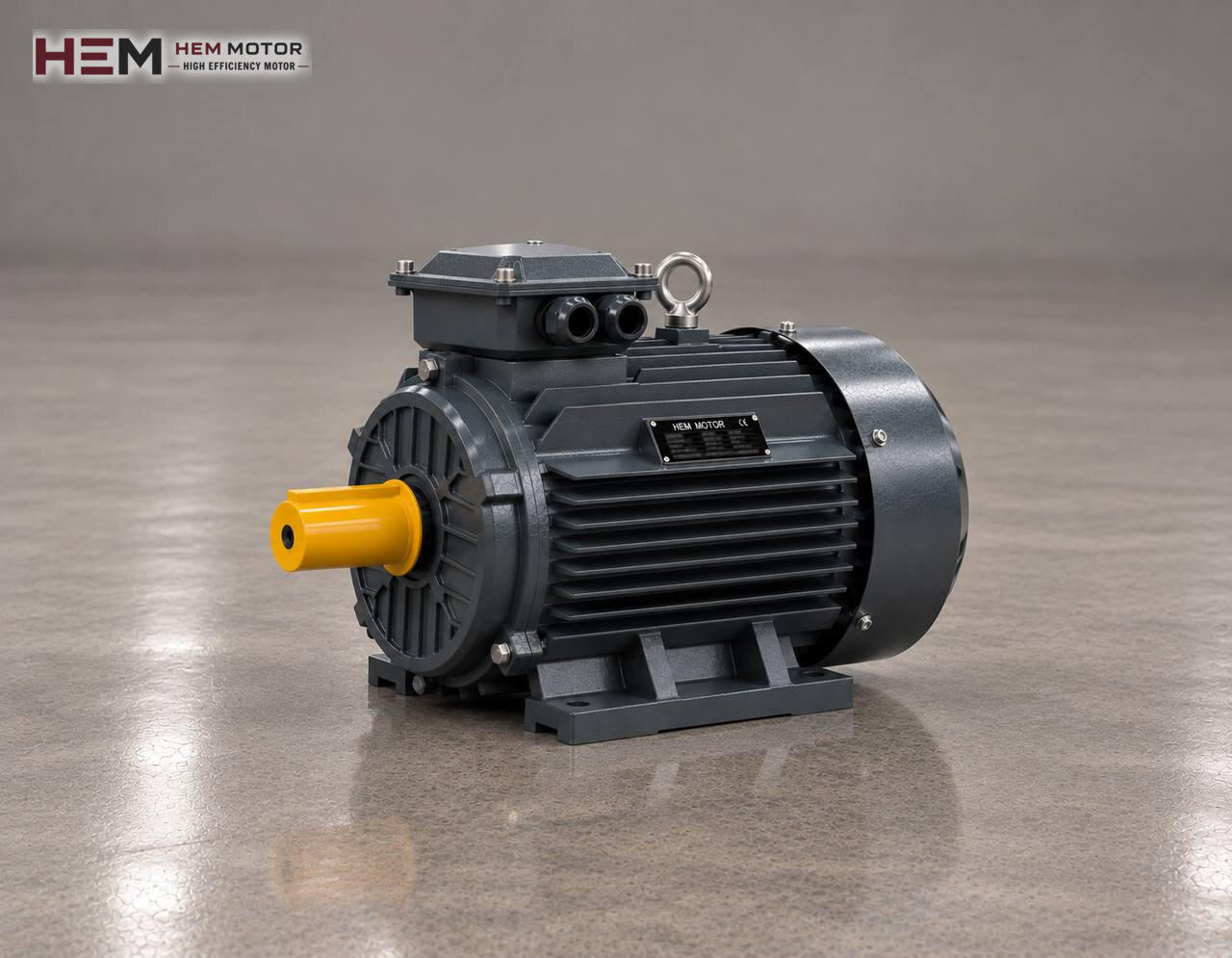
A grain seed cleaner sorts grain coming from threshing, or grain set aside as seed, by size, shape and weight; it separates broken kernels, weed seeds, straw and dust. Several different mechanisms do this work together, and each one has its own motor. This page focuses on the motors that drive the cleaner's sieve box, air channel and cylinders; for the other machines on the farm, the agricultural machinery electric motors page gives a general overview.

By which properties does the cleaner separate grain?
The first separation is done with air. As grain falls in a curtain, an upward air stream carries off light husks, dust and empty kernels. The grain then passes over perforated sieves stacked one above the other: the top sieve holds back large foreign matter and the bottom sieve lets broken and shrivelled kernels fall through. These two steps form the basis of the classic air-screen cleaner.
In plants preparing seed, the work does not end there. A slowly rotating cylinder called an indented cylinder separates short, round kernels from long ones using small pockets on its inner surface. A gravity table sorts kernels of the same size by specific weight on an inclined, vibrating deck with air blown from below. Some lines end with a seed treating machine.
Sieve box: crank-driven oscillation
The sieve box is usually shaken back and forth by an eccentric or crankshaft. The motor turns this shaft via a belt and pulleys; the box moves forward and back once per turn. This motion puts a pulsating torque on the motor: torque rises at the points where the box changes direction and falls in between. In large cleaners two boxes oscillate in opposite directions to partly balance this pulsation.
With a belt drive the motor bearing carries a side load, and vibration from the box can reach the motor base. That is why the motor mounting bolts should be checked periodically and belt tension maintained. Since the number of oscillations is set by the pulley ratio, the new motor's speed must match the old one; otherwise the grain flow over the sieve changes.
Air channel fan and aspiration
The fan that performs air separation sits on top of or beside the machine and is usually mounted directly on the motor shaft. Air volume is adjusted with a damper; on some newer machines fan speed is changed with an inverter instead. The power drawn by the fan rises quickly with speed; the relationship is roughly cubic and the exact value depends on duct resistance.
The fan motor stands where dust is heaviest. Separated husks and dust go to a cyclone or filter, but fine dust is always present around the machine. IP55 protection limits dust entry into the frame; blowing the motor fins and fan cover clean with air at the end of every shift keeps cooling effective. In an area classified for dust explosion risk, a standard IP55 motor is not designed for that condition; such a zone must be stated in the order.
Indented cylinder and gravity table
The indented cylinder turns at a few tens of revolutions per minute; the motor is connected through a gearbox and the load is steady and even. Starting the cylinder full is not difficult, but in a geared arrangement the choice of foot or flange motor and the shaft size must match the gearbox. For geared applications, see the electric motors for reducers page.
A gravity table has two separate drives: the eccentric mechanism that shakes the deck and the fan or fans blowing air from below. Deck slope, vibration frequency and air volume are adjusted together. On these machines an inverter is used to fine-tune vibration and air. Our three-phase series can be driven by an inverter; where long periods at full load and low speed are expected, extra cooling and cable length are assessed at the time of order.
Small operations and single phase
Small village-scale seed cleaning machines often use a single motor to turn both the sieve and the fan. On a single-phase supply, the single-phase electric motor series in the 0.18–5.5 kW range can be an option for such machines. On a motor that turns several mechanisms by belt, starting torque becomes important; the choice should follow the machine manufacturer's data.
Example HEM models and selection table
On a medium sieve box, the 2.2 kW aluminium 100L1-4 delivers 14.5 Nm at 1,450 rpm. For the air channel fan, the 3 kW aluminium 100L2-4 (1,450 rpm, 19.8 Nm) is a model worth looking at. On heavy boxes needing a slower pulley speed, the 6-pole 3 kW cast iron 132S-6 produces 29.6 Nm at 968 rpm. At the input of the indented cylinder gearbox, the 1.5 kW cast iron 90L-4 (1,445 rpm, 9.91 Nm) can serve as an example.
| Cleaner section | Nature of the load | What to check | Example HEM model |
|---|---|---|---|
| Eccentric sieve box | Pulsating torque, vibration | Pulley ratio, base rigidity | 100L1-4, 2.2 kW |
| Air separation fan | Continuous, dusty environment | Direct or belt drive, damper or inverter | 100L2-4, 3 kW |
| Heavy, slow-oscillating box | High torque, low speed | Number of poles, belt load | 132S-6, 3 kW |
| Indented cylinder | Smooth, geared rotation | Gearbox flange, shaft size | 90L-4, 1.5 kW |
These models are given as examples; the final choice depends on machine load, required speed, mounting and operating conditions.
What to send when requesting a quote
Tell us the make and capacity of the cleaner and which mechanism the motor drives. Contact us with the motor power (kW), speed (rpm), supply voltage (single or three phase), mounting type (foot, flange), pulley or gearbox details and the quantity. A nameplate photo of the existing motor makes it easier to choose an equivalent.
All models and current prices are listed in the shop; for WhatsApp and phone, use the contact page.
Frequently Asked Questions
Why does the sieve box motor work loose on its base?
The oscillation of the box sends a shock to the motor and base on every turn. Bolts should be retightened periodically, belt tension maintained and any imbalance in the box corrected.
Does it make sense to adjust the air fan with an inverter instead of a damper?
Because fan power falls quickly with speed, inverter control of air has become common. The right air volume for each grain type is still found by trial; the inverter just makes this easier.
What happens if I replace the sieve motor with one of a different speed?
The number of box oscillations changes and grain moves over the sieve at a different rate. Separation quality may suffer; if the speed differs, the pulley ratio must be recalculated.
Can a single-phase motor be used on a small single-motor cleaner?
On low-power machines it can. Since all belt-driven mechanisms start moving together, power and starting torque should be checked with the machine manufacturer.