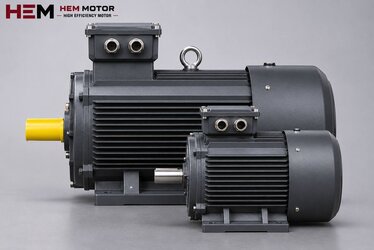
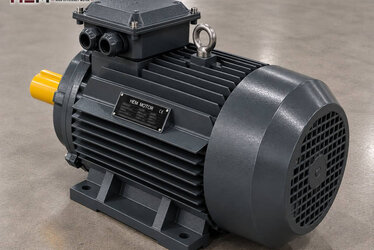
If a three-phase electric motor that should be delta-connected is connected in star, each winding receives about 58% of its design voltage and the torque the motor can produce falls to roughly one third. At light load the motor seems to turn normally, but as load rises the speed drops, the windings overheat, and under heavy load it either fails to start or trips the thermal relay within a short time.
On which motors does this mistake occur, and how?
The problem occurs on motors whose nameplate reads 400/690 V and which must run in delta on a 400 V supply. In the HEM Motor series this voltage rating is found on models of 4 kW and above; models below 4 kW are rated 230/400 V, and for them the correct link arrangement on a 400 V supply is star.
There are three typical scenarios on site. First, on a motor that was removed and refitted, the links are left in star according to the old motor's diagram. Second, in a star-delta starter, the timer or the delta contactor fails; the motor starts in star and stays there. Third, an old 230/400 V motor is replaced with a new 400/690 V one and the terminal arrangement is never changed.
The third case is common in maintenance teams. The old motor ran correctly in star, so the same connection is made for the new one. Because nobody looks at the voltage line on the nameplate, the mistake goes unnoticed on day one.
Why does the voltage across each winding fall in star connection?
In delta, both ends of each coil group go directly to two different phases, so the coil receives 400 V; in star, one end of each of the three coils is joined by a shorting link and each coil sits between one phase and this neutral point only, so it receives 400 / √3 ≈ 230 V.
In an asynchronous motor the magnetic flux is proportional to winding voltage. Torque depends on the product of flux and rotor current and, at a given slip, varies with the square of voltage:
T ∝ U2 → (1 / √3)2 = 1/3
Starting torque, breakdown (pull-out) torque and the torque at every slip all fall by the same ratio. That is the whole logic of star-delta starting: deliberately reduce current and torque to a third at start, then switch to delta once the motor has accelerated. The problem is when the switch never happens (general information; confirm with the machine manufacturer).
Why does the motor seem to run normally at light load?
As long as load torque stays below the reduced torque curve in star, the motor starts and turns; that is why the fault stays hidden while a pump is half throttled, a conveyor is empty or a fan damper is closed.
The symptoms begin as load comes on. To produce the same torque with a weaker field, the rotor slips more. At the same load torque, slip grows roughly in proportion to the drop in voltage squared, so a motor with 30 rpm slip at rating slips about 90 rpm in star. An optical tachometer reads around 1410 instead of 1470.
Winding current rises too. With torque unchanged and flux √3 times weaker, the current through the winding increases by about √3. Here is the deceptive part: in star the current read on the cable is the current through the coil, while in delta the cable current is √3 times the coil current. The clamp meter may show a value close to the nameplate current on the line while the windings run well above their own design current (rough approximation; magnetising current and the effect of slip are neglected).
Prices and technical data are on the product pages; choose a model and order online.
Hypothetical example: how much torque does a 22 kW motor give in star?
Take the cast iron frame 180L-4: 22 kW, 1470 rpm, 39.7 A at 400 V, nominal torque 142.9 Nm, rated voltage 400/690 V. With this rating the terminal box is set up in delta on a 400 V supply.
Assume breakdown torque is 2.5 times nominal torque (the real value is in the catalogue). In delta that comes to about 357 Nm. In star it falls to a third, about 119 Nm.
The result is clear: if the machine continuously demands more than 120 Nm, the motor stalls in star, meaning it cannot accelerate and draws high current at a speed close to standstill. If the load is between 80 and 110 Nm, the motor turns, but close to the breakdown limit, with large slip and running hot. Only if the load stays below about 70 Nm, that is under half of rated load, does winding current remain within an acceptable limit. Torque values of 400/690 V rated models at similar ratings can be seen on the electric motor sales page.
Before the cover is closed, check that the links in the terminal box are in the correct position for the nameplate voltage (representative image).
Which on-site measurement reveals the wrong connection?
The quickest check is to look inside the terminal box; with the motor running, speed and winding temperature measurements give the fault away.
Check
Correct (delta)
Wrong (star)
Terminal links
Three links, each joining the upper and lower rows vertically
The three lower terminals shorted by one horizontal link
Voltage across winding
400 V
About 230 V
Speed under load (180L-4 example)
About 1470 rpm
Drops into the 1400–1420 rpm band
Heavy start
Accelerates in normal time
Long start, stalling, thermal trip
Frame temperature
Within the insulation class
Rises quickly with load
Use this order. First isolate and lock off the supply, open the terminal cover and compare the link arrangement with the diagram inside the cover. Then read the voltage line on the nameplate: if it says 400/690 V, delta is required on a 400 V supply. With the motor running, measure speed with an optical tachometer, each phase current separately with a clamp meter and the frame with an infrared thermometer. On star-delta panels, listen at the changeover moment; on a panel that works correctly you hear the contactor after a few seconds and the motor picking up speed.
Can a motor that ran in star for a long time be used again?
Usually yes; still, before recommissioning, the insulation value should be read with a megger and the winding and terminals checked for signs of overheating. A motor that ran at light load is mostly undamaged; one that tripped often under heavy load may have aged insulation.
Measure between winding and frame with an insulation tester, and compare the value taken on a cold motor with the previous record. If you find darkened links, melted cable insulation or a burnt smell in the terminal box, have the winding checked at a rewind shop. Class F insulation provides thermal reserve, but every overheating cycle takes a piece out of insulation life.
When putting the motor back into service, the commissioning checklist gives the link, direction and no-load current steps in order. If a new motor is needed, 400/690 V rated 4-pole models at different power steps, such as the 112M-4 (4 kW, 7.95 A) or the 160M-4 (11 kW, 20.4 A), are listed with their voltage line in the electric motor shop. All power steps of the same family are on the asynchronous electric motors page.
If you send a photo of the terminal box and the nameplate through our contact page, we will check together whether the link arrangement suits your supply and, if necessary, which model can replace it. To compare the voltage line when choosing a new motor, see the HEM Motor product list.
Frequently Asked Questions
Why does a star-connected motor trip the thermal relay late?
The thermal relay is set according to the current flowing in the cable. In star this current looks close to the nameplate value, but the coils are heating above their own design current.
What happens if I connect a 230/400 V motor in delta on a 400 V supply?
This time each winding receives √3 times its design voltage. No-load current rises sharply, the lamination stack saturates and the motor heats up quickly even without load; this connection must not be made.
How can you tell that the motor does not switch to delta on a star-delta panel?
A few seconds after starting, no contactor sound is heard, speed does not rise and current fluctuates under load. Measure the timer and the coil of the delta contactor.
Does running in star at light load save energy?
At very light load losses may change slightly, but this is not a permanent solution. When load rises the motor struggles; if speed and load adjustment are needed, a frequency converter is the right way.
HEM Motor Models Related to This Article
The cards show example models related to the topic. A suitable motor is not chosen by power alone: compare speed, voltage, mounting, shaft and connection dimensions on the product page; if unsure, send a photo of the existing motor’s nameplate on WhatsApp.
Checking that electric motor pulleys lie in the same plane means seeing whether the side faces of both pulleys meet on one straight line. In practice a taut string, a steel straigh... More Details
If an electric motor's coupling element fails often, the first thing to investigate is shaft misalignment, followed by coupling selection, starting and shock loads, environmental e... More Details
The quickest way to tell foundation looseness from unbalance in electric motor vibration is to loosen the foot bolts one at a time while measuring and watch the change, and to comp... More Details
When building a sound enclosure around an electric motor, cooling is preserved by giving the enclosure a labyrinth or silenced inlet large enough for the air the motor fan draws, p... More Details
In an electric motor running in a hot environment, winding and bearing temperatures are monitored separately because they heat up from different sources, have different limits and ... More Details
When an electric motor is started for the first time at sub-zero temperatures, three things need checking: winding insulation resistance and any moisture or ice inside, bearing gre... More Details
We use necessary and optional cookies to improve your experience, enhance content and analyse traffic. Under the GDPR, optional (analytics/marketing) cookies are only used with your explicit consent. Please choose your preference below.
Cookie Policy
 English
 Français
 Türkçe
 Español
 Русский
 العربية
 Deutsch
 Italiano