When replacing an electric motor in building heating, cooling and ventilation systems, the first point to watch is that the new motor carries over not just the old one's power but also the mechanical and electrical relationship it had with the fan or pump: pulley or direct-coupled impeller, vertical or horizontal mounting, drive parameters and the link to building automation. The second point is that the replacement has to be done without disturbing the building's comfort, within a short time window and often on a roof or in a cramped boiler room.
Below we have gathered the pre-replacement checks for HVAC equipment in order, from the air handling unit to the cooling tower.
What sets an HVAC motor replacement apart from one in a factory?
When an air handling unit stops in an office building, hospital or shopping centre, there is no lost production, but the people inside immediately feel the change in temperature, humidity and air quality. In a unit serving an operating theatre or a data room, this becomes a direct operational risk. That is why HVAC replacements are usually planned for nights, weekends or the change of season, and the new motor is expected to run at the first attempt.
Access is a separate issue. The motors are usually high up or in tight spots. Air handling units mostly sit on the roof or a plant floor, circulation pumps in tight corners of the boiler room, and cooling tower fans high up. If the frame length and mounting type of the new motor are not chosen correctly from the start, a motor lifted up by crane may have to be brought back down.
What should be checked on each type of HVAC equipment during replacement?
Equipment
Typical drive
Point often overlooked on replacement
Air handling unit supply/exhaust fan
Belt and pulley or direct-coupled plug fan
Pulley diameter and shaft fit, impeller seating on the shaft, motor slide rails
Heat recovery unit fan
Direct-coupled, compact cabinet
Frame length inside the cabinet, cable exit direction
Heating/cooling circulation pump
Flange motor, often vertical in-line type
Vertical mounting, flange size, seal and coupling
Chiller and condenser water pump
Coupled on a baseplate
Coupling alignment, choice of 2 or 4 poles
Cooling tower fan
Vertical motor, gearbox or direct
Humid environment, vertical design, condensation
Car park jet fan and smoke exhaust fan
Direct-coupled
Temperature resistance in a fire scenario (special motor)
How is pulley, belt and impeller compatibility kept on the air handling unit fan?
Compatibility is kept by giving the new motor the same number of poles, the same shaft diameter and the same key size. In belt-driven units, fan speed is set by the diameter ratio of the motor and fan pulleys. If the new motor does not have the same number of poles as the old one, the pulley ratio is upset, the fan delivers a different flow and the unit's balancing is lost. The pole count must stay the same. If the existing pulley is to be fitted to the new motor, the shaft diameter and key size must be compared; you can see the dimensions on the technical drawings by frame page.
In direct-coupled designs known as plug fans, the impeller sits directly on the motor shaft and the motor carries the fan. Here shaft length, bearing type and a frame sturdy enough to carry the impeller's weight are decisive.
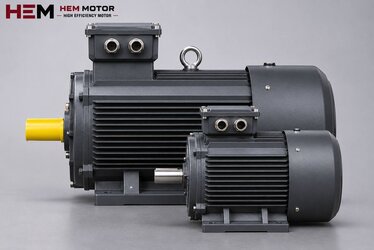
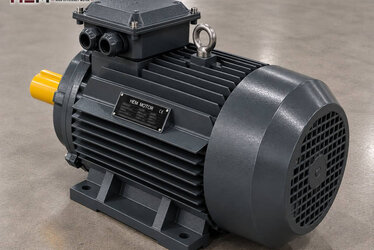
For a medium-sized unit fan, the 7.5 kW aluminium frame 132M-4 can be considered; it turns at a rated speed of 1460 rpm and its voltage is 400/690 V.
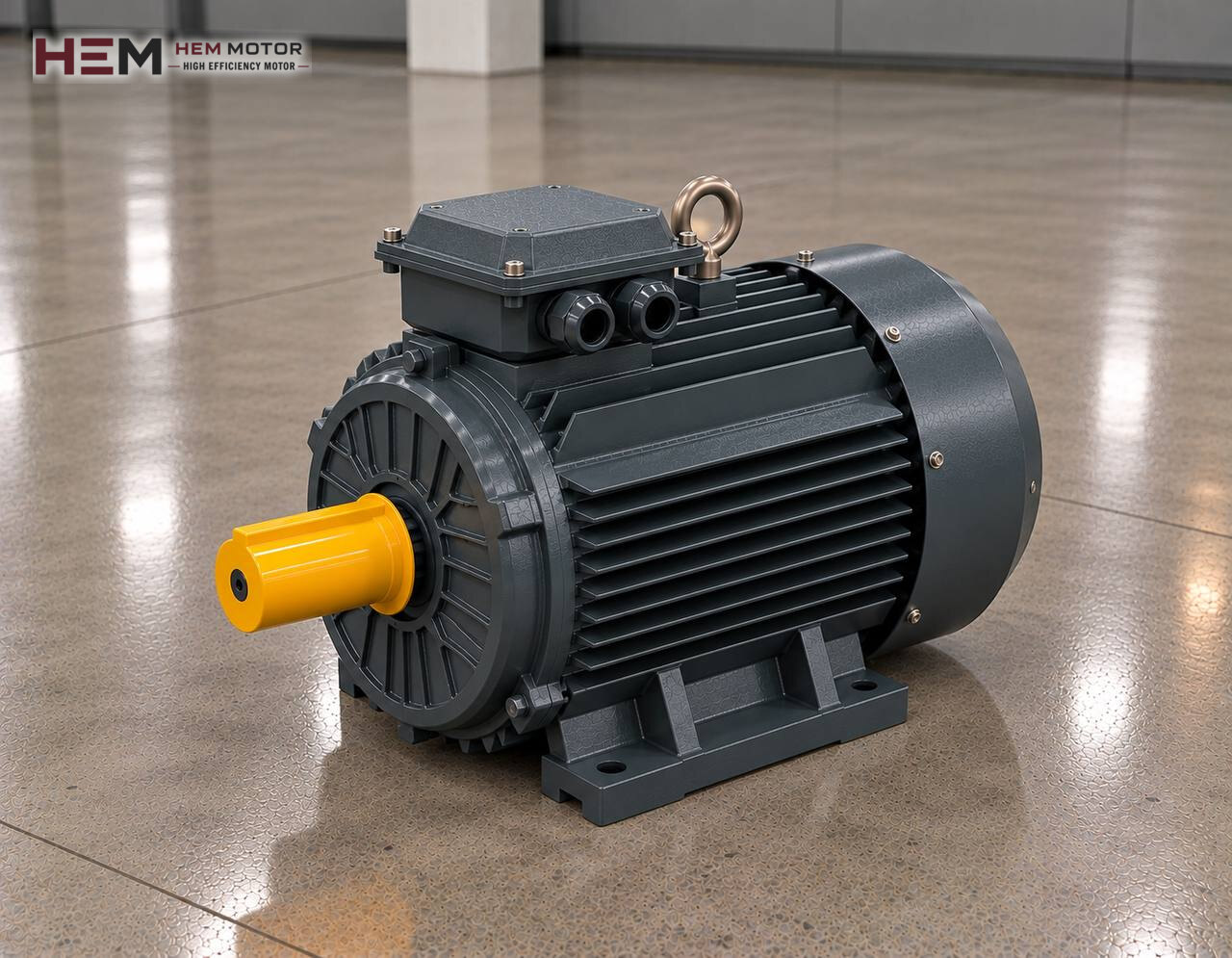
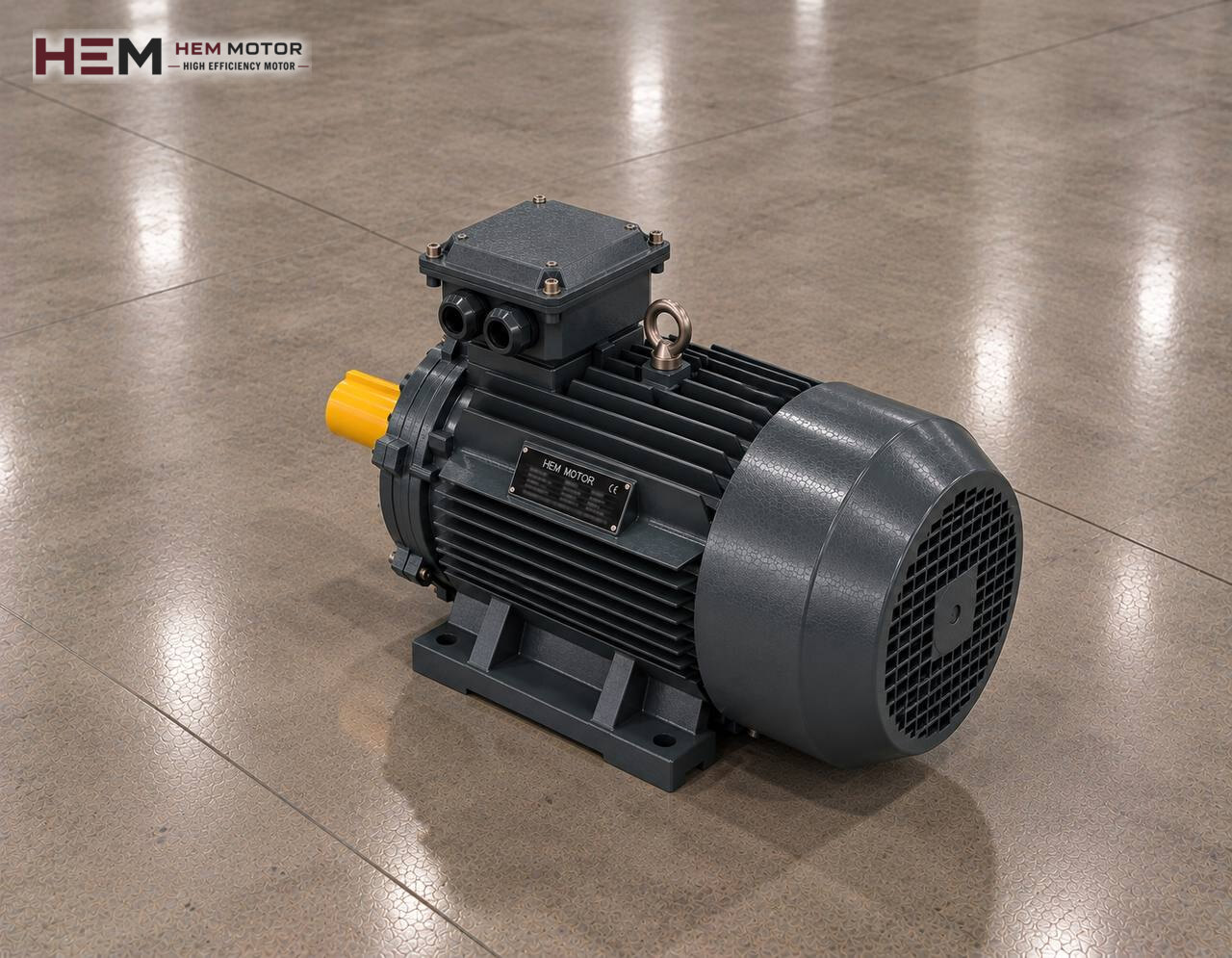
Fan drive inside an air handling unit (representative image).
How are vertical mounting and the flange checked on circulation and chiller pumps?
The check confirms that the new motor suits vertical mounting and that its flange type and diameter match the old one. In-line pumps used in boiler rooms and chiller installations mostly carry the motor vertically; the motor is flanged onto the top of the pump casing. It is obvious that a horizontal foot-mounted motor will not fit in this position, but it is often forgotten that the same flange type can come in different diameters. B3, B5, B14, B34, B35 and vertical V1, V3, V5, V6 and V15 designs are offered according to frame size, and we confirm the flange size together at the time of ordering.
For chiller and condenser water pumps, systems that require a high head usually run with 2-pole motors, while systems with high flow but low pressure use 4-pole motors. Changing the number of poles of the old motor shifts the pump's operating point completely; this decision can only be made by looking at the pump manufacturer's curve. For a chiller pump coupled on a baseplate, the 4 kW 112M-2 is one example; its rated speed is 2905 rpm.
Why do humidity and vertical design matter on cooling tower and roof fans?
These motors run inside mist and often vertically, so protection against condensation and the mounting direction decide the choice. The cooling tower fan motor runs in or just above the mist created by evaporating water. Condensation inside the frame is unavoidable. The mist keeps carrying moisture to the frame; in a motor that runs continuously all summer and then stands for months in winter, this gradually weakens the winding insulation. Our standard range offers IP55 protection and class F insulation; for towers where water splashes directly, IP56 as a special order, and an anti-condensation heater and PTC winding sensor as order options, should be asked about.
Large-diameter tower fans turn at low speed and are often driven through a gearbox. For a drive of this kind, the 6-pole 11 kW aluminium frame 160L-6 can be considered; it turns at a rated speed of 970 rpm. Whether the motor will run vertically or horizontally, and whether the shaft end points up or down, should be written on the first line of the order.
You can compare other 4- and 6-pole power steps in our shop.
What needs doing on the drive, building automation and cabling side after a motor change?
The new motor's nameplate values are entered into the drive, the identification run is repeated if needed and the need for a cable filter is reviewed. In modern HVAC systems, most fans and pumps run on frequency converters, and speed is set according to a signal from the building automation system. When the motor is changed, the new motor's nameplate values (power, current, speed, voltage, frequency) must be entered into the drive again, and the motor identification run repeated if necessary. A drive left with the old parameters protects the motor incorrectly or trips unnecessarily. Old parameters do not fit a new motor.
HEM Motor's three-phase models are suitable for speed control with a drive. If the unit fan is held at very low speed for long periods in night mode and the motor delivers high torque during that time, a separate cooling fan may be needed; if the drive panel is far from the rooftop unit, a dv/dt or sine filter is considered for the motor cable. It is enough to state these conditions when ordering.
Cable cross-section and protection ratings are calculated in the electrical design, taking into account motor power, cable length, installation method and panel temperature.
How is the efficiency class chosen, and which duties require a special motor?
The efficiency class is chosen from IE3, IE4 or IE5 according to the long operating hours, while smoke exhaust fans that run in fire mode require a special motor. Because HVAC motors run long hours all year round, a replacement is also a good opportunity to raise efficiency. HEM Motor offers options in efficiency classes IE3, IE4 and IE5; you can compare the classes for the same power and frame at the quotation stage.
When moving to a higher efficiency class, check in tight cabinets whether the frame length changes.
Car park and tunnel smoke exhaust fans must run for a set time at a set temperature in the event of a fire; this duty requires a special motor and may fall outside the standard range in HEM Motor's 2026 catalogue, so ask us with the nameplate and application details. The motor used for the same fan in everyday ventilation mode should not be confused with the requirements of fire mode.
What preparation is needed before replacement day?
Before the motor is removed, its nameplate, shaft end, pulley, flange and terminal box position should be photographed. If you share these photos and the type of equipment (unit fan, circulation pump, tower fan) through the equivalent-from-nameplate page, we will determine the right model together for a replacement that fits the building's operating schedule. You can review the power steps of the motors on your plant floor in advance in the shop's model list.
Frequently Asked Questions
Does replacing an air handling unit fan motor with a more powerful model increase the airflow?
As long as the pulley ratio and number of poles stay the same, fan speed does not change, so airflow does not increase either. Any airflow increase should be made on the basis of fan and duct calculations, with the designer's approval.
Can the motor of an in-line circulation pump be replaced with a horizontal motor?
If the pump carries its motor vertically on a flange, it must be replaced by a motor with the same flange type that is suitable for vertical mounting. Compatibility is confirmed by comparing flange size and shaft values.
What should be done on the frequency converter after the motor is changed?
The new motor's nameplate values should be entered into the drive and the motor identification run repeated if necessary. Otherwise overcurrent protection and speed control may not work correctly.
What should be watched when a cooling tower fan motor stands idle in winter?
During long standstills, condensation builds up inside the frame. Using an anti-condensation heater and having an insulation test done at the start of the season protects the winding.
HEM Motor Models Related to This Article
The cards show example models related to the topic. A suitable motor is not chosen by power alone: compare speed, voltage, mounting, shaft and connection dimensions on the product page; if unsure, send a photo of the existing motor’s nameplate on WhatsApp.
Checking that electric motor pulleys lie in the same plane means seeing whether the side faces of both pulleys meet on one straight line. In practice a taut string, a steel straigh... More Details
If an electric motor's coupling element fails often, the first thing to investigate is shaft misalignment, followed by coupling selection, starting and shock loads, environmental e... More Details
The quickest way to tell foundation looseness from unbalance in electric motor vibration is to loosen the foot bolts one at a time while measuring and watch the change, and to comp... More Details
When building a sound enclosure around an electric motor, cooling is preserved by giving the enclosure a labyrinth or silenced inlet large enough for the air the motor fan draws, p... More Details
In an electric motor running in a hot environment, winding and bearing temperatures are monitored separately because they heat up from different sources, have different limits and ... More Details
When an electric motor is started for the first time at sub-zero temperatures, three things need checking: winding insulation resistance and any moisture or ice inside, bearing gre... More Details
We use necessary and optional cookies to improve your experience, enhance content and analyse traffic. Under the GDPR, optional (analytics/marketing) cookies are only used with your explicit consent. Please choose your preference below.
Cookie Policy
 English
 Français
 Türkçe
 Español
 Русский
 العربية
 Deutsch
 Italiano