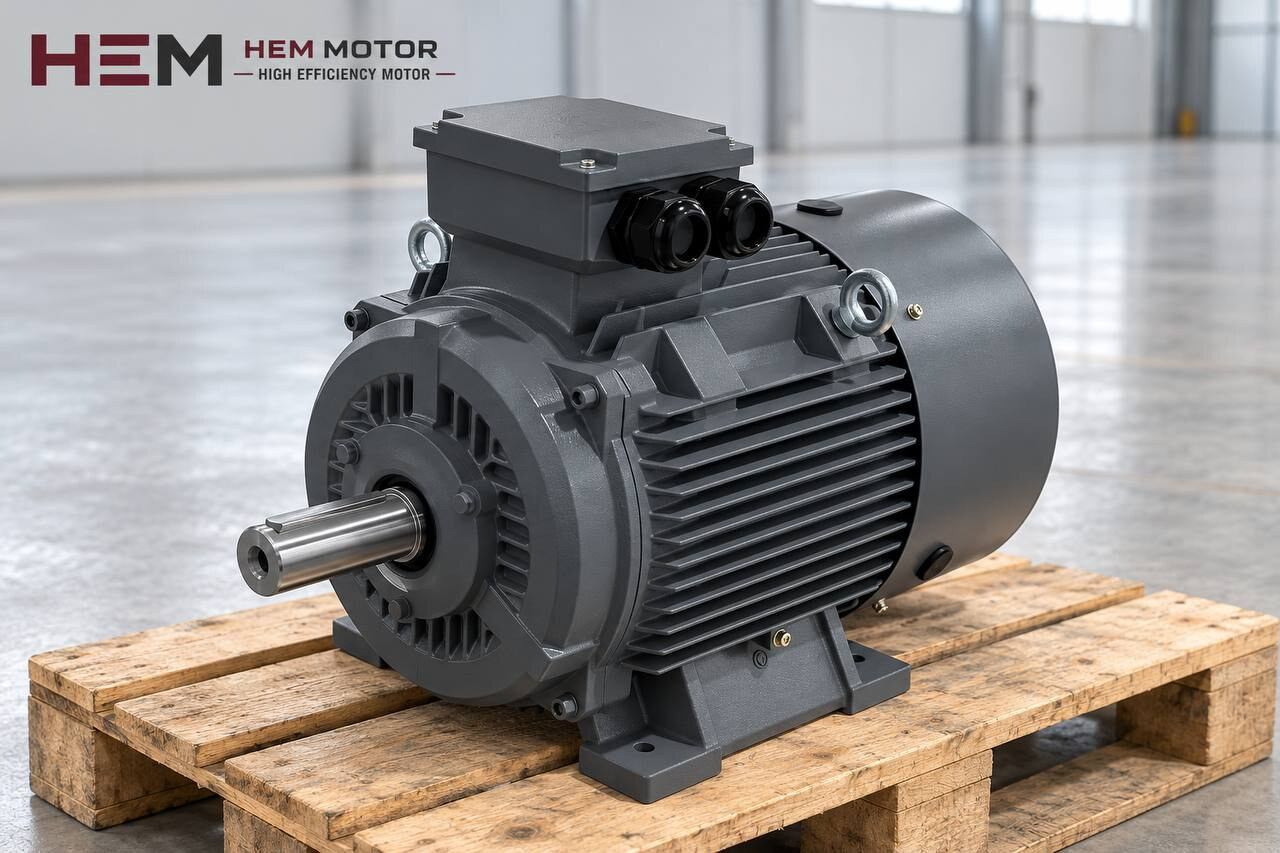
In a V-belt drive, the radial load on the drive-end bearing of an electric motor is the vector sum of the forces in the two belt spans; it is determined by the power transmitted, the pulley diameter and above all by how tightly you tension the belt. If tension is too low the belt slips, heats and wears; if it is too high bearing life drops fast and the shaft is pushed towards bending. The correct setting is to apply the static tension recommended by the belt manufacturer, measured rather than felt, and to fit the pulley as close to the shaft shoulder as possible.
What force do the belt spans put on the shaft?
In a running V-belt, the tight side and the slack side carry different forces. The difference between the two spans is the effective pull, and it transmits the torque:
Fe = T1 − T2 = 2000 × M / d: Fe: effective pull (N), M: torque at the motor shaft (Nm), d: effective diameter of the motor pulley (mm).
The radial load on the motor shaft is close to the sum of the forces in the two spans. If the belt wrap angle is close to 180 degrees, in practice Fr ≈ T1 + T2 can be used. For the belt to run without slipping, the force in the slack span must not fall below a certain value; this is ensured by the belt pre-tension.
A common assumption in the field is that the total radial load is about 1.5–2.5 times the effective pull. The value depends on belt type, wrap angle and pre-tension (general information; confirm with the belt and machine manufacturer's calculation). The top of this range appears when you over-tension the belt "so it stays firm".
How large is the belt radial load on an 11 kW motor?
Hypothetical example: an 11 kW, 4-pole motor delivers about 71.7 Nm rated torque at 1465 rpm. Let the effective diameter of the motor pulley be 140 mm.
Effective pull: Fe = 2000 × 71.7 / 140 ≈ 1024 N.
Taking a radial load factor of 1.8 at normal tension: Fr ≈ 1.8 × 1024 ≈ 1840 N.
If the belt is over-tensioned and the factor rises to 3: Fr ≈ 3 × 1024 ≈ 3070 N.
If you run the same motor with a 200 mm pulley, effective pull drops to about 717 N and radial load at normal tension to about 1290 N. A larger pulley reduces belt force. Enlarging the pulley diameter is the most effective way to transmit the same torque with a smaller belt force; the lower limit for diameter is the minimum pulley diameter the belt manufacturer specifies for that section.
How does radial load shorten bearing life?
The theoretical life of ball bearings is roughly inversely proportional to the cube of the equivalent load on the bearing: L ∝ (C / P)3. Here C is the bearing's dynamic load rating and P the equivalent load acting on it (general information; confirm with the bearing manufacturer's catalogue calculation).
In the example above, when the load rises from 1840 N to 3070 N the ratio is about 1.67; life falls to (1/1.67)3 ≈ 0.21, that is, to about one fifth. In other words, over-tensioning the belt can mean changing the bearing within months instead of years.
For cylindrical roller bearings the exponent is different, but the trend is the same.
In addition, excessive radial load ages the grease faster, heats the bearing shield and causes deflection at the shaft end, and in the long term fatigue cracks at the shaft shoulder and wear in the bearing housing may appear.
The further out along the shaft end the belt force acts, the higher the bearing load and the bending on the shaft (representative image).
Prices and technical data are on the product pages; choose a model and order online.
Where the belt force acts on the shaft matters at least as much as its magnitude. In motor catalogues the permissible radial load is usually given for the middle of the shaft extension or a specific point on it. As the pulley moves outwards, the lever arm of the force relative to the bearing grows, and the load on the bearing becomes larger than the belt force.
In a simplified model the load on the front bearing can be written as: Fbearing ≈ Fr × (a + b) / a, where a is the distance between the two bearings and b the distance of the belt force from the front bearing. Seating the pulley against the shaft shoulder reduces b. Letting the pulley hub overhang, fitting a spacer, or pushing the pulley out beyond the shaft end stresses the bearing and shaft unnecessarily.
Permissible radial load values and shaft-end dimensions are given by frame size in the motor catalogue; check the values in the HEM Motor technical and product catalogue.
How is belt tension measured?
Tension is measured with the deflection–force method or the frequency method. The "press with your thumb and let it give a bit" method varies from person to person and usually ends in over-tensioning. The two methods in detail:
Deflection–force method: At the middle of the free belt span between the pulleys, a force perpendicular to the belt is applied with a belt tension gauge. The belt manufacturer gives a deflection per 100 mm of free span and the force range that produces it. If the measured force lies within the range, the tension is correct.
Frequency method: The free belt span is plucked like a guitar string and an acoustic or optical meter reads its natural frequency. Belt tension is proportional to the square of the frequency, the square of the free span and the belt's mass per unit length: T ≈ 4 × m × L2 × f2. The instrument usually performs this calculation itself.
New belts stretch and bed in quickly during their first hours of running. Tension should therefore be measured again after a short run once a new belt is fitted. The belt manufacturer's "new belt" value is used for the first setting. On multi-groove drives belts should be replaced as a set; if old and new belts are mixed, the load is not shared evenly.
How do alignment and the number of belts affect bearing load?
Angular or parallel misalignment of the pulleys loads one flank of the belt, the belt climbs in the groove and generates vibration. Check with a straightedge or a laser pulley alignment tool that both pulley faces are in the same plane. On a misaligned drive even the correct tension is not enough to protect bearing life.
Adding more belts than necessary can increase total radial load, since each belt must be tensioned individually. The belt calculation should follow the belt manufacturer's method using transmitted power, service conditions and pulley diameters. For carrying heavy radial loads in belt drives, cast iron frame motors offer an advantage in the rigidity of the bearing housings; the general features of this series are described on the cast iron frame electric motor series page. You can compare power and speed options in our electric motor shop.
Example models for belt drives (pairings are hypothetical):
For a belt-driven extractor or small compressor, the 5.5 kW, 4-pole cast iron 132S-4: 1460 rpm, 36 Nm.
For a drive like the one in the worked example, the 11 kW 160M-4: 1465 rpm, 71.7 Nm.
For a belt-driven crusher or mill, the 30 kW 200L-4: 1475 rpm, 194.2 Nm.
If you share the pulley diameters, belt type and motor nameplate of your existing drive through the nameplate submission page, we will assess together whether the motor's shaft end and bearing side can carry this load. All cast iron and aluminium frame options are in the HEM Motor product list.
Frequently Asked Questions
What happens if V-belt tension is too low?
The belt slips on the pulley, heats up, squeals and its flanks wear quickly. Slip also reduces the power transmitted and polishes the pulley grooves.
Which bearing fails sooner in a belt drive?
The drive-end bearing, which carries the belt force directly, wears faster. If the pulley is mounted far out, the effect becomes even more pronounced.
Why does a new belt loosen after a while?
A new belt stretches and beds into the pulley groove during its first hours of running. Tension should therefore be measured and adjusted again after a short run.
How does a smaller motor pulley affect the bearing?
The smaller the pulley, the greater the belt force needed to transmit the same torque. This increases the radial load on the shaft and the stress on the bearing.
HEM Motor Models Related to This Article
The cards show example models related to the topic. A suitable motor is not chosen by power alone: compare speed, voltage, mounting, shaft and connection dimensions on the product page; if unsure, send a photo of the existing motor’s nameplate on WhatsApp.
Checking that electric motor pulleys lie in the same plane means seeing whether the side faces of both pulleys meet on one straight line. In practice a taut string, a steel straigh... More Details
If an electric motor's coupling element fails often, the first thing to investigate is shaft misalignment, followed by coupling selection, starting and shock loads, environmental e... More Details
The quickest way to tell foundation looseness from unbalance in electric motor vibration is to loosen the foot bolts one at a time while measuring and watch the change, and to comp... More Details
When building a sound enclosure around an electric motor, cooling is preserved by giving the enclosure a labyrinth or silenced inlet large enough for the air the motor fan draws, p... More Details
In an electric motor running in a hot environment, winding and bearing temperatures are monitored separately because they heat up from different sources, have different limits and ... More Details
When an electric motor is started for the first time at sub-zero temperatures, three things need checking: winding insulation resistance and any moisture or ice inside, bearing gre... More Details
We use necessary and optional cookies to improve your experience, enhance content and analyse traffic. Under the GDPR, optional (analytics/marketing) cookies are only used with your explicit consent. Please choose your preference below.
Cookie Policy
 English
 Français
 Türkçe
 Español
 Русский
 العربية
 Deutsch
 Italiano