The star-delta changeover time is set according to the time an electric motor needs in star to reach roughly 90–95% of synchronous speed; there is no fixed number of seconds. The time is determined on site by watching with a clamp meter the moment starting current falls towards rated value, or calculated from the inertia and torque data of the load.
Why should the timer relay not be set by habit?
Two motors of equal power can take several times longer or shorter to accelerate depending on the machine they drive. An empty fan impeller and a heavy crusher rotor bring the same 22 kW motor up to speed in very different times.
A habit often seen in panels is leaving the timer relay at its factory setting. If the time is too short, the contactors jump to delta before the motor reaches speed and a current close to that of direct-on-line starting is drawn from the supply; the fuse or moulded-case breaker can trip at that moment. If the time is too long, the motor runs in star, that is with about one third of its torque, for longer than needed. On a heavily loaded machine speed stalls at some point and current does not fall. The common symptom of both mistakes is a sharp current jump at changeover. Someone standing in front of the panel can notice it as the lights flicker briefly while the contactors pull in.
How is the right changeover moment measured on site?
A clamp meter with true-RMS and peak hold (inrush) function is placed on one phase of the motor cable after the star contactor, and the current-time curve is watched. The time elapsed when current comes down from the starting peak and settles at a flat level is the star time needed.
Set the timer relay temporarily to a long value; let the motor run up to speed in star.
Start a stopwatch with the start command; note on the clamp meter the moment current falls from its peak and stabilises.
If possible, hold a tachometer to the shaft end; when speed approaches synchronous speed and no longer rises noticeably, current also levels off.
Set the relay to the time found plus a small margin; repeat the measurement over several starts, especially with the machine cold.
The measurement must be made under load. A time found with an empty belt or a closed valve may not be enough once material is loaded. The gap is not small.
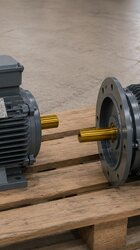
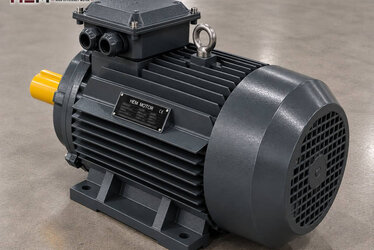
Star time is measured under load, together with the machine the motor drives (representative image).
How can acceleration time be estimated in advance by calculation?
Acceleration time is roughly calculated with t ≈ J × ω / (Tavg − Tload). Here J is the total moment of inertia referred to the shaft (motor + coupling + machine; SI unit kilogram square metre), ω the target angular speed (rad/s), Tavg the average motor torque in star, and Tload the average torque of the load during acceleration (general information; confirm with the machine manufacturer).
Hypothetical example: a 22 kW, 1470 rpm motor has a rated torque of 142.9 Nm. Assume the starting torque ratio taken from the catalogue is 2.2 and the average accelerating torque in star stays a little below one third of that, at about 90 Nm. For a fan, let the average load torque during acceleration be 30 Nm and the total moment of inertia referred to the shaft 4 kilogram square metres. ω = 2π × 1470 / 60 ≈ 154 rad/s; t ≈ 4 × 154 / (90 − 30) ≈ 10 seconds.
If the same motor were driving a light pump with a moment of inertia of 1 kilogram square metre, the time would drop below 3 seconds. The calculation is rough. Still, it shows in advance the range the relay will sit in; the final setting is made by measurement.
Prices and technical data are on the product pages; choose a model and order online.
The short gap between the star contactor opening and the delta contactor closing prevents both contactors from being closed at once and causing a phase-to-phase short circuit. This gap is usually in the order of tens of milliseconds and is fixed or adjustable in timer relays designed for star-delta (general information; confirm with the relay manufacturer's instructions).
If the gap is longer than needed, the motor slows during it and the rotor's magnetic field loses phase alignment with the supply. At changeover to delta the current peak grows. A knock is felt in the coupling. In panels built with a general-purpose timer relay and two separate contacts, this gap can be left uncontrolled; if a hard “clack” is heard at changeover, the relay type should be checked.
On which machines does star-delta starting struggle?
Because torque in star drops to about one third, on machines that need high torque at start the star stage gets longer or never completes. The table below summarises typical behaviour and the point to check on site.
Machine
Starting behaviour
Effect on changeover time
What to check on site
Centrifugal pump (valve throttled)
Load torque rises with speed, low at first
Short, stable
Is the valve throttled at start?
Large fan or extractor
High inertia, low load torque at first
Long
Starting with the damper closed
Loaded belt conveyor
High breakaway resistance
Risk of stalling in star
Is the belt empty at start?
Piston compressor
Pulsating torque if it starts under load
Uncertain
Is the unloading valve working?
Crusher, mill
High inertia and friction
Long, sometimes insufficient
Is the feed cut at start?
If speed stalls halfway in star and current does not drop, extending the time is no solution. Either the starting load is reduced or another starting method such as a soft starter or a drive is adopted. Our three-phase series are suitable for speed control with a frequency converter; long running at low speed with full torque may need a separate fan; with a long drive–motor cable a dv/dt or sine filter is considered; these conditions are stated with the order.
Which motors are suitable for star-delta starting?
In a plant with a 400 V supply, a motor to be started with Y/Δ must show 400/690 V on its plate, because in normal running the motor must be in delta. In HEM Motor's three-phase list, models from 4 kW upwards carry this voltage statement. The method cannot be built with a motor whose plate shows 230/400 V.
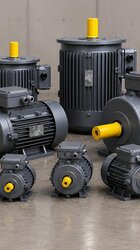
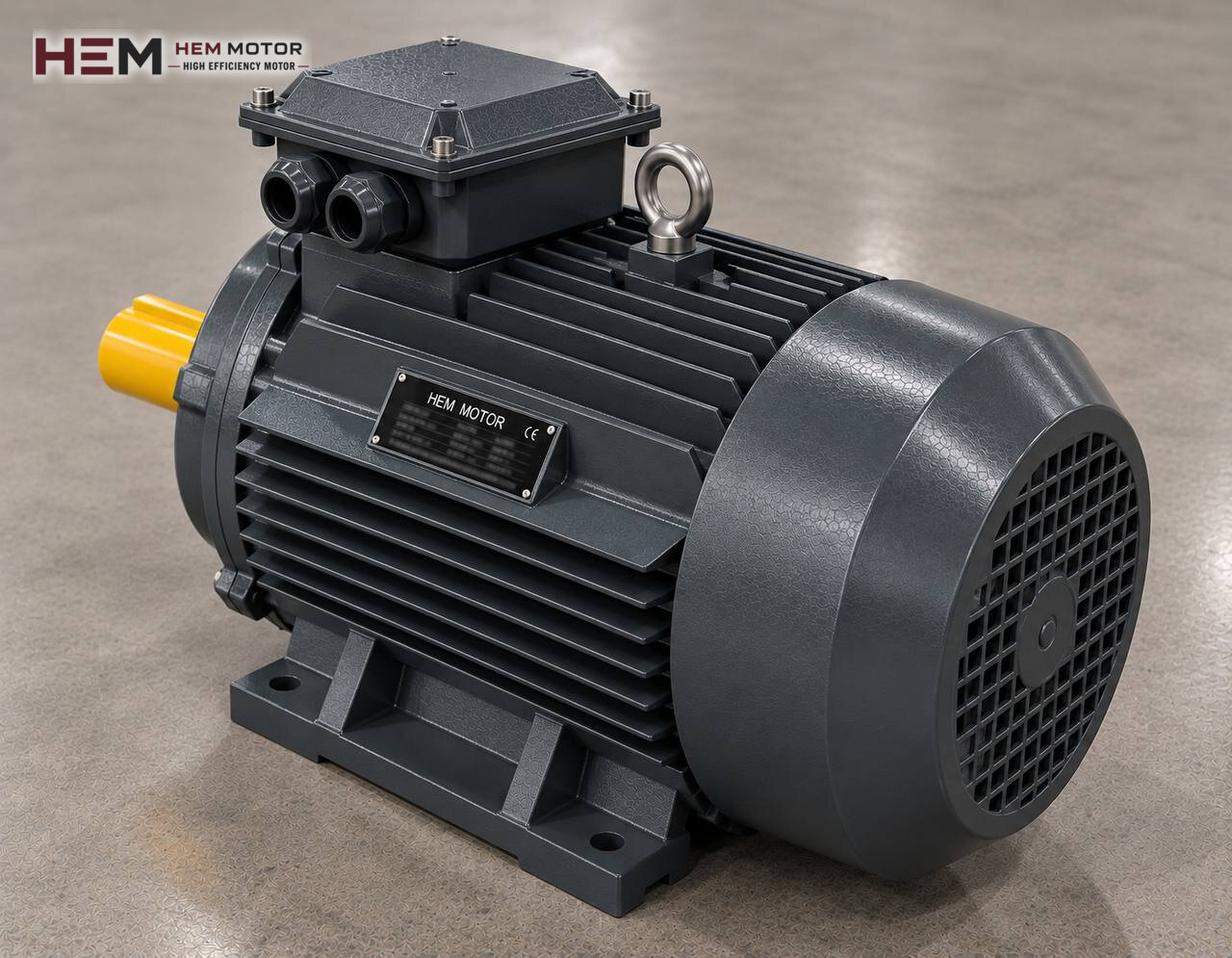
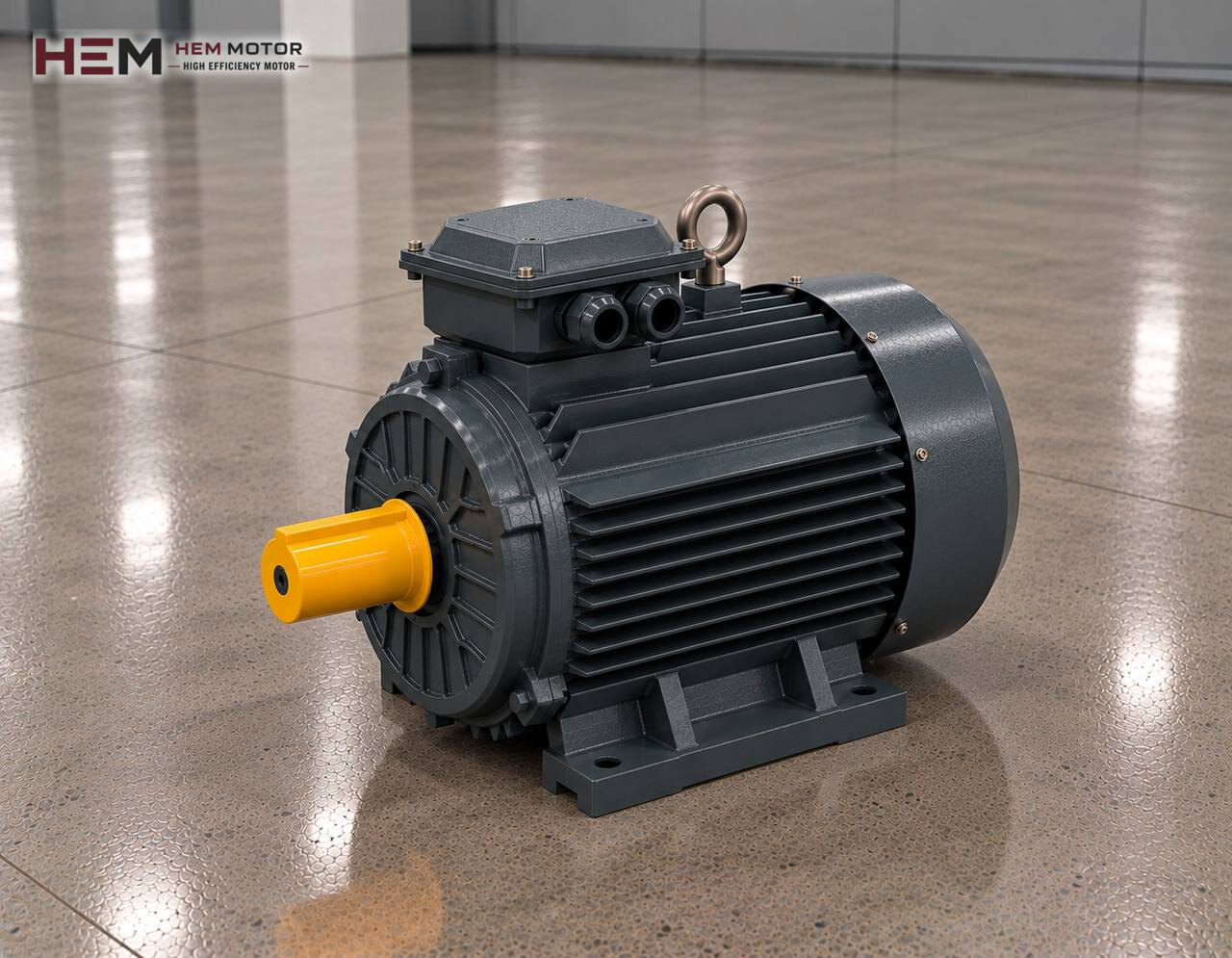
Three cast iron models that fit the power range of the example calculation are listed below. We confirm the starting torque ratios together with the order; other ratings and speeds are listed with voltage data in the HEM Motor shop.
160L-4: 15 kW, 1465 rpm, rated torque 97.8 Nm, 27.3 A at 400 V, 400/690 V.
180L-4: 22 kW, 1470 rpm, rated torque 142.9 Nm, 39.7 A at 400 V, 400/690 V. The motor in the hypothetical calculation.
200L-4: 30 kW, 1475 rpm, rated torque 194.2 Nm, 53.8 A at 400 V, 400/690 V.
All three have IP55 frame protection and class F winding insulation; the whole family is gathered on the asynchronous electric motors page. To add the timer relay setting to the checklist at first start, the commissioning guide can be used.
If in your existing panel the motor cannot reach speed in star or the breaker trips at changeover, send a photo of the motor nameplate and the type of driven machine via our contact page; we will review the starting method and the suitable rating together. All power steps can be seen in our sales list.
Frequently Asked Questions
Is the motor damaged if the star time is set too long?
If the load is light, the motor reaches speed in star and running a little longer usually causes no problem. If the load is heavy, the motor stays at low torque for minutes at a current close to starting current and winding temperature climbs; the overload relay may trip in this case.
Does the changeover time stay the same at every start?
It changes as the machine's load and temperature change. A gearbox with cold oil or a full bunker lengthens the time; that is why the setting is verified for the heaviest starting condition.
Can changeover be made with a current relay instead of a timer relay?
In some panel designs changeover happens when current falls below a certain level; this method gives more consistent results with variable loads. Applying it is the panel designer's decision, and it is set according to the instructions of the relay used.
What should be done if the motor does not gain speed in star at all?
First check the connection and links, then the starting load. If the connection is right and the load cannot be reduced, star-delta is inadequate for that machine; another starting method should be considered.
HEM Motor Models Related to This Article
The cards show example models related to the topic. A suitable motor is not chosen by power alone: compare speed, voltage, mounting, shaft and connection dimensions on the product page; if unsure, send a photo of the existing motor’s nameplate on WhatsApp.
Checking that electric motor pulleys lie in the same plane means seeing whether the side faces of both pulleys meet on one straight line. In practice a taut string, a steel straigh... More Details
If an electric motor's coupling element fails often, the first thing to investigate is shaft misalignment, followed by coupling selection, starting and shock loads, environmental e... More Details
The quickest way to tell foundation looseness from unbalance in electric motor vibration is to loosen the foot bolts one at a time while measuring and watch the change, and to comp... More Details
When building a sound enclosure around an electric motor, cooling is preserved by giving the enclosure a labyrinth or silenced inlet large enough for the air the motor fan draws, p... More Details
In an electric motor running in a hot environment, winding and bearing temperatures are monitored separately because they heat up from different sources, have different limits and ... More Details
When an electric motor is started for the first time at sub-zero temperatures, three things need checking: winding insulation resistance and any moisture or ice inside, bearing gre... More Details
We use necessary and optional cookies to improve your experience, enhance content and analyse traffic. Under the GDPR, optional (analytics/marketing) cookies are only used with your explicit consent. Please choose your preference below.
Cookie Policy
 English
 Français
 Türkçe
 Español
 Русский
 العربية
 Deutsch
 Italiano