When replacing a cooling fan, the dimensions to keep are the hub bore fit on the shaft, the fan outer diameter, the number and pitch of the blades, the axial position of the fan on the shaft and its clearance to the fan cover. If any of these changes, the amount of air passing over the motor changes; winding temperature rises, the fan may rub on the cover or a new source of vibration appears.
What does the fan do in cooling the motor?
In a totally enclosed, surface-cooled motor (IC 411) the fan sits on the rear shaft end and turns together with the rotor at the same speed. It draws air through the fan cover grille and blows it between the frame fins. Heat produced in the winding and rotor passes into the frame and is carried away from the frame by this airflow.
So the fan is not a simple accessory. The power on the nameplate holds when the airflow foreseen in the design is delivered. With less air, frame temperature climbs at the same load.
In standard asynchronous motors the fan usually has radial blades; it gives the same air in both directions. Fans with blades inclined in one direction are found on some large frames or special applications, and flow drops clearly if the direction of rotation is reversed.
When is a fan replaced?
The most common reason is breakage. Plastic fans can crack from a bolt dropped into the fan cover, prying with a screwdriver during removal, excessive heat or a chemical vapour atmosphere. A broken blade both reduces air and creates imbalance.
The second reason is work on the shaft end. During a bearing change the fan is removed; if the hub has loosened or the keyway is crushed, a new one is fitted instead of refitting the old. The third reason is fitting a brake, encoder or separately powered fan to the rear shaft end; in that case the fan is either removed or changed to another type.
On site this is also seen: a "similar" fan from the shelf goes on in place of the broken one. The motor runs and sounds normal. But a few weeks later it turns into thermal trips or a smell of hot winding.
The problem is usually that the dimensions do not match.
Which dimensions must be kept during replacement?
Six dimensions and features are checked together.
Dimension / feature
Why it matters
What happens if it does not match
Hub bore, keyway
Play-free fit of the fan on the shaft
Fan slips on the shaft, hub heats, imbalance
Outer diameter
Airflow and radial clearance to the fan cover
Too small reduces cooling; too large rubs the cover
Number and angle of blades
Delivery pressure and flow
Flow changes, noise character changes
Axial position
Distance to cover grille and frame fins
Air is not directed properly along the fins, risk of rubbing
Fixing method
Circlip, set screw or press fit
Fan creeps axially
Material
Ambient temperature and chemical resistance
Plastic fan softens and deforms
The safest route is to ask the motor manufacturer for the original fan for the same frame and pole count. Having the same frame number is not a sufficient sign; 2-pole and 4-pole motors may use different fans in the same frame, because a fan running at 3000 rpm pushes much more air and makes more noise. For figures, see the technical drawings and catalogue data by frame. Model pages by frame and pole count are listed on the motor sales page.
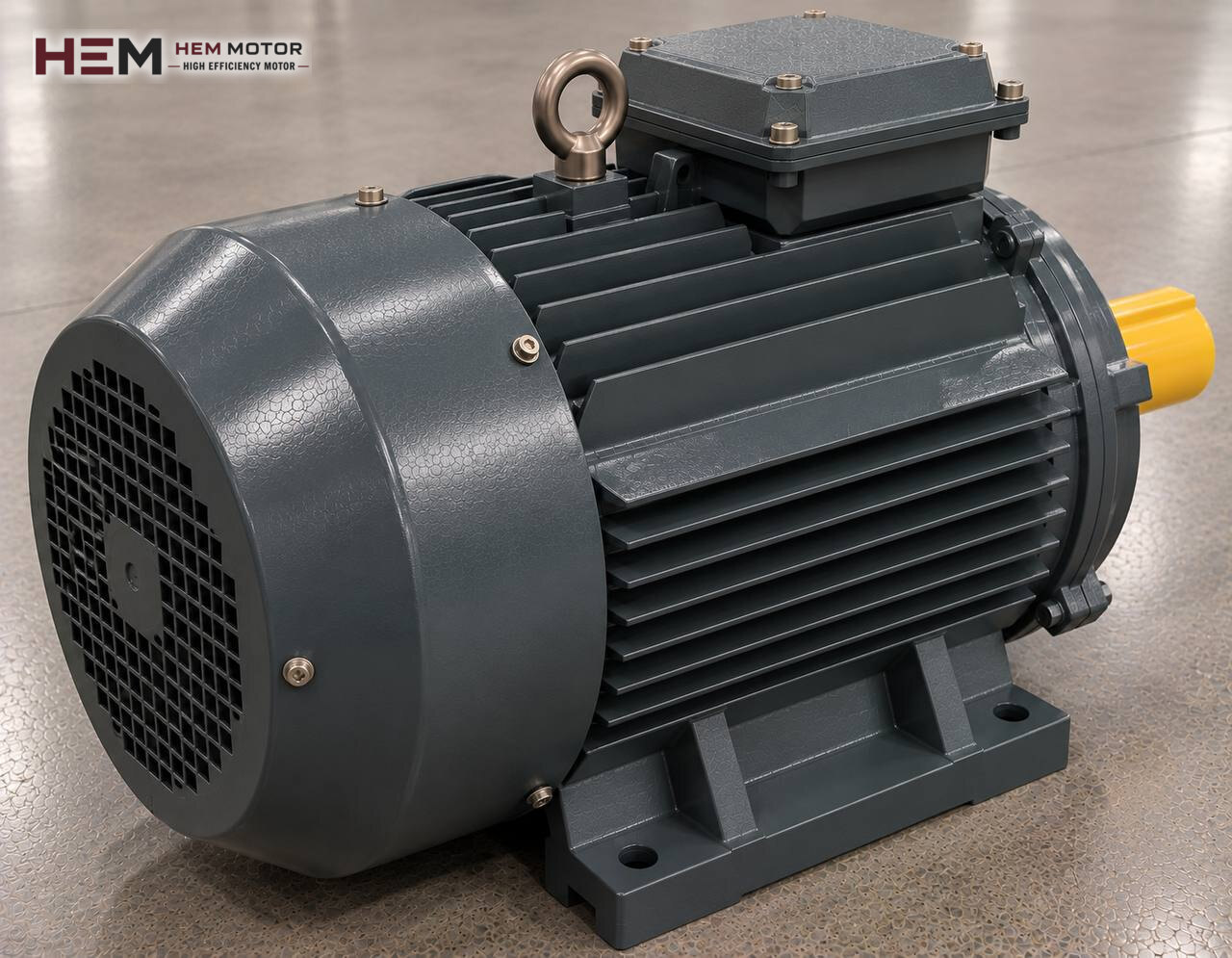
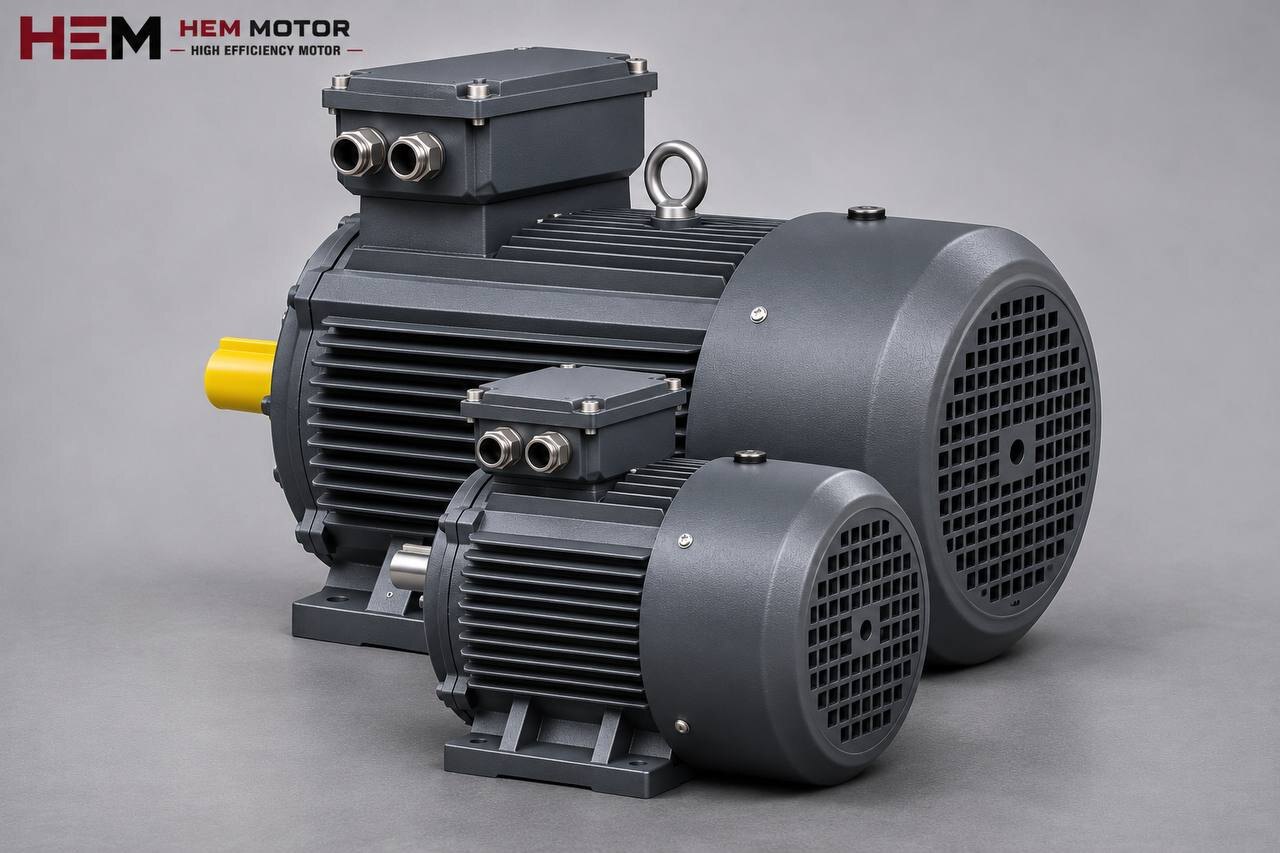
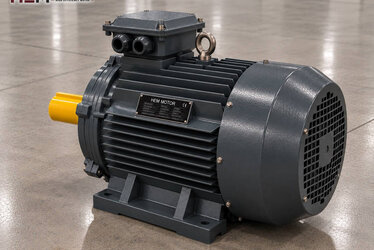
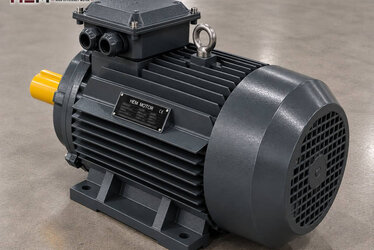
The fan sits on the rear shaft end inside the fan cover; the clearance between cover and fan is kept during replacement (representative image).
How are axial position and cover clearance checked?
Measuring the old fan before removal is the easiest way. Proceed as follows:
Remove the fan cover. Measure the distance from the rear face of the fan to the shaft end with a caliper and note it.
Measure the distance from the front face of the fan hub to the rear end shield.
Photograph the fan from the blade side and from the side; count the blades.
If there is a circlip or screw, note its type and position.
Fit the new fan at the same distance, close the cover and turn the shaft by hand, listening for rubbing.
With the cover on, run the motor briefly unloaded; compare noise and vibration with the old fan.
A certain gap must remain between the cover grille and the fan blades. If the blades come too close to the grille, whistling increases and less air returns to the frame. If they are too far, the air does not spread fully along the fins.
When fitting the fan onto the shaft, the hammer never strikes the hub directly. The impact marks the bearing balls. It is fitted with a suitable piece of tube, preferably by warming or with a press tool.
Prices and technical data are on the product pages; choose a model and order online.
What shows up in the motor if the wrong fan is chosen?
The first sign is temperature. If at the same load and ambient temperature the frame is clearly hotter than before the change, the fan is not delivering enough air. Taking infrared thermometer readings at the middle of the frame before and after the change shows this difference.
The second sign is vibration and noise. An unbalanced fan produces vibration at 1x running frequency, especially on 2-pole motors. Rubbing on the cover is heard as a regular tick or swish.
The third appears in the long run. As winding temperature rises, insulation ages faster and bearing grease dries out. According to an approach widely used on site, when the winding runs 10 °C hotter, the expected insulation life roughly halves (general information; confirm with the motor manufacturer's data).
A fan difference that looks small can shorten motor life by several years.
Plastic or aluminium fan?
In standard environments a plastic fan is enough; it is light, does not corrode and balances well. In hot environments, near ovens and drying lines or where some solvent vapours are present, the temperature and chemical resistance of the material are checked.
An aluminium fan withstands high temperature better; it must still carry the same hub and position dimensions as the plastic fan it replaces. If the material changes, the difference in mass and balance is also taken into account; a heavy fan adds, if only a little, to bearing load.
With inverter-driven motors the matter is different. As speed drops, the air pushed by the fan drops too. The answer here is not a bigger fan but a separately powered external fan. Our three-phase series are suitable for speed control with a frequency inverter; for long periods at low speed with full torque a separately driven fan may be needed; if the drive-to-motor cable is long, a dv/dt or sine filter is considered; these conditions are stated with the order.
Which checks follow a fan replacement?
When the change is done, a short checklist is applied before the motor is put into service. Are all fan cover screws in place, is the grille cracked, has any part been left inside the cover? Is there a rubbing sound when the shaft is turned by hand?
After the first start, current and frame temperature under load are logged and compared with the values before the change. The full commissioning steps are described in the first start-up check guide.
On a motor whose fan breaks often, the root cause is looked for separately. A foreign object hitting the cover, a vibrating base or very frequent stop-start operation can strain the fan hub.
What should be sent for a spare fan or a new motor?
For fan matching, a photo of the motor nameplate, photos of the old fan from two directions and caliper measurements of hub and position are enough. If the motor is old, or the frame and shaft end are worn, replacing it with a new one may be more economical.
Example models: aluminium frame 90L-4 (1.5 kW, 1445 rpm), 132M-4 (7.5 kW, 1460 rpm) and cast iron 160M-4 (11 kW, 1465 rpm). All three belong to the asynchronous electric motors family and are IC 411 surface-cooled; protection is IP55, insulation class F. Other options by power and frame are in the electric motor shop.
Send the nameplate and fan photos via the send your motor nameplate route or through our contact page; we will decide together on matching the fan or replacing the motor. If a new motor is needed, you can compare models of the same frame number in the HEM Motor product list.
Frequently Asked Questions
Can the fan from another motor with the same frame number be fitted?
Not always. The fan may differ by pole count, shaft end size and manufacturer. Hub bore, outer diameter, blade design and axial position should be checked together.
Can a motor run briefly without a fan?
Not recommended, except for a few seconds unloaded to check direction. Under load a motor without a fan heats up quickly.
Is the fan chosen by direction of rotation?
On standard motors a radial-blade fan works in both directions. With inclined-blade fans the direction matters and flow drops in reverse.
Does fitting a larger fan improve cooling?
Not recommended, even if cover clearance allows it. Noise and fan losses rise and the fan may rub the cover. If cooling is insufficient, an external fan or a larger power step is considered.
HEM Motor Models Related to This Article
The cards show example models related to the topic. A suitable motor is not chosen by power alone: compare speed, voltage, mounting, shaft and connection dimensions on the product page; if unsure, send a photo of the existing motor’s nameplate on WhatsApp.
Checking that electric motor pulleys lie in the same plane means seeing whether the side faces of both pulleys meet on one straight line. In practice a taut string, a steel straigh... More Details
If an electric motor's coupling element fails often, the first thing to investigate is shaft misalignment, followed by coupling selection, starting and shock loads, environmental e... More Details
The quickest way to tell foundation looseness from unbalance in electric motor vibration is to loosen the foot bolts one at a time while measuring and watch the change, and to comp... More Details
When building a sound enclosure around an electric motor, cooling is preserved by giving the enclosure a labyrinth or silenced inlet large enough for the air the motor fan draws, p... More Details
In an electric motor running in a hot environment, winding and bearing temperatures are monitored separately because they heat up from different sources, have different limits and ... More Details
When an electric motor is started for the first time at sub-zero temperatures, three things need checking: winding insulation resistance and any moisture or ice inside, bearing gre... More Details
We use necessary and optional cookies to improve your experience, enhance content and analyse traffic. Under the GDPR, optional (analytics/marketing) cookies are only used with your explicit consent. Please choose your preference below.
Cookie Policy
 English
 Français
 Türkçe
 Español
 Русский
 العربية
 Deutsch
 Italiano