English
 Français
 Türkçe
 Español
 Русский


A circular saw machine uses a rotating toothed disc to rip or cross-cut solid wood, planks and boards. For all woodworking machines see the woodworking machine electric motors page. This page deals only with the motor of single-blade machines such as the table saw, the up-cut cross-cut saw and the radial arm (pendulum) saw.

Types of single-blade circular saws
On a table saw the blade rises through a fixed table; the operator guides the workpiece against the rip fence into the blade. The blade usually comes with height adjustment and tilting up to 45 degrees. In that case the motor is fixed on a slide or cradle that moves together with the arbor.
On an up-cut cross-cut saw the workpiece is clamped on the table, and the blade rises from below, driven by a pedal or a pneumatic cylinder, cuts the plank across and drops back. On a radial arm saw the motor and blade sit at the end of an arm; the operator pulls the arm towards himself to make the cut. Optimising cross-cut lines work on the same principle but with automatic feeding.
Sliding table and beam panel saws that divide boards are covered under a separate heading; we do not go into their scoring saw arrangement here.
What the motor does on the saw arbor
The cut quality of a circular saw depends on the peripheral speed of the blade. This speed is set by blade diameter multiplied by arbor speed; the blade manufacturer gives a maximum speed for each diameter. For this reason the motor is almost always chosen as 2-pole, in the 3,000 rpm class. On small machines the blade is mounted directly on the motor shaft; on larger machines the motor drives the arbor by belt and the pulley ratio sets the arbor speed.
The load changes quickly with cutting depth and wood hardness. In soft wood such as pine the motor runs easily, while in oak, hornbeam or thick and wet planks the current rises noticeably. Ripping means long loaded running along the grain; cross-cutting gives a short and repeated load.
Points to watch with a direct-mounted blade
If the blade sits on the end of the motor shaft, the shaft end size, the flange type and the bearing's ability to carry axial load become important. This arrangement is usually built with a flanged frame; the flange and shaft size of the old motor should be compared one-to-one with the new one.
Starting, stopping and kickback
On a circular saw the blade and pulleys form a small inertia; on most machines the motor is started direct on line. The real issue is stopping: when power is cut, the blade coasts for a while. Shortening that time belongs to the machine's safety design; some manufacturers use a brake motor, others a separate braking arrangement. If a brake motor is needed, state it in your order.
When the workpiece pinches the blade, kickback can occur. The motor is then loaded suddenly and the belt may slip. Measures such as the riving knife, guard and push stick are the machine's equipment; motor selection does not remove this risk.
Example motors by machine type
| Machine | Cutting character | What to check | Example HEM model |
|---|---|---|---|
| Small workshop table saw | Intermittent, thin material | Blade diameter, supply voltage | 90L-2 aluminium — 2.2 kW, 2,895 rpm |
| Radial arm (pendulum) saw | Short, repeated cross-cuts | Mounting on the arm, motor length | 112M-2 aluminium — 4 kW, 2,905 rpm |
| Heavy-duty table saw | Long rip cuts in thick planks | Cutting depth, wood species | 132S2-2 aluminium — 7.5 kW, 2,930 rpm |
| Up-cut cross-cut saw | Frequent cuts in series production | Cutting frequency, belt arrangement | 160M1-2 cast iron — 11 kW, 2,945 rpm |
These rows are only examples; the final choice is made by considering the machine's real load, the required speed, the way the motor is attached and the workshop conditions together.
Workshop environment, mounting and the single-phase option
The circular saw is one of the machines that produce the most coarse chips and fine dust. The motor usually sits under the table, in the compartment where chips fall. Chips filling the fan cover and cooling fins make the motor run hot; regular cleaning and a correctly placed extraction inlet are therefore important.
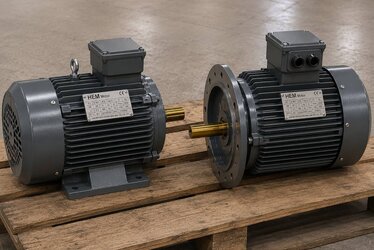
HEM's three-phase motors can be prepared, depending on frame size, as foot-mounted B3, flange B5 or B14, foot-and-flange B34/B35 and vertical V1, V3, V5, V6, V15. The flange and shaft end sizes are cross-checked at the ordering stage. A PTC or PT100 sensor can be added to the winding if required.
Some modern machines adjust blade speed with a frequency converter. Our series are suited to being fed by a drive; if the motor will turn at low speed under full load for long periods, an additional cooling fan should be considered, a dv/dt or sine filter if the cable between motor and drive is long, and this information should be given with the order.
For small workshops without three-phase supply there is also a single-phase electric motor series in the 0.18–5.5 kW range.
What to share with your motor request
To find the right motor quickly, write the machine type (table, radial arm, up-cut), the motor power (kW), the speed (rpm), the workshop voltage, the mounting (foot, flange or fixed to a slide), whether the blade is on the shaft directly or by belt, and how many units are needed. Add it if a brake motor is wanted.
If the old motor's nameplate is readable, sending a photo may be enough; the method is explained in the article on finding an equivalent from the motor nameplate. Current prices are listed in our electric motor shop; use the contact page for WhatsApp and phone.
Frequently Asked Questions
The circular saw motor stalls when cutting oak — is power insufficient?
First check blade sharpness, number of teeth and belt tension. A dull blade raises the load considerably in hard wood. If the current is still above the nameplate value after these are corrected, a more powerful motor can be considered.
Is it right to fit the blade directly on the motor shaft?
This is a common solution on small machines. The shaft end size, flange type and bearing load must suit the machine's design; on replacement the same dimensions as the old motor are required.
Does the motor tilt with the blade on a tilting saw?
On most table saws the motor sits on the same cradle as the arbor and tilts with it. The motor length and cable exit direction must therefore fit the space inside the machine.
The blade coasts for a long time after switching off — will a new motor fix it?
Coasting time depends on the braking arrangement, not on the motor. If the machine has no brake, the manufacturer's recommended solution should be applied; if a brake motor is wanted, state it in the order.