English
 Türkçe


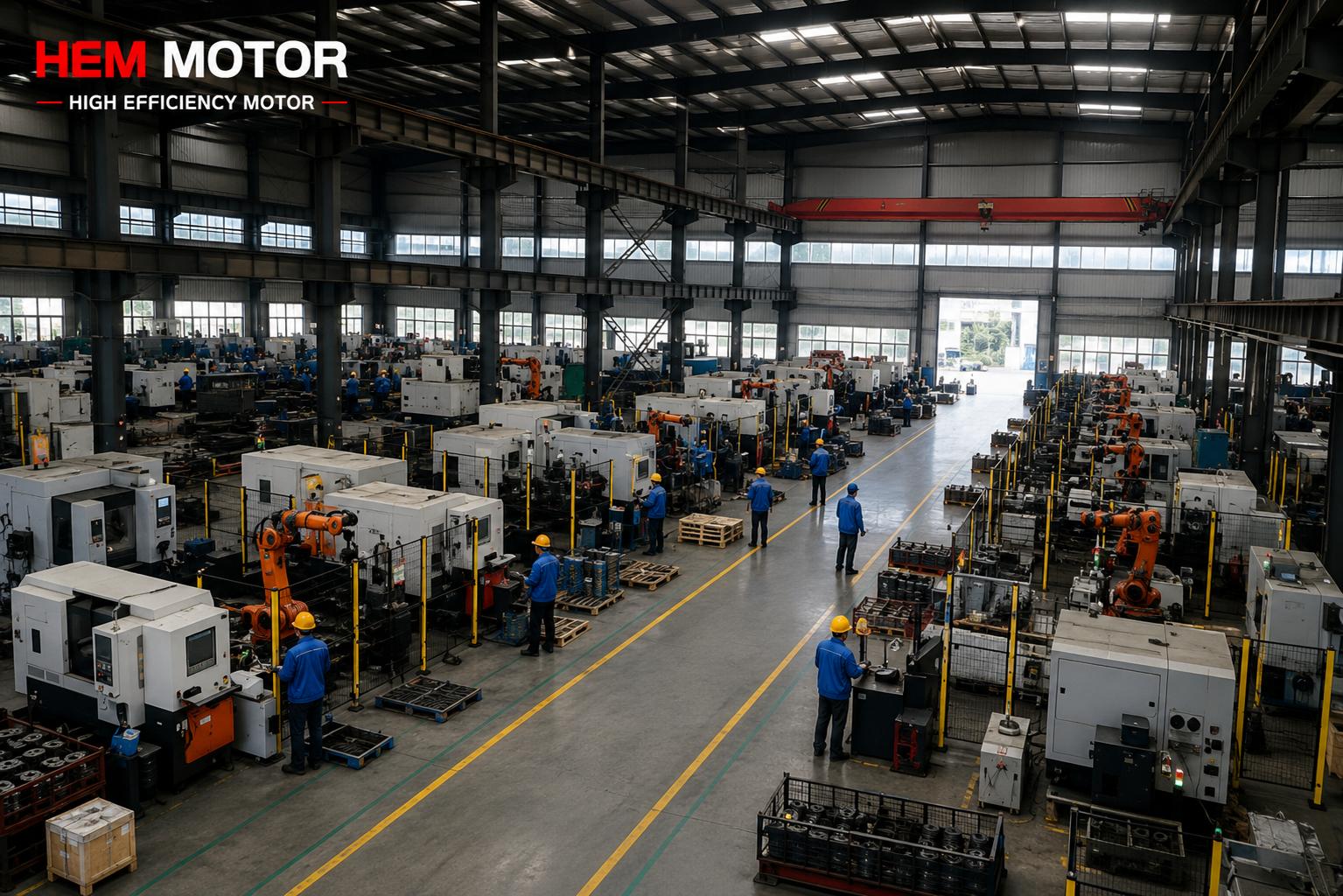

Bottle, jar and flat glass production relies on a continuous drive chain stretching from the melting furnace to the blowing machine, from the annealing (lehr) furnace to the packaging conveyor. Every link in this chain contains a correctly selected electric motor. In glass blowing factories the ambient temperature is high, the line runs continuously 24/7 (S1 duty) and downtime is extremely costly, because the melting furnace cannot be cooled down. This article maps the motor requirements of a glass factory from IS (Individual Section) blow molding machine drives to furnace combustion air and stack fans, from the annealing lehr conveyor to the finishing line, along with correct power-speed-protection class selection and fast supply logic.
The Drive Chain in a Glass Factory: Which Machine, Which Motor?
In a glass blowing plant motors fall into four main groups: melting and combustion air fans, blow molding/forming machine drives, annealing and cooling conveyors, and the finishing and packaging line. Each group has very different load profiles, ambient temperatures and protection needs. For correct supply each machine must be treated as a separate load item.
Melting Furnace Combustion Air and Stack (Exhaust) Fans
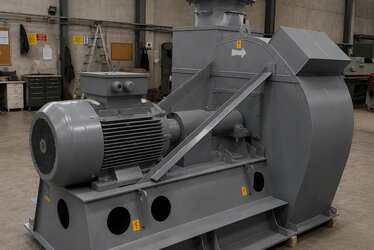
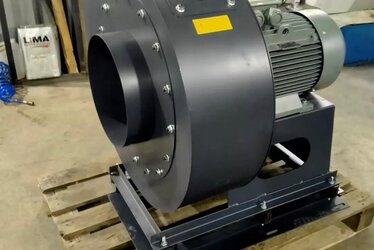
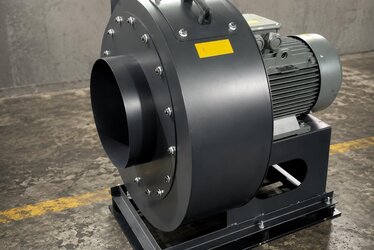
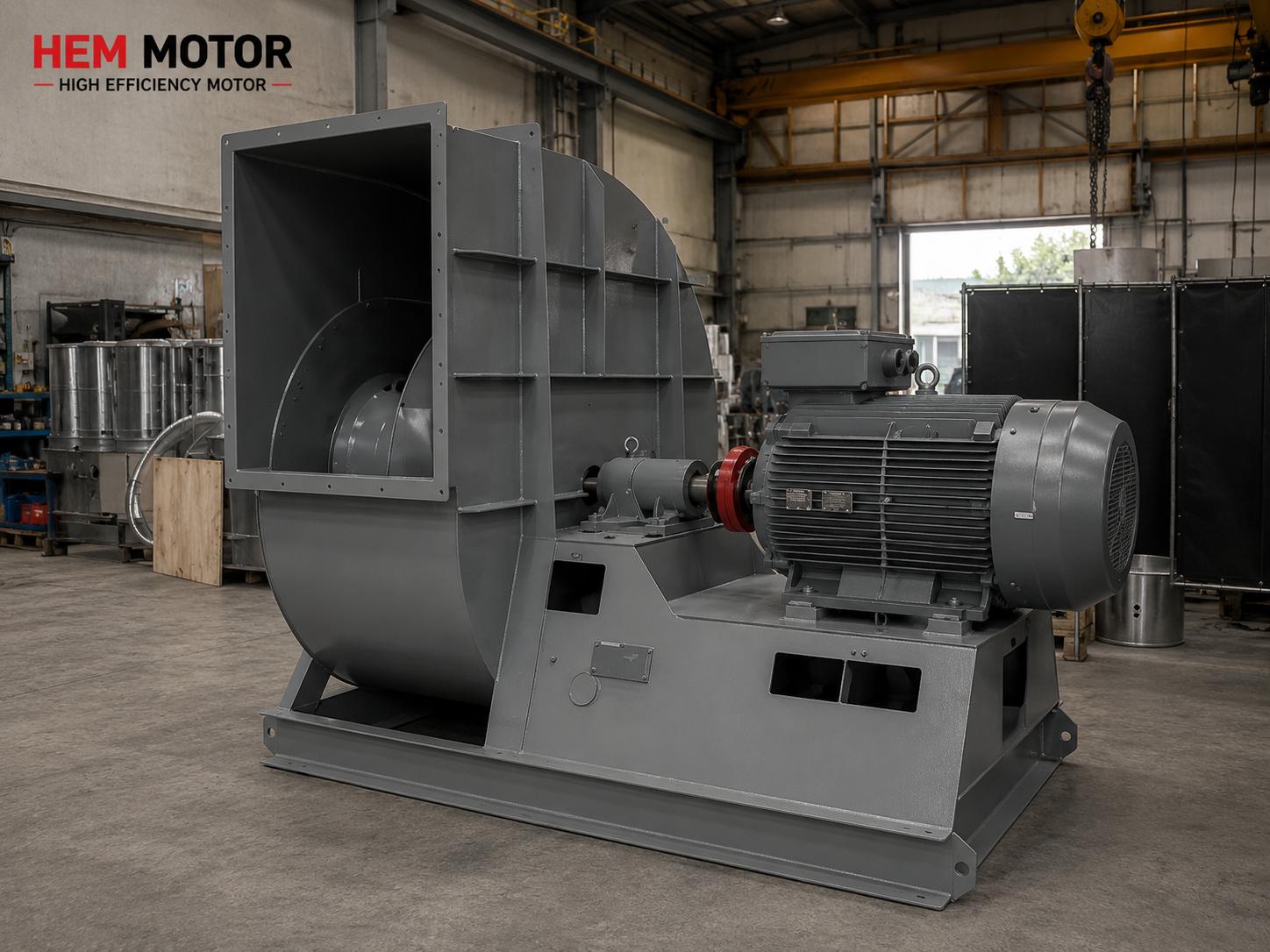
The melting furnace is the heart of a glass factory and runs continuously above 1500 °C. Fans pushing combustion air to the burners and stack/exhaust fans removing combustion gases directly determine furnace efficiency. These fans are usually centrifugal and draw between 10 kW and 160 kW. Because the motor itself operates in a hot environment, Class F insulation is standard and Class H insulation is preferred at critical points. In our guide on glass and ceramics factory furnace fan motors we covered detailed criteria; continuous S1 duty and low vibration are essential here. For fan motors, our article on centrifugal and axial fan motor selection explains power matching by fan type.
IS (Individual Section) Blow Molding Machine Drive
The IS machine is the heart of bottle and jar production. The gob feeder, shears, mold mechanisms and conveyor synchronization are all driven by motors. On an IS machine drive motors are mostly run by a variable frequency drive (VFD), because line speed changes with product type and precise synchronization is required. In this application the VFD with asynchronous motor combination is standard, and force-cooled motors provide adequate cooling even at low speed. The power range is typically 1.5 kW to 30 kW.
Annealing Lehr Conveyor
Hot formed glass products are passed through the annealing furnace (lehr) at controlled speed to relieve internal stresses. The lehr conveyor runs at low speed, high torque and in a hot environment, so it is usually used with a bevel helical reducer or a worm gear reducer. The conveyor motor speed should be VFD-adjustable, and the reducer output speed must match the product transit time. The points to watch in conveyor and belt drive motors also apply here.
Hot Environment: Why Insulation and Cooling Are Critical
In a glass factory the ambient temperature can rise to 45-55 °C, especially in the furnace and forming areas. Standard motors are rated for 40 °C ambient; above this the motor power must be derated. For correct supply there are two strategies: either select a larger power/frame, or choose a Class H insulated motor.
The Difference Between Class F and Class H Insulation
Class F insulation withstands 155 °C winding temperature, Class H 180 °C. In furnace fan and circulation fan motors operating in hot environments, Class H insulation significantly increases motor life and reliability. We detailed this difference in our article on winding insulation class F and H. When high altitude and hot environment combine, a power derating calculation must be performed.
Continuous S1 Duty and Cooling Design
In a glass factory almost all motors run in continuous (S1) duty. Therefore the cooling fan design and frame surface area matter. A cast iron frame provides both dimensional stability at high temperature and good heat dissipation. In the cast iron vs aluminum frame decision, a hot and continuous environment favors cast iron. For motors running at low speed with a VFD, proper cooling fan design and forced cooling are essential.
Power, Speed and Efficiency Class Selection
The power range for glass factory motors extends from 0.55 kW small auxiliary drives to 355 kW large furnace fans. Fan applications commonly use 1500 rpm (4-pole) and 3000 rpm (2-pole); conveyor and forming drives commonly use 1500 rpm with a reducer combination. Current regulations are decisive for the efficiency class.
IE3 and IE4 Efficiency Mandate
Under Turkish and EU regulations, IE3 is mandatory for DOL motors in the 0.75-1000 kW range, and IE4 for 2/4/6-pole motors in the 75-200 kW range. For a continuously running glass factory, high efficiency means direct energy cost savings. Our articles on the IE3-IE4 efficiency mandate and regulation and IE3 vs IE4 motor investment include payback calculations. For continuously loaded fan motors, the total cost of ownership (TCO) calculation clarifies the decision.
Correct Sizing and Pole Selection
Oversizing fan and conveyor motors hurts both the investment and the efficiency. Our articles on motor load ratio and correct sizing and 2/4/6-pole selection guide this. For large furnace fans above 90 kW, review the high power motor supply above 90 kW plan.
Mounting Type and Mechanical Fit
Fan motors are usually foot-mounted (B3) or combined (B35); IS machine and conveyor reducer drives are connected with flange (B5/B14) mounting. When replacing an old motor, the frame size, shaft diameter, key dimensions and flange holes must match exactly. Our articles on B5 vs B14 mounting type and shaft diameter and key dimensions prevent the wrong part from arriving. For worm and bevel helical reducer options see our worm gear reducer product group, and for the motor range our high efficiency electric motors page.
Emergency Replacement and Stock Logic
In a glass factory a melting furnace fan or IS drive motor failure can stop the entire line. Therefore spares of critical motors must be kept in stock. Our articles on the critical spare motor list and stock planning and emergency replacement and direct swap show which power ratings to keep in stock. When replacing an old brand motor, use our equivalent motor selection guide.
Starting Method and Inrush Current Management
Large furnace fans and IS drive motors can have high inertia, which creates a high current demand at the moment of starting. Direct-on-line (DOL) starting is suitable at small powers; however, for fan motors above 30-45 kW, star-delta or a soft starter is preferred to avoid stressing the grid and reduce mechanical shock. On drives using a variable frequency drive (VFD), the inrush current is already controlled; the drive provides a soft start with a ramp time. Our star-delta and soft starter article helps you choose the starting method. If operating on a generator for site or backup power, generator kVA - motor kW matching takes the inrush current into account.
Energy Efficiency and Savings in Continuous Operation
Because a glass factory runs 24/7, the annual operating hours are very high, which means even small efficiency differences turn into large energy costs. An IE4 furnace fan motor can save thousands of kWh per year compared to its IE3 equivalent. In pump and fan applications, adjusting flow/pressure with a variable frequency drive eliminates throttling losses for additional savings. Our articles on high efficiency motor + VFD savings and nameplate vs field efficiency explain how to calculate real savings correctly.
Maintenance, Monitoring and Bearing Life
In hot and continuously running motors, the bearing is the most critical wear item. High ambient temperature shortens grease life, so a suitable lubrication interval and high-temperature grease where needed are used. On large furnace fans, winding and bearing temperature can be continuously monitored with temperature sensors (PT100 or thermistor), preventing unexpected failures. Our articles on bearing life and motor protection devices explain which protection and monitoring equipment to request at the time of order.
Frequently Asked Questions
Does a glass factory furnace fan motor need Class F or Class H insulation?
If the ambient temperature is below 40 °C and the motor is not close to hot surfaces, Class F insulation is sufficient. However, if the ambient around the furnace rises to 45-55 °C or the stack fan is near a hot gas duct, Class H insulation is recommended. Class H extends motor life by increasing the winding temperature margin. A derating calculation should also be done in hot environments and a larger frame selected if needed.
Why is a variable frequency drive used on the IS blow molding machine drive?
On an IS machine the line speed changes with the bottle type produced and the number of sections. The VFD provides synchronization and flexible production by precisely adjusting motor speed. Because self-cooling can decrease at low speed with a VFD, force-cooled (independently ventilated) motors are preferred. This keeps motor temperature safe even at low speed.
Which reducer type is suitable for the annealing lehr conveyor?
The lehr conveyor requires low speed and constant torque. Worm gear (HEM series) reducers are preferred on lower-power lines; K series bevel helical reducers on lines requiring higher power and efficiency. Bevel helical reducers offer higher efficiency and longer life; worm gear offers self-locking and compactness. The choice is made according to the required output speed, torque and budget.
Get a Quote
We supply electric motors in the correct power, speed, insulation and protection class for the melting furnace fan, IS blow molding machine drive, annealing lehr conveyor and packaging line of your bottle, jar and flat glass factory, from stock and with fast delivery. For F/H insulated motors suited to hot and continuous operation, IE3/IE4 efficient solutions and compatible reducer options, contact us: +90 (532) 345 49 86. For a fast and accurate quote reach us via our contact page.
Purchasing and Selection Checklist
Before ordering motors for a glass blowing factory, clarify the following:
- Machine and duty: Furnace combustion air fan, stack fan, IS drive, lehr conveyor and packaging line listed separately.
- Power and speed: kW and rpm (2/4/6-pole); by fan curve for fans, by reducer ratio for conveyors.
- Insulation class: Class H in hot zones, Class F elsewhere; derating by ambient temperature.
- Protection class: At least IP55 in dusty/hot environments, IP65 at critical points.
- Efficiency class: IE3/IE4 per regulation; TCO advantage under continuous load.
- Mounting: B3/B5/B35; frame, shaft, key and flange dimensions for an old motor.
- VFD compatibility: Drive-compatible windings and forced cooling where needed on IS and conveyor drives.
- Spare/stock: Stock plan for critical fan and drive motors.