English
 Türkçe

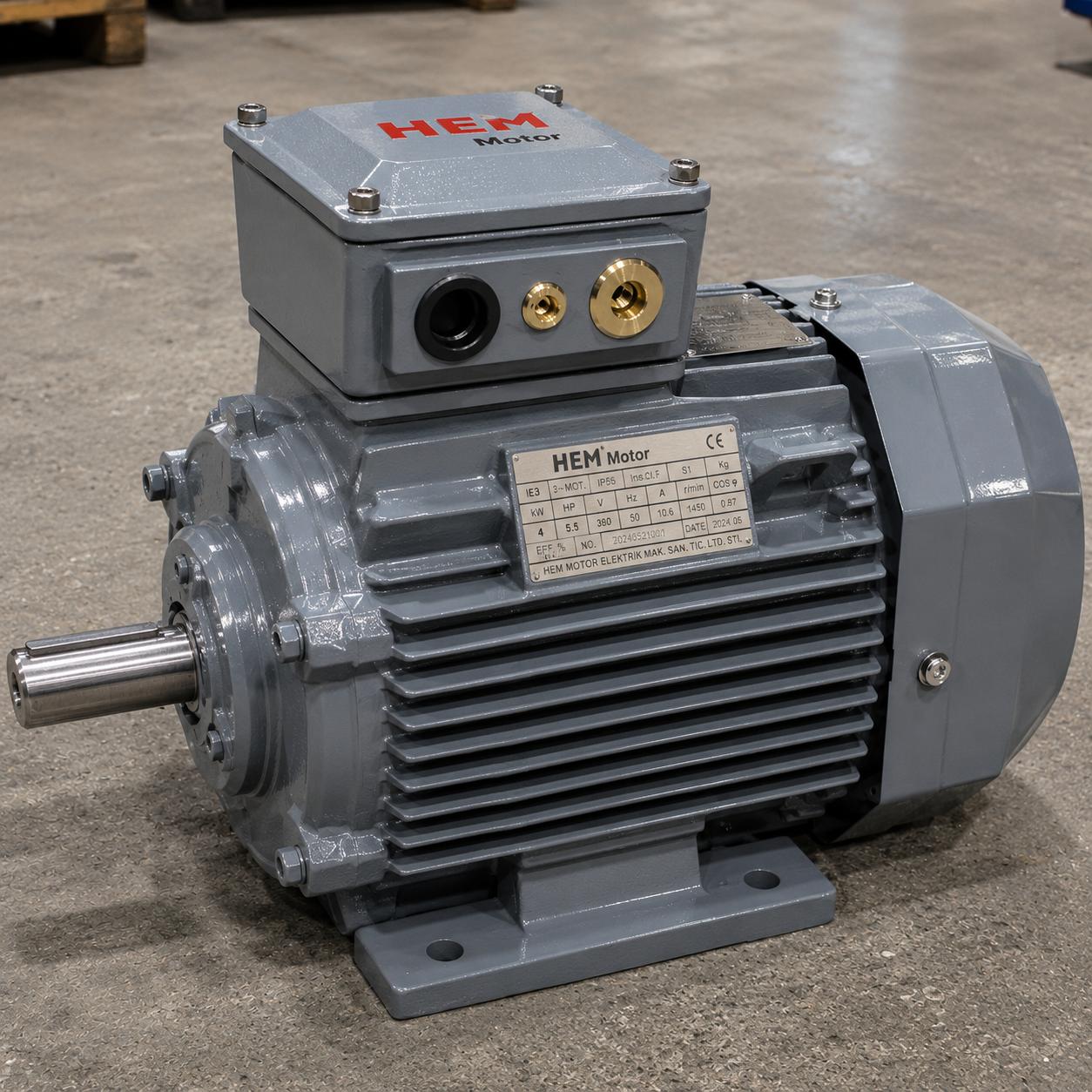

When buying an asynchronous motor, most people look only at power, that is, how many kW it is. Yet even with the right power, a motor bought at the wrong speed either runs the machine far below the target speed, slowly, or strains it into early failure. And the single variable that sets speed is the pole count. Since the grid frequency in Turkiye is 50 Hz, pole count fixes the motor's synchronous speed with mathematical certainty: 2-pole 3000 rpm, 4-pole 1500 rpm, 6-pole 1000 rpm. This guide explains, in buying-guide language, which jobs 2-, 4- and 6-pole motors are bought for and the five pieces of information you must give before ordering.
Power tells you "how much work the motor can do", while speed tells you "at what speed it will do that work". The two are not independent; the different speed options of a same-power motor suit completely different applications. So when ordering a motor, the question "how many kW" must be immediately followed by "how many poles / what speed". Skipping speed is one of the most common and most costly purchasing mistakes.
How Does Pole Count Set Speed? The 50 Hz Reality
The synchronous speed of an asynchronous motor is tied to pole count by a simple formula: synchronous speed = (120 × frequency) / pole count. Since the grid in Turkiye is 50 Hz, this calculation is fixed, and as the pole count rises the speed falls:
- 2-pole → 3000 rpm (synchronous): Highest speed; turns at roughly 2900 rpm under load.
- 4-pole → 1500 rpm (synchronous): Medium speed; roughly 1450 rpm under load. The most common class in industry.
- 6-pole → 1000 rpm (synchronous): Low speed; roughly 960 rpm under load. High-torque applications.
The actual load speed (rotor speed) is slightly below synchronous speed due to slip; that is why the nameplate speed is written as values like 2900, 1450, 960. What matters is that pole count rigidly fixes the speed band; you cannot make a same-power motor "a bit faster" or "a bit slower"; speed comes in steps. To evaluate the right motor family holistically, the electric motor types and buying map guide is a good start.
2-Pole Motors (3000 rpm): High-Speed Jobs
2-pole motors turn at the highest speed and are bought for applications needing high speed and relatively low torque:
- Centrifugal pumps and high-pressure pumps
- Compressors and compressed air units
- High-speed separators, some blowers and fans
In these applications speed directly sets performance; for example, in a centrifugal pump the head and flow depend on speed. If a 4-pole motor is fitted by mistake, the pump cannot deliver the target pressure. To evaluate the efficiency-class decision in pumps and compressors together, we recommend reviewing the IE4 threshold in pumps, fans and compressors guide.
4-Pole Motors (1500 rpm): The General-Purpose Majority
4-pole motors are the most common speed class in industry and the first option that comes to mind when "general-purpose drive" is mentioned. The medium speed offers the ideal speed-torque balance for many machines:
- Conveyor and belt drives (usually with a reducer)
- Agitators, mixers and process machines
- Medium-speed fans and general industrial machinery
Most machine builders design around a 1500 rpm motor; that is why 4-pole has the widest stock availability. When used with a reducer, the motor's 1500 rpm input is reduced to the desired output speed. To see the most sought-after stock combinations, the IE3 electric motor stock guide is useful.
6-Pole Motors (1000 rpm): High Torque, Low Speed
6-pole motors turn at low speed and are bought for heavy-duty applications needing high torque and slow, steady motion:
- Heavy-duty drives requiring high torque
- Large fans and some crusher/screen/feeder drives
- Machines requiring slow, smooth rotation
Low speed often lets you reach the desired slow output with fewer gear stages or a smaller reducer ratio. In applications requiring high torque, 6-pole is the way to run the machine steadily without straining it. For the right frame-power matching in heavy-duty drives, the cast iron motor frame size and power matching guide is complementary.
The Cost of Choosing the Wrong Speed
Even with the right power, choosing the wrong pole count causes two kinds of problems:
- Running too slowly: If a lower-speed motor is fitted, the machine cannot reach the target speed; the pump cannot deliver, the fan cannot give the wanted flow, the line slows down.
- Strain and failure: If a higher-speed motor is fitted, the machine is overstrained, and the mechanical parts and the motor itself heat up and are dragged into early failure.
So speed is a parameter as binding as power and must be clarified before ordering.
The Five Pieces of Information to Give Before Ordering
To buy the right asynchronous motor first time, give your supplier these five pieces of information in full:
- Power (kW): The motor's rated power.
- Pole count / speed: 2/4/6 poles or target rpm.
- Frame number and mounting: Frame size and foot/flange (B3/B5/B35) type.
- Efficiency class: IE3 or IE4.
- Voltage/frequency: Standard 400V / 50 Hz, or a special requirement.
If you are replacing an existing motor, photographing its nameplate is the fastest way to gather these five pieces of information. To pick the motor with the right pole count and power from our wide stock, you can visit our homepage. When you choose the speed correctly, the motor seats fully into the machine first time.
The Speed-Reducer Relationship: How Do You Set the Output Speed?
Since the speed of asynchronous motors comes in steps (3000, 1500, 1000 rpm), the exact intermediate speeds a machine needs cannot be provided directly by the motor. This is where the reducer comes in. A reducer lowers the motor's standard speed by its gear ratio down to the desired output speed and at the same time increases torque. So in conveyors, agitators and many heavy-duty applications, motor + reducer is selected as a whole.
In practice the common approach is to base on the 4-pole (1500 rpm) motor, which has the widest stock availability, and reach the desired slow output through the reducer ratio. When very high torque and very slow output are needed, starting with a 6-pole motor can reduce the reducer ratio. When choosing the right combination, it is also critical that the motor's frame size and flange type fit the reducer; on this, the cast iron motor frame size and power matching guide gives complementary information.
What to Watch in Motor + Reducer Selection
- The desired output speed and torque; this sets the reducer ratio.
- The motor's pole count; this fixes the starting speed.
- Flange type and shaft compatibility; for the motor's physical connection to the reducer.
- Service factor; for the reducer's strength in heavy-duty and shock loading.
Changing Speed With a Variable Frequency Drive (VFD)
Pole count fixes synchronous speed at 50 Hz; but when a variable frequency drive (VFD) is used, the speed can be adjusted steplessly by changing the frequency fed to the motor. This provides a big advantage especially in variable-flow applications such as pumps and fans: instead of throttling with a damper or valve, adjusting the motor's speed directly both optimises the process and brings energy savings.
Even so, a VFD does not make pole selection unnecessary. Even when running with a drive, the motor's base speed (pole count) must be chosen correctly; because the drive adjusts within a band around the motor's nominal speed. For example, it is possible to slow down or speed up a 4-pole motor somewhat with a drive, but forcing it to reach 3000 rpm like a 2-pole motor is not the right approach. So starting with the right pole count is essential even in drive applications.
Field Symptoms of the Wrong Speed Choice
When a motor is bought at the wrong speed, the problem usually shows itself shortly after installation. The typical symptoms are:
- The pump cannot deliver: When a lower-speed motor is fitted, the pump cannot give the target pressure and flow.
- The fan delivers insufficient air: Low speed directly lowers the fan's flow.
- Overheating: When a higher-speed motor strains the machine, the motor and bearings heat up early.
- Vibration and noise: Speed mismatch leads to mechanical strain and vibration.
The appearance of these symptoms usually stems from the speed/pole information being given incompletely before ordering. Clarifying the right pole count from the start prevents all of these problems. To see the most sought-after power-speed combinations, the IE3 electric motor stock guide is a practical resource.
The Power and Torque Relationship in Speed Selection
When a motor's power is fixed, there is an inverse relationship between speed and torque: at the same power, a lower-speed motor produces higher torque. Understanding this relationship is the basis of choosing the right pole count. In an application requiring high torque, choosing a low-speed (6-pole) motor lets you run the machine steadily without straining it; whereas fitting a high-speed motor to the same job means either insufficient torque or overstrain.
So speed selection should be done not only with the question "how fast does it need to turn" but together with "how much torque is needed". For example, in a crusher or heavy feeder drive where high torque is the priority, a 6-pole motor or a 4-pole motor reduced with a reducer is the right choice. Conversely, in a centrifugal pump where high speed is the priority, a 2-pole motor is suitable. Thinking through the power, speed and torque triangle together makes the motor seat into the machine in terms of both speed and torque.
Practical Rules in the Power-Speed-Torque Balance
- If high torque, low speed is needed: Prefer 6-pole or 4-pole with a reducer.
- If general-purpose balance is needed: 4-pole is the most common and flexible choice.
- If high speed, low torque is needed: 2-pole is suitable (pump, compressor).
- If an intermediate speed is needed: Pair a standard-pole motor with a reducer.
Setting this balance correctly both extends the motor's life and ensures the machine runs efficiently. A wrong speed-torque match is one of the most common and most costly purchasing mistakes; clarifying the right pole count from the start removes this risk entirely.
Frequently Asked Questions
What is the difference between 2, 4 and 6 poles?
The difference is in speed. Since the grid in Turkiye is 50 Hz, pole count fixes synchronous speed exactly: 2-pole 3000 rpm, 4-pole 1500 rpm, 6-pole 1000 rpm. 2-pole is bought for high speed-low torque (pumps, compressors), 4-pole for general-purpose balance (conveyors, fans, process), and 6-pole for low speed-high torque (heavy-duty) applications.
What happens if I buy a correctly powered motor at the wrong speed?
It either runs the machine below the target speed, slowly, or strains it into early failure. A lower-speed motor cannot drive the pump or bring the fan to the wanted flow; a higher-speed motor overstrains and heats the mechanical parts and the motor, shortening its life. That is why speed is a parameter as binding as power.
What information should I give the supplier for speed selection?
Five pieces of information are enough before ordering: power (kW), pole count or target speed, frame number and mounting type, efficiency class (IE3/IE4) and voltage/frequency. If you are replacing an existing motor, photographing its nameplate is the most practical method; this prevents a motor arriving at the wrong speed and lets the right motor seat first time.