English
 Türkçe

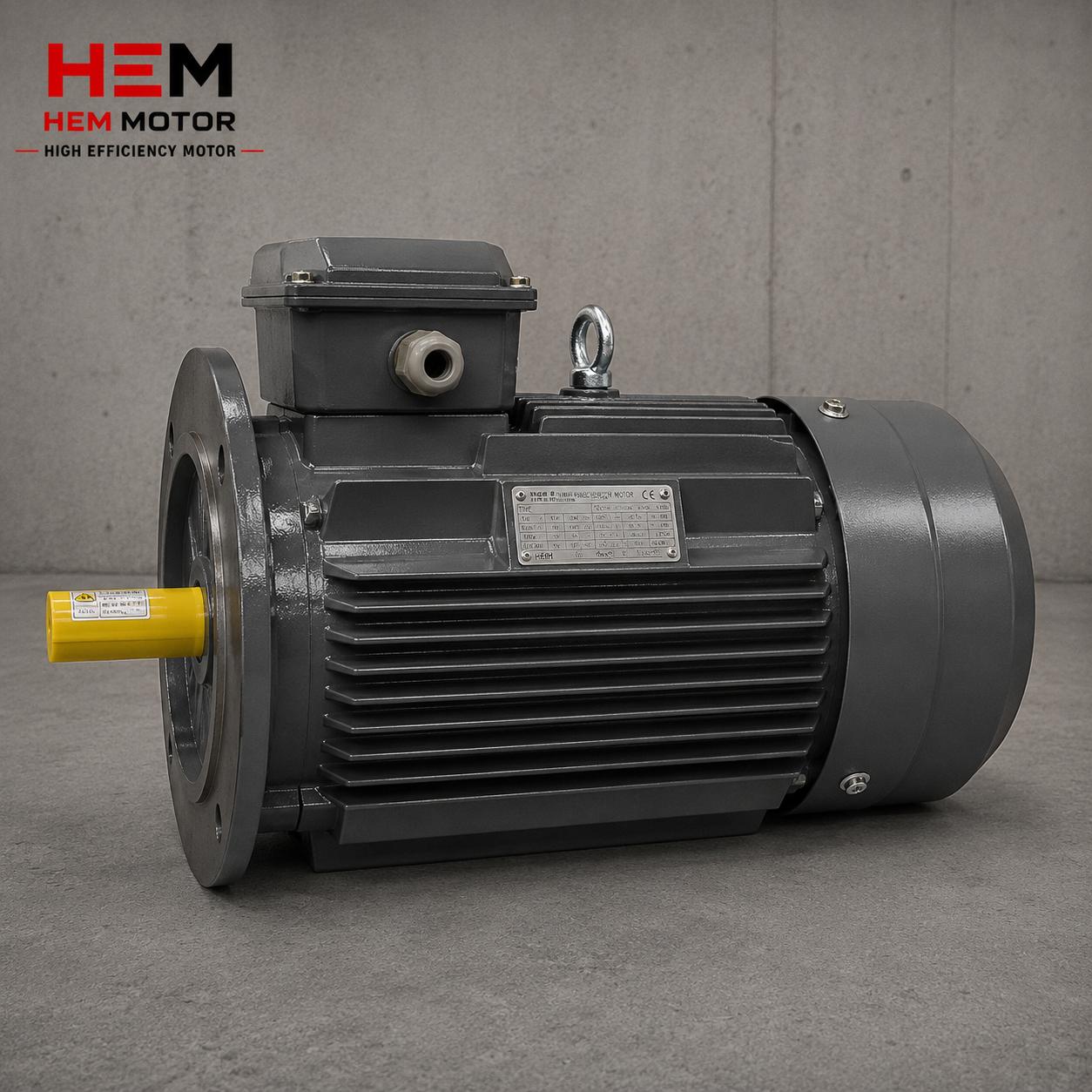

The efficiency value (%) written on the nameplate of an asynchronous motor shows the best point reached at full load. But in real plants motors rarely run at full load; most of the time they run around 50-75% load, and some at much lower loads. This is where the efficiency-load curve comes in: the efficiency of the motor changes with the load ratio it draws. An oversized motor, even if its nameplate shows high efficiency, runs at low load in the field and loses both efficiency and power factor. In this guide we cover the efficiency-load curve of the asynchronous motor: how efficiency changes at 25%, 50%, 75% and 100% load, why peak efficiency is usually around 75% load, and the effect of correct kW selection on savings.
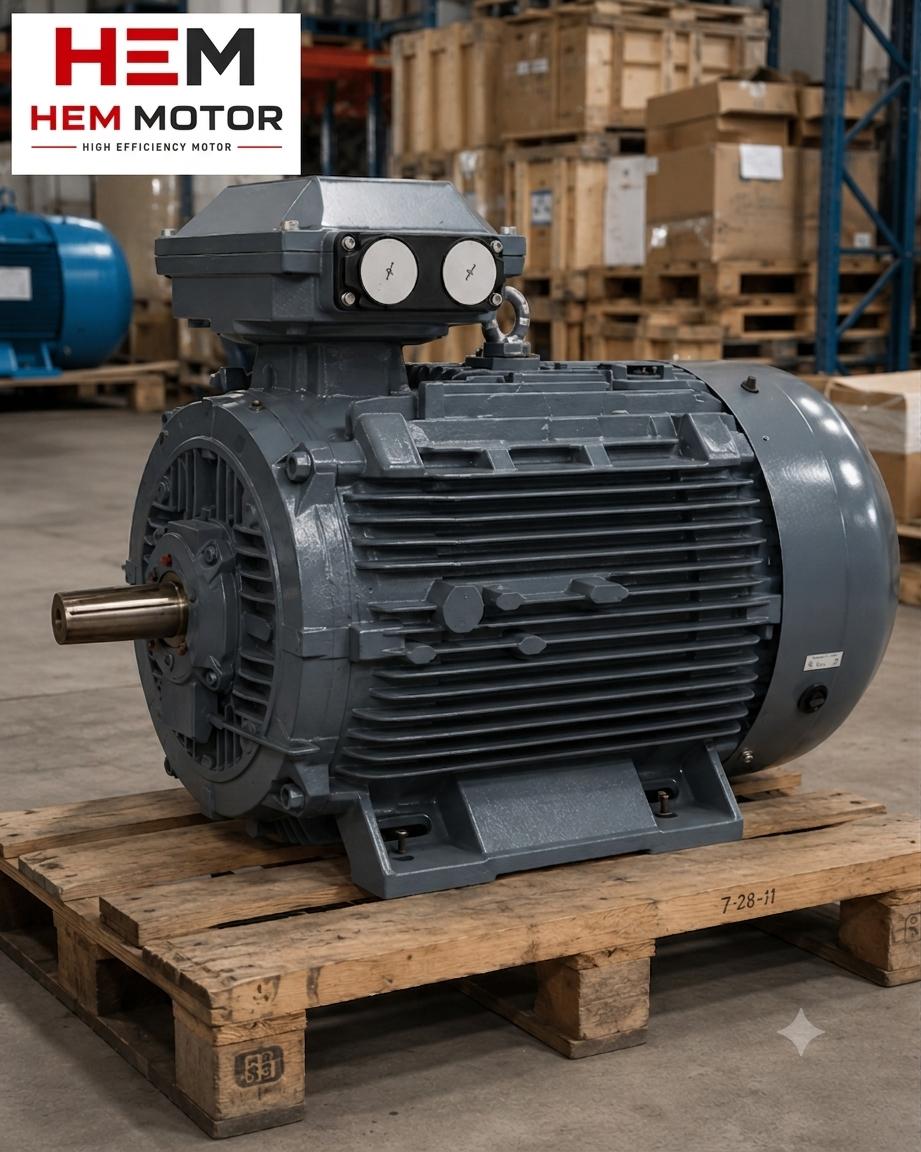
What Is the Efficiency-Load Curve and Why Is It Not a Straight Line?
The efficiency of an asynchronous motor is the ratio of output (shaft) power to input (electrical) power. While the motor runs, two kinds of loss occur: fixed losses independent of load (iron loss, friction, fan loss) and variable losses dependent on load (copper loss, i.e. heating in the winding resistances). Fixed losses stay almost the same as long as the motor runs; variable losses rise in proportion to the square of the load.
The sum of these two loss types determines the shape of the efficiency curve. At very low load the fixed losses form a large share relative to the small output power, and efficiency falls. As load increases the output power exceeds the fixed losses and efficiency rises. But as load approaches 100%, the copper loss (with the square of load) grows rapidly and efficiency starts to fall slightly again. This is why in most asynchronous motors the peak efficiency is seen not at full load but usually around 75% load. To better understand where the losses occur, the IE4 motor efficiency losses: iron, copper and friction loss article forms the basis.
Efficiency at 25%, 50%, 75% and 100% Load
It is practical to think of the efficiency curve at four points. Around 25% load the efficiency is markedly low, because the fixed losses dominate the small output. At 50% load the efficiency recovers but is still below the best point. 75% load is usually the peak efficiency region. At 100% load the efficiency is very close to 75% but mostly slightly lower. What matters is that the curve is fairly flat and high between 50-100%; the real collapse begins when you go below 50%. You can find the effect of efficiency class differences on this curve in the asynchronous motor efficiency and pole count article.
Drop in Power Factor (cosφ) at Part Load
The second important quantity that falls along with efficiency is the power factor (cosφ). An asynchronous motor draws a magnetizing current independent of load to set up its magnetic field. At full load this current is a small share of the total current and cosφ is high. At low load, as the active current decreases while the magnetizing current stays constant, cosφ falls sharply. A low power factor leads to drawing extra reactive current from the grid and, in some tariffs, a reactive penalty.
Therefore an oversized motor creates a double loss with both low efficiency and low cosφ. For reactive draw and correction at part load, the asynchronous motor power factor (cos fi) and correction article explains capacitor selection. Assess the effect of the reactive penalty on operating cost in the high efficiency motor power factor and reactive penalty article.
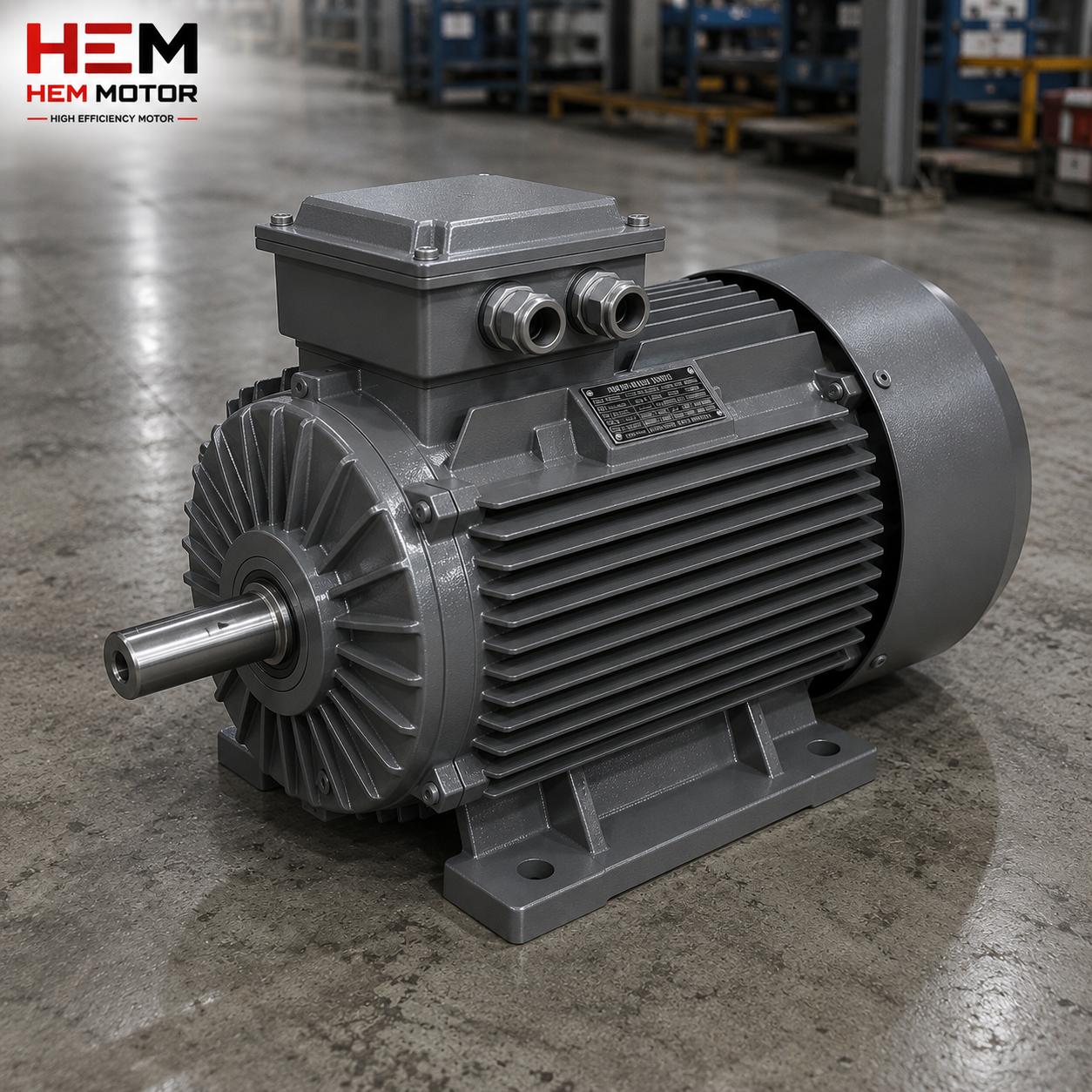
The Harm of Oversizing: A Bigger Motor Is Not Always Better
One of the most common mistakes in the field is choosing a motor larger than needed to be safe. When an 18.5 kW motor is fitted while an application needs 11 kW, the motor constantly runs around 60% load. At this point it operates below the peak of the efficiency curve, but worse, in the region where the power factor is low. As a result the motor does not burn or stop, but every hour it draws more energy and reactive power than necessary. On a motor running all year, this difference can completely consume the expected savings.
The IE4 motor part and low load efficiency: why oversizing eats savings article works through how oversizing consumes savings in detail. To choose the right load ratio, the at what load a motor should run and for general correct sizing the high efficiency motor: efficiency class and correct sizing articles are guides. Conversely, a motor chosen too small is constantly stressed at overload and heats, shortening its life; the asynchronous motor temperature rise class article explains this balance.
Correct kW Selection: Power Close to the Need
The ideal motor is one chosen close to the real power need of the application, leaving a reasonable power margin. As a general rule, the motor running mostly around 75% load is the best point for both efficiency and power factor. To calculate the real power need, the motor power calculation: required kW in pump, fan and conveyor and for HP-kW conversion the HP or kW: understanding electric motor power correctly articles are references.
Load Detection by Measurement: How Do You Read the Motor in the Field?
What load a motor actually runs at must be determined by measurement, not by guessing. The most practical method is to measure the current the motor draws with a clamp ammeter and compare it with the rated current on the nameplate. If the drawn current is around half the rated current, the motor runs at about half load. For a more accurate result, the real active power (kW) and cosφ are measured with a power analyzer. You can find the difference between nameplate and field efficiency in the nameplate versus field efficiency article.
For a more comprehensive assessment, logging the load profile of the motor over a period reveals real savings opportunities; we cover this method in the finding hidden energy savings with motor load profile and data logging article. To verify field efficiency with a power analyzer, the verifying field efficiency with a power analyzer in an efficient motor article offers an advanced method. To build a plant-wide inventory, the preparing for an energy efficiency audit: plant motor inventory article helps.
Preserving Efficiency Under Variable Load with a VFD
In applications where the load varies, such as pumps and fans, lowering the speed with a variable frequency drive (VFD) instead of running the motor at fixed speed and throttling with a valve both preserves efficiency and provides large savings. By the affinity law, when fan or pump speed drops, the power need decreases in cubic proportion. We cover this in detail in the energy savings in pumps and fans with a VFD: affinity law article. For the basis of VFD selection, see the variable frequency drive (VFD) with an asynchronous motor article. If you wonder about the technology with the highest efficiency at very low load, the IE5 synchronous reluctance motor efficiency curve: why superior at part load article provides a comparison.
Pole Count, Speed and Efficiency Relationship
The efficiency of a motor of the same power also changes with the pole count (i.e. its speed). In general, 4-pole (1500 rpm) motors lie in the most favorable region in the efficiency-cost balance compared with 2-pole (3000 rpm) and high-pole (1000/750 rpm) motors. If the application needs low speed, a geared 4-pole solution is often more efficient and economical than a direct high-pole motor. You can find the effect of pole count on efficiency in the asynchronous motor efficiency and pole count and pole selection in the asynchronous motor purchasing guide: 2, 4, 6 poles articles. The asynchronous motor slip and actual speed article explains the slip difference between rated and actual speed.
The shape of the efficiency curve also differs by the motor's efficiency class. IE4 and IE5 motors offer a flatter and higher efficiency curve than IE3, especially at part load; that is, their advantage becomes clear in applications where the load varies. Assess this difference in the IE4 motor efficiency losses and the technology comparison in the IE4 asynchronous or synchronous reluctance article.
Annual Savings in Continuous Running: Small Difference, Big Bill
The practical importance of the efficiency-load curve appears in continuously running motors. On a motor running twenty-four hours a day, even a few points of difference in efficiency turns into a notable energy cost by the end of the year. Therefore the right kW selection and the right efficiency class affect the total cost of ownership (TCO) much more than the purchase price. You can find the TCO calculation in the total cost of ownership (TCO) in high efficiency motors article, and measuring annual savings in the measuring annual energy savings in high efficiency motors article.
Motors running for long periods at idle or very low load wander in the worst region of the efficiency curve; switching these motors off or sizing them correctly provides direct savings. We cover standby and idle loss in the idle and no-load loss in an efficient motor article. To see savings scaled from a single motor to the whole fleet, the scalable savings in transitioning to high efficiency motors article offers a comprehensive view. You can calculate the payback of replacing an old motor with an efficient equivalent in the replacing your old motor with IE4 article.
Frequently Asked Questions
Why is the peak efficiency of an asynchronous motor not at full load?
A motor has fixed losses independent of load (iron, friction) and variable losses that rise with the square of load (copper). The balance of these two losses places the peak efficiency usually around 75% load. At full load, as copper loss rises, efficiency drops slightly.
Is choosing a motor larger than needed harmful?
Yes. An oversized motor constantly runs at low load, which leads to loss of both efficiency and power factor (cosφ). On a motor running all year this difference can consume the expected energy savings and cause a reactive penalty.
How do I tell what load a motor runs at?
You can measure the drawn current with a clamp ammeter and compare it with the rated current on the nameplate. For a more accurate result, real kW and cosφ are measured with a power analyzer. Long-term load profile logging is the most reliable method.
Get a Quote
We offer IE3, IE4 and IE5 motor options suited to the real power need of your application, running in the peak efficiency region. Share the load profile, running hours and application type of your current motor; let us determine the right kW and efficiency class together and calculate the savings potential. For a fast quote reach us through our contact page or call +90 (532) 345 49 86. Browse our whole product range from our home page and the efficiency class decision from our IE3 or IE4 electric motor investment article.
Correct Sizing Checklist
1) Determine the real power need (kW) of the application by measurement or calculation. 2) Detect the load ratio on the existing motor with a clamp ammeter. 3) Choose a power at which the motor will run mostly around 75% load. 4) Account for the power factor (cosφ) drop at very low load. 5) Avoid oversizing; leave a reasonable power margin. 6) Consider lowering speed with a VFD under variable load. 7) Plan power factor correction against the reactive penalty risk. 8) Calculate the payback of raising the efficiency class (IE3/IE4/IE5) on motors running continuously. 9) Find hidden savings with long-term load profile logging. 10) Confirm the right kW and efficiency class together and request a quote.