English
 Türkçe




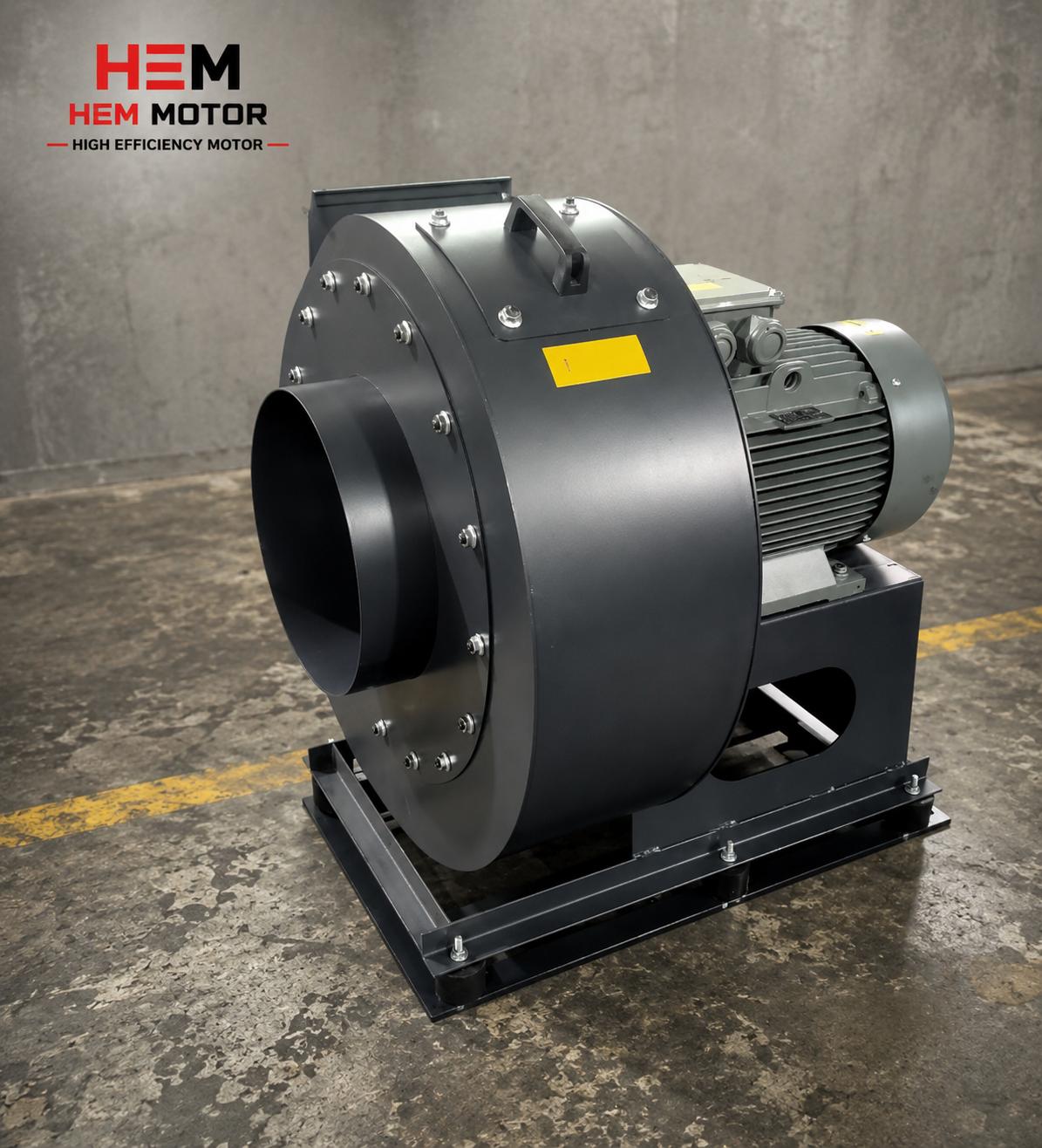
One of the most effective ways to cut the energy bill in pump and fan plants is, instead of running the motor at fixed speed and throttling the flow with a valve, to reduce the motor speed with a variable frequency drive (VFD) according to the real need. The physics behind this is known as the affinity law (similarity laws) and explains why a small speed reduction provides a large power saving. In this guide we cover the affinity law, the difference between throttling and speed reduction, why a 20% speed reduction provides such a large gain, the IE4/IE5 + VFD combination and correct motor-drive selection, conceptually and proportionally.
What Is the Affinity Law (Similarity Laws)?
In centrifugal pumps and fans there is a very strong relationship between speed (the rotational speed of the motor) and flow, pressure and power. This relationship is defined by the affinity law:
- Flow is directly proportional to speed: if you halve the speed, the flow also halves.
- Pressure is proportional to the square of speed: if you halve the speed, the pressure drops to a quarter.
- Power is proportional to the cube of speed: if you halve the speed, the power drops to one eighth.
The secret of all the saving lies in this third rule: power varies with the cube of speed. So a small reduction in speed turns into a much larger reduction in power (and therefore energy consumption). We covered the relationship of pumps and fans with the motor in centrifugal pump motor selection and centrifugal and axial fan motor selection.
The Difference Between Throttling and Speed Reduction
There are two classic ways to reduce the flow of a pump or fan, and the difference between them is huge in energy terms:
- Throttling valve: the motor continues to run at full speed and the flow is reduced by throttling the outlet valve. This method is like blocking water by partly closing a tap. The motor still draws nearly full power; the energy is wasted as heat and turbulence at the throttled valve.
- Speed reduction (VFD): the motor speed is reduced electronically, the flow genuinely decreases and, by the affinity law, the power drops to far less in proportion to the cube. There is no wasted energy; the motor draws only as much power as needed.
So in every application requiring variable flow, reducing speed with a VFD instead of using a throttling valve means direct energy saving. We explained running an asynchronous motor with a VFD in variable frequency drive (VFD) with an asynchronous motor and the variable/constant torque distinction in motor selection in variable-speed applications.
The Real Gain of a 20% Speed Reduction
Let us see the practical effect of the affinity law with a concrete ratio. Suppose you reduce a fan speed by only 20%, that is the speed drops to 80% of the original. Since power is proportional to the cube of speed:
- The new power is about 80% x 80% x 80% = roughly half of the old power.
- So a reduction of only 20% in speed turns into a reduction of about 50% in power.
This is the most striking result of the affinity law: a small speed reduction provides a very large energy saving. Moreover, this saving turns into a larger monetary gain the more hours the motor runs per year. So on large continuously running pumps and fans the VFD investment usually pays back quickly. We covered measuring and documenting energy saving in measuring and documenting annual energy savings. We explained the saving the high-efficiency motor + drive combination provides in pumps and fans in detail in high-efficiency motor plus variable frequency drive.
In Which Applications Does the Affinity Law Provide Gain?
The affinity law applies to centrifugal-type loads requiring variable flow/pressure. The applications that provide the most gain:
- Centrifugal pumps: circulation, transfer and pressure pumps; see our in-line and circulation pump motor selection article.
- Fans and aspirators: ventilation, flue and dust collection fans; review our aspirator and dust collection fan motor selection article.
- HVAC systems: air-conditioning fans and pumps running at variable load; see our HVAC project fan motor supply article.
- Cooling tower and chiller fans: flow adjustment by outdoor temperature; our cooling tower and chiller fan motors article gives an example.
- Irrigation and booster systems: pressure and flow varying with demand.
By contrast, the affinity law does not apply to constant-torque loads such as conveyors or crushers; there a VFD is used with a different logic (soft start, speed adjustment). For an example of constant-torque loads see our conveyor belt motor article.
The IE4/IE5 + VFD Combination
If on top of the saving from the affinity law you add the gain of a high-efficiency motor, the total saving multiplies. That is:
- The VFD reduces the required power via the affinity law by reducing speed.
- The IE4 or IE5 motor keeps the losses inside the motor to a minimum even at that reduced power.
These two gains complement each other. In particular, IE5 synchronous reluctance motors form a very strong combination with a VFD because they hold their efficiency curve at part load; we covered this in the part-load efficiency curve of the IE5 motor. We explained why IE5 motors mostly do not run without a drive in why an IE5 synchronous reluctance motor does not run without a drive. For the choice between IE4 and IE5 see our IE5 or IE4 article.
Correct Motor-Drive Selection
To get full benefit from VFD pump/fan saving, the motor and drive must be selected correctly together. Points to watch:
- Drive-compatible motor: the insulation and bearing design of a motor to run with a frequency drive must be suitable for it. We covered the topic in insulated bearing.
- Cooling at low speed: if the motor will run for long at very low speed, its own fan may not cool it enough; independent cooling may be needed. We explained cooling methods in IC411 and IC416 cooling methods.
- Correct power and speed: to select the motor suited to the operating point so it benefits from the affinity law, our motor power calculation and IE4 2-pole 3000 rpm pump and fan articles guide you.
- Do not connect a capacitor to the terminals: a compensation capacitor is not fitted to the terminals of a VFD-fed motor.
To see in which application the IE4 threshold is crossed, our IE4 threshold in pumps, fans and compressors article, and to see the total cost, our total cost of ownership (TCO) article will be useful.
Cooling, Bearing and Insulation Considerations on a Drive Motor
Although the saving from reducing speed with a VFD is large, a few technical points must be watched for the motor to run reliably with the drive over the long term. The first is cooling: the standard fan mounted on the motor frame turns with the motor own speed. When the speed is reduced the fan also slows and cooling capacity decreases; yet the motor is still under load. So if running at very low speed for long periods, a forced (separately fed) cooling fan running independently of the motor may be needed. We explained the difference between cooling methods in IC411 and IC416 cooling methods.
The second is bearings and insulation: the high-frequency switching the drive produces can create unwanted voltages on the shaft and over time lead to electrical wear (fluting) in the bearings. To reduce this risk, insulated bearings or shaft grounding solutions are used. Also, since the drive waveform stresses the winding insulation more, a reinforced-insulation, drive-compatible motor is preferred. We covered the insulated bearing topic in bearing type and life in asynchronous motors and the winding insulation class in winding and insulation class (F/H). We compiled the general installation principles of an asynchronous motor with a VFD in variable frequency drive (VFD) with an asynchronous motor.
The System Curve and Static Load: Limits of the Affinity Law
The affinity law theoretically promises a very strong saving, but the real saving depends on the load type of the system. Two concepts matter here: friction loss (dynamic load) and static load (lift height). In a fully friction-based system (for example a closed-loop circulation), the affinity law works almost exactly and the saving from reducing speed is very high. But if the system has a significant static lift height (for example a pump lifting water to a high tank), once the speed drops below a certain point the pump can no longer push water to that height and the flow falls to zero.
So in applications with a high static load the speed reduction range is limited; the gain from the affinity law is not as large as in fully friction-based systems. The correct solution is to determine the speed range by analysing the system curve and the real operating point of the pump or fan. This analysis also prevents oversizing the motor and drive. We covered correct power and speed selection in what load to run a motor at and the flow-head relationship in a pump in centrifugal pump motor selection.
VFD and Speed Synchronisation in Multi-Pump Systems
In many plants, instead of a single large pump there are several pumps running in parallel (for example booster groups, circulation lines). In these systems the traditional approach is to bring pumps on line one by one as demand rises. But when all pumps run at fixed speed, at intermediate demands the system either over-pressures or wastes energy by throttling a valve. In multi-pump systems managed by a VFD, the speed of one or several pumps is continuously adjusted to demand; the system draws exactly as much energy as needed at every moment.
Another benefit of this approach is even wear of the pumps: the control system balances running hours and prevents a single pump from wearing out early. On large continuously running booster and circulation groups this provides a gain in both energy and maintenance. We covered multi-pump and circulation applications in in-line and circulation pump motor selection and boiler room applications in boiler room and circulation pump motors. For variable pressure management on irrigation lines see our irrigation and agricultural pump motors article.
Frequently Asked Questions
Why does a small drop in speed provide a large saving in power?
Because in centrifugal pumps and fans power is proportional to the cube of speed. Reducing speed by 20% reduces power by about 50%, because 0.8 x 0.8 x 0.8 is roughly 0.5. This cube relationship is the heart of the affinity law and explains why reducing speed with a VFD is so efficient. With a throttling valve this saving cannot be achieved because the motor keeps running at full speed.
Is it sensible to use a VFD on every pump and fan?
A VFD is very sensible in applications where flow varies. For a pump that runs continuously at the same flow, at full load and is never throttled, the saving a VFD provides may be limited; there a high-efficiency fixed-speed motor may be enough. The decision depends on how much the flow varies and the annual runtime of the motor. If you share your application we will recommend the right solution.
Is there a saving by the affinity law on a conveyor or crusher too?
No. The affinity law applies only to centrifugal-type (variable-torque) pump and fan loads. On constant-torque loads such as conveyors, crushers and cranes, reducing speed does not reduce power by the cube. A VFD is still used on these loads, but the aim is soft start, precise speed adjustment and mechanical protection rather than energy saving.
Get a Quote
Share the flow profile and runtime of your pump and fan application; let us determine together the motor + drive combination that provides the most gain from the affinity law. For our IE4 and IE5 drive-compatible motors, reach us via our contact page or request a quote on +90 (532) 345 49 86. You can review our product range on our efficient electric motors and worm gear reducers pages, and all our guides on our blog home page.
Purchasing and Selection Checklist
- Confirm the application is a centrifugal (pump/fan) load type.
- Determine how much the flow varies; variable flow is ideal for a VFD.
- Plan speed reduction with a VFD instead of a throttling valve.
- Calculate the annual runtime; the more hours, the larger the saving.
- Select a drive-compatible motor; watch the insulation and bearing design.
- Evaluate the cooling need at low speed.
- Consider the IE4/IE5 + VFD combination together.
- Do not connect a capacitor to the terminals of a VFD-fed motor.