English
 Türkçe




The efficiency figure printed on an electric motor's nameplate usually reveals only one end of how the motor actually performs in service. That value is the efficiency at full load, that is, at the motor's rated power. Yet the vast majority of motors in the field never run at full load; pumps, fans and conveyors spend most of the day at half load or even lower operating points. This is precisely where the part-load efficiency curve comes into play. A motor's efficiency is a curve that changes with the load point, and a motor selection made without understanding this curve can largely waste the savings promised by high-efficiency classes such as IE3 or IE4. In this article we examine in detail how efficiency changes with load, what happens in the 50-75% load range, and why oversizing eats the savings.
Why Is Efficiency Not Constant?
The efficiency of an asynchronous motor is not a single number but a function that varies with load. The losses inside a motor fall into two main groups: fixed losses that are independent of load, and variable losses that rise with load. Fixed losses consist of iron losses and friction-and-windage losses; these are nearly constant from the moment the motor starts to turn and stay the same regardless of load. Variable losses are the copper losses that grow with the square of the current in the windings; as load rises, current rises and these losses climb quickly.
The interaction of these two loss types determines the characteristic shape of the efficiency curve. At very low load the fixed losses remain disproportionately large compared with the small mechanical power produced, so efficiency is low. As load increases the power produced overtakes the fixed losses and efficiency rises rapidly. But when load climbs very high, the copper losses take over and efficiency begins to fall back somewhat. As a result a typical motor's efficiency curve shows a peak that usually occurs around 75% load.
Why Is Peak Efficiency Not at Full Load?
Many people assume the most efficient point of a motor is at 100% load, but this is not correct. Modern high-efficiency motors are designed to place the efficiency peak around 75% load. This is because manufacturers optimise the motor for typical real-world operating points, since very few applications run a motor continuously at full load. So when you select a motor with a sensible margin over the real demand, you most often end up operating very close to the efficiency peak.
What Happens in the 50-75% Load Range?
Most industrial applications run the motor between 50% and 75% load. This range is the highest and most stable region of the efficiency curve. At 75% load a well-designed IE3 or IE4 motor turns at an efficiency very close to its nameplate value; the difference is usually negligible. As you drop to 50% load efficiency falls somewhat but is still in an acceptable region. The real problem begins when load falls below about 40%; here the weight of the fixed losses grows and efficiency curves sharply downward.
To evaluate this behaviour concretely, the following points deserve attention:
- 75% load: The most economical operating region where efficiency peaks. Here the motor turns with both high efficiency and a high power factor.
- 50% load: Efficiency is still high; only a few points of drop from the peak are seen. Many pumps and fans run efficiently in this range.
- 25-30% load: Efficiency begins to fall markedly; fixed losses grow disproportionately relative to the mechanical power produced.
- 10% load: Efficiency drops a great deal and the motor becomes almost an idling consumer; this point is a typical indicator of oversizing.
Power Factor Drops Together With Efficiency
At part load not only efficiency but also the power factor (cosφ) drops. This is a critical point that is often overlooked. At low load the reactive current drawn by the motor becomes dominant relative to the active current, which pulls the power factor down. A low power factor means a higher apparent power drawn from the grid, greater loading of cables and transformers, and in some tariffs the risk of a reactive-power penalty. In other words, at low load the motor both runs less efficiently and presents a worse load profile to the grid. This double loss is the true cost of oversizing.
Why Does Oversizing Eat the Savings?
A common habit in engineering is to select the motor a few sizes larger than the real need, just to be safe. Though this approach looks safe, it is costly in energy terms. An oversized motor runs continuously on the left side of the efficiency curve, that is, in the low-load region. For example, when a 55 kW motor is fitted to an application whose real demand is 30 kW, the motor turns continuously at about 55% load and never reaches the efficiency peak.
This produces a paradoxical outcome: you buy an expensive IE4 motor, but you run it at a load point where the efficiency advantage of the high IE class is largely lost. Because IE-class efficiencies are defined around full load, when you run the motor at very low load the difference between IE4 and IE3 narrows and at some points even becomes meaningless. In the end you both pay a high purchase price and fail to obtain the savings you expected.
Correct Sequence: First kW, Then IE Class
The correct approach is to reverse the order in motor selection. First you must correctly analyse the real load demand and determine the suitable power, that is, the correct kW. Only after this step is complete should the IE class be decided. When this sequence is followed, the motor spends most of its running time near the efficiency peak and the promise of the chosen IE class truly shows up on the bill. On choosing the right power, our 55 kW electric motor selection content offers a concrete example of power and speed matching.
When determining the real load demand the following steps should be followed:
- Measure or calculate the real power requirement of the driven machine; act on data, not assumptions.
- Add a reasonable safety margin considering continuity and sudden load increases, but do not exaggerate this margin.
- Check whether the selected power keeps the expected operating point near the peak of the efficiency curve.
- If variable load is involved, consider speed control rather than a fixed-speed motor.
Optimisation With a VFD at Variable Load
In applications where load changes over time, the most powerful solution is to use a variable frequency drive, that is, a VFD. In variable-flow systems such as pumps and fans, keeping the motor at fixed speed and throttling the flow with a valve or damper causes great energy waste. Instead, adjusting the motor speed to real demand both keeps the flow at the right point and significantly lowers energy consumption. Because in centrifugal loads power varies with the cube of speed, a small reduction in speed produces a large saving in power.
Using a VFD also removes a significant part of the part-load problem. Because the motor continuously adapts to changing demand, instead of idling needlessly at low load it operates at every moment near the real requirement. However, on motors driven by a VFD, matters such as winding insulation, bearing currents and cooling must be handled correctly; therefore VFD-compatible motor selection is itself a separate engineering topic. For the relationship between efficiency classes and correct selection, our asynchronous motor rotor bar material content explains another fundamental factor that determines efficiency.
Summary of the Correct Approach
In conclusion, motor efficiency is not merely the IE class on the nameplate; it is directly related to the load point at which the motor operates. Choosing the highest efficiency class does not deliver the expected gain when the motor is wrongly sized. The correct strategy is to first select the right power according to the real load demand, then determine the suitable IE class, and if variable load exists, to consider optimisation with a VFD. To supply the right motor quickly across a broad power range, the electric motor solutions offered by HEM Motor provide technical support in choosing the correct kW and efficiency class.
Verifying the Efficiency Curve in the Field
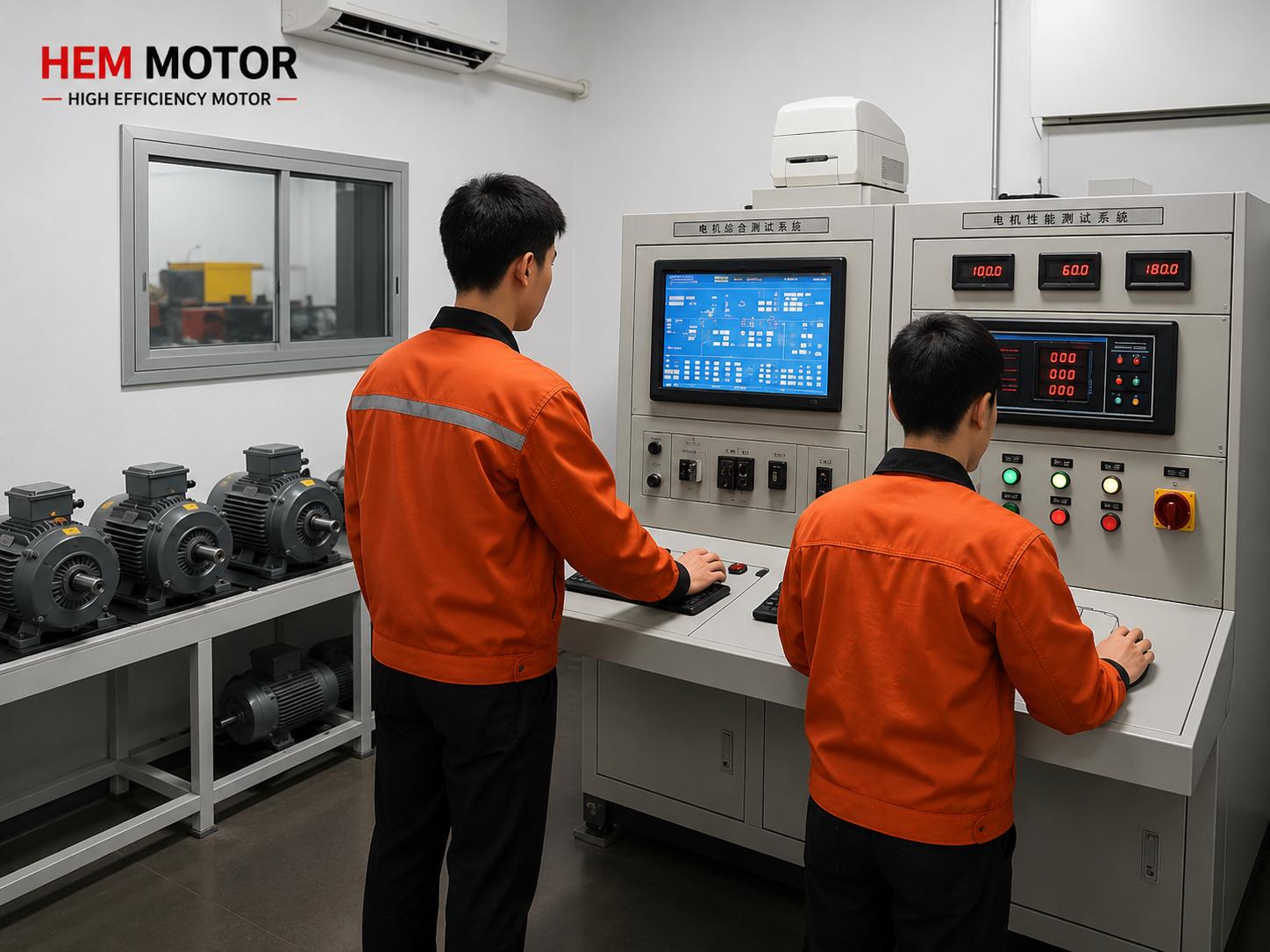
However clear the theoretical curve may be, field measurement is needed to know at which load point a motor runs in a real plant. The simplest method is to measure the current drawn by the motor and compare it with the rated current on the nameplate. If the drawn current is around half the rated value, the motor is probably turning somewhere near 50% load. But current alone can be misleading; because at low load the magnetising current becomes dominant, current does not vary in exact proportion to load. For a more accurate assessment, active power should therefore be measured and ratioed against the motor's rated power.
The main indicators to consider in field assessment are as follows:
- Active power drawn: The real power measured with a clamp meter or analyser, ratioed to the rated power, gives the load percentage.
- Power factor value: A lower-than-expected cosφ is a strong sign that the motor is running at low load.
- Winding temperature: A large motor that runs continuously at low temperature often indicates that it is oversized.
- Operating time profile: Knowing at which load points the motor spends how much time during the day is critical for correct resizing.
These measurements are the soundest way to detect wrongly sized motors in an existing plant. Most businesses, once measurements are taken, realise that a significant portion of their motors were selected larger than needed and run continuously below the efficiency peak. This finding builds a concrete database for stepping down to the correct power in the next renewal or capacity planning.
Resizing and the Investment Decision
Replacing an oversized motor immediately may not always be economical, because the existing motor is working and replacement requires an outlay. The correct approach here is to assess the motor's lifetime cost as a whole. The energy loss accumulating in a large motor that runs continuously at low load can, within a few years, exceed the purchase price of a correctly sized motor. In that case a planned replacement becomes sensible. By contrast, in a rarely used, low-priority application, using the existing motor to the end of its life may be more economical.
When deciding, the motor's annual operating hours and real load profile are decisive. A motor that runs long hours and turns continuously at low load provides both energy savings and a better power factor when replaced with a correctly sized equivalent. This double gain markedly shortens the payback period of the investment. For correct power and speed selection, our centrifugal pump motor selection content offers a complementary view of how to set the operating point correctly in pump applications.
Frequently Asked Questions
Why does motor efficiency peak at 75% load rather than full load?
Because modern high-efficiency motors are optimised for typical real-world operating points, and very few applications run a motor continuously at full load. The balance between fixed losses and copper losses that rise with load places the efficiency peak around 75% load. That is why a motor selected with a sensible margin most often runs close to the efficiency peak.
Why does oversizing reduce energy savings?
An oversized motor runs continuously at low load, that is, on the left side of the efficiency curve. In this region both efficiency and power factor drop, and this double loss largely eats the advantage provided by the high IE class. In the end you both pay a high purchase price and fail to reach the savings you expected.
What should be done at variable load?
In pump and fan applications where load changes over time, the most effective solution is to use a VFD. Adjusting the motor speed to real demand provides large energy savings because in centrifugal loads power varies with the cube of speed. This way the motor operates at every moment near the real requirement, at high efficiency.