English
 Türkçe



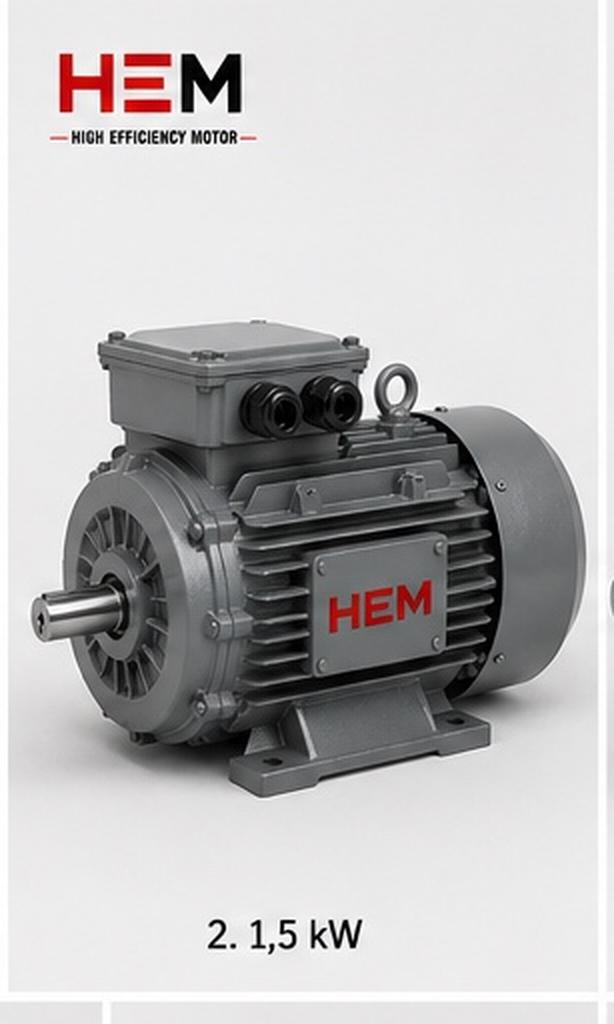

The efficiency value printed on an electric motor's nameplate shows the case where the motor runs at full load (100%). But in real life most motors spend the greater part of their time below full load, that is, at partial load. This is where the part-load efficiency curve comes in: the curve showing how efficiently the motor runs at 100%, 75%, 50% and 25% load is the real factor that determines actual energy consumption and savings. One of the biggest advantages of high-efficiency IE4 and IE5 motors is that this curve is flat; that is, efficiency stays high even when the load drops. By contrast, selecting a motor larger than needed (oversizing) makes the motor run continuously in the low-load region, lowering both efficiency and power factor. In this article we cover, with HEM Motor engineering insight, the part-load efficiency curve, the flat-curve advantage of IE4/IE5, the effect of oversizing, and real savings through correct sizing.
A motor's efficiency is the ratio of output (shaft) power to input (electrical) power. The difference is the losses: iron losses, copper losses, friction/windage losses and additional (stray) losses. Some of these losses are independent of load (constant), and some vary with load. When the load drops, the output power falls but the constant losses stay the same; that is why efficiency drops at very low loads. The shape of the part-load efficiency curve is determined by the balance of these constant and variable losses.
What Is the Part-Load Efficiency Curve?
The part-load efficiency curve is a graph showing the motor's efficiency at different load levels. Typically the efficiency values at the 25%, 50%, 75% and 100% load points are given. In most motors efficiency peaks at around 75% load and decreases slightly from there toward full load, and more markedly toward low loads. The reason is that at very low loads the share of the constant losses (especially iron loss and magnetizing) within the total grows.
- 100% load: Nameplate efficiency; the motor's efficiency at its rated point.
- 75% load: The point where efficiency is highest in most motors.
- 50% load: Efficiency is still good; in IE4/IE5 almost at full-load level.
- 25% load: The region where efficiency drops markedly; constant losses dominate.
Understanding that nameplate efficiency shows only full load and that real consumption depends on the part-load curve is the foundation of correct motor selection. To verify nameplate efficiency with field measurement, our article on nameplate efficiency value and field verification is a good reference.
Typical Efficiency Values by Load Level
The table below shows approximate typical part-load efficiency values by efficiency class for a medium-power motor (for example 30 kW, 4 poles). Values vary with design; the aim is to grasp the shape of the curve and the difference between classes. The key point to note is that as the efficiency class rises, the curve both shifts upward and stays flatter at low loads.
| Efficiency class | 100% load | 75% load | 50% load | 25% load |
|---|---|---|---|---|
| IE2 | 92.7% | 92.9% | 91.8% | 87.5% |
| IE3 | 93.6% | 93.9% | 93.1% | 89.5% |
| IE4 | 94.5% | 94.8% | 94.2% | 91.5% |
| IE5 (synchronous reluctance) | 95.4% | 95.6% | 95.2% | 93.0% |
Looking carefully at the table, the IE5 motor's efficiency at 25% load (93.0%) is even higher than an IE2 motor's efficiency at full load (92.7%). This is the clearest indicator of the real superiority of high-efficiency motors: they make a difference not only at full load but at partial load too. In IE4 and IE5 motors, the curve staying this flat at low loads provides large energy savings in systems running at partial load. For the effect of the difference between efficiency classes on loss components, our article on efficiency losses in IE4 motors: iron, copper and friction deepens the topic.
The Flat Efficiency Curve Advantage in IE4/IE5
The reason for the flat efficiency curve in high-efficiency motors is that the constant losses have been reduced. IE4 and especially IE5 (synchronous reluctance) motors reduce iron and magnetizing losses thanks to low-loss laminations, an optimized magnetic circuit and better winding design. When the constant losses shrink, the rate at which efficiency falls as the load drops also slows. The result is an efficiency that stays high even at 50% or even 25% load. For the detail of superiority at partial load, our article on IE5 synchronous reluctance efficiency curve: why it is superior at partial load focuses directly on this topic.
How Does Oversizing Lower Efficiency?
Selecting a motor larger than needed "just in case" is a common but costly mistake. An oversized motor runs continuously in the low-load region because its real load is well below the rated value. For example, if a 55 kW motor is chosen for a 30 kW load, the motor runs continuously at about 55% load; if the load drops from time to time, it falls into the 25-30% load region. In this region efficiency is at the lowest part of the curve.
Oversizing has two core negative effects. First, efficiency drops at low load; the motor does the same work with more losses. Second, the power factor drops; because the share of the magnetizing current grows at low load, cosφ falls significantly. A low power factor increases the plant's reactive load, raises the need for compensation and increases the total current drawn from the grid. So oversizing creates both a direct energy loss and an indirect reactive cost.
Correct Sizing and Real Savings
Correct sizing means choosing the motor's rated power to suit the real load. The ideal target is for the motor to run most of the time in the 75-100% load range; this region is where both efficiency and power factor are highest. The first step for this is to measure or correctly calculate the application's real shaft power. Then the motor is selected with a rated power close to but slightly above this power, with a reasonable safety margin and without leaving an excessive surplus.
Real savings come from the combination of three factors: a high efficiency class (IE4/IE5), a flat part-load curve and correct sizing. When these three come together, the motor runs at the highest possible efficiency at its real operating point and annual energy consumption drops markedly. Simply buying a high efficiency class motor is not enough; if it is oversized, the advantage of the curve is largely lost. For correct power selection in variable-load applications such as pumps and fans, our article on correct power selection for pumps and fans provides guidance. For a cross-class comparison in terms of total cost of ownership, our article on IE5, IE4 and IE3 TCO comparison is useful.
Efficiency Under Variable Load and the Drive
In many applications the load is not constant; in systems such as pumps and fans the demand changes over time. In this case the motor runs over a wide load range and part-load efficiency becomes even more critical. In variable-load systems, instead of sizing the motor for the highest demand and running it mostly at low load, adjusting the motor's speed to demand with a frequency converter (drive) is far more efficient. The drive keeps the motor at a suitable load point at all times and provides large savings especially with variable-torque loads such as pumps and fans. The flat efficiency curve of IE4 and IE5 motors, combined with a drive, gives the highest system efficiency.
Efficiency Class, Loss Components and the Shape of the Curve
To understand why the part-load efficiency curve is flat in some motors and steep in others, we need to look at the loss components. The losses in a motor fall into four main groups. Iron losses (hysteresis and eddy current) are largely independent of load; they exist as long as the magnetic field is established. Copper losses (I²R) vary strongly with the square of the current, that is, with load. Friction and windage losses are related to speed and barely change at constant speed. Additional (stray) losses increase with load.
At low load the current decreases, so copper losses fall rapidly; but iron and friction losses stay almost the same. As the output power drops, the ratio of these constant losses to the output grows and efficiency falls. In IE4 and IE5 motors, because iron losses (better laminations), friction losses (better bearing and fan design) and magnetizing loss are reduced, the constant-loss base is small. That is why efficiency falls more slowly when the load drops and the curve stays flat. In lower efficiency-class motors, because the constant losses are large, the curve drops markedly at low loads. This mechanism explains why the efficiency class matters not only at full load but across the whole load range.
A Real Sizing Example
Let us go through an example. Suppose a plant has a fan drive with a real shaft power of about 22 kW. In the first scenario, a 45 kW IE3 motor is chosen "to be safe"; the motor runs continuously at about 50% load. In the second scenario, a 30 kW IE5 motor is chosen to suit the real load; the motor runs most of the time around 75% load, that is, in the region where efficiency is highest. In the second scenario the motor is both correctly sized and a higher efficiency class.
As a result, the motor in the second scenario runs at higher efficiency and has a better power factor. The oversized IE3 motor in the first scenario, because it runs in the low-load region, both loses more energy and burdens the plant with reactive load. This simple example clearly shows the difference between "buying a high efficiency class motor" and "obtaining real savings": both are needed, and without one the other is incomplete. For the efficiency-class mandate and which class is required at which power, see our article on efficiency class mandate and power-efficiency table.
A Checklist for Correct Sizing
To obtain real savings from part-load efficiency, follow these steps:
- Determine the real shaft power: Measure or calculate how much power the application really draws.
- Target the operating load point: Select the motor to run most of the time in the 75-100% load range.
- Assess load variability: If the load varies over a wide range, consider using a drive.
- Choose a high efficiency class: If it runs at partial load, the flat curve of IE4/IE5 is an advantage.
- Avoid excessive margin: Leave a reasonable safety margin; unnecessary oversizing lowers efficiency.
These steps both steer the initial investment correctly and lower the operating cost for years. In motor selection, the greatest saving often lies not in buying a more expensive motor, but in selecting the motor at the right power and the right class.
Questions and Answers
Does the motor's nameplate efficiency show real consumption?
No, not exactly. Nameplate efficiency shows the motor's efficiency at full load (100%). Real consumption depends on the motor's real operating point and the part-load efficiency curve. If the motor runs mostly at 50% load, the real efficiency may differ from the nameplate value; that is why the part-load curve matters.
Why is even slightly oversizing a motor harmful?
A mild oversizing (10-20%) is usually an acceptable safety margin. But serious oversizing (such as choosing a motor twice the real load) makes the motor run continuously in the low-load region; this lowers both efficiency and power factor and creates unnecessary energy and reactive cost.
How much does the IE5 part-load advantage matter in practice?
In systems running at variable or low load the difference is clear. An IE5 motor's efficiency at 25-50% load can be even higher than the full-load efficiency of lower-class motors. This means notable energy savings in a system that runs at partial load throughout the year.
At HEM Motor we offer IE4 and IE5 high-efficiency motors across a wide power range from stock and with fast supply. By evaluating your application's real load profile together, we help you select a motor at exactly the right power and the right efficiency class, neither too large nor too small. Contact us to obtain real savings from part-load efficiency and to request a quote.