English
 Türkçe

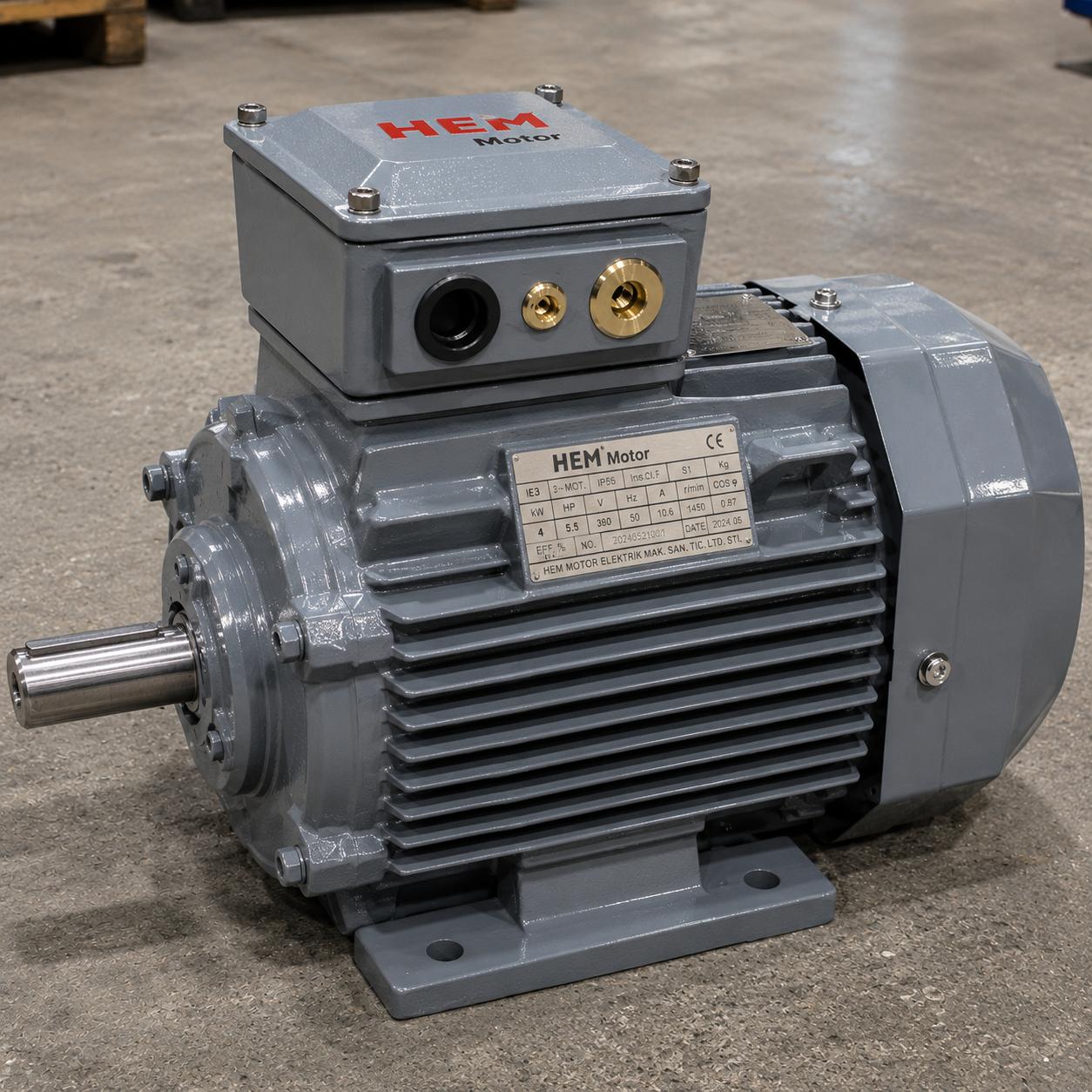

The nameplate of the old machine you have says "5 HP," but today's motors are sold in kW. So how many kW does 5 HP make, and which motor should you order? This small conversion error can lead all the way to buying a motor of the wrong power and being unable to run the machine, or paying for an unnecessarily large motor. In this guide we clearly explain the relationship between HP and kW, the common matchings and which information you need to provide in the order; so you can order the right kW motor from an old HP nameplate the first time.
As HEM Motor, we have been manufacturing since 1979 and quickly supply electric motors across a wide power range from our Türkiye stock. Whether you know the power in HP or kW, matching the right motor is our job; but knowing the basic conversion makes placing a sound order much easier for you. You can review the wide power and speed range in our high-efficiency electric motors category and easily find the power most suited to your need.
Why Are There Two Different Units?
"Horsepower" (HP) is a unit that historically arose to compare the power of steam engines with the pulling power of horses, and it is widely used especially in old machines, pumps and compressors. kW, on the other hand, is the modern power unit belonging to the International System of Units (SI) and is the standard nameplate unit of today's electric motors. Because motor production in Türkiye and around the world is done in kW, if you have an old piece of equipment labeled in HP, you must know its kW equivalent. Because both units measure the same physical quantity (power), there is a fixed conversion coefficient between them; that is why the transition is extremely simple. This conversion constantly comes up when renewing old catalogs, imported machines or lines installed years ago.
The Basic Relationship Between HP and kW
HP (horsepower) and kW (kilowatt) are both power units; they simply come from different systems. The conversion between them is simple:
- 1 HP ≈ 0.75 kW (more precisely: 0.746 kW)
- 1 kW ≈ 1.34 HP
That is, to convert kW to HP multiply by 1.34; to convert HP to kW multiply by 0.75 (or divide by 1.34). For example, a 4 kW motor is about 5.4 HP; a 10 HP motor is about 7.5 kW. This simple rule is the basis of the transition from the old nameplate to the new motor. The only practical figure you need to keep in mind is actually the "0.75" coefficient: when you multiply the HP value you see by three-quarters, you find the approximate kW equivalent. Conversely, when you add a third to the kW value (that is, multiply by 1.33), you reach the HP equivalent.
A point to note: the metric (PS) and imperial (HP) versions of "horsepower" are very close but not exactly the same; in practice, the approximation of 1 HP ≈ 0.75 kW is used confidently in the field for electric motors. If precise engineering calculation is required, you can take the value of 0.746 kW as the basis, but since you will already select one of the standard kW steps when ordering a motor, this difference disappears in practice.
Why Is It Necessary to Round to Standard kW Steps?
Electric motors are produced not in random powers but in standard kW steps: 0.12 - 0.18 - 0.25 - 0.37 - 0.55 - 0.75 - 1.1 - 1.5 - 2.2 - 3 - 4 - 5.5 - 7.5 - 11 - 15 - 18.5 - 22 - 30 - 37 - 45 - 55 - 75 - 90 kW and beyond. For this reason, the value you convert from HP may not land exactly on a step; it is rounded to the nearest standard step (usually up).
For example, a 3 HP motor makes 2.24 kW; its standard equivalent is 2.2 kW. 7.5 HP makes 5.6 kW; its equivalent is 5.5 kW. In the table below we have compiled the most common matchings.
Common HP - kW Matchings
- 0.5 HP ≈ 0.37 kW
- 1 HP ≈ 0.75 kW
- 1.5 HP ≈ 1.1 kW
- 2 HP ≈ 1.5 kW
- 3 HP ≈ 2.2 kW
- 4 HP ≈ 3 kW
- 5.5 HP ≈ 4 kW
- 7.5 HP ≈ 5.5 kW
- 10 HP ≈ 7.5 kW
- 15 HP ≈ 11 kW
- 20 HP ≈ 15 kW
- 25 HP ≈ 18.5 kW
- 30 HP ≈ 22 kW
- 40 HP ≈ 30 kW
- 50 HP ≈ 37 kW
- 75 HP ≈ 55 kW
- 100 HP ≈ 75 kW
This table shows at a glance which kW motor to order from an old machine's HP nameplate. In most industrial applications these matchings are used directly. Remember that the values in the table are rounded: the aim is not an exact decimal equality but finding the nearest produced standard kW step. If you have an HP value that falls on the borderline (for example between two steps), decide by considering whether the load is continuous or intermittent and whether the machine struggles at start; if you are not sure, tell us your application and let us select the right step together.
Ordering the Right kW Motor from an Old Machine's HP Nameplate
If the motor of an old machine has burned out and the nameplate states only HP, follow these steps:
- Read the HP value (for example 5 HP).
- Find the kW equivalent (5 HP ≈ 3.7 kW → standard step 4 kW; in some applications 3 kW may be sufficient).
- Check the speed (rpm): At the same power there are 2-pole (≈3000 rpm), 4-pole (≈1500 rpm) and 6-pole (≈1000 rpm) motors; read the machine's speed from the old nameplate.
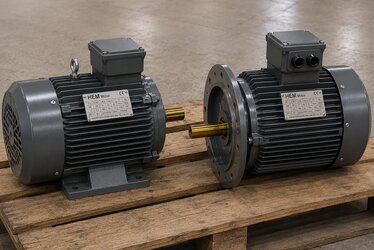
- Determine the body and connection type: Foot-mounted (B3), flange-mounted (B5/B14) or combined (B35).
Let us clarify with an example: the nameplate of an old milling machine states "5.5 HP, 1440 rpm, B3." 5.5 HP ≈ 4 kW; 1440 rpm means 4-pole (1500 rpm class); B3 is a foot-mounted connection. Therefore the motor you will order is: a 4 kW, 4-pole (1500 rpm), B3 foot-mounted, three-phase motor. An order given with this clarity reduces the chance of the wrong motor arriving to nearly zero. With these four pieces of information (kW, speed, body, connection) it is possible to match the right motor exactly. If you want to examine the speed subject in depth, you can take a look at our 2, 4, 6 pole selection guide, where we address which pole count motor to select for which job. To replace an old branded motor exactly, our article on matching from the nameplate information guides you step by step.
Shaft Power or Drawn Power? Avoid the Confusion
The kW (or HP) value on a motor's nameplate expresses the mechanical power the motor can deliver from its shaft; that is, this is the "rated power." The electrical power it draws from the mains is slightly higher than this because of efficiency. For example, a motor delivering 7.5 kW of shaft power draws a little more from the mains depending on its efficiency. What should be taken as the basis when ordering is the shaft power the machine requires; that is, the kW/HP value on the nameplate. Knowing this distinction prevents unnecessary worries such as "my motor is 7.5 kW but it draws over 8 kW, did I buy the wrong one?" The power it draws is always slightly above the shaft power because of efficiency, and this is completely normal. As the efficiency class rises (IE3, IE4), this difference decreases, that is, the motor does the same job with less electricity.
Common Mistakes When Going from HP to kW
Although the conversion is simple, a few mistakes are repeated in the field:
- Skipping the speed: Only converting the HP and ordering the motor, but not asking about the old motor's speed (2 or 4 pole). The wrong speed at the same kW runs the machine at the wrong speed.
- Confusing rounding up/down: At a borderline value (for example 5 HP ≈ 3.7 kW), both 3 kW and 4 kW seem close; selecting without knowing the load condition leads to an inadequate or unnecessarily large motor.
- Overlooking the phase difference: Ordering three-phase (380 V) while the old motor is single-phase (220 V), or vice versa; this creates incompatibility with the mains.
- Not considering the service factor: Some old motors may be labeled with a service factor; this shows that the motor can carry a higher load for a short time and can affect the power selection.
All of these mistakes are prevented by clarifying the power + speed + body + phase information together. For this reason, giving the right order information is as important as the conversion table.
Power Alone Is Not Enough: Speed and Body Are Also Essential
Finding the power correctly in HP or kW is only the first step of the order. At the same 4 kW power, there are many motors with different speeds (1500 rpm or 3000 rpm) or different bodies (B3 foot-mounted or B5 flange-mounted). The wrong speed causes the machine to turn at the wrong speed; the wrong body causes the motor not to fit the machine. For this reason, when ordering it is essential to state the power + speed + body trio together. To see the difference between mounting types, you can read our B5 or B14 flange guide.
The HP Nameplate Is Very Common in Pumps, Fans and Compressors
The places where you most often encounter the HP nameplate are pumps, booster sets, fans and compressors; because these pieces of equipment are traditionally referred to in horsepower. Expressions such as "2 HP booster," "5 HP compressor," "10 HP fan" are frequently heard in the market. When the motor of this equipment burns out or needs to be renewed, you need to convert the HP value to kW and find the suitable motor. For example, for a 2 HP booster pump an approximately 1.5 kW motor is suitable, and for a 10 HP compressor an approximately 7.5 kW motor. At this point selecting the speed correctly is also important: in boosters and high-pressure pumps generally 2-pole (3000 rpm) motors are preferred, and in fans, depending on the application, 4 or 6-pole motors. If you tell us the type of the equipment and the desired performance, we determine the motor with both the right kW and the right speed together.
Three-Phase or Single-Phase? Phase Information Is as Important as Power
Even if you do the power conversion correctly, the motor must be of a phase compatible with your mains. In industrial facilities, a three-phase (380 V) mains is common and motors at medium-to-large powers are three-phase. In small workshops and residential applications, there is a single-phase (220 V) mains. The old motor's nameplate states the voltage and phase information; be sure to check this. Although at the same power both three-phase and single-phase motors exist, they are connected to different mains and cannot be fitted in place of each other. Especially at powers of 4 kW and above, applications are almost always solved with a three-phase asynchronous motor. Stating the phase information in the order is one of the critical steps that prevents the wrong motor from arriving.
Which Motor Should You Order?
For general industrial applications, general purpose industrial motors can be supplied from stock in the most common power-speed combinations. For standard applications, the standard electric motors series meets your need. Both series are IE4 efficiency class, cast iron body and 100% copper wound. To see all power and speed options, you can review our IE4 electric motors category. We have compiled which information you need to provide before ordering in our article on information to provide when requesting a quote.
Frequently Asked Questions
How many kW does 1 HP make?
1 HP equals about 0.75 kW (with its more precise value, 0.746 kW). In the reverse direction, 1 kW makes about 1.34 HP. In practice, when selecting a motor you multiply the HP value by 0.75 and round to the nearest standard kW step. For example, 2 HP ≈ 1.5 kW, 5 HP ≈ 3.7 kW (standard 4 kW), 10 HP ≈ 7.5 kW. This simple conversion lets you find the right kW motor for old HP-labeled machines.
The nameplate says HP but its exact equivalent is not a standard kW, what should I do?
The value converted from HP often does not land exactly on a standard kW step; this is normal because motors are produced in certain steps. In this case you round to the nearest standard step, usually up. For example, 3 HP = 2.24 kW has an equivalent of 2.2 kW, and 7.5 HP = 5.6 kW has an equivalent of 5.5 kW. If you are not sure of your load condition, send us the machine's HP value, speed and application; let us determine the right kW step together and prevent you from buying an unnecessarily large or inadequate motor.
Which information do I need to provide when ordering?
For a sound order, four basic pieces of information are essential: power (kW or HP), speed (rpm or pole count), body/connection type (B3 foot-mounted, B5 or B14 flange-mounted, B35 combined) and phase (three-phase 380 V or single-phase 220 V). If possible, sending a photo of the old motor's nameplate is most reliable; we match the exact equivalent with the information on the nameplate and prevent the wrong motor from arriving. If there is a special environment (high temperature, dust, humidity), stating that too lets us select a motor in the right protection class.
I converted the HP value to kW but my machine still struggles, what could be the reason?
If the motor struggles even though you selected the right kW equivalent, the problem is usually not in the conversion but either in the speed or in the actual load requirement. If the old motor's speed and the new motor's speed are different (for example, 1000 rpm was bought instead of 1500 rpm), the motor tries to do the same job at a lower speed and can struggle. In addition, the machine's load may have increased over time; in this case an upper kW step may be needed. In such a situation, send us the machine's application and the symptom you observe; let us re-evaluate the right power and speed combination and recommend a permanent solution.
Get a Quote
Send us your old machine's HP nameplate, speed and connection type; let us find the right kW equivalent, match the exactly fitting motor from our Türkiye stock quickly and present a quote. With manufacturer's assurance since 1979, you obtain the motor at the right power and the right speed the first time. Call our line at +90 (532) 345 49 86 right away or reach us from our contact us page.