English
 Türkçe

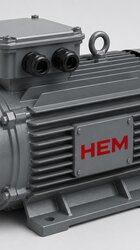
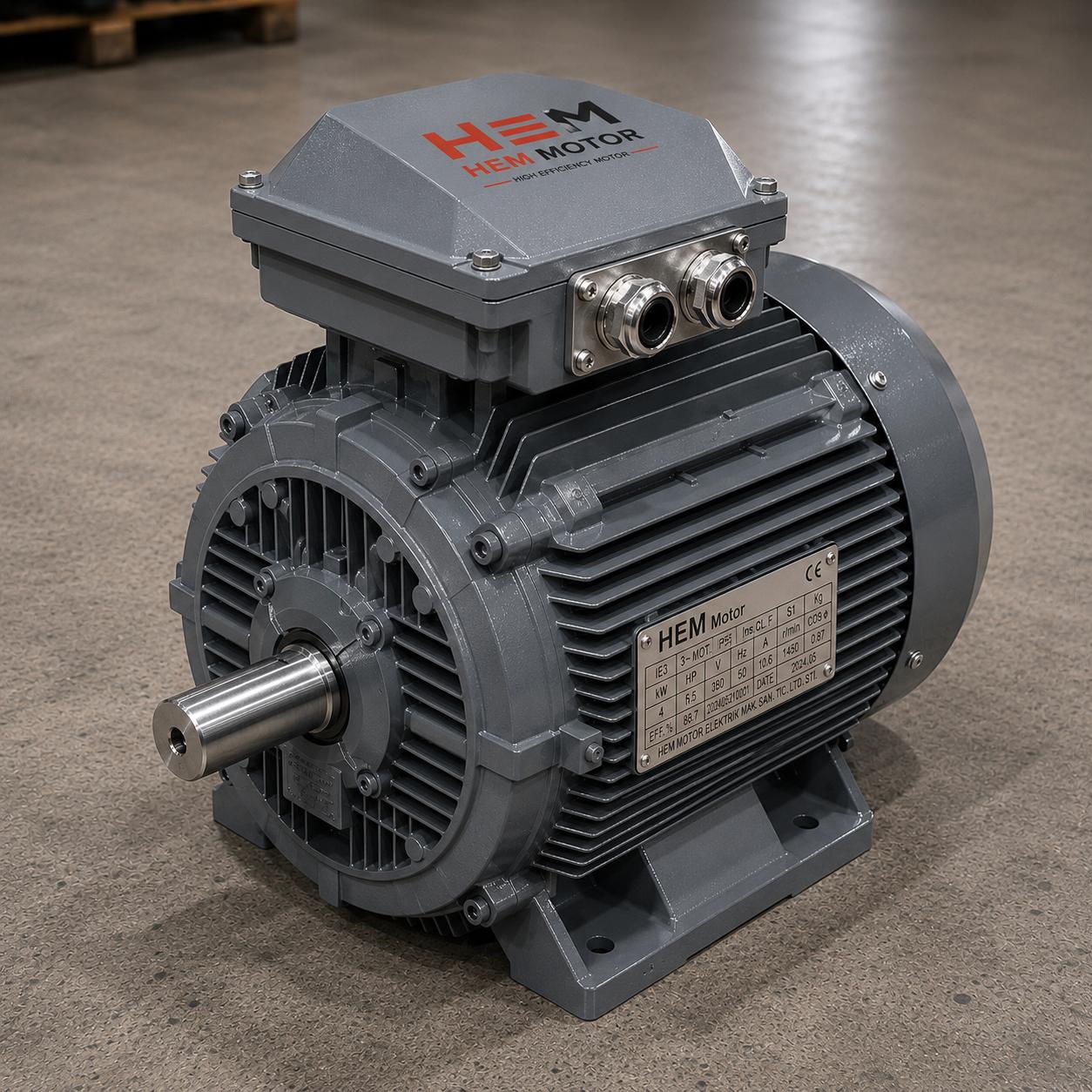

In industry the most expensive motor is not the one with the highest price tag; the most expensive motor is the wrong one. A motor whose feet won't seat on the chassis, whose shaft won't meet the coupling, or whose terminal box faces the wrong side adds not a single bolt to production even after it has travelled all the way to your floor. Once you add freight, customs, downtime and the cost of reordering, ordering the correct motor on the first attempt is both the cheapest and the fastest route. In this article we walk through, step by step, which details to read from the old motor's nameplate, how to convey those details to the supplier, and the final checks to make before you confirm the order.
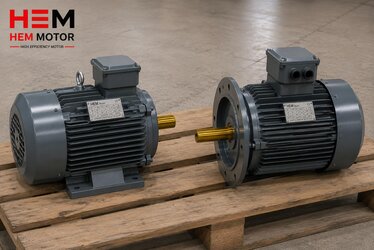
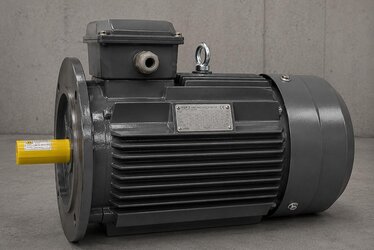
Many buyers assume that saying "I need a 5.5 kW motor" is enough. In reality the same 5.5 kW rating can sit in stock at two different speeds (for example 1450 rpm and 2900 rpm), in at least three mounting types (foot-mounted B3, flange-mounted B5, foot-and-flange B35) and in several frame sizes. They are all 5.5 kW, all correct in power, yet only one will match your machine exactly. The purpose of this article is to let you select that "one" without leaving it to chance.
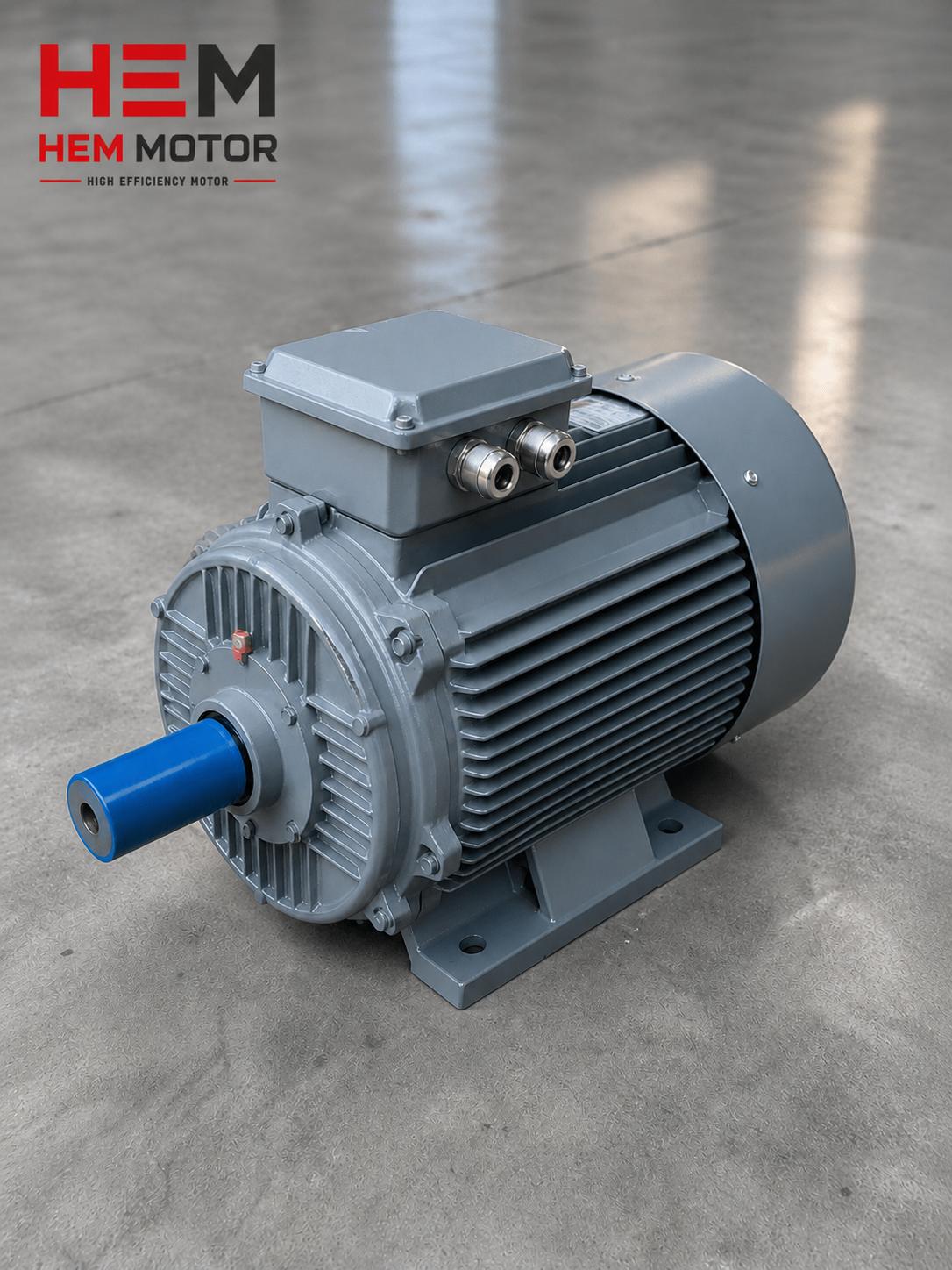
Why Does the Wrong Motor Cost So Much?
The cost of the wrong motor is never limited to the product itself. When a production line stops, the lost output is usually many times the price of the motor. The realisation that the delivered motor does not fit typically happens at the worst possible moment, when the installation crew is already standing at the machine. At that point you are left with three options: forcing the wrong motor to fit (which invites shaft breakage, premature bearing wear and vibration), starting a return process (lost time and freight), or scrambling to find the correct motor in a hurry (usually more expensive and delayed).
The right approach, therefore, is not to inspect the motor when it arrives but to ensure the wrong motor never arrives at all. That path runs through one-to-one nameplate matching. When the correct information reaches the supplier in full, the chance of a surprise drops to almost zero. Even a standard motor shipped from stock is useless if this matching step is skipped.
Which Details Should Be Read From the Old Nameplate?
The metal nameplate on the housing of your old or burnt-out motor is the most reliable source you have for selecting a replacement. If it is too dirty to read, wipe it with a soft cloth; if it still cannot be read, draw on the motor catalogue or the machine manufacturer's documentation. The items that must be read from the nameplate are:
- Power (kW / HP): The rated output. Remember that the same kW value exists in different variants; power alone is not enough.
- Speed (rpm): Load values corresponding to synchronous speeds such as 3000, 1500, 1000 or 750 rpm. It determines the number of poles (2, 4, 6, 8) and directly affects the machine's speed.
- Voltage and frequency (V / Hz): Connection voltages such as 230/400 V or 400/690 V and the 50 Hz frequency. This determines whether the motor is connected in star or delta.
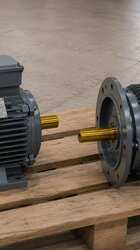
- Mounting type (IM B3, B5, B14, B35): Foot, flange or foot-and-flange construction. This is one of the most critical parameters defining how the motor attaches to the machine.
- Frame number: A standard frame size such as 80, 90L, 100L, 112M or 132S. Shaft height, foot-hole spacing and flange diameter all depend on this number.
- Protection class (IP): A dust and water rating such as IP55 or IP54, chosen according to the environment.
- Insulation class and duty (F, H / S1, S3): Thermal capacity and continuous or intermittent operation.
- Shaft diameter and length: The coupling, pulley or gear seats on this dimension. If absent from the nameplate, it must be measured with calipers.
All of these items must be considered together. For a broader view of correct motor selection you can explore our extensive electric motor stock and technical support service; the variant you are looking for is most likely available from the shelf.
Frame Number and Mounting Type: The Most Common Mistake
In practice the most common mistake is to report power and speed correctly while overlooking the mounting type and frame number. A B3 foot-mounted motor and a B5 flange-mounted motor cannot be installed in place of each other even at identical power and speed. Likewise, the difference in hole pattern and diameter between a small B14 flange and a large B5 flange makes attaching the motor to the machine impossible.
The frame number determines shaft height. For example, a 100L-frame motor has its shaft centre 100 mm above the foot base; on a 112M-frame motor that value is 112 mm. This 12 mm difference completely ruins alignment in a coupling-connected system and causes vibration. That is why the frame number on the nameplate is as important as the power and must always be confirmed before ordering.
Shaft and Coupling Compatibility
Shaft diameter, shaft length and keyway dimension form the critical interface that transmits power from the motor to the machine. If the shaft diameter is not stated on the nameplate, it must be measured with calipers. If the new motor's shaft is thicker than the old one the coupling will not seat; if thinner, a gap remains and vibration appears. In pulley-belt systems the same issue shows itself as the pulley refusing to slide onto the shaft. For this reason the shaft dimensions must also be conveyed to the supplier together with the nameplate data. In applications with custom couplings or direct connection to a reducer, shaft tolerance demands millimetre precision.
How to Convey the Nameplate Data to the Supplier?
The most robust method is to take a clear photograph of the nameplate and send it. When all values are legible, the supplier's technical team can verify the variant. Sharing the following information in writing alongside the photograph reduces the margin of error:
- The type of machine the motor drives (pump, fan, conveyor, reducer, etc.)
- Mounting position (horizontal, vertical, shaft up/down)
- Operating environment (dusty, humid, outdoor, high temperature)
- Whether it will run with a frequency inverter (drive)
- The desired orientation of the terminal box
A request for a quote made with this information lets the supplier offer you an exactly matching variant. Depending on stock, most standard motors can be supplied quickly; for special variants the delivery time is clarified from the outset. This keeps both the supply schedule and the budget free of surprises.
Pre-Order Final Checklist
Before confirming the order, verify this list item by item:
- Do power (kW) and speed (rpm) match the old nameplate?
- Does the mounting type (B3 / B5 / B14 / B35) match exactly?
- Is the frame number the same? If different, are shaft height and foot holes compatible?
- Are shaft diameter, length and key dimension correct?
- Do voltage, frequency and connection (star/delta) suit the panel?
- Is the protection class (IP) sufficient for the environment?
- Is the terminal-box orientation suitable for the installation?
- If it runs with a drive, is the motor inverter-compatible?
When all eight items read "yes," the chance of the delivered motor failing to fit the machine is practically eliminated. At every point of doubt, sharing the dimensions and photograph with the supplier for technical confirmation prevents large costs later. A correct flow of information is as valuable as fast supply, because even the fastest motor is worthless if it is wrong.
Frequently Asked Questions
What should I do if the nameplate is completely unreadable?
If the nameplate is worn off or rusted, first check the documentation of the machine the motor is fitted to; a motor reference may be found there. If not, measure the motor's physical dimensions (frame, shaft diameter, shaft height, foot-hole spacing, flange diameter) with calipers and send them with photographs to the supplier's technical team. From these dimensions the frame number and mounting type can largely be identified.
What happens if I fit a same-power motor with a higher speed?
Speed directly determines your machine's operating rate. If you fit a 3000 rpm motor instead of a 1500 rpm one, the pump or fan turns twice as fast; this changes flow, pressure and current draw and can even overload the motor. That is why speed is as critical as power and must match the old nameplate exactly.
Can I fit a B3 foot-mounted motor in a flange position?
You cannot do so directly. A B3 foot-mounted motor is fixed to the floor or chassis by its feet; flange mounting (B5/B14) is done from the flange on the motor's front cover. Some motors are B35 with both feet and flange and are more flexible, but you cannot make a pure B3 motor fit a position that requires a flange. Confirming the mounting type from the nameplate is therefore essential.