English
 Türkçe


When selecting an electric motor, perhaps the most common first question is: "How many rpm do I need?" The answer to this question is directly related to the motor's number of poles. In asynchronous (induction) motors, the speed is determined by the grid frequency and the number of poles. Two motors of the same power, if they have different pole numbers, run at completely different speeds and torques. Choosing the right motor therefore begins with correctly determining the speed and torque the application needs. In this comprehensive guide, we explain — with full tables — the synchronous speeds of all standard motors from 2 to 12 poles at 50 Hz and 60 Hz, the real full-load speeds after slip, the pole-speed-torque relationship and which speed suits which application.
As HEM Motor, our goal is that after reading this guide you can correctly interpret the speed values in motor catalogues, understand why the rpm on the nameplate is not exactly 3000 or 1500, and select the right pole-speed combination for your application. You will also see, with examples, why different loads such as pumps, fans, conveyors, mills and mixers require different speeds.
How Is Synchronous Speed Calculated?
The synchronous speed of an induction motor (the rotation speed of the magnetic field) is found with a simple formula: ns = (120 × f) / p. Here ns is the synchronous speed (rpm), f is the grid frequency (Hz) and p is the number of poles. The pole number is always even (2, 4, 6, 8, 10, 12...) because poles always come in pairs (north-south). The value from this formula is the ideal speed at which the motor's magnetic field rotates; the rotor always turns slightly below this speed. The difference between them is called slip.
Applying the formula to a 50 Hz grid: 2 poles give 3000, 4 poles 1500, 6 poles 1000, 8 poles 750, 10 poles 600 and 12 poles 500 rpm synchronous speed. On a 60 Hz grid (for example North America and some export markets), the speeds for the same pole numbers are 20% higher.
Full Pole-Speed Table (50 Hz and 60 Hz)
The table below gives the synchronous speeds of standard induction motors by pole number for both 50 Hz and 60 Hz. The full-load speed column shows the rotor's real rotation speed after typical slip (about 2-5%); this is the rpm written on the motor nameplate and is slightly below the synchronous speed.
| Number of Poles | 50 Hz Synchronous Speed (rpm) | 50 Hz Typical Full-Load Speed | 60 Hz Synchronous Speed (rpm) | 60 Hz Typical Full-Load Speed |
|---|---|---|---|---|
| 2 poles | 3000 | ~2850 – 2950 | 3600 | ~3450 – 3550 |
| 4 poles | 1500 | ~1420 – 1470 | 1800 | ~1720 – 1760 |
| 6 poles | 1000 | ~940 – 980 | 1200 | ~1140 – 1170 |
| 8 poles | 750 | ~700 – 735 | 900 | ~850 – 880 |
| 10 poles | 600 | ~560 – 585 | 720 | ~680 – 705 |
| 12 poles | 500 | ~465 – 490 | 600 | ~560 – 585 |
As the table shows, the more poles, the lower the speed. A 2-pole motor turns fastest (around 3000 rpm) and a 12-pole motor slowest (around 500 rpm). The full-load speed on the nameplate is never exactly the synchronous speed; because an induction motor must always have slip (the rotor lagging behind the magnetic field) to produce torque.
Slip: Why Is the Nameplate Speed Not Exactly 1500?
The basic operating principle of an induction motor is this: the rotor cannot turn exactly at the speed of the rotating magnetic field; if it were synchronous, the magnetic flux cutting the rotor bars would not change, no induction would occur and no torque would be produced. So the rotor always turns slightly below the synchronous speed. This difference is called slip and is usually expressed as a percentage. In a typical IE3 motor, slip is between 2% and 5% at full load; as the load rises, slip increases, and as the load falls, the rotor approaches synchronous speed.
Example: the synchronous speed of a 4-pole motor is 1500 rpm. If slip is 3%, the full-load speed is 1500 × (1 − 0.03) = 1455 rpm. That is why you see a value like "1455 rpm" in the catalogue and on the nameplate; the motor is not faulty, this is entirely normal. High-efficiency motors (IE3, IE4) generally have lower slip, meaning they run a little closer to synchronous speed.
The Relationship Between Poles, Speed and Torque
There is a very important point here: two motors of the same power (kW), if they have different pole numbers, produce different torque. Because power is proportional to the product of torque and speed: P ≈ Torque × Speed. When power stays constant, if speed drops, torque rises. This is a critical rule in motor selection:
- 2 poles (3000 rpm): High speed, low torque. Produces the lowest torque at the same kW.
- 4 poles (1500 rpm): Balanced speed and torque; the most widely used pole number in industry.
- 6 poles (1000 rpm): Lower speed, higher torque.
- 8 poles and above (750 rpm and below): Low speed, high torque; for applications needing heavy-load starting.
So a 4 kW 2-pole motor and a 4 kW 8-pole motor have very different shaft torque; the 8-pole produces roughly four times the torque but turns four times slower. For this reason, when selecting a motor for an application, not only the power but also the speed (and therefore torque) must be correctly determined. The wrong pole choice means either insufficient torque (the load will not start) or unnecessarily high speed (having to reduce it with a gearbox).
Which Speed Suits Which Application?
Speed selection is made according to the needs of the driven machine. The table below summarizes the pole-speed combinations typically preferred for common applications.
| Application | Typical Poles / Speed (50 Hz) | Why? |
|---|---|---|
| Centrifugal pump (high pressure) | 2 poles / 3000 | High speed, high head |
| General pump, compressor | 2 or 4 poles | Flow/pressure balance by application |
| Exhaust, radial fan | 4 poles / 1500 | Balanced flow and quiet operation |
| Axial fan, cooling tower | 6 or 8 poles | Low speed, low noise, high air flow |
| Conveyor belt | 4 or 6 poles + gearbox | Medium-low speed, constant torque |
| Agitator, mixer | 6 or 8 poles + gearbox | Low speed, high torque |
| Mill, crusher | 6, 8 or more poles | Very high starting torque |
| Crane, hoist | 4 or 6 poles (braked) | Controlled speed, high torque |
Selection Guide: Step-by-Step Checklist
- 1. Determine the speed of the driven machine. The pump/fan curve or the machine manufacturer's stated operating speed is the basis.
- 2. Direct coupling or gearbox? If the machine speed is below 500 rpm, a geared motor is usually needed.
- 3. Calculate the required torque. Finding torque (Nm) from power and speed verifies motor suitability.
- 4. Check the starting (breakaway) torque. For heavy loads such as mills and crushers, high starting torque is essential.
- 5. Verify the frequency. Is it 50 Hz or 60 Hz? In export projects the speed changes by 20%.
- 6. Will a VFD be used? If variable speed is needed, the speed can be adjusted over a wide range with a frequency inverter.
60 Hz Grids and Export Projects
A motor designed for 50 Hz turns about 20% faster when connected to a 60 Hz grid. This has important consequences for loads such as pumps and fans, whose power rises rapidly with speed (variable torque): at 60 Hz the same motor draws more power at higher speed and can be overloaded. For this reason, in export projects the frequency at which the motor will operate must be clarified from the start; in multi-country plants, 50/60 Hz compatible motors should be preferred. That is why we gave the 60 Hz speeds in a separate column in the table; the right selection must be made according to the grid frequency of the target market.
As HEM Motor, we supply IE3 and IE4 motors from 2 to 8 poles from stock, with 50 Hz and 50/60 Hz compatible options, in a wide range of speeds and powers. We determine the right pole-speed combination together according to your application's speed and torque needs.
Speed Adjustment with a VFD: Going Beyond the Pole-Number Limit
The number of poles determines the motor's "natural" fixed speed; but in modern plants this speed can be adjusted over a wide range with a frequency inverter (VFD). The VFD lowers or raises the motor's synchronous speed by changing the grid frequency (50 Hz). For example, while a 4-pole motor runs at 1500 rpm synchronous speed at 50 Hz, lowering the drive frequency to 25 Hz brings the synchronous speed down to 750; raising it to 60 Hz brings it up to 1800. Thus a single motor adapts to different operating points.
There are two important limits here, however. First, when running the motor below its rated frequency, you stay in the constant-torque region, but because the shaft-mounted cooling fan also slows down, cooling weakens; if continuous high torque is needed at low speed, a forced (external) cooling fan is essential. Second, when going above the rated frequency (for example 60-70 Hz), the motor enters the "field-weakening" region; the speed rises but the available torque decreases. So even with a VFD, the right pole selection remains important: the pole number should be chosen so that the continuous operating speed is close to the motor's rated speed. For variable-torque loads such as pumps and fans, a VFD offers a major advantage by providing both energy savings and soft starting.
A Practical Example: Choosing the Right Pole for a Fan
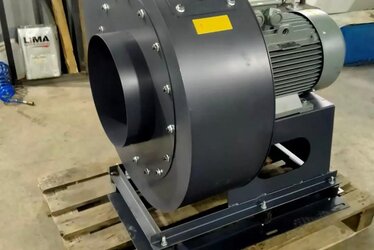
Suppose a ventilation fan will run at 950 rpm and be directly coupled to the motor. Looking at the table, we see that the full-load speed of a 6-pole motor is about 940-980 rpm; this is very close to the fan's need. So the right choice is a 6-pole motor. If a 4-pole (1455 rpm) motor were chosen by mistake, the fan would run far above its design speed, the air flow and power consumption would be much higher than expected, and the motor could even be overloaded. Because fan power rises with the cube of speed: if speed increases by 50%, power rises to about 3.4 times. This example shows why the pole-speed selection is not just a detail but a decision that directly affects energy cost and safety.
The same logic applies to pumps: in a centrifugal pump, the head varies with the square of speed and the power with the cube of speed. For this reason, the wrong speed in pump and fan selection is an expensive mistake not only in terms of performance but also in terms of the energy bill. For constant-torque loads such as conveyors and agitators, the speed directly determines the production rate or mixing intensity; here too, the speed given by the machine manufacturer should be taken as the basis.
Frequently Asked Questions
Why does the nameplate say 1455 instead of exactly 1500 rpm?
Because an induction motor needs slip to produce torque; the rotor always turns slightly below the synchronous speed (1500). With 3% slip a 4-pole motor runs at about 1455 rpm. This is normal and does not mean the motor is faulty. In high-efficiency motors slip is lower, so the speed is a little closer to the synchronous value.
For the same power, should I choose 2 poles or 4 poles?
This depends entirely on the application. If high speed and low torque are needed (for example a high-pressure centrifugal pump), 2 poles; if balanced speed-torque and quieter operation are needed, 4 poles is preferred. Remember: at the same kW, a 4-pole motor produces about twice the torque of a 2-pole but turns at half the speed.
What is done where very low speed (e.g. 50 rpm) is required?
Even a 12-pole motor turns at most around 500 rpm; lower speeds are not practical with a motor alone. In this case a geared motor (motor + gearbox) is used; the gearbox reduces the speed to the desired low value while increasing the torque by the same ratio. In applications such as conveyors, agitators and mills, this is the standard solution.
The right pole-speed selection lets the motor fit the application perfectly and helps you avoid unnecessary gearbox or energy costs. To obtain the right-speed IE3/IE4 motor for your pump, fan, conveyor or mill application from the HEM Motor stock range with fast delivery, get in touch with us.
Related content: HP-kW matching and quick order table, calculating torque (Nm) from kW and speed, geared motor selection and IE3 power and speed stock guide.