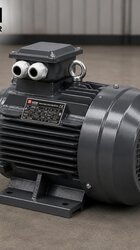
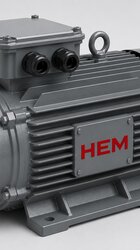
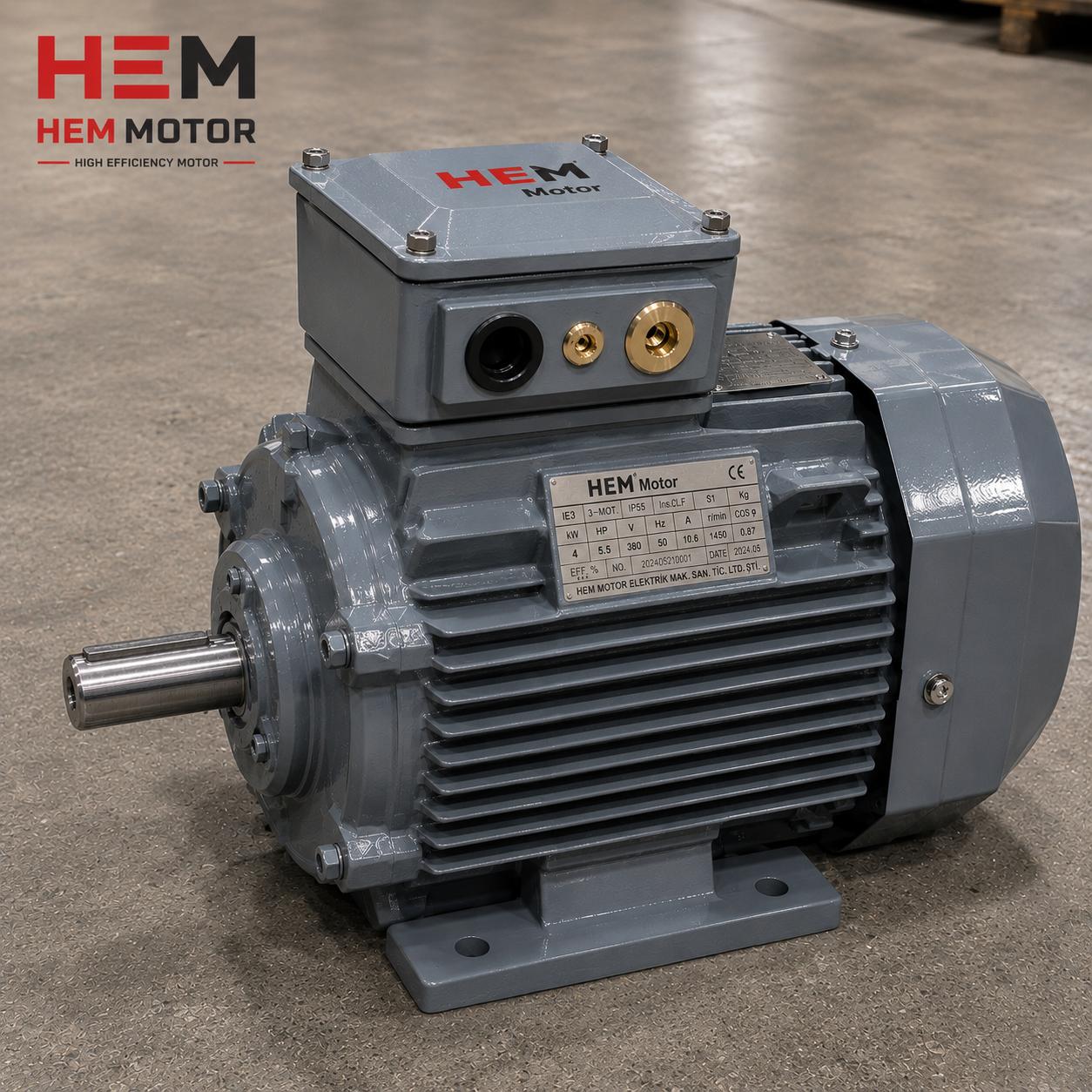
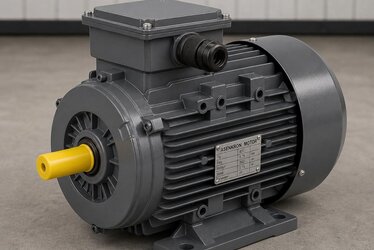
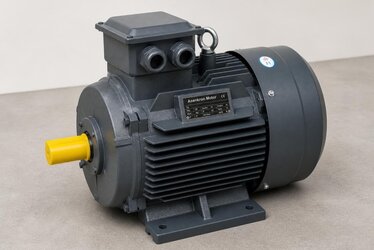
There is an electric motor in your facility that has been running smoothly for ten, fifteen, perhaps twenty years. With the "if it works, don't touch it" logic, it has stayed in place for years; its winding has been renewed a few times, its bearings have been changed, but it does its job. So have you ever calculated how many extra kilowatt-hours this motor quietly bills you each month? An old motor loses money even without failing; and because this loss does not appear as a separate item on your bill, it goes unnoticed for years. In this article we will speak mathematically rather than emotionally: through a real 22 kW example we will calculate the actual consumption of your old motor, set out the difference with a new IE4 class motor on a kWh basis, and give you a clear formula with which you can calculate the payback period using your own electricity unit price.
As HEM Motor, manufacturing electric motors since 1979, we have provided product and engineering support to thousands of motor renewal projects. The clearest truth distilled from this experience is this: when the motor replacement decision is made with the right calculation, the IE4 investment provides a permanent and measurable relief in businesses' energy budgets. Now let us make this calculation together.
Your Old Motor Consumes More Than What Is Written on Its Nameplate
The first thing you need to know is that the current efficiency of your old motor is not the value written on its nameplate. The nominal efficiency of a typical IE1 or IE2 class 22 kW motor produced in the early 2000s is already below or just around 90%. The effect of the years is added on top of this:
- Rewind losses: Every rewind operation typically takes 1-2 points off the efficiency, due to the lamination pack being affected by the heat treatment and the differences in winding quality. A motor rewound twice may be running 2-4 points below its nameplate value.
- Mechanical ageing: Worn bearings, a degraded air gap and fan fouling increase friction and cooling losses.
- Old design technology: Low-quality steel, a low copper fill factor and old rotor geometry have caused the motor to be born behind today's standards from the very start.
For this reason, when calculating, you need to use a realistic efficiency value for your old motor. In the example below, we will base the calculation on the 89.0% efficiency value frequently measured in the field for an old IE1/IE2 motor whose winding has been renewed once.

Real Consumption Calculation: A 22 kW Motor, Step by Step
Our scenario: a 22 kW pump motor in a two-shift production facility, running 16 hours a day, 300 days a year, close to nominal load. The comparison:
- Current situation: Old motor, real efficiency ≈ 89.0%
- New investment: IE4 super premium motor, nominal efficiency ≈ 94.5%
Step 1: Power Drawn from the Grid
The electrical power the motor draws from the grid is found by dividing the shaft power by the efficiency:
Drawn power = Shaft power ÷ Efficiency
- Old motor: 22 ÷ 0.890 = 24.72 kW
- IE4 motor: 22 ÷ 0.945 = 23.28 kW
The old motor draws 1.44 kW more power from the grid every hour to do the same job. This is an invisible tax you pay for every hour the motor runs.
Step 2: Annual kWh Difference
Annual operating time: 16 hours × 300 days = 4,800 hours.
Annual consumption difference = (22 ÷ 0.890 − 22 ÷ 0.945) × 4,800 = 1.44 × 4,800 ≈ 6,900 kWh/year
On a single motor, around 6,900 kilowatt-hours per year. This means that energy equal to almost the entire annual electricity consumption of a small workshop is lost simply because old technology is persisted with. Moreover, this loss repeats every year until the motor is changed.
Step 3: Payback Period
Because the electricity unit price varies according to your tariff, we do not write a fixed amount; insert the unit price on your bill as X per kWh:
Annual saving = 6,900 kWh × X per kWh
Payback period (years) = The price of the new IE4 motor ÷ annual saving
Notice that here the formula is based not on the price difference between two motors, as in the IE3-IE4 comparison, but on the entire price of the new motor; because your existing motor has already been amortised. Even so, the annual saving of 6,900 kWh pays back the price of the new motor in the early years of the motor's life under most tariff scenarios; over the remaining 15-20 years of life the saving turns into net gain. When the copper and steel value of your scrap motor and the efficiency incentives for renewal investments are also taken into account, the payback period shortens even further. In a facility running three shifts instead of two, when the annual hours exceed 7,000, the difference for the same motor approaches the order of 10,000 kWh.

The Scale Effect: Think Not of a Single Motor but of the Motor Fleet
The calculation above is for a single motor; whereas a medium-sized facility has dozens of motors running at a similar age and on a similar profile. When you replace ten old motors in the same scenario with IE4, the annual difference reaches 69,000 kWh, and in a fleet of fifty motors the order of 345,000 kWh. At this scale, motor renewal is no longer a maintenance item; it is a plannable and reportable efficiency investment that structurally lowers the energy cost. Businesses that draw up a motor fleet inventory and gather each motor's age, rewind history and operating hours in a single table can spread the renewal budget over a few years, starting with the highest-return motors, and finance the next year's investment with each year's saving.
Repair or Replace? The Real Cost of Rewinding
When a motor fails, the first reflex is often "let's have it rewound"; the decision is made easily because the rewinding cost appears below the price of a new motor. Yet this comparison is incomplete, because it compares only the cash outflow of that day. The correct comparison is made as follows: add to the rewinding cost the additional energy expense that the post-rewind efficiency loss will create over the life of the motor; and set against it the price of the new IE4 motor less the annual energy saving. When this calculation is made, it often turns out — especially at powers of 11 kW and above, on motors with high operating hours — that rewinding is in fact the most expensive option.
Let us make it concrete with an example: if a 91% efficient motor drops to 89.5% after rewinding, in our 22 kW and 4,800-hour scenario this loss alone means around 440 kWh of extra consumption per year — and moreover the motor is still old technology, and the time until the next failure usually shortens. It is a realistic rule to find rewinding economical only on small powers, on motors with low operating hours and special bodies. In every other scenario, thinking of the rewinding budget as the down payment on a new IE4 motor gains your business more.
Do Not Estimate the Saving, Measure It: A Simple Field Method
Measuring the actual consumption of your existing motor before deciding moves the calculation from estimate to certainty. An expensive energy analyser is not essential for this; you can start with a simple method:
- Current measurement: Measure the current of the three phases with a clamp meter and compare it with the nameplate current; it gives a first idea about the load factor.
- Power measurement: If possible, record the active power (kW) with a mains analyser; it shows what the motor actually draws from the grid.
- Operating hours: Extract the hours the motor actually runs under load from the shift plan or the meter; "open 16 hours a day" and "under load 16 hours a day" are not the same thing.
- Temperature check: If the body temperature is markedly high compared with similar motors, it is a practical sign that the losses have increased.
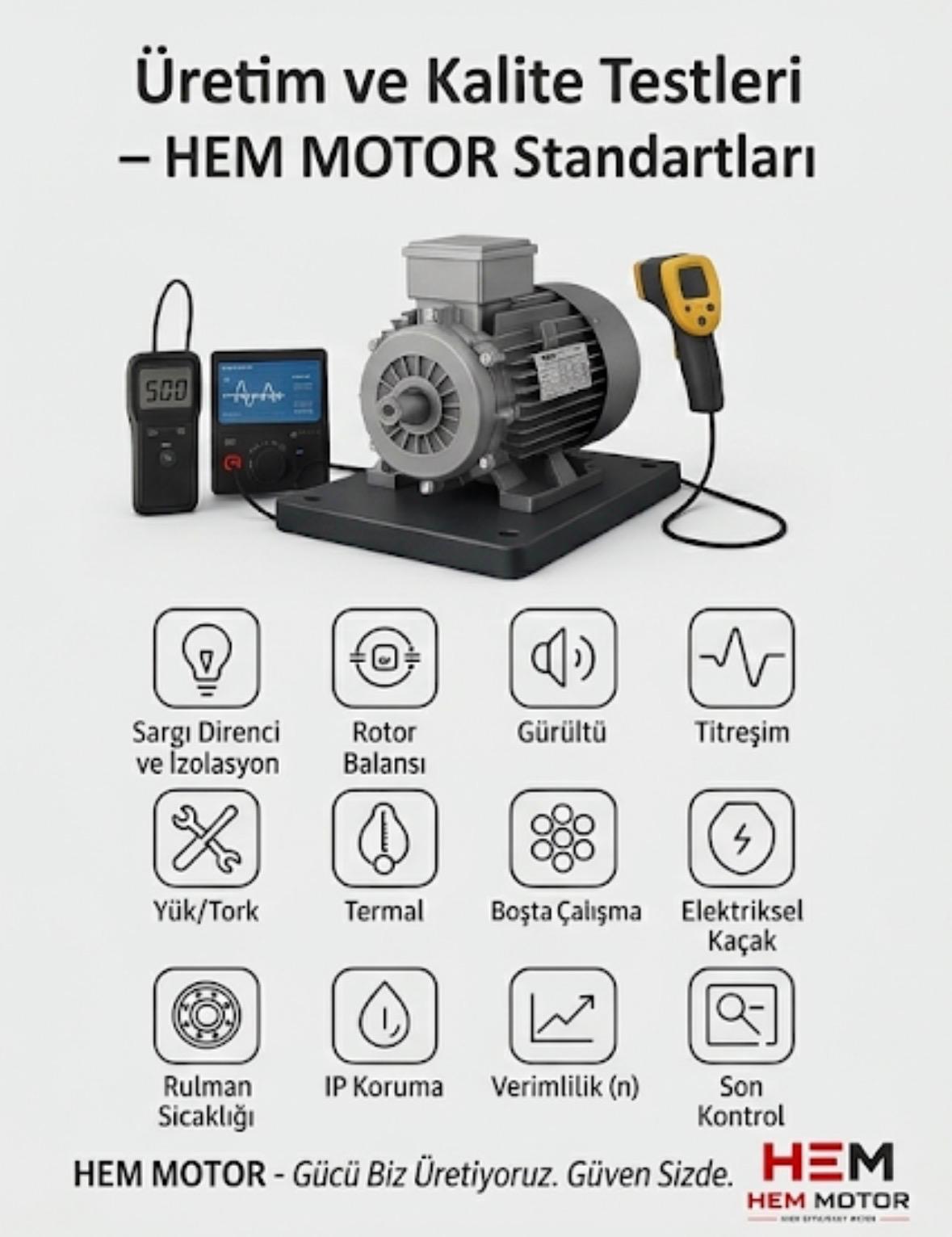
When you send us these measurements, we prepare a clear table comparing your current consumption with the expected consumption of the new IE4 motor; the decision is then built on data, not on feeling.
Beyond Energy: The Hidden Costs of Carrying On with an Old Motor
Even making the calculation on a kWh basis alone justifies the change; but the real picture is even more striking than this, because the cost of the old motor is not limited to energy:
- Unplanned downtime risk: Aged insulation and fatigued mechanical components increase the probability of failure every year. The cost of a single motor failure that stops the production line — lost production, idle labour, delayed shipment — often exceeds the price of a new motor.
- Repeated repair expenses: Every rewind is a serious expense together with transport and labour; and it makes the motor a little more inefficient each time. A motor that comes for a third repair has economically long since reached the end of its life.
- The risk of being left without a spare: Finding a like-for-like equivalent of old-series motors in an emergency becomes difficult; incompatible body and shaft dimensions mean mechanical modification in the middle of a crisis.
- Heat and noise: A low-efficiency motor radiates the energy it loses into the environment as heat; in enclosed spaces this also increases your ventilation and cooling load.
The Right Time for Replacement: Which Motors Should You Start With?
You do not need to renew the entire motor fleet overnight; a sensible order of priority maximises the impact of the investment:
- The hardest-working first: The motors with the highest annual operating hours (continuously running fans, pumps, compressors) should be written at the top of the list; the saving is multiplied directly by the hours.
- Those with renewed windings: Motors rewound one or more times are more inefficient than their nameplates; their replacement priority is high.
- Critical line motors: On motors whose failure stops production, replacement adds the zeroing of downtime risk alongside the energy saving.
- Those with a failure history: On motors repaired in the last two years the next failure is a matter of time; planned replacement is always cheaper than unplanned replacement.
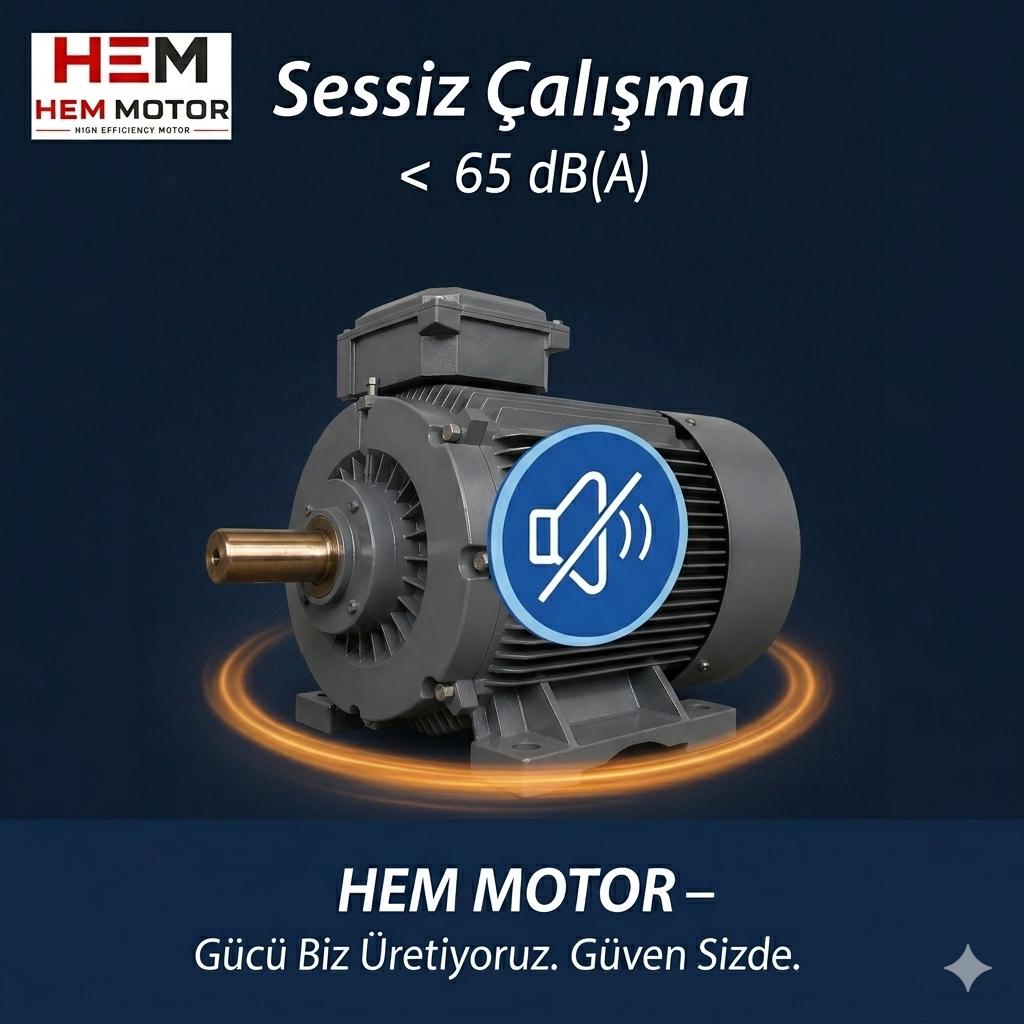
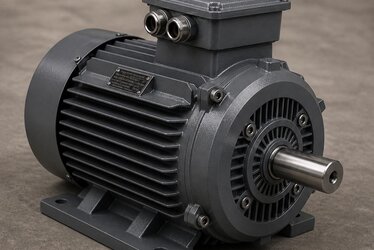
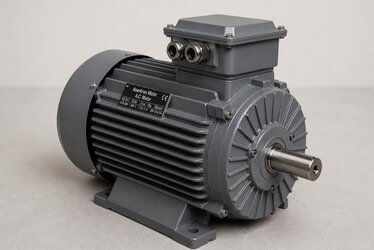
After making this prioritisation, the turn comes to choosing the right product. HEM Motor's IE4 high-efficiency electric motors, across a broad power range from 0.55 kW to 355 kW, with IP55 protection class, class F insulation and a cast iron body, are designed precisely for these renewal projects. Thanks to standard IEC frame dimensions, in most cases they are installed in place of your old motor without requiring mechanical modification. For applications for which an IE4 budget cannot yet be allocated, or for low-operating-hour points, our standard electric motors series is also produced with the same quality infrastructure; if you are undecided about the right class selection, we recommend taking a look at our article in which we answer the question IE3 or IE4 with a payback calculation.

Technical Points to Watch in a Replacement Project
Motor replacement is a simple operation, but a few technical details guarantee the smooth progress of the project:
- Take the nameplate details in full: Record the power, speed, body type, mounting form (B3, B5, B35) and shaft dimensions of the existing motor; if the old nameplate is unreadable, our technical team determines the model from a photo and the dimensions.
- Confirm the frame size: IE4 motors are usually produced in the same frame size; but in some power-speed combinations the body may grow one size larger. Confirmation before ordering prevents a surprise on installation day.
- State the drive use: If the motor will be driven by a frequency converter, the suitability of the winding insulation and bearing structure for the drive must be validated in advance.
- Review the load profile: Replacement is also an opportunity to resize the motor's power. Choosing an IE4 of the right power instead of an oversized motor that has been running at low load for years can double the saving.
- Take a commissioning measurement: Take current and power measurements after replacement; documenting the saving is a strong basis both for reporting to management and for subsequent investment decisions.
Why Should You Work with HEM Motor?
In motor renewal projects, supplier selection is as important as product selection. HEM Motor has worked with a manufacturer's identity since 1979; the design, winding and testing of every motor we sell are under our own control. Thanks to our strong stock structure in Turkey, IE4 motors in standard powers are delivered without waiting; in your planned replacement projects we set up the delivery schedule together according to your maintenance shutdown. Because we are the manufacturer, we select the model that will replace your old motor not just from a catalogue but with engineering validation. In fleet renewal projects covering more than one motor, bulk purchase advantages come into play; on this subject our guide on the ways to reduce cost in wholesale purchasing will guide you.
Frequently Asked Questions
Is it really sensible to replace my old motor while it is still running?
Yes — if the calculation shows it. The fact that it "works" does not mean it is economical. In the example above, the old motor does its job, but consumes around 6,900 kWh extra per year. When you put your motor's power, age, rewind history and daily operating hours into the formula, the result becomes clear: on motors with high operating hours, replacement mostly pays for itself in a short time. On motors with low operating hours, waiting may be the right choice; we present you the honest calculation in either case.
Can the new IE4 motor be installed directly in place of my old motor?
Thanks to standard IEC frame dimensions, in most cases yes: the shaft height, flange and mounting dimensions are preserved, and the existing base and coupling arrangement are used. Because the body may grow one size larger in some power-speed combinations, it is enough to send us the nameplate details of your existing motor before ordering; our technical team confirms the like-for-like replacement suitability and, if necessary, proposes a compatibility solution.
How long does delivery take, will it be in time for my planned maintenance shutdown?
Our IE4 motors in standard power and frame types are ready in our stocks in Turkey; shipment from stock is scheduled the same day or the next business day. When you give a date for your planned maintenance shutdown, we commit to a delivery programme in which the motors will be on your site before the shutdown. In urgent failure cases, we make a quick model identification from a nameplate photo and offer the shortest delivery option.
Get a Quote
To learn what your old motor actually costs you, all you need to do is share a few pieces of data with us: the motor power, its age, its rewind history and its daily operating hours. Let us make your payback calculation together and finalise the stock and delivery plan the same day. You can reach us on +90 (532) 345 49 86 or send your request via our contact us page. Close the invisible bill of the old motor with the assurance of HEM Motor; see the saving in your own coffers.