English
 Türkçe

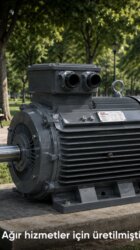
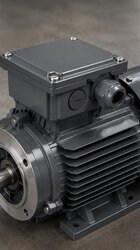

Powder coating and electrostatic coating lines determine surface quality across a very wide range of industries, from metal furniture and white goods to automotive suppliers and aluminium profiles. At the heart of these lines sits a group of electric motors that are easy to overlook yet must run continuously: the geared motor that drives the overhead (monorail) conveyor, the circulation fan motor that distributes hot air inside the curing oven, and the booth cyclone/exhaust fan motor that recovers excess powder. When these three motors are not selected with the right kW, pole/speed, protection and insulation class, the line stops, coating quality drops and scrap rates rise. In this article we examine each motor of the powder coating line separately, covering selection criteria, supply and lead-time notes, and the matching between efficient electric motors and worm gear reducers from a sector perspective.
The Three Main Motor Groups of a Powder Coating Line
When planning an electrostatic coating line, dividing the motors into three functional groups simplifies both selection and spare-parts strategy. The first group is the overhead monorail conveyor drive that moves parts between pretreatment, booth, oven and cooling stations; the second is the circulation fan that evenly distributes hot air inside the oven; and the third is the booth cyclone and exhaust fan that enables powder recovery. Because each group has a different operating temperature, speed requirement and ambient dust level, fitting the same motor everywhere is a mistake. The correct approach is to evaluate each station's load separately and define the right body, pole and protection class.
Overhead (Monorail) Conveyor Geared Motor
The skeleton of a powder coating line is the monorail conveyor that travels on a ceiling-mounted track. Parts are hung on carriers and circulate through the stations at a fixed, low speed. The motor that creates this motion must have a low output speed (typically in the 5–60 rpm band) but high torque; therefore a direct asynchronous motor is never used, but always a geared motor.
Reducer Type: Worm or Bevel-Helical?
On lines where conveyor speed is very low and self-locking (no back-driving) is required, a worm gear reducer (HEM30–HEM130 body, ratio 1/7.5 – 1/100) is an economical and compact solution. On larger lines requiring higher efficiency, continuous heavy load and a 90° angled output, a bevel-helical reducer (K series) is preferred. Correct matching of motor and reducer depends on IEC flange and shaft compatibility; our worm gear reducer to motor matching guide walks through this step by step. It is also important to assess whether to buy a geared motor or a separate motor and reducer for your line, both for cost and spare-parts management.
Brake Motor Option
When the conveyor must position precisely at certain stations or carriers must not drift during a power cut, the brake motor option comes into play. An electromagnetic brake motor prevents the shaft from spinning freely at standstill and improves safety especially on inclined track transitions. In conveyor and crane applications, our article on IE4 brake motor supply covers brake torque and supply details. To avoid stopping the line during a breakdown, planning the conveyor motor emergency replacement and swap process in advance is critical for line continuity.
Speed Control with VFD
On modern powder coating lines, conveyor speed must be adjustable according to part density and oven cycle time. For this reason the monorail drive motor is usually run through a frequency drive (VFD). When drive-compatible winding and insulation are chosen, the motor produces stable torque even at low frequencies. Driving an asynchronous motor with a VFD and the low-speed high-pole motor options should be referenced for flexible line-speed management.
Curing Oven Circulation Fan Motor
Curing the powder coating onto the part surface (polymerization) takes place in an oven that typically operates between 160–220 °C. Uniform temperature at every point in the oven is the main condition for coating quality, and the circulation fans provide it. The motors driving these fans work in the harshest thermal environment of the line and require special measures.
High Temperature and Insulation Class
For the oven fan motor, standard Class F insulation is often insufficient; motors that will run in the hot zone use Class H insulation and derating where necessary. The motor is preferably mounted as far outside the oven body as possible, with the shaft extending into the oven; this keeps the winding from being exposed directly to the curing temperature. Our articles on motor insulation class in hot and dusty environments and IE3 motor winding insulation class F/H explain the temperature-insulation relationship in detail. A cast iron body stands out in oven fans for its heat dissipation at high temperature and its vibration resistance.
Fan Type and Speed Selection
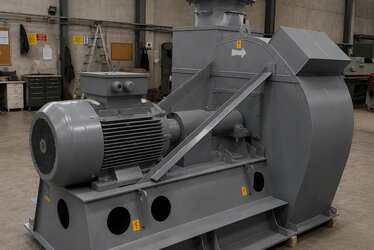
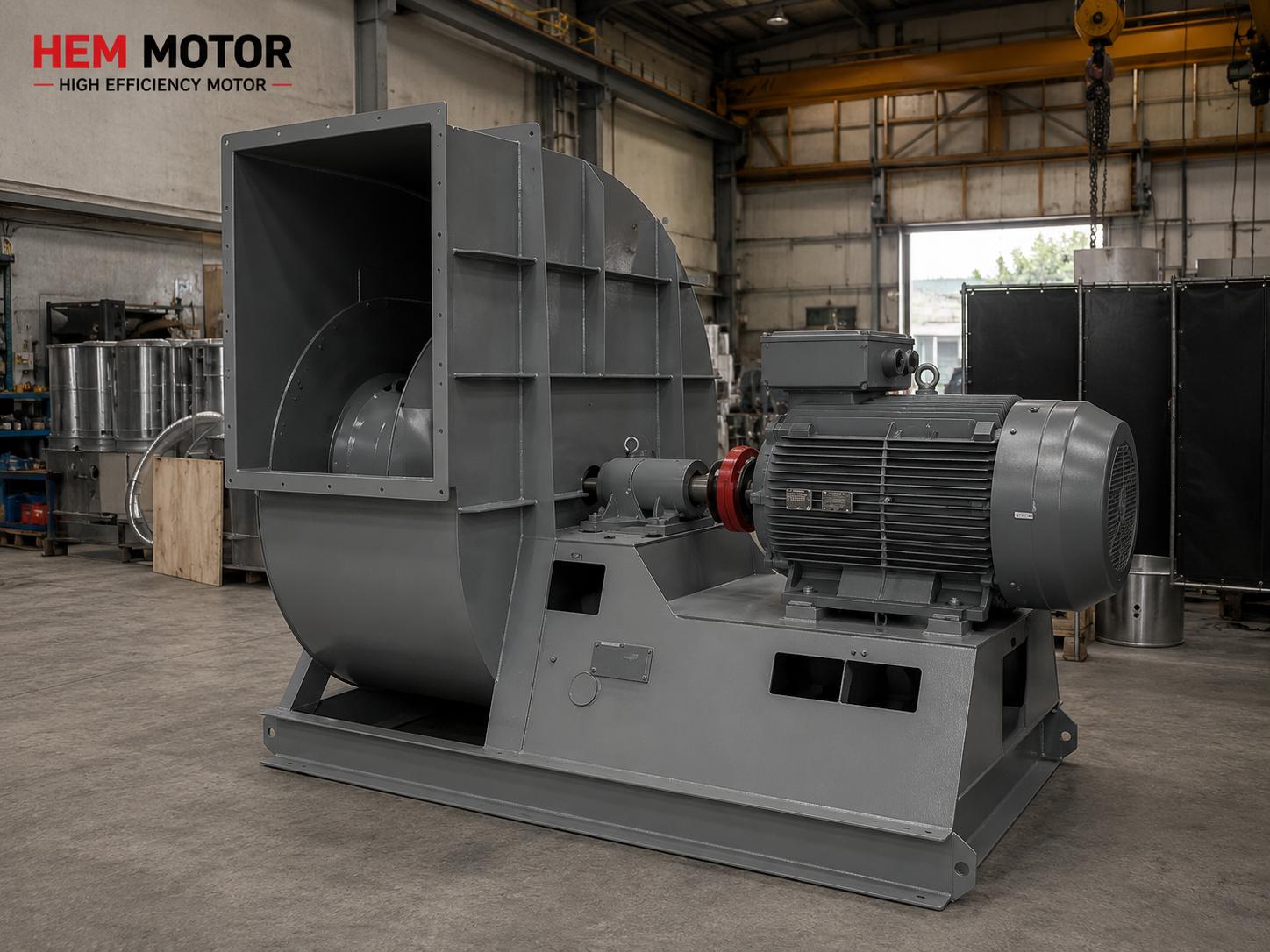
Circulation fans are usually centrifugal or axial type and are selected at 1500 rpm (4 pole) or 1000 rpm (6 pole) according to the required flow/pressure. In fan motor selection, not only the flow but also the density of the hot air must be taken into account. Our centrifugal and axial fan motor selection guide includes the steps for determining kW and pole for the oven circulation fan. Similar high-temperature principles also apply to tunnel and jet fan motor applications.
Booth Recovery Cyclone and Exhaust Fan Motor
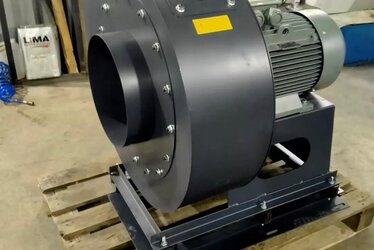
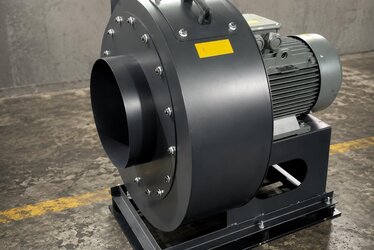
In the electrostatic booth, powder coating that does not adhere to the part is reused through the recovery system. The exhaust fan that draws booth air into the cyclone and filter unit is the motor of this system. Because this motor operates in an environment with dense dust particles in the air, its most important criterion is the protection class.
Dusty Environment and IP Protection Class
Standard IP55 is often sufficient for the booth exhaust motor; however, in environments with dense fine powder coating, IP56 or IP65 may be requested. The right protection class choice directly affects motor life. Our article on electric motor IP protection class selection explains what the IP digits mean for dusty environments. For dust collection and recovery fans, the exhaust and dust collection fan motor selection guide addresses flow-pressure calculation and protection selection together.
Continuous Operation and Duty Type
The exhaust fan must run without stopping as long as the line operates; therefore S1 continuous duty type and robust bearing selection are essential. It usually runs at 2900 rpm (2 pole) or 1450 rpm (4 pole), and kW is determined according to the cyclone pressure loss. To protect the motor against overload, phase loss and overheating, electric motor protection devices should not be neglected for line continuity.
Efficiency and Energy: IE3, IE4, IE5
Since all three motor groups on the powder coating line run for long hours each day, the efficiency class is directly reflected in the energy bill. IE3 Premium is standard, with IE4 Super Premium on request and IE5 Ultra Premium with synchronous reluctance technology. Especially for the continuously running oven and exhaust fans, a high efficiency class pays for itself within a few years. Our experience in press and CNC motor supply for high-volume facilities such as automotive suppliers is applied with the same care to coating lines.
Mounting Types and Body Selection
Conveyor drives generally use a B5 large flange or B35 (foot+flange) reducer input; oven and booth fans use B3 foot-mounted or B5 flange-mounted depending on the fan hub. For body material, cast iron is preferred for heavy duty and high temperature, while aluminium is preferred for compact low powers. To determine the right mounting type, you can review the B3/B5/B14/B35 options on our electric motor mounting types page. For high-efficiency bodies, efficient electric motors, and for angled drive, helical worm gear reducers are suitable starting points.
Powder Coating Line Motor Selection and Purchasing Checklist
- Have the required output speed (rpm) and torque for the conveyor and the reducer ratio (1/7.5 – 1/100) been determined?
- Has the reducer type been chosen? Worm gear for self-locking, bevel-helical for high efficiency.
- Is a brake motor needed on the conveyor (inclined track, precise positioning, power-cut safety)?
- Is Class H insulation selected for the oven fan motor, and will the motor be mounted outside the hot zone?
- Have kW, pole/speed (4 or 6 pole) and flow-pressure calculation been done for the oven and exhaust fans?
- Is the protection class of the booth exhaust motor (IP55 / IP56 / IP65) chosen according to dust density?
- Are a VFD and drive-compatible winding planned for conveyor speed control?
- Has the efficiency class (IE3/IE4/IE5) been evaluated against energy cost?
- Are the mounting type (B3/B5/B35) and body material (cast iron/aluminium) finalized?
- Is a spare-stock and fast-delivery/lead-time plan created for critical motors?
To speed up the quotation process, filling in the checklist in our information to provide when requesting a quote article ensures the right motor is determined quickly.
Frequently Asked Questions
Which insulation class is required for a powder coating oven circulation fan motor?
Since the oven operates in the 160–220 °C range, Class H insulation is usually recommended instead of standard Class F. Mounting the motor as far outside the oven body as possible, with the shaft extending inside, protects the winding. A cast iron body is preferred for heat dissipation at high temperature.
Should I buy a geared motor or a separate motor and reducer for the monorail conveyor?
Because low output speed and high torque are required, a reducer is always used. For a compact, economical and self-locking solution, a worm geared motor is suitable; for high efficiency and heavy continuous load, a bevel-helical reducer is preferred. You can choose a single package or separate components according to your spare-parts management.
Is IP55 sufficient for the booth exhaust motor?
IP55 is sufficient for most applications; however, in environments with dense fine powder coating in the air, IP56 or IP65 protection class may be requested. The right IP choice reduces dust-related failures and extends motor life.
Get a Quote
We can supply the conveyor, oven fan and booth exhaust motors of your powder coating and electrostatic coating line from manufacturer stock with fast delivery and clear lead times. Reach us with your line layout and load data through our contact page or at +90 (532) 345 49 86; let us determine the right kW, pole, protection and insulation class together and offer you the most suitable solution. For our product family, you can review our homepage and our efficient electric motors catalogue.