English
 Türkçe



When ordering an IE4 Super Premium motor, choosing the right kW, speed and efficiency class alone is not enough. The mounting range that determines how the motor connects to the machine, namely the flange and foot configuration, is the source of most wrong deliveries and mounting problems. In IE4 motor supply, knowing what mounting types such as B3, B5, B14 and B35 mean, how IEC 60072 flange dimensions are read, and which mounting to choose for which frame in a gearbox, pump or fan connection is critical for an error-free order. In this article we cover the mounting options in the IE4 range and the correct order code step by step.
IE4 Mounting Range: What Do B3, B5, B14 and B35 Mean?
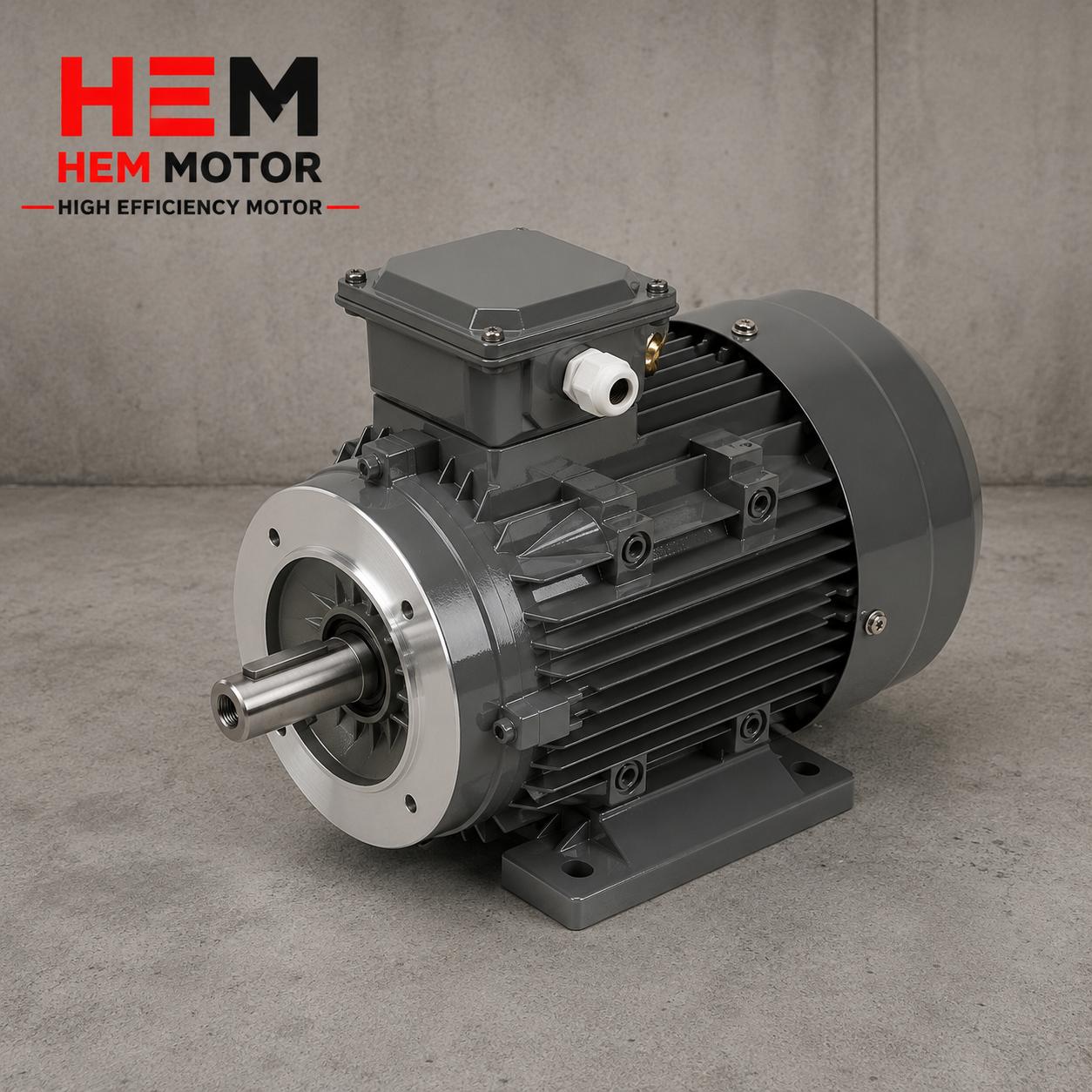
The mounting (IM) code defines the frame, foot and flange configuration of the motor. IE4 Super Premium motors are offered with standard mounting options in the 0.25 kW – 355 kW power range. The four most common configurations are:
- B3 (foot-mounted): Connected to the chassis, floor or base via the feet under the frame. Common in belt-pulley, coupling and general industrial applications.
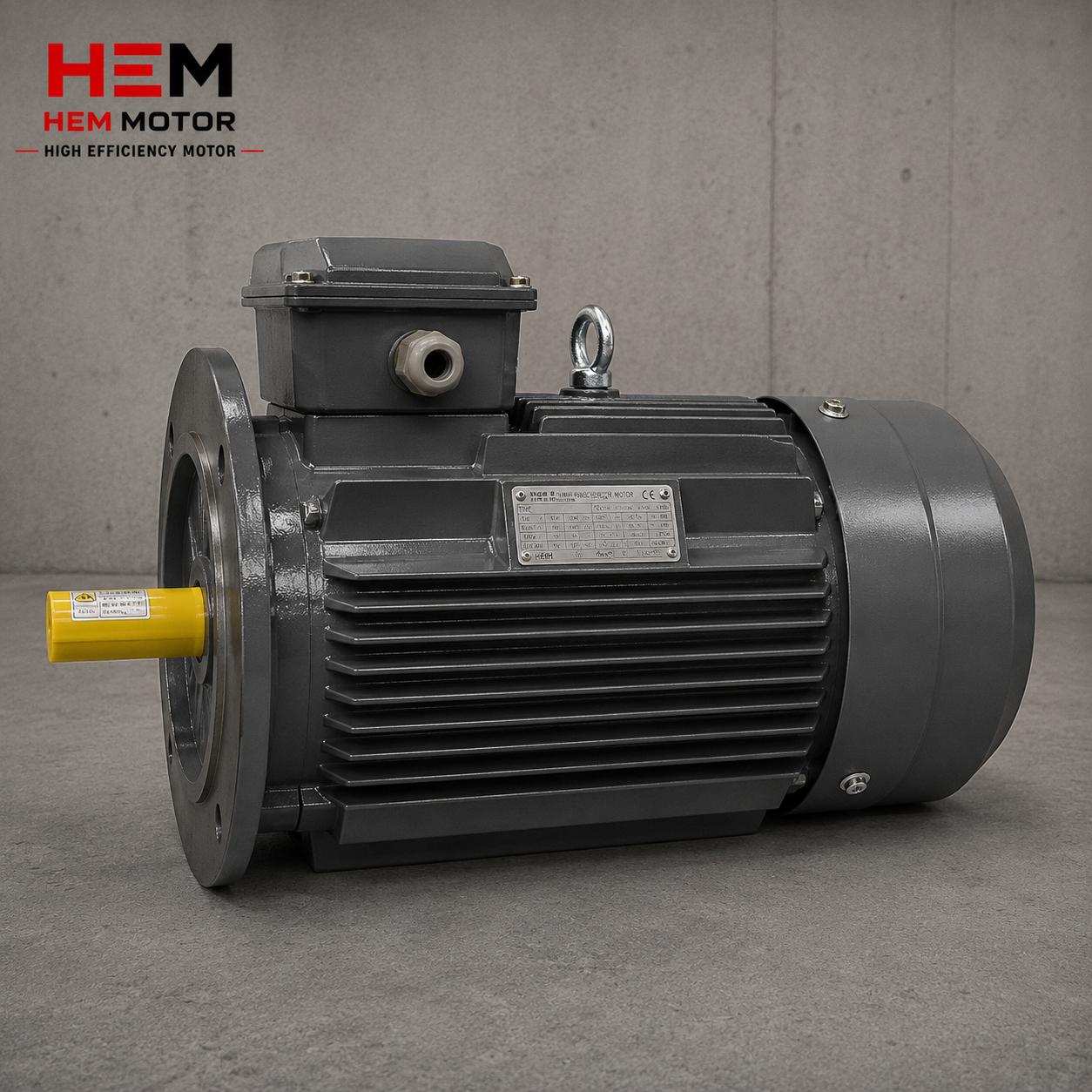
- B5 (large flange): Footless; connected directly to the machine via the large flange on the front cover with flange holes and bolts. Preferred in pump and gearbox connections.
- B14 (small/face flange): Footless; connected via the threaded (face) holes on the front flange. Used in small power and compact machines.
- B35 (foot + large flange): Carries both the B3 foot and the B5 large flange together; it both sits on the chassis and connects to the machine via the flange. It is the most flexible configuration.
We explained the detailed reading of IM mounting codes in our article on IM mounting code reading (IM B3, IM B5, IM V1). Choosing the mounting type according to the power and frame of the IE4 motor secures mechanical compatibility in the IE4 transition; we also addressed this in our article on mechanical compatibility in the IE4 transition.
Flange Dimensions: FF and FT Types with IEC 60072
In flanged motors, the most critical point is that the flange bolt circle and the spigot diameter match the machine exactly. The IEC 60072 standard defines flange dimensions by frame size:
- FF (large flange, B5): The holes are clearance type, the bolt passes through the flange. Codes such as FF165, FF215, FF265 express the flange bolt circle diameter.
- FT (face flange, B14): The holes are threaded, the bolt threads into the flange. Defined with codes such as FT85, FT100, FT130.
We examined in depth how to select the flange type and hole dimensions for the correct order in our article on flange type (FF/FT) and hole dimensions. The choice between B5 and B14 varies by machine; for the right decision, our B5 vs B14 mounting type selection guide will help.
Can B14 Be Fitted in Place of B5?
No, not directly. The flange dimensions of B5 (FF large flange) and B14 (FT face flange) are different; the bolt circle, spigot diameter and connection form do not match each other. During ordering, the flange type required by the machine must be clearly stated; otherwise a motor with the wrong flange arrives. To prevent the wrong motor, our article on exact matching with nameplate information is useful.
Which Mounting for Which Frame in the IE4 Range?
Mounting options vary by frame size. As a general rule:
- Small frames (IEC 56-90): B3, B5, B14 and B35 may all be available; B14 face flange is especially common in this range.
- Medium frames (IEC 100-160): B3, B5 and B35 are standard; B14 decreases toward the upper limit.
- Large frames (IEC 180-355): B3, B5 and B35 are essential; B14 is generally not offered at high powers because the face flange does not provide the rigidity to carry these loads.
Mounting compatibility is especially important when using an IE4 motor with a gearbox; on this topic see our article on using an IE4 motor with a gearbox. For equivalent selection and IEC connection dimensions, our IE4 motor equivalent replacement guide helps.
B3 Foot Mounting: When Is It Preferred?
Flanged mounting is not always necessary. In belt-pulley drives, coupled connections and most general industrial applications, B3 foot mounting is preferred. In foot mounting, the motor is bolted to a base or chassis via the feet under the frame. For this connection to be vibration-free, the anchor bolts must be tightened to the correct torque and the floor must be level. We addressed bolt, nut and foundation mounting in our article on bolt, nut and foundation/base mounting.
In the IE4 range, B3 mounting is available at all powers from IEC 63 frame to 355 frame. At high powers, fixing the heavy motor firmly to the chassis is of critical importance; otherwise vibration and misalignment problems arise. The coupling or pulley connection at the shaft end of a foot-mounted motor must be considered together with shaft alignment. B35 mounting eases this alignment by offering both foot and flange support; this is why B35 is frequently preferred in gearbox and pump connections.
Connection by Application: Gearbox, Pump and Fan
Gearbox Connection
Worm gear (NMRV) and bevel helical gearboxes usually run directly coupled to a B5 or B14 flanged motor. For the IEC frame and flange matching of a motor suitable for a gearbox, our article on which motor fits a worm gear and NMRV reducer is a comprehensive guide.
Pump Connection
Centrifugal and in-line pumps are mostly connected directly with a B5 large flange. For the right power and connection selection in a pump motor, see our article on centrifugal pump motor selection, and for the IE4 threshold, see our article on the IE4 threshold in pumps, fans and compressors.
Fan Connection
In fan and aspirator applications, B3 foot or B35 combined mounting is common. For IE4 HVAC and AHU fan supply, our article on IE4 HVAC air handling unit and AHU fan supply is application-oriented. For power selection by fan type, our article on centrifugal and axial fan motor selection helps.
Vertical Mounting: IE4 Motor in V1 and V5 Positions
The mounting range is not limited to horizontal B configurations. In some pump and mixer applications the motor is mounted vertically, with the shaft down (V1) or up (V5). In vertical mounting, the oil seal selection, bearing load and sealing differ; we addressed this topic in our article on vertical mounted motor selection (V1/V5). When ordering an IE4 motor in a vertical position, clearly stating the mounting code (for example IM V1) together with the flange type ensures the right product arrives.
When switching between vertical and horizontal mounting, it must be checked whether the frame supports both positions. Some frames are certified only for certain mounting positions; this information is found in the technical document. The wrong mounting position can adversely affect bearing life and lubrication performance.
Shaft Diameter, Key and Mechanical Matching
Even if the flange and foot configuration is chosen correctly, the mechanical compatibility of the motor shaft with the machine is a separate check point. The shaft diameter, key dimension and shaft length are critical for the coupling or pulley connection to seat correctly. We examined the shaft diameter and key dimensions in depth in our article on shaft diameter and key dimensions. According to the IEC standard, each frame size corresponds to a certain shaft diameter; in replacement orders the shaft diameter must always be confirmed.
Coupling type selection is also part of mechanical matching; whether a flexible or rigid coupling is used determines the shaft alignment tolerance. On this topic our article on flexible or rigid coupling guides you. Even in a flanged connection, shaft alignment and coupling selection are the foundation of vibration-free, long-life operation.
How to Give an Error-Free Order Code?
For the right order, the power, speed, efficiency class (IE4) and mounting code of the motor must be stated together. An example definition: "IE4, 7.5 kW, 4 pole (1500 rpm), IEC 132 frame, B35 mounting". The terminal box orientation and cable entry side must also be stated in the order; on this topic our article on terminal box and cable entry orientation guides you. To verify all nameplate fields before ordering, use our IE4 nameplate reading guide. For more, you can review our electric motors blog homepage and our article on the IE4 stock range.
Frequently Asked Questions
What is the difference between B5 and B35?
A B5 motor connects only with the large flange (FF), has no foot, and the entire load is carried through the flange. A B35 motor has both the B3 foot and the B5 large flange; it both sits on the chassis and connects to the machine via the flange. B35 is the most flexible option because it offers both foot and flange connection, giving more support and alignment possibility during mounting.
Is the B14 face flange available at high IE4 powers?
Generally no. Because the B14 face flange connects with threaded holes, it is offered in small and medium frames (about IEC 56-160). At high powers, since the face flange cannot provide the rigidity to carry heavy motor and high torque loads, the B5 large flange or B35 combined mounting is preferred.
How should I state the flange dimension in the order?
The flange type (B5/FF or B14/FT) and the flange code (for example FF265) must be given together. The flange code expresses the flange bolt circle diameter according to the IEC 60072 standard. The safest method is to verify the flange bolt circle and spigot diameter dimensions of the existing motor or machine and state them clearly in the order code.
Get a Quote
Get support from our team to order your IE4 Super Premium motor error-free with the right power, speed, frame and mounting type (B3/B5/B14/B35). For the right connection for your machine and fast supply, contact us at +90 (532) 345 49 86 or reach us via our contact page.
IE4 Mounting and Order Checklist
- Determine the mounting type required by the machine: B3, B5, B14 or B35.
- If flanged, verify the flange type (FF/FT) and flange code (for example FF215).
- Check that the frame size supports your chosen mounting (B14 may not exist at high powers).
- State the power (kW), speed (pole count) and efficiency class (IE4) clearly.
- Specify the gearbox/pump/fan connection and, if needed, the shaft diameter-key dimensions.
- Add the terminal box orientation and cable entry side to the order code.
- If replacing an existing motor, match it exactly with the nameplate.