English
 Türkçe


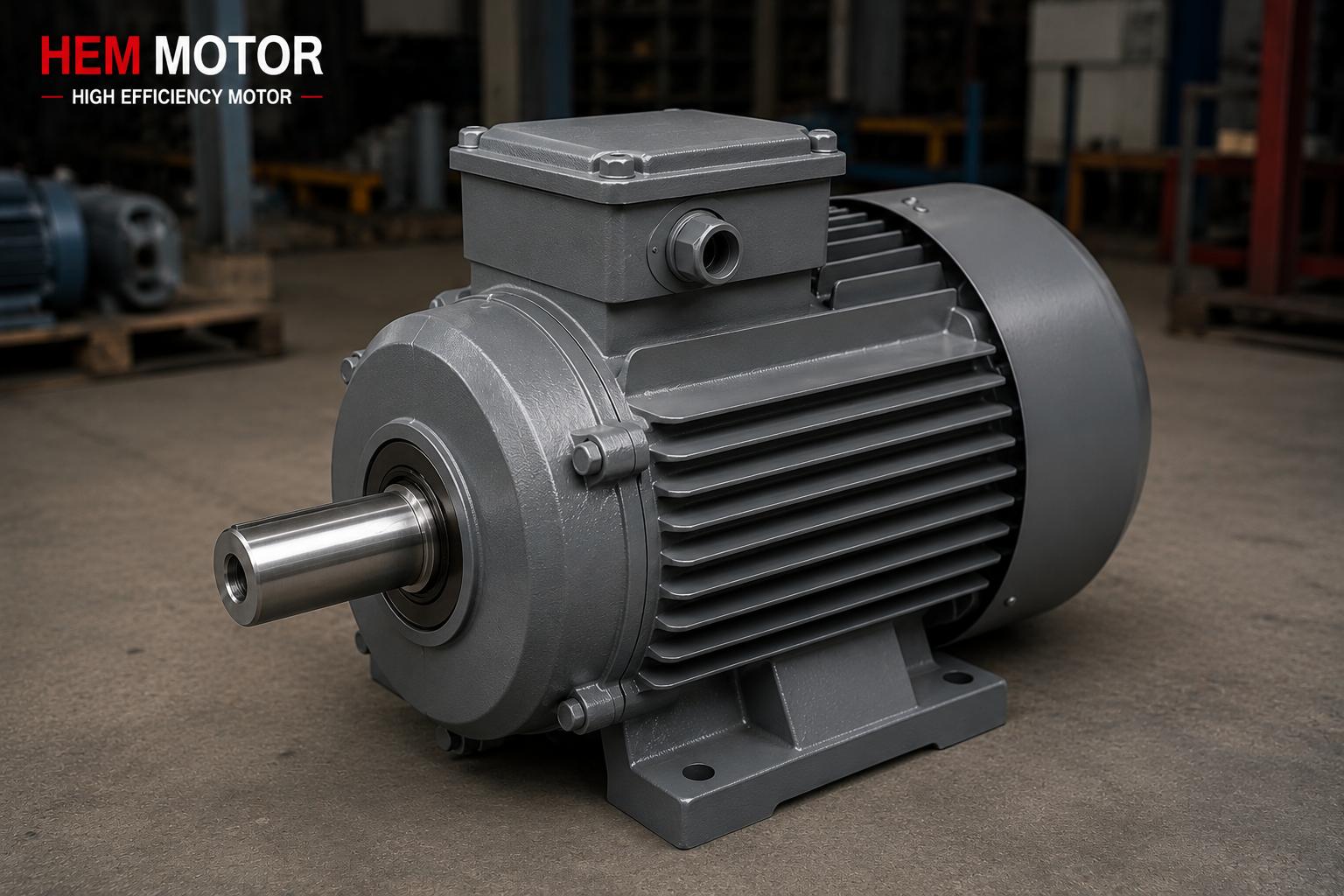

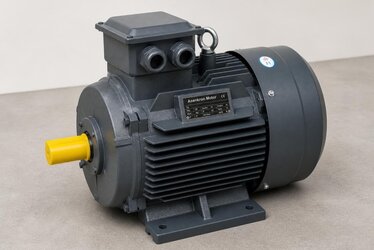
When a motor fails or needs to be replaced with a more efficient model as part of a modernization, the first question that comes to mind is: "What will I do if I cannot find the same brand?" The good news is that electric motors are produced to an international standard. Thanks to this standard, even if the motor's brand is different, choosing an equivalent with the right dimensions is entirely possible. Especially when replacing a high-efficiency IE4 motor with another IE4 equivalent, what matters is not so much the brand but that the mechanical connection dimensions and electrical values match exactly.
In this guide we address how the IEC standard makes equivalent selection possible, which dimensions must match, and why an equivalent that looks correct on paper may still fail to fit in the field. Our goal is to clearly lay out all the criteria you need in order to confidently select the right equivalent product when performing a motor replacement.
The IEC Standard: The Framework That Makes Equivalent Selection Possible
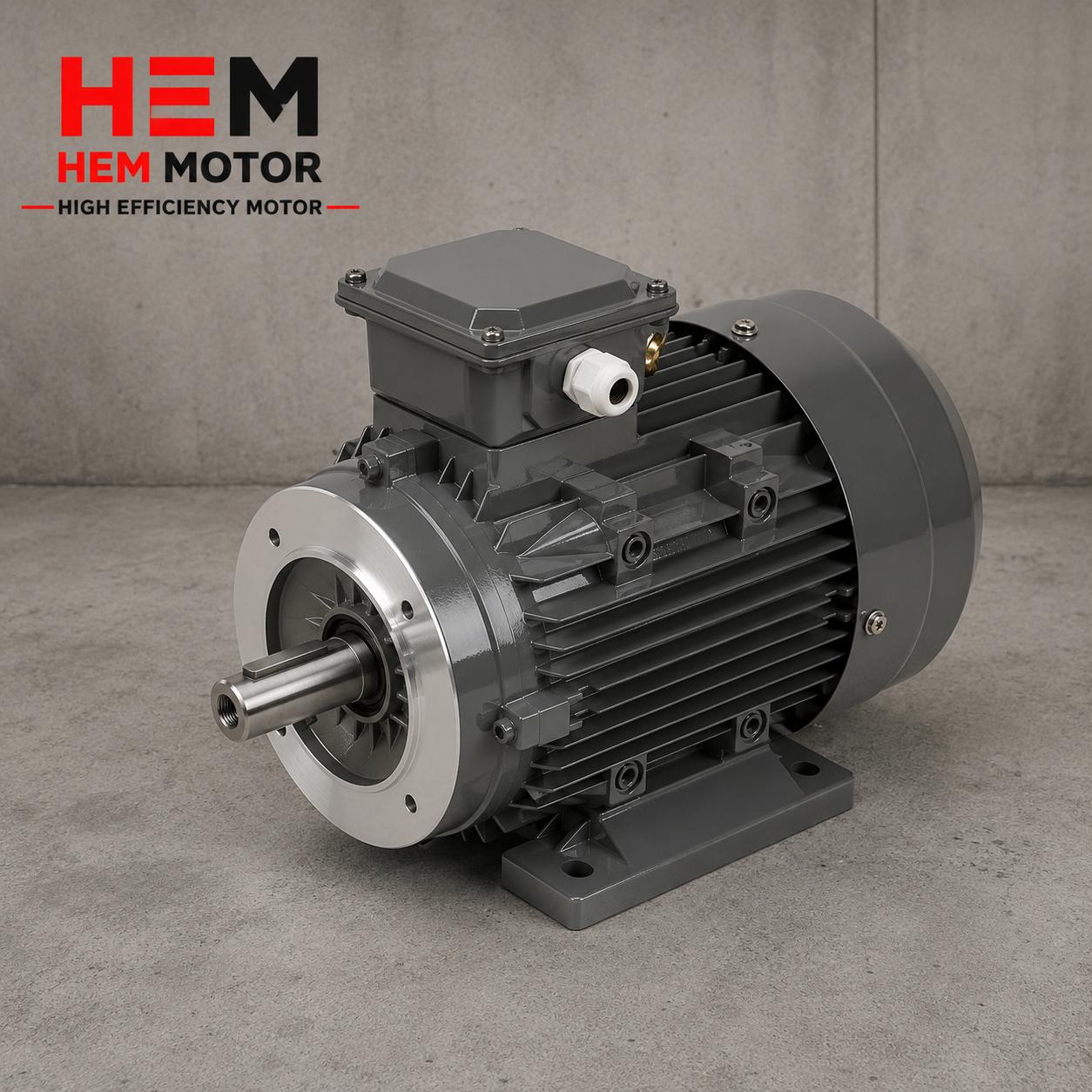
Electric motors are largely produced worldwide to the IEC (International Electrotechnical Commission) standard. This standard defines the motor's physical dimensions, mounting interfaces and performance definitions. Thanks to IEC, one manufacturer's motor of frame size 132 and another manufacturer's motor of the same frame size can replace each other in terms of mounting.
This standardization is the basis of equivalent selection. If two motors have the same power, speed and IEC connection dimensions, the brand difference is not an obstacle in most applications. This offers both fast replacement in case of failure and supply flexibility; you are not dependent on a single brand.
The Values That Must Match for a Correct Equivalent
When replacing an IE4 motor with an equivalent, both electrical and mechanical values must be compatible. Let us examine these in two groups.
Electrical Values
- Power (kW): The new motor's rated power must be the same as the motor being replaced. Lower power is insufficient, while unnecessarily high power wastes energy and cost.
- Speed / Pole Count: Speed determines the operating rate of your machine. Fitting a 2-pole motor in place of a 4-pole one doubles the application's speed; therefore the pole count must absolutely be the same.
- Voltage and Frequency: Must be compatible with the grid voltage and frequency.
- Efficiency Class: If you are replacing an IE4 motor, choosing an IE4 (or at least IE3) equivalent to preserve the efficiency advantage is sensible.
Mechanical Connection Dimensions
This is the truly critical point. Even if the electrical values match, if the mechanical dimensions do not fit, the motor cannot be physically attached to the machine.
- Frame Size: The IEC frame number (80, 90, 100, 112, 132, 160, 180, 200...) determines the motor's shaft height and overall dimensions. The same frame size indicates the motors are dimensionally compatible.
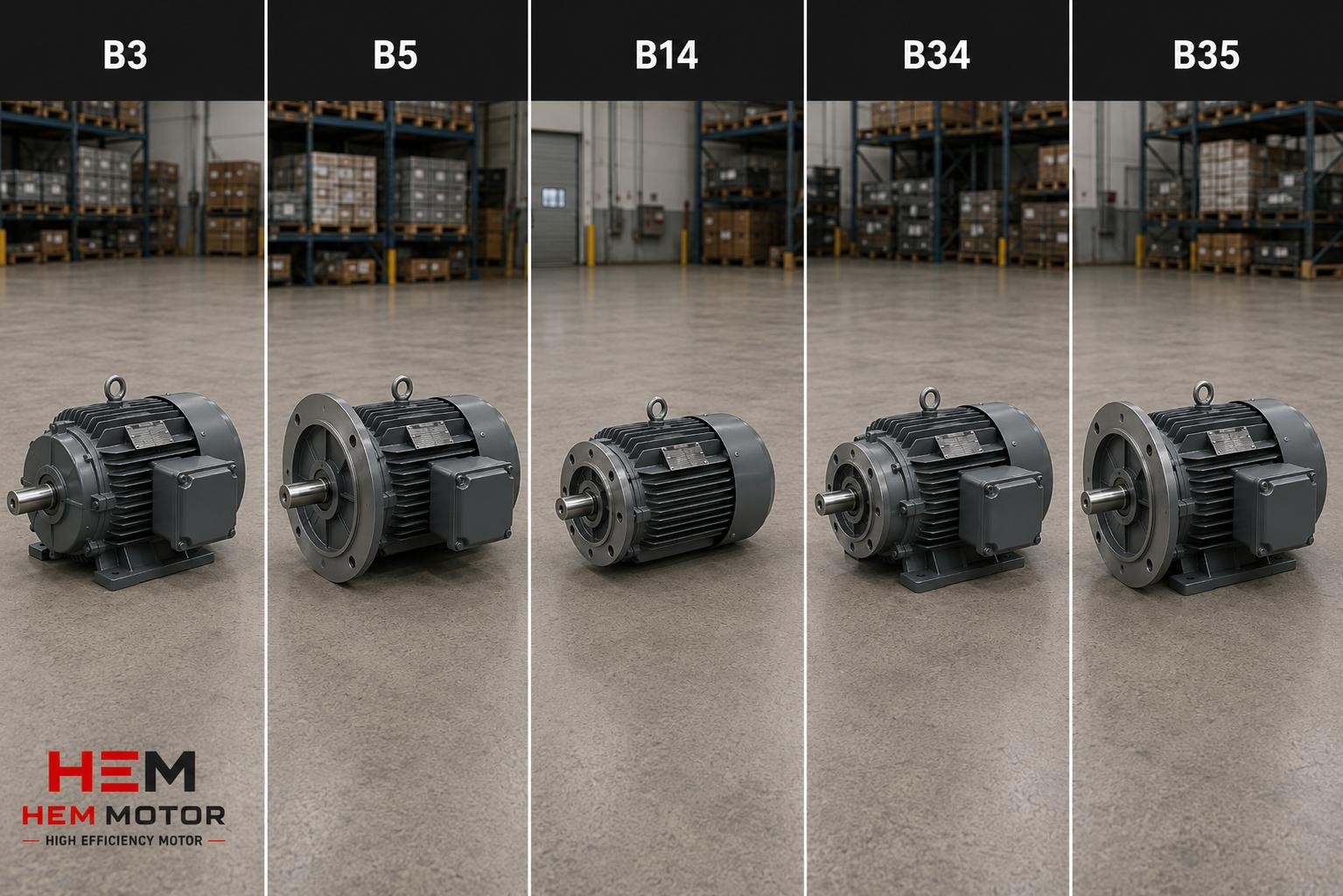
- Mounting Type: Mounting types such as B3 (foot-mounted), B5 (large flange) and B14 (small flange) define how the motor connects to the machine. The equivalent's mounting type must be the same as the existing motor.
- Shaft Diameter and Length: The motor shaft's diameter and length must be compatible with the coupling, pulley or gear. A wrong shaft diameter means the drive element cannot be attached.
- Flange Dimensions: On flange-mounted motors the flange diameter, bolt circle and bolt holes must match exactly.
IEC Frame Sizes and Mounting Types
The IEC frame system is based on the height of the motor's shaft axis above the foot (shaft height) in millimetres. For example, a 132 frame refers to a motor with a shaft height of 132 mm. Thanks to this system, two motors of the same frame size produced anywhere in the world are extremely close in terms of mounting dimensions.
Correctly understanding the mounting types is also critical. B3 foot-mounted motors are bolted to a floor or bracket via the feet on their body. B5 and B14 flange-mounted motors connect directly to the machine via the flange on their front; B5 uses a large flange and B14 a smaller one. Some motors can be both foot- and flange-mounted (B35). When selecting an equivalent, correctly identifying the existing motor's mounting type is the precondition for compatibility in the field.
Right on Paper, Wrong in the Field: What to Watch For
Sometimes an equivalent looks perfectly compatible on paper in terms of power and speed but does not fit the machine in the field. The reason is usually an overlooked mechanical detail:
- Shaft diameter difference: Even within the same frame size, the shaft diameter can differ in special applications. If the coupling or pulley does not fit, the motor cannot be used.
- Flange type confusion: A B14-flanged motor instead of a B5 cannot be bolted to the machine because the bolt circle is different.
- Terminal box orientation: In some tight installations the position of the terminal box can make wiring difficult.
- Overall length: Different designs of the same power can change the motor's total length and cause problems in a tight installation space.
For this reason, looking only at power and speed is not enough when selecting an equivalent; conveying the existing motor's nameplate and, if possible, its dimensions in full is the key to a correct replacement.
Supplying the Right Equivalent
When ordering an IE4 equivalent, you should provide your supplier with the following information in full: power (kW), speed/pole count, voltage and frequency, efficiency class, IEC frame size, mounting type (B3/B5/B14), shaft diameter and length, flange dimensions and application information. A request with this clarity both guarantees that the right product arrives and speeds up the supply process. For up-to-date electric motor prices and equivalent stock availability, the healthiest approach is to clarify these values and request a quote.
In terms of stock and supply, determining an equivalent with the right IEC dimensions in advance eliminates production loss, especially in emergency replacement situations. For a wider product range you may also evaluate the IE3 electric motor and three-phase electric motor options.
The Importance of Preserving the Efficiency Class: Why Prefer an IE4 Equivalent?
When replacing an IE4 motor, considering only the mechanical fit is not enough; preserving the efficiency class is at least as important. IE4 (super premium efficiency) motors lose less energy than IE3. In a continuously running application this difference turns into a serious energy cost over the years. For this reason, replacing a high-efficiency motor with a lower efficiency-class equivalent may look suitable at first glance but raises the energy bill in the long term.
Another benefit of preserving the efficiency class is operating temperature. A high-efficiency motor runs at a lower temperature because it produces fewer losses at the same load. This extends the life of both the winding insulation and the bearings. In other words, choosing an IE4 equivalent means not only energy savings but also a longer life and fewer failures. When making the supply decision, considering the total lifetime cost as much as the initial cost is the most correct approach.
Equivalent Selection for Motors Running with a Frequency Converter
If the motor to be replaced runs with a frequency converter (drive), an additional criterion must be observed in equivalent selection: the motor must be drive-compatible (inverter duty). A frequency converter creates additional voltage spikes on the winding insulation; therefore the insulation class and winding structure of a motor that will run with a drive must be suitable for this. In variable-speed applications, selecting the right equivalent preserves both performance and motor life.
Step-by-Step Checklist for Equivalent Selection
To determine the right equivalent, following the order below minimizes errors:
- Step 1: Read the existing motor's nameplate in full (power, speed, voltage, efficiency class).
- Step 2: Determine the IEC frame size and mounting type (B3/B5/B14).
- Step 3: Measure the shaft diameter, shaft length and flange dimensions, or confirm them from the nameplate/catalogue.
- Step 4: Convey these values to your supplier and request an exactly compatible equivalent.
Frequently Asked Questions
Can I safely use a motor of a different brand as an equivalent?
Yes. Because electric motors are produced to the IEC standard, when the power, speed, frame size, mounting type and shaft dimensions match, a motor of a different brand can be used as an exact equivalent. What matters is not the brand itself but that the electrical and mechanical dimensions match.
Why did a motor of the same power and speed not fit my machine?
Most likely a mechanical dimension is different. The most common causes are a shaft diameter difference, a wrong mounting type (such as B14 instead of B5), or a flange bolt circle that does not match. Even if power and speed match on paper, if these mechanical dimensions do not match, the motor cannot be physically attached.
Can I replace an IE4 motor with an IE3 equivalent?
As long as the mechanical dimensions and electrical values match, it is technically possible; however, because the efficiency class drops, you lose part of the energy advantage. In continuously running applications, preferring an IE4 equivalent to preserve the efficiency advantage is more correct.